PEPE outpaces DOGE but trails BONK – Here’s truth behind 14% rally

ambcryptoPublished on 2026-07-04Last updated on 2026-07-04

Abstract

PEPE surged 14.06% in 24 hours to $0.00002808 with a $1.16B market cap, supported by a 49.6% rise in trading volume to $274.5M, indicating renewed market participation. Spot trading volume grew faster (80.46%) than futures volume (69.27%), suggesting fresh buying demand was a key driver, though futures open interest also increased. PEPE's performance lagged behind BONK's stronger volume growth but outpaced DOGE. Technically, PEPE rebounded from support at $0.0000231 and approached the $0.0000300 resistance level, with its RSI at 55.96 showing improved but not overheated buying strength. The token's ability to break above $0.0000300 will determine if it can target the next resistance near $0.0000400.

PEPE climbed 14.06% over the past 24 hours as buyers returned after the token rebounded from recent lows.

The memecoin traded at $0.00002808 while its market capitalization reached $1.16 billion, reflecting the same 14.06% daily increase.

Trading activity also strengthened as the token recorded $274.5 million in volume, representing a 49.6% increase over the same period. The gains suggested renewed market participation rather than an isolated price jump.

In addition, PEPE maintained its position among the market’s leading memecoins as investors responded to improving sentiment.

This latest recovery followed several sessions of weakness, leaving traders focused on whether stronger participation would continue supporting higher prices.

Did spot buyers take control of PEPE?

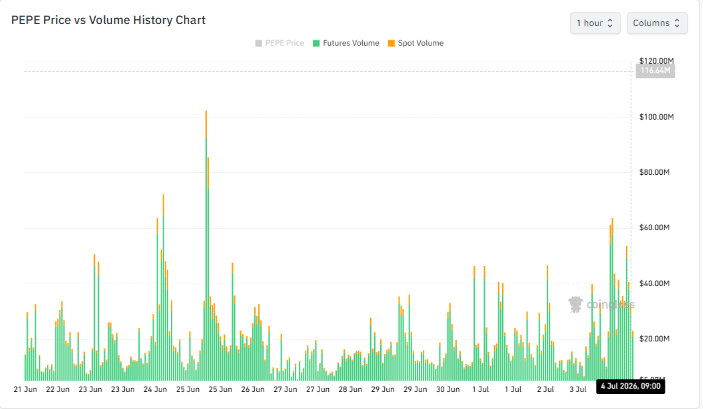
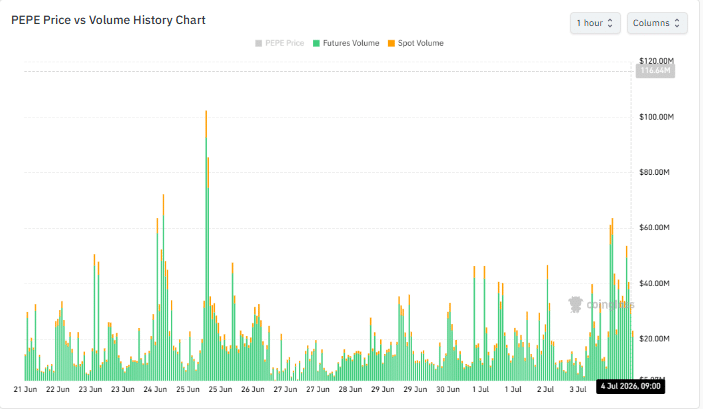
Spot market activity strengthened faster than derivatives participation during the latest rally. PEPE’s spot trading volume climbed 80.46% to $62.41 million, while futures volume increased 69.27% to $622.40 million over the same period.

That difference suggested fresh buying demand entered the spot market at a quicker pace than leveraged speculation.

Although futures trading still accounted for a much larger dollar value, the stronger growth rate in spot volume indicated buyers increasingly acquired the token directly instead of relying primarily on leverage.

Open Interest also rose 21.60% to $178.35 million, showing traders continued opening new futures positions as prices advanced.

However, the slower increase in futures activity compared with spot volume reduced concerns that excessive leverage alone had driven the recovery.
Source: CoinGlass

PEPE lagged BONK but stayed ahead of DOGE

Trading activity across the memecoin sector expanded broadly, although PEPE delivered mixed relative performance.

BONK attracted the strongest participation, with spot volume surging 131.53% and futures volume jumping 136.49%, comfortably exceeding PEPE’s respective gains of 80.46% and 69.27%. Those figures showed traders concentrated more aggressively on BONK during the latest market recovery.

However, PEPE clearly outperformed DOGE, whose spot volume increased only 19.57% while futures volume rose 17.04%.

The comparison suggests PEPE captured stronger speculative interest than the largest memecoin despite falling behind BONK’s exceptional growth.

As a result, PEPE occupied a middle ground within the sector, attracting meaningful capital without becoming the strongest destination for new trading activity.

Can PEPE clear the next resistance?

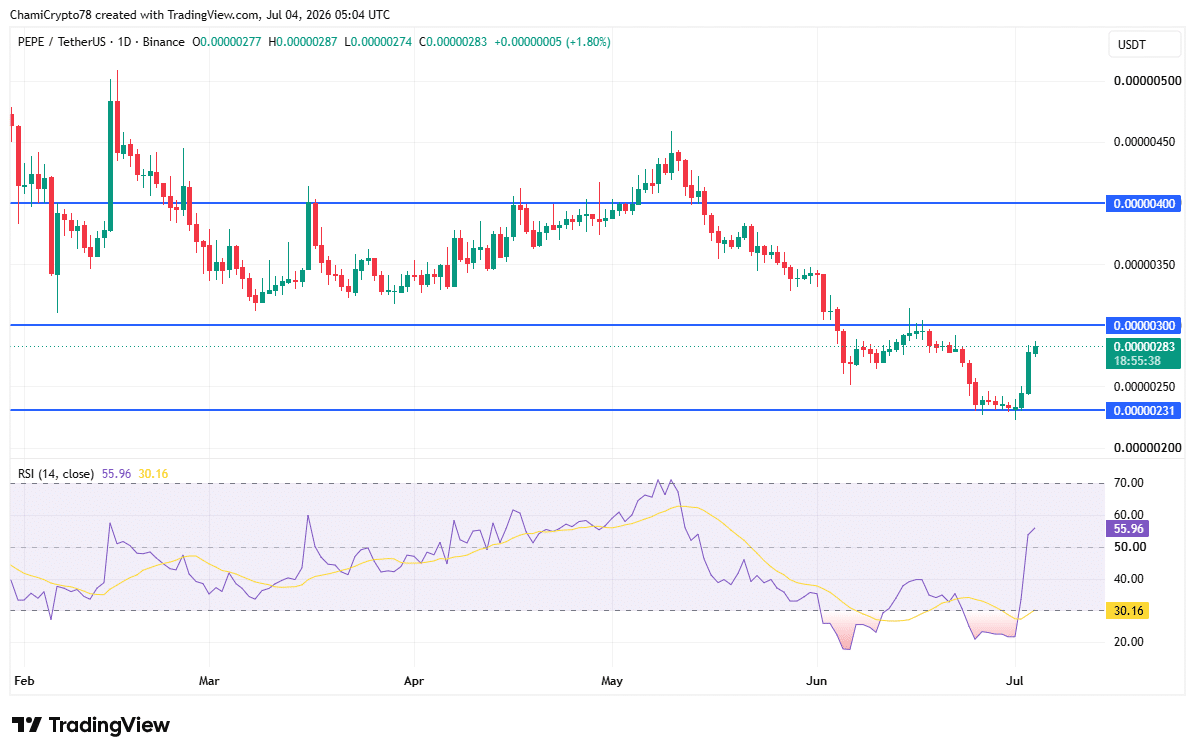
At press time, PEPE recovered sharply after bouncing from the $0.0000231 support zone and approached the important $0.0000300 resistance level.

Buyers steadily reclaimed lost ground instead of producing a single explosive move, leaving the broader structure more constructive.

The Relative Strength Index [RSI] was at 55.96, moving above the neutral threshold after recovering from oversold territory earlier in the decline. That reading suggested buying strength improved without reaching overheated conditions.

Price also remained below the next major resistance around $0.0000400, which continued defining the broader recovery objective.
Source: TradingView

If buyers maintain current participation and successfully push above $0.0000300, the chart would likely open the path toward that higher resistance. However, repeated rejection beneath $0.0000300 could encourage another period of consolidation before the next directional move emerges.


Final Summary

  • Spot buying expanded faster than futures activity, supporting PEPE’s latest price recovery.
  • PEPE neared major resistance after short liquidations accelerated the recent upward move.

Trending Cryptos

Related Questions

QWhat was the percentage increase in PEPE's price over the past 24 hours according to the article?

APEPE's price climbed 14.06% over the past 24 hours.

QHow did PEPE's spot trading volume change during its recent rally, and what did this suggest?

APEPE's spot trading volume climbed 80.46% to $62.41 million. This faster growth compared to futures volume suggested that fresh buying demand entered the spot market at a quicker pace than leveraged speculation, indicating more direct acquisition of the token.

QIn terms of trading volume growth, how did PEPE's performance compare to BONK and DOGE?

APEPE lagged behind BONK but stayed ahead of DOGE. BONK's spot volume surged 131.53% and futures volume jumped 136.49%, exceeding PEPE's gains. However, PEPE clearly outperformed DOGE, whose spot volume increased only 19.57% and futures volume rose 17.04%.

QWhat are the key resistance and support levels mentioned for PEPE's price?

AThe key support level mentioned is $0.0000231. The important resistance level PEPE approached is $0.0000300, with the next major resistance cited around $0.0000400.

QWhat was the value of the Relative Strength Index (RSI) for PEPE at press time, and what did it indicate?

AThe Relative Strength Index (RSI) for PEPE was at 55.96 at press time. This reading, above the neutral threshold, suggested that buying strength had improved without reaching overheated conditions.

Related Reads

Blood Loss of $55 Million Selling 3,588 BTC, Strategy Becomes a Literal Scumbag

On July 6th, Strategy (formerly MicroStrategy) disclosed in an SEC filing that it sold 3,588 Bitcoin (BTC) between June 29th and July 5th for approximately $216 million, at an average price of ~$60,200. This marked the company's largest net sale since initiating its Bitcoin strategy in 2020 and its first institutionalized reduction of its core holding. The sale resulted in a realized loss of about $54.8 million, as the selling price was below its average cost basis of ~$75,476 per BTC. The proceeds were used to pay preferred stock dividends and replenish USD reserves. This move follows a new "Digital Credit Capital Framework" approved on June 29th, authorizing the sale of up to $1.25 billion in Bitcoin. The sale consumes roughly 17% of this authorized amount in its first week. Strategy's foundational narrative, built by founder Michael Saylor, was a commitment to "never sell" Bitcoin. The recent institutionalized selling framework and these substantial sales represent a significant shift from that original promise. While the amount sold is only 0.4% of Strategy's total holdings of 843,775 BTC, the action challenges the premium at which its stock (MSTR) trades relative to its Bitcoin holdings. Investors had priced in the "never sell" narrative. The company now faces a contradiction: it sells Bitcoin at a loss to pay dividends on the preferred stock it issued to fund Bitcoin purchases. Saylor has framed selling as a tool for future strategic purchases, but each sale erodes the credibility of the original commitment, potentially threatening the premium valuation of MSTR shares.

Foresight News5m ago

Blood Loss of $55 Million Selling 3,588 BTC, Strategy Becomes a Literal Scumbag

Foresight News5m ago

Dialogue with Yihui Capital, SoundAI Technology, Ling Universe, and Zhongbo Jili: Opportunities and Challenges in the AI Smart Hardware Track

On June 28, 2026, an event titled "New Opportunities in AI Hardware: The Battle for Interactive Entry Points Begins" was held in Beijing. It featured a report from ITJuzi and discussions with experts from SoundAI, Ling Universe, One Reed Capital, and Zhongbo Juli on the opportunities and challenges in China's AI hardware sector. Key report findings highlight the sector's intense activity: 327 out of 431 startups founded post-2023 have secured funding, with 179 investments in H1 2026 alone. The landscape is dominated by embodied intelligent robots, while wearable tech like smart rings and AI glasses shows rapid growth. Geographically, Shenzhen leads, leveraging its superior hardware supply chain, followed by Beijing and Shanghai. The overarching trend is for companies to focus on micro-innovations within specific scenarios rather than reinventing foundational technology. Industry leaders shared several critical insights: 1. **Balancing Innovation & Market Readiness**: Entrepreneurs face the "hammer looking for a nail" dilemma. Success requires balancing technical capability with user acceptance, cost control, and incremental design improvements rather than chasing disruptive innovation. 2. **Competitive Landscape**: The future interactive entry point may not be a single super-device but a mix of universal terminals and specialized, scenario-specific hardware. While large companies have ecosystem advantages, startups can win by deeply targeting vertical markets and specific user groups. 3. **Core Challenges & Business Models**: Key hurdles include deep understanding of AI models and navigating non-transparent hardware supply chains. Viable business models may involve selling hardware at cost and generating revenue through software subscriptions, but this requires tight control over both hardware BOM and model inference costs. 4. **The Road to Commercialization**: The ultimate test is market validation—achieving sales growth and sustainable cash flow. Companies must find the right application scenario, use edge computing effectively, and close the loop from technology to commercial success. 5. **The Future of Interaction**: Proactive, context-aware interaction is the next frontier, though it's currently limited by issues like model hallucinations and environmental perception. The near-term focus should be on identifying target users and creating a coherent experience in specific domains, such as health wearables. In summary, to succeed in the competitive AI hardware arena, companies must strategically choose their niche, build a team with the right geographical advantages (e.g., leveraging Shenzhen's supply chain), and most importantly, execute a flawless commercialization strategy that translates technology into market-accepted products and sustainable business growth.

marsbit59m ago

Dialogue with Yihui Capital, SoundAI Technology, Ling Universe, and Zhongbo Jili: Opportunities and Challenges in the AI Smart Hardware Track

marsbit59m ago

Trading

Spot

Hot Articles

Discussions

Welcome to the HTX Community. Here, you can stay informed about the latest platform developments and gain access to professional market insights. Users' opinions on the price of S (S) are presented below.

活动图片