The Market Trades on Expectations, But You're Waiting for Answers

marsbitPublished on 2026-07-03Last updated on 2026-07-03

Abstract

The market trades on expectations, not on waiting for answers. A common misconception is that prices react after data is released. In reality, sensitive capital moves based on anticipated changes in policy, capital flows, and sentiment. Once an expectation forms, prices adjust in advance. For example, if the market expects the Federal Reserve to cut interest rates, assets like gold, growth stocks, or BTC may rise ahead of the actual announcement. When the cut finally happens, the market might show little movement or even pull back—not because the news isn't significant, but because it was already priced in. The same applies to reports like non-farm payrolls. If weak employment data is anticipated, gold and bonds may rally beforehand. When the data confirms the weakness, prices may not rise further, as it merely validates existing expectations. This explains why markets sometimes appear irrational: good news doesn't always lift prices, and bad news doesn't always cause declines. The key is to assess whether an event was already anticipated and whether capital has begun to price it in or is now taking profits. The market is always trading the future, not the present. Price movements reflect bets on what comes next. Therefore, focusing solely on headlines can lead to losses. Instead, investors should ask: Was this news already expected? Is the market still pricing it in, or is it time to cash out? In short, the market doesn't wait for answers—it acts on the future it...

Author: SOL I Don't Understand

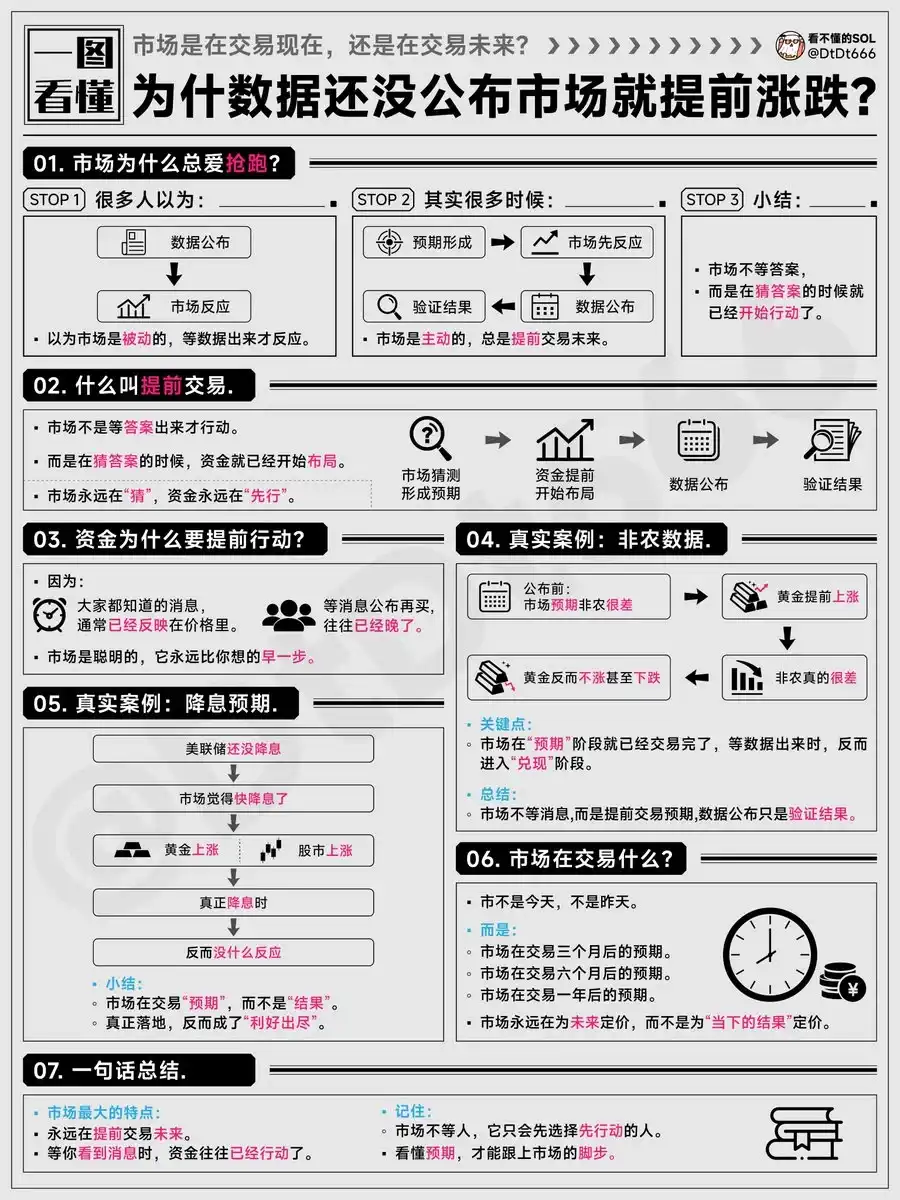
Why does the market often rise or fall before data is even released?

Because the market never trades solely on the "outcome"; more often, it trades on "expectations."

Many people understand the market like this:

Data is released, the market sees it, and then starts reacting.

But the real market often isn't like that.

Truly sensitive capital rarely waits for the answer to come out before acting. It first assesses: How might policy change next, where will capital flow, and how will sentiment shift.

Once expectations form, prices move first.

For example, if the market thinks the Fed is about to cut rates, gold, growth stocks, and BTC might react in advance. But by the time the actual rate cut happens, the market may show little movement, or even pull back.

It's not that the positive news is useless.

It's because that positive news was already traded during the preceding rally.

The same goes for Non-Farm Payroll data.

If before the release, the market already expects employment to weaken, gold and bonds might rise in advance. When the NFP data truly comes out weak, gold might not necessarily continue rising.

Because for the market, this isn't "new information," it's merely "confirmation."

So you often see:

Positive news comes out, but no rise.

Negative news comes out, but no fall.

Many people think the market makes no sense.

Actually, it's not that the market is crazy; it's that the market has already moved ahead of the news.

Where ordinary investors lose money most easily is by only reading news headlines.

Seeing good news, they chase; seeing bad news, they flee.

But the real question should be:

Did the market anticipate this news beforehand?

Has capital already priced it in?

Is this the beginning of pricing it in, or is it the stage of realization?

The market isn't trading today; it is constantly trading the future.

Behind price movements is capital continuously betting on what will happen next.

So when looking at the market, don't just focus on "what happened."

Look more at:

What did people previously think would happen.

Does the current result exceed expectations.

Is capital continuing to price it in, or starting to cash out.

Many market moves seem illogical because you're looking at the result, while the market trades on the deviation from expectations.

To summarize in one sentence:

The market doesn't wait for answers.

The market only chooses, in advance, the future it believes in.

By the time you see the news, capital has often been moving for a long time.
Trending Cryptos

Related Questions

QWhat is the core idea of the article regarding how financial markets work?

AThe article's core idea is that markets trade on expectations of future events, not just on the official results or news when they are announced.

QAccording to the author, why might an asset fail to rise after positive news (e.g., a Fed rate cut) is officially announced?

ABecause the positive expectation was likely already priced into the market beforehand. Traders anticipated the event and acted on it, so the official announcement is just a confirmation, not new information that triggers a new reaction.

QWhat does the term 'expectation gap' or 'expectation differential' refer to in the context of the article?

AIt refers to the difference between what the market was expecting to happen and what actually happens. The market's price movement often reflects this gap, not the raw news itself.

QWhat is a key mistake the article says ordinary investors often make?

AA key mistake is reacting directly to news headlines (buying on good news, selling on bad news) without considering whether that news was already anticipated and 'priced in' by the market.

QWhat should an investor analyze instead of just the news itself, according to the article's conclusion?

AAn investor should analyze the market's prior expectations, whether the actual result exceeded or fell short of those expectations, and whether capital is still pricing in the future event or has begun to take profits ('sell the news').

Related Reads

1600 Lines of Code Create an Underwater Manhattan, Fable 5 Leaves Karpathy Stunned

Title: Fable 5 Stuns Karpathy with 3D Worlds Built from 1600 Lines of Code An AI model, Fable 5, has demonstrated a remarkable leap in generating complex, interactive 3D worlds with minimal code. Showcased by Peter Gostev of Arena.ai, the model created 63 diverse 3D environments across themes like immersive cityscapes, explorable famous paintings, natural wonders, and cosmic phenomena. Many were generated in a single attempt. A standout creation is a detailed, submerged Manhattan built with only 1600 lines of Three.js code. Other highlights include traversable versions of Van Gogh's "Starry Night," a bear catching a salmon with realistic physics, and a split Red Sea. The model's ability to cohesively manage vast numbers of elements within a scene represents a significant technical advancement. Andrej Karpathy, who recently joined Anthropic's pre-training team, expressed amazement, particularly at how the model intuitively understood and rendered complex real-world interactions like a fish struggling when caught. He coined the term "fablemaxxing" to describe this qualitative leap. While Fable 5 excels at world-building, Gostev notes current limitations in creating engaging, long-form gameplay. The model also sometimes requires prompting to fully utilize its capabilities. Having topped the Agent Arena benchmark for real-world task completion, Fable 5 signals that the boundaries of AI-generated content are rapidly expanding, with its full potential yet to be discovered.

marsbit5m ago

1600 Lines of Code Create an Underwater Manhattan, Fable 5 Leaves Karpathy Stunned

marsbit5m ago

From ANSEM to CZ, The Celebrity Coin Relay Race Between Solana and BSC

The past week was a whirlwind of on-chain activity, sparked by the meteoric rise of $ANSEM, a Solana-based meme coin that surged 600x and hit a $100 million market cap in a single day. This rally began when crypto influencer Ansem announced his return to buying Solana meme coins and publicly advocated for an airdrop from the platform pump.fun. Ansem’s subsequent "soft claim" of the token—promising to airdrop creator revenue to followers—ignited a frenzy, drawing comparisons to past community-led token distributions. However, his dual role as a co-founder of the trading terminal Bullpen, which later hosted the $ANSEM airdrop, suggests a strategic promotional element. The narrative quickly shifted to "celebrity coins," where tokens named after influencers are sent to their public addresses in hopes of endorsement. While a similar coin, $TJR, briefly gained traction, it faltered after the influencer TJR urged focus back on $ANSEM. Attention then turned to projects Ansem endorsed and coins found in his wallet, like $manlet, but momentum on Solana began to stall. The action then migrated to BSC with the viral resurgence of a 2021 tweet from former Binance CEO CZ, referencing a "final form" bull. This sparked the explosive launch of $CZ, which briefly approached a $90 million market cap despite expectations that CZ wouldn't actively engage like Ansem. Another BSC token, $TCC, gained attention due to CZ's interactions with its promoter. The BSC ecosystem saw faster-paced, albeit volatile, "celebrity coin" plays, with tokens like $dingaling experiencing rapid pumps and dumps without official endorsements. Currently, BSC shows more momentum for new token launches than Solana, with the market awaiting a new narrative to succeed the fleeting "celebrity coin" trend.

marsbit15m ago

From ANSEM to CZ, The Celebrity Coin Relay Race Between Solana and BSC

marsbit15m ago

A Decade of Change: The Demise of Crypto Startups

"The Decade-Long Transformation: The Demise of Crypto Startups" The article traces the dramatic evolution of the cryptocurrency industry from its anarchic beginnings to its current highly regulated and institutionalized state. In the early days (circa 2017), launching a crypto startup was remarkably simple: a whitepaper, a GitHub repository, and a Telegram group could attract thousands of retail investors via an Initial Coin Offering (ICO). Founders operated anonymously with near-zero regulatory and financial barriers, enabling rapid, global innovation but also widespread fraud. By 2026, the landscape is fundamentally different. To operate in major markets like the US, EU, and Asia, crypto businesses must now navigate a complex web of regulations akin to traditional finance. Compliance costs are prohibitive: estimates for a US multi-state operation range from $750,000 to $1.2 million in the first three years, with annual costs exceeding $2 million thereafter. Regulations like MiCA in the EU and New York's BitLicense have created high capital and operational hurdles that act as barriers to entry. Simultaneously, venture capital investment has shifted dramatically. Following the collapses of Terra and FTX, funding has concentrated in later-stage, established companies, creating a "barbell market." Early-stage and seed funding has shrunk significantly, while mega-funds like Andreessen Horowitz's $15 billion pool dominate. Most capital now flows to trading platforms, lending infrastructure, and B2B services. This environment favors mergers and acquisitions as the primary path for growth. Companies like Coinbase and Ripple are acquiring firms like Deribit and Hidden Road not for their technology, but for their licenses, banking relationships, and institutional trust—assets far more valuable than code. Distribution channels, compliance, and brand reputation have become the new moats, overshadowing pure technical innovation. The industry's maturation brings benefits: reduced scams, increased institutional participation, and clearer regulatory frameworks. However, it comes at a cost. The low-barrier, experimental ethos that defined crypto's first decade is fading. Entrepreneurs without substantial capital, pre-existing licenses, or institutional connections face immense challenges. Funding for exploratory fields like decentralized social media or novel governance models is drying up. Ultimately, the crypto industry is replicating the consolidation pattern seen in banking and tech after the 2008 financial crisis. While this brings stability and legitimacy, it raises a critical question: in this new, resource-intensive reality, is there still room for the disruptive, from-scratch innovation that gave birth to the sector?

Foresight News1h ago

A Decade of Change: The Demise of Crypto Startups

Foresight News1h ago

Trading

Spot

Hot Articles

Discussions

Welcome to the HTX Community. Here, you can stay informed about the latest platform developments and gain access to professional market insights. Users' opinions on the price of SOL (SOL) are presented below.

活动图片