‘Hard-backed currency’ – Coinbase CEO pushes crypto for $39T debt

ambcryptoPublished on 2026-07-02Last updated on 2026-07-02

Abstract

Coinbase CEO Brian Armstrong proposes using cryptocurrency as "hard-backed currency" to address the U.S. national debt, which stands at $39.4 trillion. He argues the U.S. Constitution needs amendments to cap government spending and mandate such a currency to prevent fiscal decline. While Bitcoin's fixed supply is seen as a digital alternative to gold, analysis suggests even significant Bitcoin reserves would only cover a fraction of the debt by 2049. The article concludes that capping spending may be a more practical step than relying solely on crypto to solve the debt issue.

Coinbase CEO Brian Armstrong has made a bold proposal to rein in inflation and unchecked government spending.

According to him, crypto can be used as ‘hard-backed currency.’ For growth, he floated AI and robotics as the best bet to spur the next growth. He noted,

The US Constitution was the most important political innovation ever, but it’s missing two important things: A cap on the growth of government spending and a requirement for hard-backed currency.

AD

He added,

Without them, every democracy drifts toward more debt and eventual loss of reserve currency status.

As of writing, the total U.S fiscal debt has hit $39.4 trillion. Armstrong cautioned that the fiscal debt increases by $1 trillion after every 100 days, largely driven by the current broken ‘political incentive structure.’

Can Bitcoin, stablecoins solve U.S. debt?

Others were quick to correct him, saying that the Constitution only allows gold and silver coins to be used to pay debts. Well, that’s why he is advocating for an amendment to include other “money” options.

For his part, BitGo CEO Mike Belshe supported his proposal and added,

The Bill of Rights protects you from the government taking your speech, your property, your liberty. It’s time to update it to protect you from the government debasing your money.

Well, this is not the first time crypto has been floated as a solution to U.S fiscal debt.

In particular, Bitcoin’s hard-coded supply limit of 21 million coins has been viewed as a potential replacement for gold or a better digital alternative to the precious metal.

In fact, the two assets have shown close correlation, sparking a ‘debasement trade’ during the West Asia crisis. They acted as macro hedges, and their demand pushed their values higher.

So far, gold and Bitcoin prices have fallen together amid slow but progress toward a solution to the West Asia crisis.

Bitcoin vs. America’s debt problem

But U.S inflation has devalued the dollar by nearly 97% since 1913. Since 2000, the US dollar’s purchasing power has dropped further to a record low. Over the same period, BTC value has surged from below $1 to over $50K.
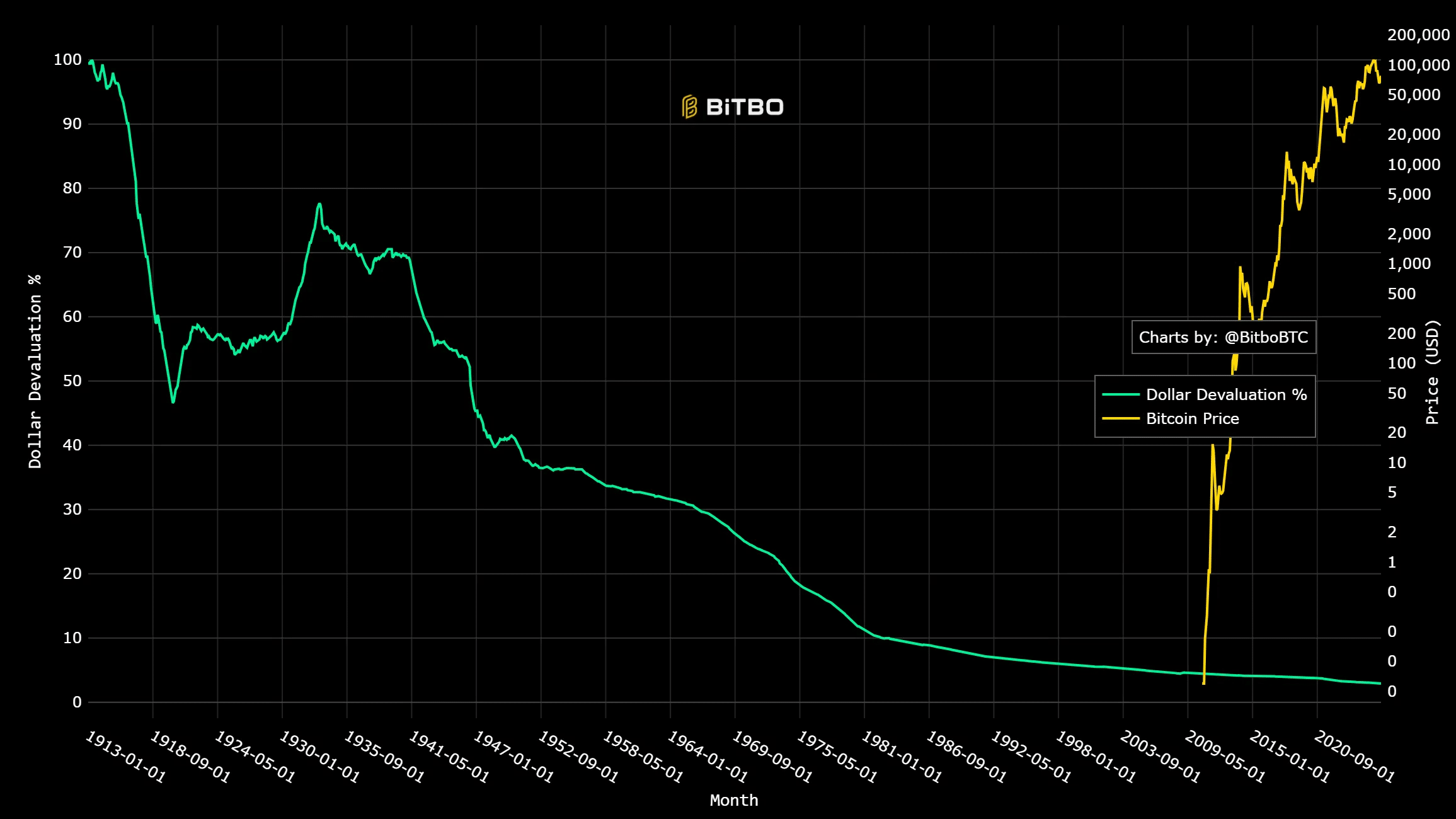
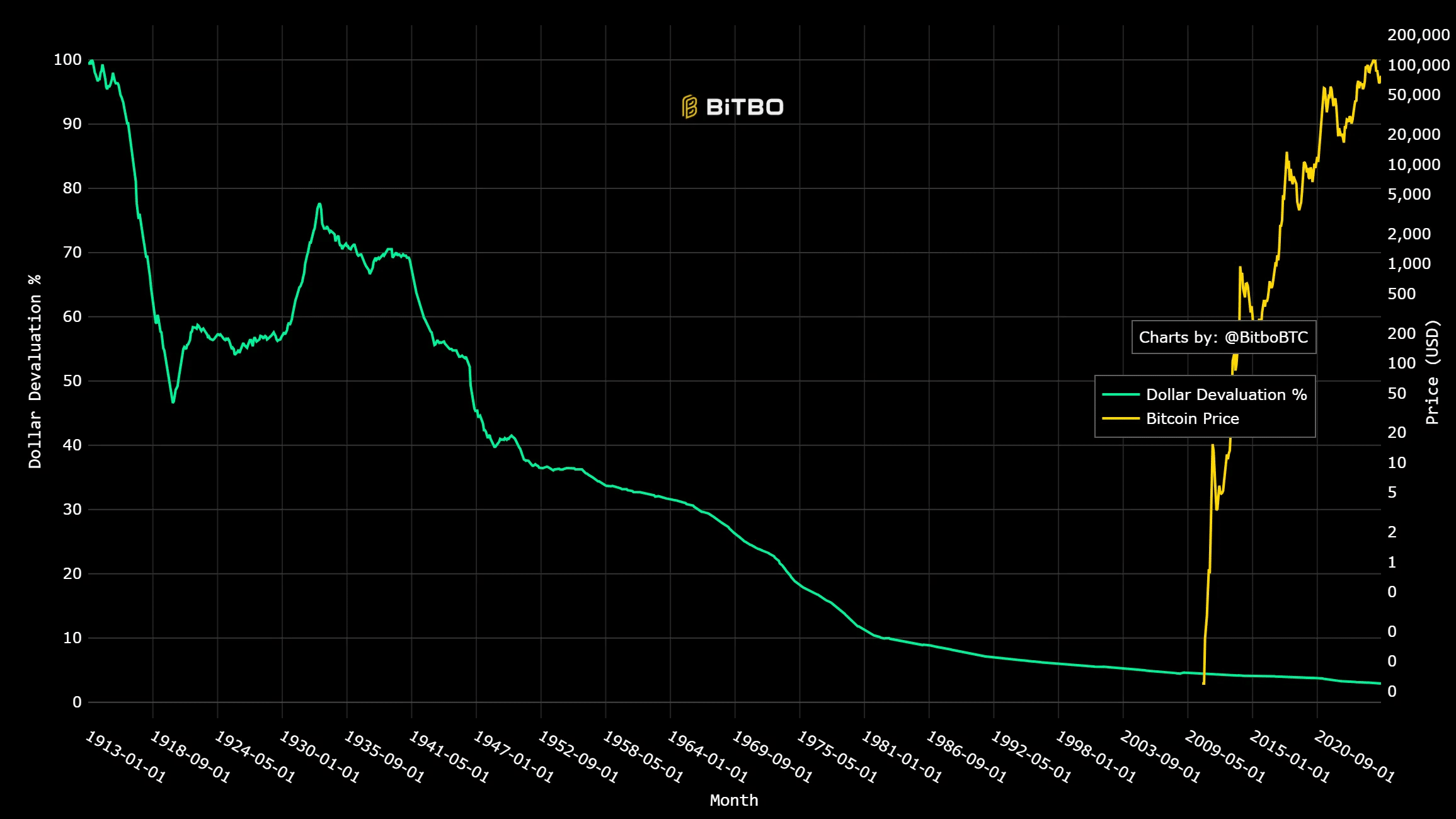
Source: Bitbo

In fact, the Trump Administration is betting on a Bitcoin strategic reserve and stablecoins to manage its debt. Unfortunately, VanEck projected that a BTC reserve can only help pay 18%-36% of the US debt by 2049.

The above projection holds only if the government holds 1 million BTC and the price surges from $250K to $43M per coin before 2050.
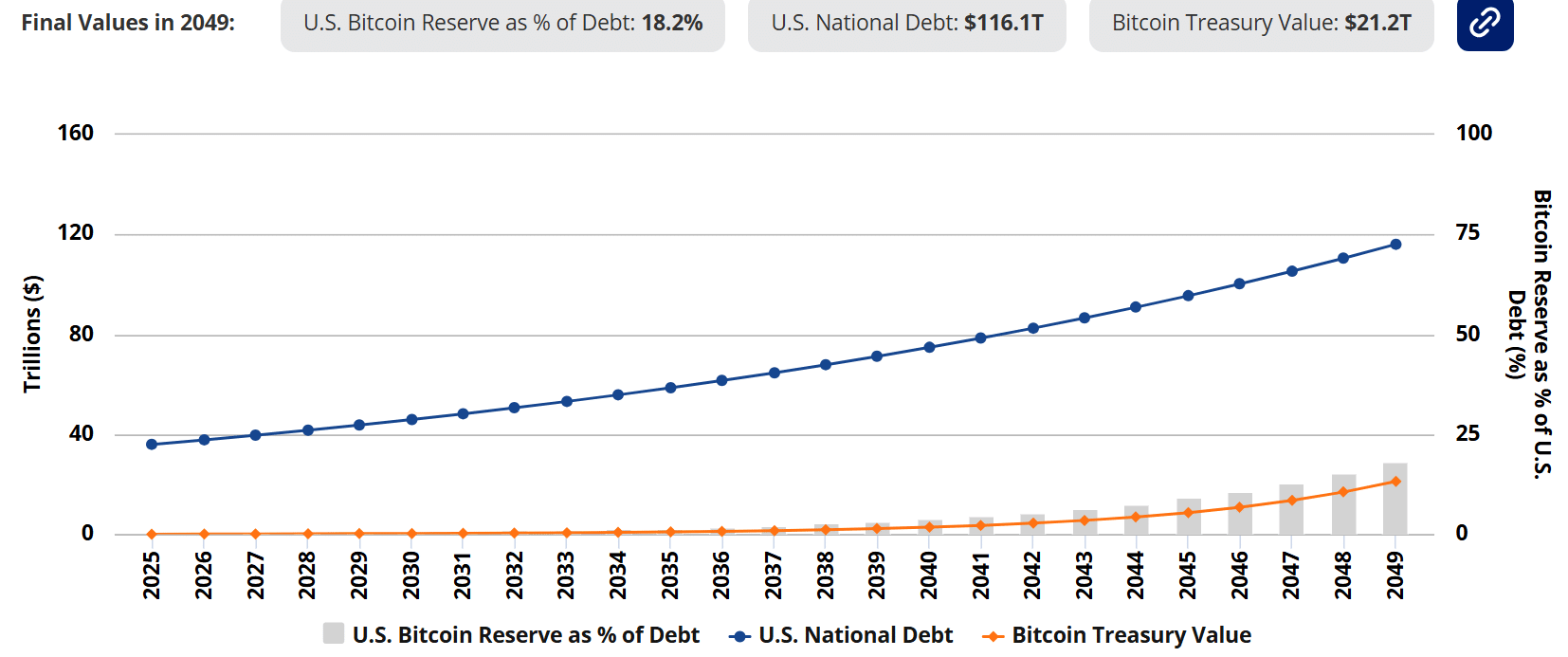
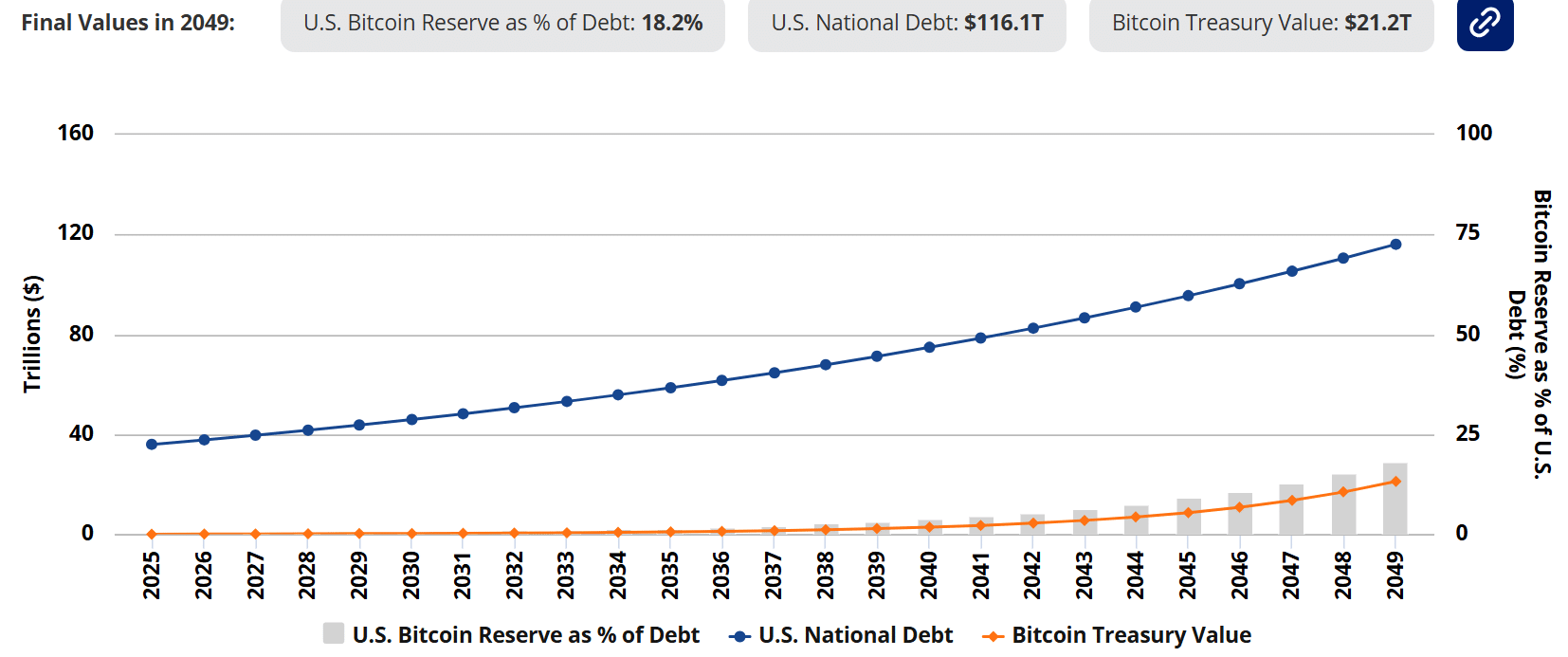
Source: VanEck

Overall, the crypto proposal may not fully solve the U.S debt problem. However, capping government spending could be a practical step toward addressing the fiscal debt issue.


Final Summary

  • Coinbase CEO proposed crypto as ‘hard-backed money’ to address the U.S $39T fiscal debt problem
  • But crypto could only pay a fraction of the U.S debt, assuming BTC price hits $43M per coin by 2049.


Related Questions

QWhat is Coinbase CEO Brian Armstrong's proposal to address the U.S. fiscal debt, and what key constitutional changes does he suggest are needed?

ABrian Armstrong proposes using cryptocurrency as 'hard-backed currency' to address inflation and U.S. fiscal debt. He suggests amending the U.S. Constitution to include a cap on government spending growth and a requirement for a hard-backed currency, which he believes are missing but necessary to prevent excessive debt and loss of reserve currency status.

QWhat is the current size of the U.S. fiscal debt according to the article, and at what rate is it reportedly increasing?

AAccording to the article, the total U.S. fiscal debt has hit $39.4 trillion. Armstrong cautions that the debt increases by $1 trillion approximately every 100 days.

QWhy is Bitcoin specifically considered as a potential tool to manage debt, and what is one significant limitation of this idea presented in the article?

ABitcoin is considered due to its hard-coded supply limit of 21 million coins, making it a potential digital alternative to gold and a hedge against currency debasement. A significant limitation, according to a VanEck projection cited, is that even if the U.S. held 1 million BTC, and its price surged to an unrealistic $43 million per coin by 2049, it would only cover 18%-36% of the U.S. debt by that time.

QAccording to the article, what role did Mike Belshe, CEO of BitGo, see for the Bill of Rights in relation to the current monetary system?

AMike Belshe suggested that the Bill of Rights protects citizens from the government infringing on speech, property, and liberty, and it should be updated to also protect people from the government debasing their money.

QWhat practical step does the article suggest might be more effective than relying solely on cryptocurrency reserves to address the U.S. debt problem?

AThe article suggests that capping government spending could be a more practical step toward addressing the fiscal debt issue, as the crypto proposal alone may not fully solve the problem.

Related Reads

Unitree's IPO Frenzy: The Real Mystery is How It Will Spend the 42 Billion Raised

Unitree, a Chinese robotics company, is set for a public listing after its IPO registration was approved by regulators. The company, which started with quadruped robots and has expanded into humanoids, plans to raise approximately 4.2 billion yuan through its offering. The article traces Unitree's rapid growth from its founding in 2016 to its current status. It highlights key milestones like the 2021 CCTV Spring Festival Gala performance, the 2023 launch of its affordable Go2 robot dog and the H1 humanoid robot, and a series of subsequent product launches. By 2025, the company reported revenue of 1.71 billion yuan, profitability, and sales exceeding 5,500 humanoid robots. As the first publicly-listed humanoid robot company on China's STAR Market, Unitree's main challenges are sustaining growth and deploying its newly raised capital effectively. The humanoid robot sector in China is crowded, with over 140 companies. Competitors include UBTech (focusing on industrial and consumer markets), Fourier, and international players like Tesla Optimus and 1X NEO. The article outlines three critical challenges for Unitree: establishing a strong second product line beyond its quadruped robots, maintaining its price advantage while ensuring quality, and successfully advancing its embodied AI capabilities through partnerships like the one with NVIDIA for the H2 Plus platform. Unitree's likely strategy involves a "developer tools + industry benchmarks" approach: using low-cost models like the R1 and G1 to build developer adoption and volume, leveraging high-end platforms for AI training, and securing pilot projects in sectors like logistics and manufacturing to build case studies. The company's future success hinges on converting its current momentum in shipments and pilot programs into sustainable, large-scale commercial contracts as the broader market evolves.

marsbit1h ago

Unitree's IPO Frenzy: The Real Mystery is How It Will Spend the 42 Billion Raised

marsbit1h ago

Examining the Open USD Partner Lineup: Follow Who's Joining to See Where the Money Flows

**Title: Deciphering the Open USD Partner Roster: Following the Money** The launch of Open USD is notable less for the stablecoin itself and more for its expansive list of over 140 founding partners, which reads like a "who's who" of global finance and tech. This coalition, including asset managers like BlackRock, card networks Visa and Mastercard, banks (BNY Mellon, Standard Chartered, etc.), tech giants (Google, IBM), merchants (Shopify), and crypto firms (Coinbase, Ripple, Aave, MetaMask), signals a strategic shift. The diverse membership reveals that stablecoins are increasingly viewed not as products to compete over, but as shared infrastructure too critical to be left to any single entity. Each partner category has distinct motives. Asset managers like BlackRock seek to manage the large, sticky cash reserves, a lucrative fee-generating opportunity. Merchants like Shopify aim for lower-cost settlement and potential yield on balances. Banks join defensively to retain custody and settlement roles, fearing deposit outflows to stablecoins. Tech companies bet on programmable money for future machine-to-machine commerce. Crypto firms gain mainstream legitimacy and distribution channels. Remarkably, the consortium includes direct competitors (Visa vs. Mastercard, Coinbase vs. Ripple), indicating that the fear of exclusion from this emerging financial layer outweighs competitive rivalries. However, this shared governance could also lead to slow decision-making. The roster's composition is the real message: it represents a collective bet that a widely accepted, consortium-owned stablecoin is preferable to proprietary versions or having none at all. For incumbents like Circle and Tether, this alliance poses a significant threat, as potential clients have collectively chosen to build their own alternative. The absence of major U.S. retail banks (busy with their own tokenized deposit networks) is equally telling. In essence, the partner list maps where the industry believes value and risk will flow in a tokenized dollar future, marking stablecoin's evolution from a product to a utility.

Foresight News1h ago

Examining the Open USD Partner Lineup: Follow Who's Joining to See Where the Money Flows

Foresight News1h ago

Trading

Spot
活动图片