Chainlink gains 8,000 new holders – Can LINK break its downtrend?

ambcryptoPublished on 2026-06-30Last updated on 2026-06-30

Abstract

Chainlink (LINK) added over 8,000 new holders in five days, pushing its non-empty wallet count to 892.8K, signaling continued user adoption despite ongoing price weakness. This growth is attributed to interest in real-world asset tokenization and institutional blockchain initiatives. On-chain data shows persistent exchange outflows, indicating accumulation rather than distribution, though this has not yet translated to a price breakout. LINK continues to trade within a descending channel, defending the $7.00 support level but struggling to challenge the upper resistance near $8.31. The RSI remains weak but not oversold. Despite the bearish trend, derivatives data shows a positive funding rate, reflecting sustained bullish conviction among leveraged traders. The summary suggests that if wallet growth and accumulation continue, LINK could eventually challenge the downtrend once stronger spot demand returns.

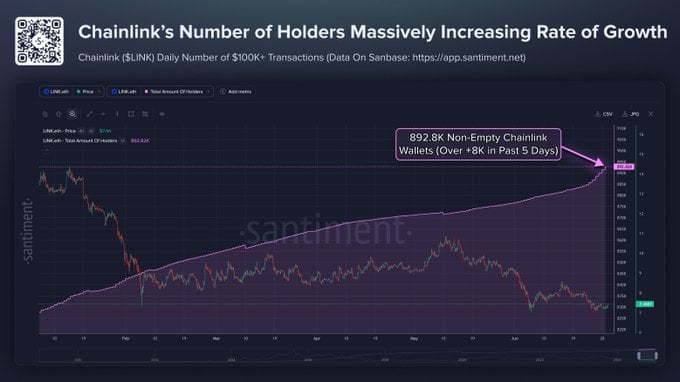
Chainlink’s [LINK] holder base accelerated sharply, reaching 892.8K non-empty wallets after adding more than 8,000 holders over the past five days. The growth unfolded while LINK remained below its local highs, highlighting continued user adoption despite lingering price weakness.

Fresh interest around real-world asset tokenization and institutional blockchain initiatives appeared to support the expanding wallet count. Rather than reflecting speculative activity alone, the steady rise in holders suggested broader participation across the network.

As a result, Chainlink strengthened its on-chain foundation even though price action remained under pressure.
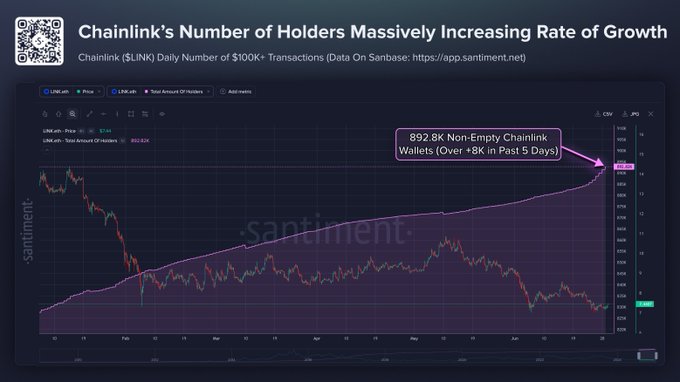
Source: Santiment/X

Why did exchange outflows remain dominant?

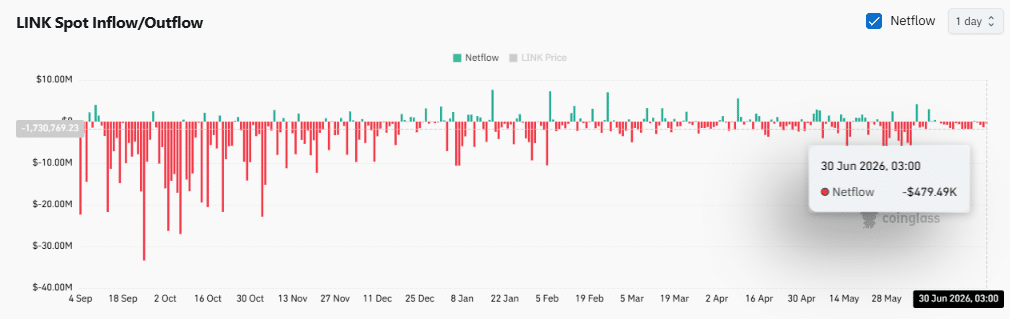
Exchange activity continued favoring withdrawals despite LINK’s recent consolidation. At press time, CoinGlass data recorded a daily spot netflow of -$479.49K, showing that more tokens left exchanges than entered them.

Such outflows often reflected reduced immediate selling availability as investors shifted holdings into private wallets or long-term storage. However, price failed to respond with an immediate recovery because broader market sentiment remained cautious.

Selling pressure eased compared to previous periods of heavier exchange inflows, yet buyers had not generated enough conviction to reverse the prevailing trend. Even so, persistent negative netflows aligned with the expanding holder count, suggesting accumulation continued beneath the surface instead of aggressive distribution.
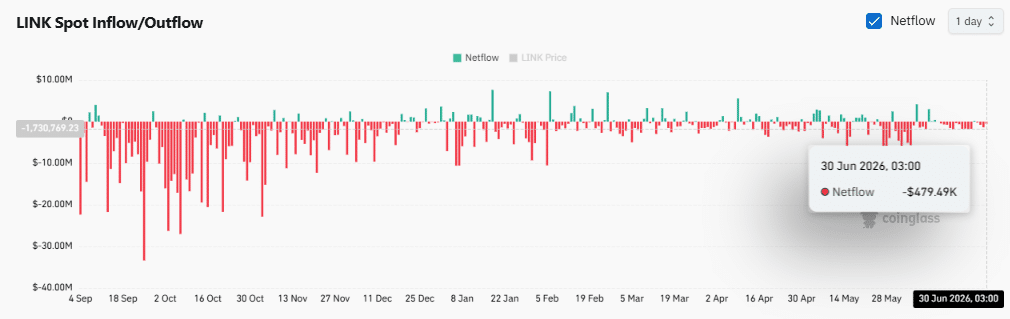
Source: CoinGlass

Can buyers protect the demand zone?

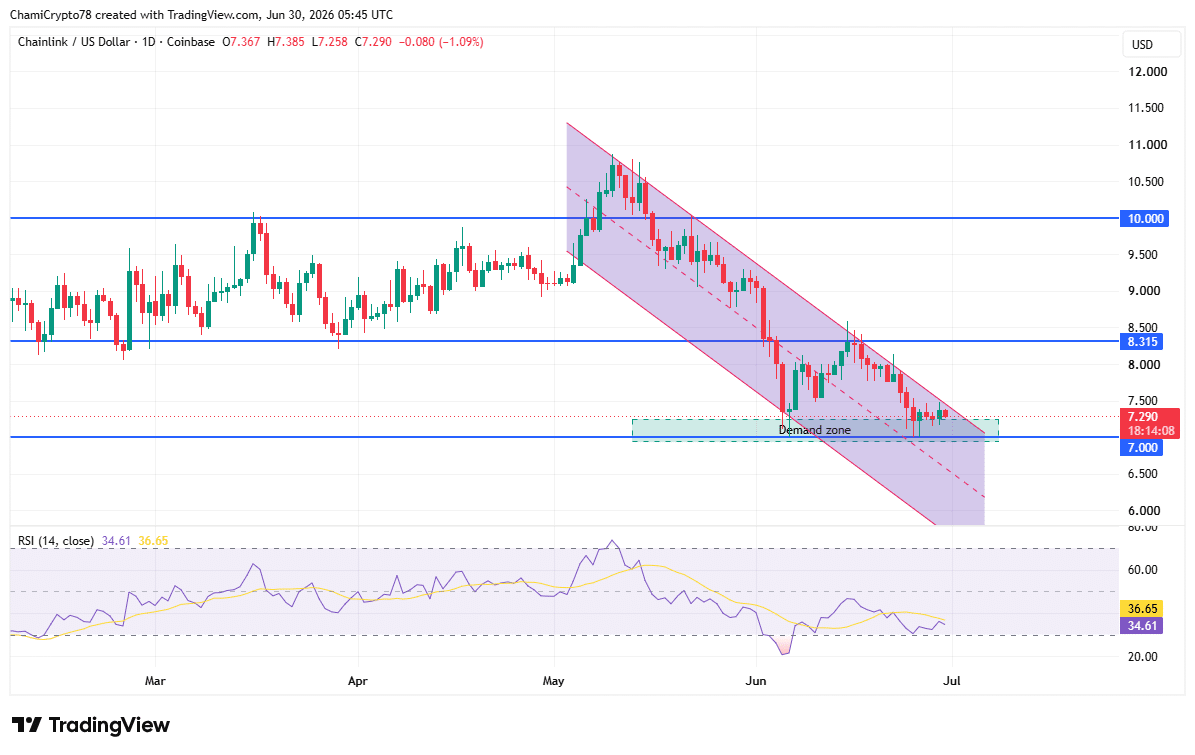
Chainlink continued trading inside a well-defined descending channel after failing to reclaim higher resistance levels.

Price repeatedly defended the $7.00 demand zone, preventing sellers from extending the broader decline despite several downside attempts. Buyers managed to stabilize the price above that support, although recovery lacked sufficient strength to challenge the channel’s upper boundary near $8.31.

Meanwhile, the RSI hovered around 34.6 as of writing, remaining below the neutral 50 level and reflecting weak buying participation rather than renewed bullish strength. Even so, the indicator stayed above deeply oversold territory, indicating selling pressure had moderated instead of accelerating.

Until LINK escapes the descending channel with stronger buying volume, the broader technical structure would likely remain cautious despite continued support around the current demand area.
Source: TradingView

Long traders refused to abandon bullish conviction

Derivatives positioning continued favoring buyers despite the prolonged corrective structure.

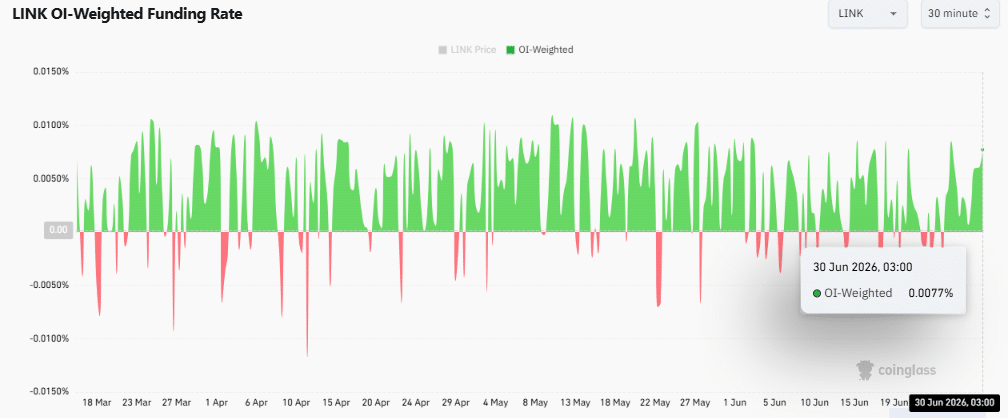
At press time, the OI-Weighted Funding Rate reached 0.0077%, remaining firmly in positive territory and showing that long traders still paid premiums to maintain leveraged exposure.

That positioning suggested participants continued expecting higher prices even while LINK traded inside its descending channel. However, optimistic funding alone had not delivered a decisive breakout because spot demand remained relatively restrained.

Even so, sustained positive funding reflected confidence that the current support region could eventually produce a stronger recovery. If leveraged sentiment stays constructive while on-chain accumulation continues expanding, derivatives positioning could reinforce buying interest once technical resistance levels start giving way.
Source: CoinGlass

To sum up, Chainlink combined accelerating network growth, continued exchange outflows, and positive funding despite remaining inside a falling channel. Buyers successfully defended the $7.00 demand zone, but they had not reclaimed higher resistance yet.

If wallet growth continues and accumulation strengthens further, LINK could eventually challenge the prevailing downtrend once stronger spot demand returns.


Final Summary

  • Chainlink adoption keeps expanding while exchange outflows suggest investors continue accumulating LINK.
  • LINK holds key support despite weak RSI as bullish funding reflects trader confidence.

Trending Cryptos

Related Questions

QWhat recent development in Chainlink's holder base does the article highlight?

AThe article highlights that Chainlink's holder base accelerated sharply, adding more than 8,000 new non-empty wallets over five days to reach 892.8K total.

QWhat does the negative daily spot netflow of -$479.49K for LINK indicate?

AThe negative daily spot netflow indicates that more LINK tokens were withdrawn from exchanges than deposited, suggesting reduced immediate selling availability as investors moved holdings to private wallets.

QWhat is the key price support level that LINK buyers have been defending according to the article?

AAccording to the article, LINK buyers have been successfully defending the key demand and support zone at the $7.00 price level.

QWhat does the positive OI-Weighted Funding Rate of 0.0077% signal about trader sentiment?

AThe positive OI-Weighted Funding Rate signals that leveraged long traders are still paying premiums to maintain their positions, reflecting continued bullish conviction and expectation of higher prices.

QWhat broader factor does the article suggest could help LINK eventually challenge its downtrend?

AThe article suggests that if wallet growth continues and on-chain accumulation strengthens further, LINK could eventually challenge the prevailing downtrend once stronger spot market demand returns.

Related Reads

A Decade of Change: The Demise of Crypto Startups

"The Decade-Long Transformation: The Demise of Crypto Startups" The article traces the dramatic evolution of the cryptocurrency industry from its anarchic beginnings to its current highly regulated and institutionalized state. In the early days (circa 2017), launching a crypto startup was remarkably simple: a whitepaper, a GitHub repository, and a Telegram group could attract thousands of retail investors via an Initial Coin Offering (ICO). Founders operated anonymously with near-zero regulatory and financial barriers, enabling rapid, global innovation but also widespread fraud. By 2026, the landscape is fundamentally different. To operate in major markets like the US, EU, and Asia, crypto businesses must now navigate a complex web of regulations akin to traditional finance. Compliance costs are prohibitive: estimates for a US multi-state operation range from $750,000 to $1.2 million in the first three years, with annual costs exceeding $2 million thereafter. Regulations like MiCA in the EU and New York's BitLicense have created high capital and operational hurdles that act as barriers to entry. Simultaneously, venture capital investment has shifted dramatically. Following the collapses of Terra and FTX, funding has concentrated in later-stage, established companies, creating a "barbell market." Early-stage and seed funding has shrunk significantly, while mega-funds like Andreessen Horowitz's $15 billion pool dominate. Most capital now flows to trading platforms, lending infrastructure, and B2B services. This environment favors mergers and acquisitions as the primary path for growth. Companies like Coinbase and Ripple are acquiring firms like Deribit and Hidden Road not for their technology, but for their licenses, banking relationships, and institutional trust—assets far more valuable than code. Distribution channels, compliance, and brand reputation have become the new moats, overshadowing pure technical innovation. The industry's maturation brings benefits: reduced scams, increased institutional participation, and clearer regulatory frameworks. However, it comes at a cost. The low-barrier, experimental ethos that defined crypto's first decade is fading. Entrepreneurs without substantial capital, pre-existing licenses, or institutional connections face immense challenges. Funding for exploratory fields like decentralized social media or novel governance models is drying up. Ultimately, the crypto industry is replicating the consolidation pattern seen in banking and tech after the 2008 financial crisis. While this brings stability and legitimacy, it raises a critical question: in this new, resource-intensive reality, is there still room for the disruptive, from-scratch innovation that gave birth to the sector?

Foresight News20m ago

A Decade of Change: The Demise of Crypto Startups

Foresight News20m ago

Trading

Spot

Hot Articles

How to Buy LINK

Welcome to HTX.com! We've made purchasing ChainLink (LINK) simple and convenient. Follow our step-by-step guide to embark on your crypto journey.Step 1: Create Your HTX AccountUse your email or phone number to sign up for a free account on HTX. Experience a hassle-free registration journey and unlock all features.Get My AccountStep 2: Go to Buy Crypto and Choose Your Payment MethodCredit/Debit Card: Use your Visa or Mastercard to buy ChainLink (LINK) instantly.Balance: Use funds from your HTX account balance to trade seamlessly.Third Parties: We've added popular payment methods such as Google Pay and Apple Pay to enhance convenience.P2P: Trade directly with other users on HTX.Over-the-Counter (OTC): We offer tailor-made services and competitive exchange rates for traders.Step 3: Store Your ChainLink (LINK)After purchasing your ChainLink (LINK), store it in your HTX account. Alternatively, you can send it elsewhere via blockchain transfer or use it to trade other cryptocurrencies.Step 4: Trade ChainLink (LINK)Easily trade ChainLink (LINK) on HTX's spot market. Simply access your account, select your trading pair, execute your trades, and monitor in real-time. We offer a user-friendly experience for both beginners and seasoned traders.

9.4k Total ViewsPublished 2024.03.29Updated 2026.06.02

How to Buy LINK

Discussions

Welcome to the HTX Community. Here, you can stay informed about the latest platform developments and gain access to professional market insights. Users' opinions on the price of LINK (LINK) are presented below.

活动图片