‘Halt is not okay’ – All about Base and its consensus problem

ambcryptoPublished on 2026-06-27Last updated on 2026-06-27

Abstract

Base, a Coinbase-incubated Ethereum Layer 2 (L2) network, experienced a significant consensus issue for nearly 48 hours, halting deposit and withdrawal functions. The problem began on June 25th when an invalid block was sequenced, leading to "unhealthy" mainnet block production. While withdrawals were partially degraded, deposits faced a "major outage." Base co-founder Jesse Pollak assured users that all funds were safe but emphasized that such a chain halt is unacceptable, vowing to improve the platform's reliability for 24/7 global finance. This disruption occurs as Base aims to expand into tokenized asset lending and borrowing, despite having achieved substantial growth with over $184M in cumulative revenue and $4B in Total Value Locked (TVL). The incident's impact on user confidence remains to be seen.

Base, a Coinbase-incubated Ethereum Layer 2 (L2) chain, has been unable to accept deposits or withdrawals for nearly 48 hours.

On the 25th of June, the L2 said that it ran into a consensus issue that caused an invalid block to be sequenced. The statement was given on 25th June, 17:21 UTC. The problem was isolated and debugged, and the team soon announced that broader recovery was underway.

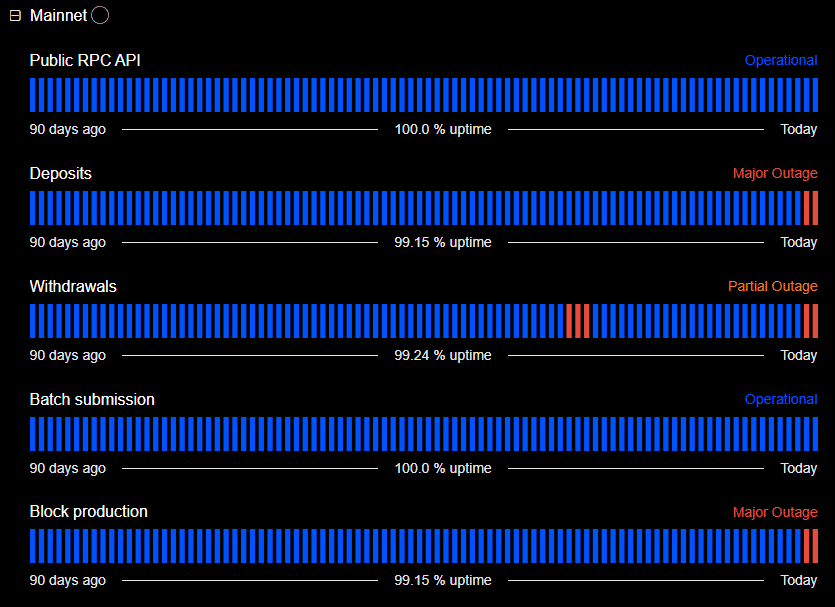
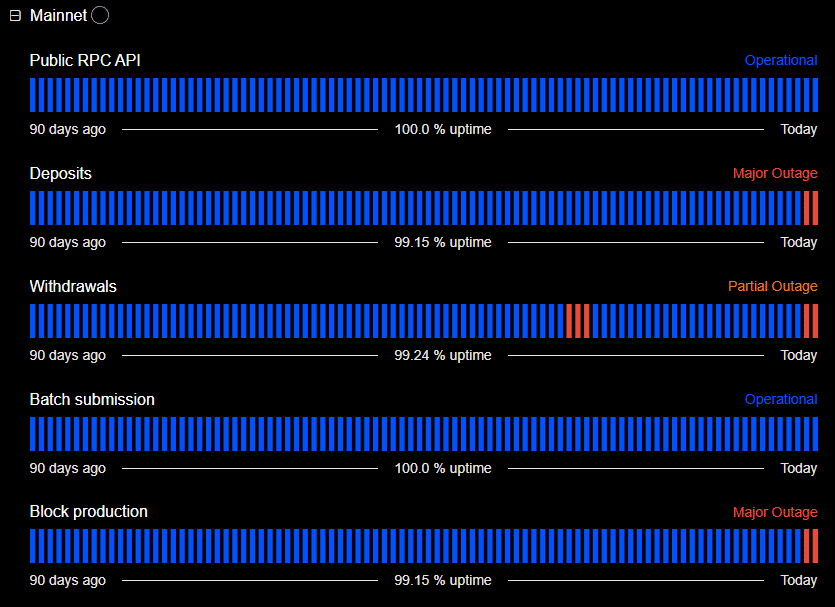
However, as of 26th June, 10:36 UTC, the issue had not been fully resolved. In fact, the chain’s status indicated that the mainnet block product was “unhealthy.”

Apart from the block production, deposits and withdrawals were also affected for the second day. Notably, withdrawals were only partially degraded, but deposits were facing a “major outage.”
Source: Base Status

For his part, Jesse Pollak, co-founder of Base, assured users that funds were safe and that they were working on a full post-mortem.

He added that halting the chain to remedy the issue was undesirable and would act as a challenge to do better in the future.

All funds are/were safe. But a halt is not okay, and we’ll use this to continue to level up Base as a platform for global, 24/7 finance. Thank you for your patience.

Base’s bet on tokenization

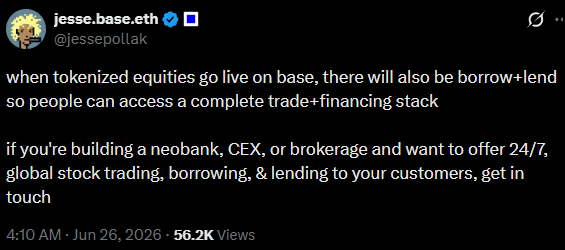
Separately, Pollak has indicated that Base will allow a DeFi-like borrowing and lending option for tokenized assets once they go live on the chain.
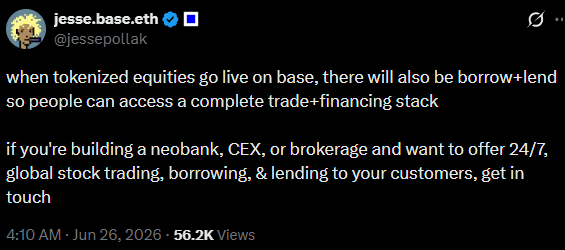
Source: X

This is part of a broader bet on tokenization as the nascent segment gains traction. Unfortunately, a chain disruption like the recent one is not a good look for such a goal.

That said, Base debuted in H2 2023 and has grown immensely over the past few months. It has done a cumulative revenue of over $184M with a total locked value (TVL) of $4B.
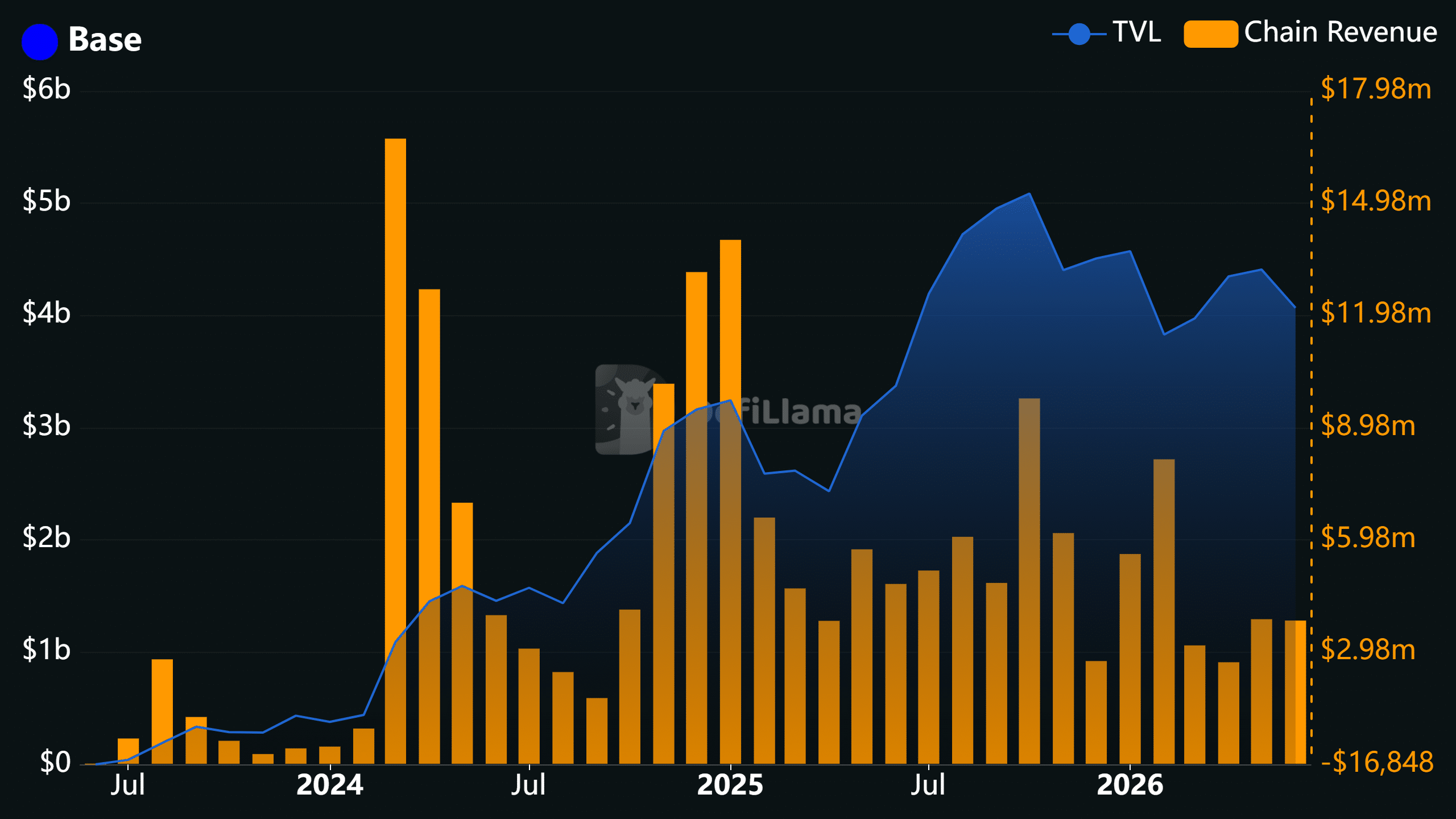
Source: DeFiLlama

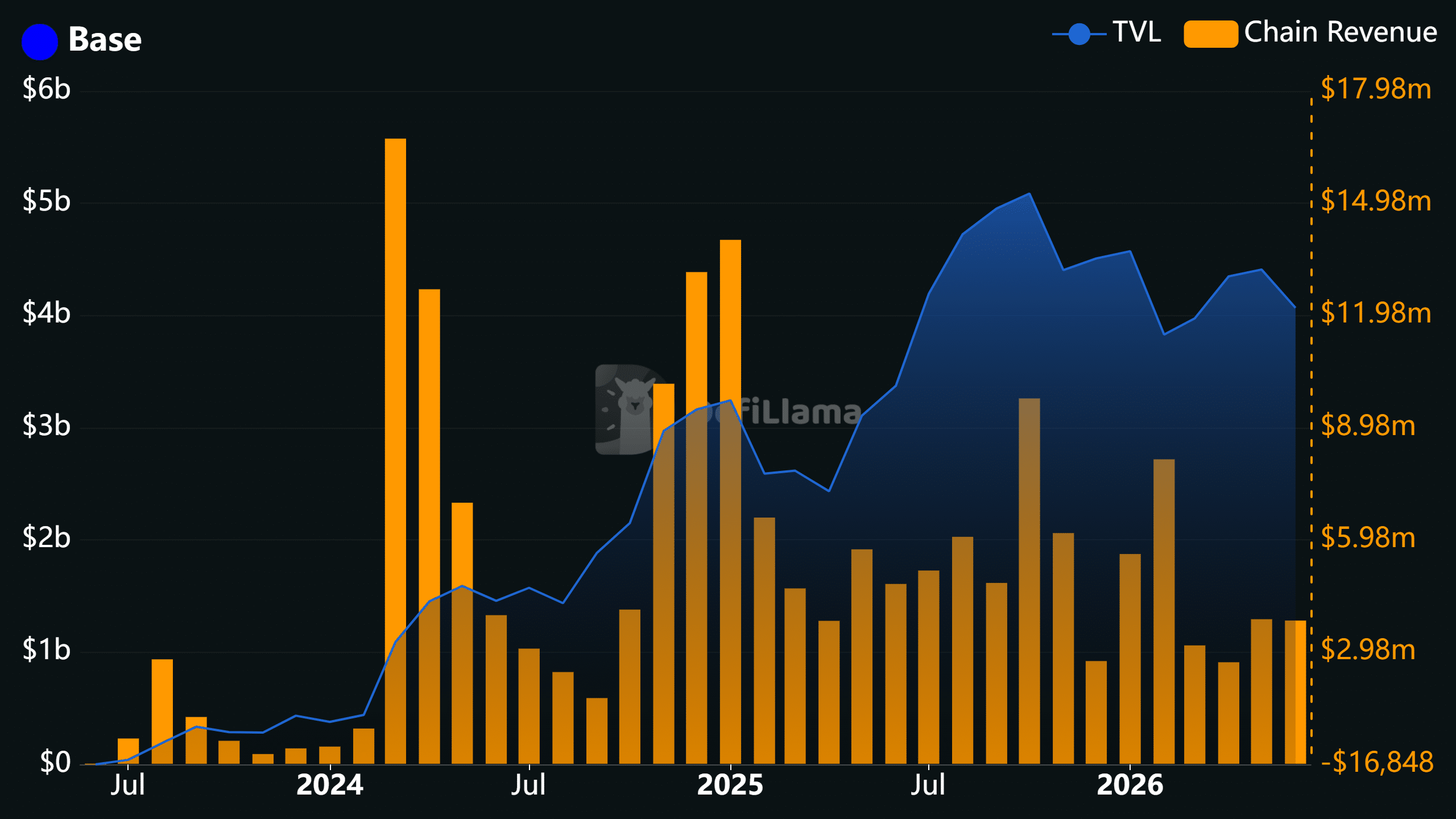
Source: DeFiLlama

Half the locked $4B value is on the DeFi lending platform Morpho Blue. Whether the ongoing outage will dent investor confidence and trigger outflows remains to be seen.


Final Summary

  • Base chain faced a consensus problem that has partially degraded withdrawals and disabled deposits.
  • Jesse Pollak, Base co-founder, is betting big on tokenized assets with DeFi-like lending and borrowing options


Trending Cryptos

Related Questions

QWhat was the main issue that affected the Base chain for nearly 48 hours?

AThe Base chain encountered a consensus problem that caused an invalid block to be sequenced. This led to the chain's mainnet block production being 'unhealthy' and resulted in a partial degradation of withdrawals and a major outage for deposits.

QWhat did Base co-founder Jesse Pollak say about the safety of funds during the outage?

AJesse Pollak assured users that all funds were safe during the outage. He also stated that halting the chain to fix the issue was undesirable and that they would use this experience to improve Base as a platform for global, 24/7 finance.

QAccording to the article, what future functionality for tokenized assets is Base planning?

ABase plans to allow DeFi-like borrowing and lending options for tokenized assets once they are live on the chain. This is part of their broader bet on the tokenization segment.

QWhat are Base's reported cumulative revenue and Total Value Locked (TVL) figures as mentioned in the article?

ABase has done a cumulative revenue of over $184 million and has a Total Value Locked (TVL) of $4 billion.

QWhat potential concern does the article raise regarding the ongoing chain disruption?

AThe article raises the concern that the ongoing chain disruption might dent investor confidence and potentially trigger outflows from the platform, especially given that half of its $4 billion TVL is on the DeFi lending platform Morpho Blue.

Related Reads

1600 Lines of Code Create an Underwater Manhattan, Fable 5 Leaves Karpathy Stunned

Title: Fable 5 Stuns Karpathy with 3D Worlds Built from 1600 Lines of Code An AI model, Fable 5, has demonstrated a remarkable leap in generating complex, interactive 3D worlds with minimal code. Showcased by Peter Gostev of Arena.ai, the model created 63 diverse 3D environments across themes like immersive cityscapes, explorable famous paintings, natural wonders, and cosmic phenomena. Many were generated in a single attempt. A standout creation is a detailed, submerged Manhattan built with only 1600 lines of Three.js code. Other highlights include traversable versions of Van Gogh's "Starry Night," a bear catching a salmon with realistic physics, and a split Red Sea. The model's ability to cohesively manage vast numbers of elements within a scene represents a significant technical advancement. Andrej Karpathy, who recently joined Anthropic's pre-training team, expressed amazement, particularly at how the model intuitively understood and rendered complex real-world interactions like a fish struggling when caught. He coined the term "fablemaxxing" to describe this qualitative leap. While Fable 5 excels at world-building, Gostev notes current limitations in creating engaging, long-form gameplay. The model also sometimes requires prompting to fully utilize its capabilities. Having topped the Agent Arena benchmark for real-world task completion, Fable 5 signals that the boundaries of AI-generated content are rapidly expanding, with its full potential yet to be discovered.

marsbit4m ago

1600 Lines of Code Create an Underwater Manhattan, Fable 5 Leaves Karpathy Stunned

marsbit4m ago

From ANSEM to CZ, The Celebrity Coin Relay Race Between Solana and BSC

The past week was a whirlwind of on-chain activity, sparked by the meteoric rise of $ANSEM, a Solana-based meme coin that surged 600x and hit a $100 million market cap in a single day. This rally began when crypto influencer Ansem announced his return to buying Solana meme coins and publicly advocated for an airdrop from the platform pump.fun. Ansem’s subsequent "soft claim" of the token—promising to airdrop creator revenue to followers—ignited a frenzy, drawing comparisons to past community-led token distributions. However, his dual role as a co-founder of the trading terminal Bullpen, which later hosted the $ANSEM airdrop, suggests a strategic promotional element. The narrative quickly shifted to "celebrity coins," where tokens named after influencers are sent to their public addresses in hopes of endorsement. While a similar coin, $TJR, briefly gained traction, it faltered after the influencer TJR urged focus back on $ANSEM. Attention then turned to projects Ansem endorsed and coins found in his wallet, like $manlet, but momentum on Solana began to stall. The action then migrated to BSC with the viral resurgence of a 2021 tweet from former Binance CEO CZ, referencing a "final form" bull. This sparked the explosive launch of $CZ, which briefly approached a $90 million market cap despite expectations that CZ wouldn't actively engage like Ansem. Another BSC token, $TCC, gained attention due to CZ's interactions with its promoter. The BSC ecosystem saw faster-paced, albeit volatile, "celebrity coin" plays, with tokens like $dingaling experiencing rapid pumps and dumps without official endorsements. Currently, BSC shows more momentum for new token launches than Solana, with the market awaiting a new narrative to succeed the fleeting "celebrity coin" trend.

marsbit14m ago

From ANSEM to CZ, The Celebrity Coin Relay Race Between Solana and BSC

marsbit14m ago

A Decade of Change: The Demise of Crypto Startups

"The Decade-Long Transformation: The Demise of Crypto Startups" The article traces the dramatic evolution of the cryptocurrency industry from its anarchic beginnings to its current highly regulated and institutionalized state. In the early days (circa 2017), launching a crypto startup was remarkably simple: a whitepaper, a GitHub repository, and a Telegram group could attract thousands of retail investors via an Initial Coin Offering (ICO). Founders operated anonymously with near-zero regulatory and financial barriers, enabling rapid, global innovation but also widespread fraud. By 2026, the landscape is fundamentally different. To operate in major markets like the US, EU, and Asia, crypto businesses must now navigate a complex web of regulations akin to traditional finance. Compliance costs are prohibitive: estimates for a US multi-state operation range from $750,000 to $1.2 million in the first three years, with annual costs exceeding $2 million thereafter. Regulations like MiCA in the EU and New York's BitLicense have created high capital and operational hurdles that act as barriers to entry. Simultaneously, venture capital investment has shifted dramatically. Following the collapses of Terra and FTX, funding has concentrated in later-stage, established companies, creating a "barbell market." Early-stage and seed funding has shrunk significantly, while mega-funds like Andreessen Horowitz's $15 billion pool dominate. Most capital now flows to trading platforms, lending infrastructure, and B2B services. This environment favors mergers and acquisitions as the primary path for growth. Companies like Coinbase and Ripple are acquiring firms like Deribit and Hidden Road not for their technology, but for their licenses, banking relationships, and institutional trust—assets far more valuable than code. Distribution channels, compliance, and brand reputation have become the new moats, overshadowing pure technical innovation. The industry's maturation brings benefits: reduced scams, increased institutional participation, and clearer regulatory frameworks. However, it comes at a cost. The low-barrier, experimental ethos that defined crypto's first decade is fading. Entrepreneurs without substantial capital, pre-existing licenses, or institutional connections face immense challenges. Funding for exploratory fields like decentralized social media or novel governance models is drying up. Ultimately, the crypto industry is replicating the consolidation pattern seen in banking and tech after the 2008 financial crisis. While this brings stability and legitimacy, it raises a critical question: in this new, resource-intensive reality, is there still room for the disruptive, from-scratch innovation that gave birth to the sector?

Foresight News1h ago

A Decade of Change: The Demise of Crypto Startups

Foresight News1h ago

Trading

Spot

Hot Articles

Discussions

Welcome to the HTX Community. Here, you can stay informed about the latest platform developments and gain access to professional market insights. Users' opinions on the price of LAYER (LAYER) are presented below.

活动图片