0G Labs Launches Consumer-Grade AI Development Platform Based on Decentralized Infrastructure

marsbitPublished on 2026-04-15Last updated on 2026-04-15

Abstract

0G Labs has launched 0G App, a consumer AI development platform that enables users to build applications using natural language instructions without coding. It combines decentralized infrastructure, privacy-preserving Trusted Execution Environment (TEE) verification, and integrated token and AI agent deployment. The platform aims to bridge the gap between Web2 usability and Web3 infrastructure, allowing users to create, preview, and deploy applications entirely within a unified ecosystem. Key features include support for real-time iteration, hardware-secured AI inference (using Intel TDX and NVIDIA H100/H200), and the use of the GLM-5 74.4B parameter model. Additionally, 0G App includes a "Launcher Hub" for app, agent, and token deployment, with compute resources tied to the $0G token. Applications can be deployed to platforms like Vercel while storing data on 0G’s decentralized storage layer.

AI agent platform 0G Labs today officially launched 0G App, a consumer-facing AI development platform that allows anyone to build applications using natural language instructions, without writing code. The platform combines decentralized computing, privacy-preserving Trusted Execution Environment (TEE) verification, and integrated token and AI agent deployment features, enabling users to complete the entire process from idea to full application deployment within a single ecosystem, thereby merging the ease of use of Web2 with the infrastructure and utility of the $0G token from Web3.

Current Challenges in AI Development

"Ambient Programming" platforms have rapidly risen, clearly demonstrating a shift in how software is created. Tools that allow users to generate applications using natural language significantly lower the barrier to entry, enabling non-technical users to build digital products for the first time. However, these platforms still heavily rely on centralized cloud service providers, raising ongoing concerns about data privacy, vendor lock-in, and opaque model behavior.

Meanwhile, crypto-native infrastructure has struggled to provide a comparable user experience, often requiring specialized technical knowledge and fragmented toolchains. Consequently, a gap has emerged between the ease of use of AI-driven development and the principles of decentralization.

A Decentralized Solution for AI Application Creation

To address this issue, 0G Labs announced the launch of 0G App. This is a consumer AI development platform designed to enable users to build applications using only natural language instructions, without writing code. The platform runs on decentralized computing infrastructure and introduces Trusted Execution Environment (TEE) verification for all supported AI models.

Users can describe an application idea in plain language and watch it generate in real-time. The platform supports real-time preview and iterative editing through an integrated development environment. Initial templates include landing pages, dashboards, and full web applications, while also supporting the upload of reference materials, prompt optimization, or voice input.

Design for Privacy and Verification

0G App's core feature is the utilization of secure hardware enclaves, combining Intel TDX and NVIDIA H100/H200 infrastructure to run inference tasks. This approach achieves verifiable, private AI computation at the architectural level, rather than relying on platform policies.

The platform launches with the open-source 744-billion parameter model GLM-5 from Zhipu AI, which runs within the TEE secure environment.

Introduction to the Launcher Hub

Beyond application generation, 0G App introduces a broader "Launcher Hub" framework, extending functionality to related areas of the development lifecycle.

· App Launcher: Supports the complete workflow from prompt to application, providing real-time preview and iteration.

· Agent Launcher (Live Now): Allows users to deploy specialized AI agents powered by OpenClaw and the 0G compute layer in one step.

· Token Launcher (Planned): Will guide users through the token creation process on the 0G chain.

These components work together to create a unified environment where users can build, deploy, and scale applications without leaving the platform.

Bridging Web2 Ease of Use with Web3 Infrastructure

0G App combines familiar Web2 tools with decentralized backend systems. Applications can be deployed to Vercel with one click, while project data is synchronized to 0G's decentralized storage layer, supporting recovery via root hash.

The use of computing resources is tied to the $0G token, establishing a direct link between platform activity and token utility. The platform supports wallet connectivity at launch, allowing users to access services and manage payments within a crypto-native framework.

Expanding the Role of AI in the Crypto Ecosystem

This launch comes at a time when interest in AI-driven development continues to surge, while scrutiny of centralized AI providers intensifies. By combining a natural language interface with decentralized infrastructure, 0G App seeks to redefine how applications are built and deployed within the crypto ecosystem.

The platform introduces a new model where users can go from idea to functional application without relying on centralized services, while integrating elements like tokenization and agent deployment into the same workflow.


Trending Cryptos

Related Questions

QWhat is the main product launched by 0G Labs and what does it allow users to do?

A0G Labs launched 0G App, a consumer AI development platform that allows anyone to build applications using natural language instructions without writing any code.

QWhat are the key technological features of the 0G App platform regarding security and infrastructure?

AThe platform runs on decentralized computing infrastructure and utilizes Trusted Execution Environment (TEE) verification for all supported AI models, leveraging secure hardware enclaves with Intel TDX and NVIDIA H100/H200 infrastructure.

QWhat is the 'Launcher Hub' framework introduced by 0G App and what are its components?

AThe 'Launcher Hub' is a framework that extends functionality across the development lifecycle. Its components include the App Launcher (for the complete workflow from prompt to app), the Agent Launcher (for one-step deployment of AI agents), and a planned Token Launcher (to guide users through token creation on the 0G chain).

QHow does 0G App connect Web2 usability with Web3 infrastructure?

A0G App combines familiar Web2 tools with decentralized backend systems. Applications can be deployed to Vercel with one click, while project data is synced to 0G's decentralized storage layer. Platform activity is tied to the utility of the $0G token, and it supports wallet connectivity for service access and payments.

QWhich large language model does the 0G App platform debut with, and in what environment does it run?

AThe platform debuts with the 744-billion parameter GLM-5 open-source model from Zhipu AI, which runs inside a TEE (Trusted Execution Environment) secure environment.

Related Reads

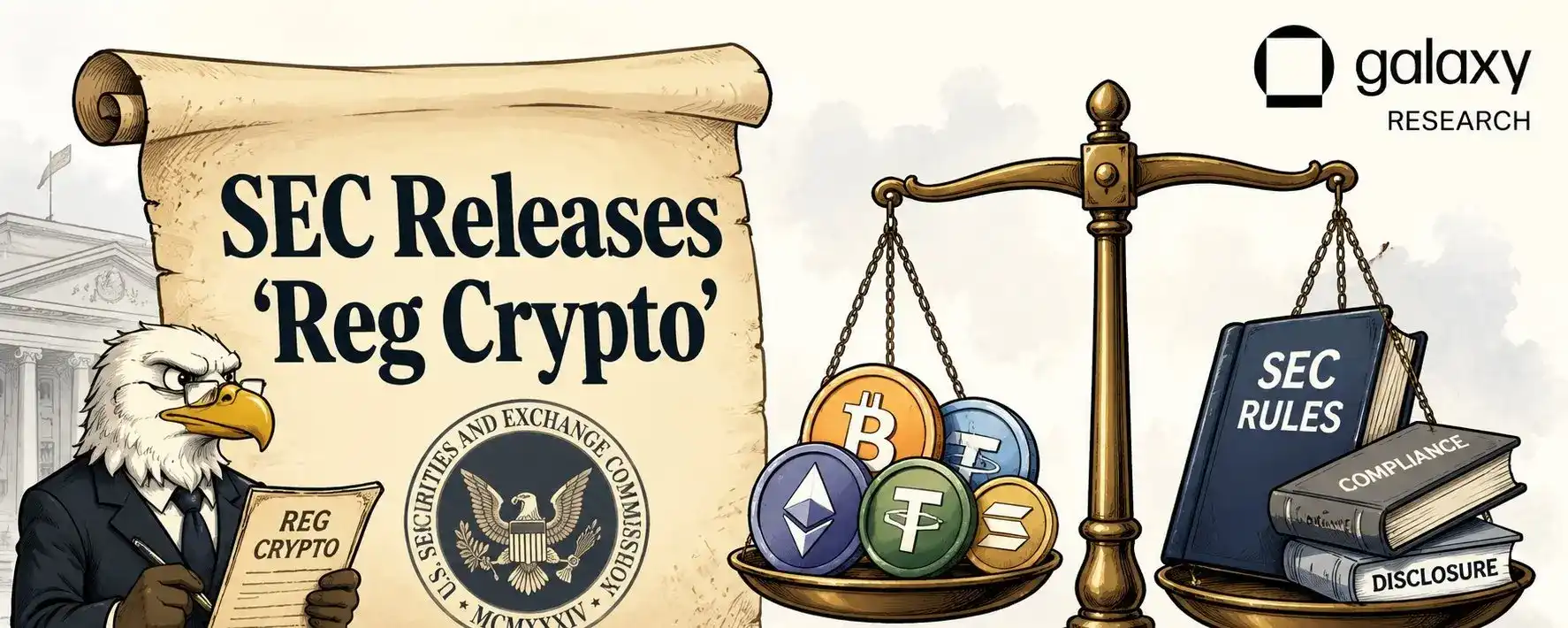
Galaxy Research: Can SEC's New Regulations Usher in a New Era for Token Financing?

**SEC Proposes New Framework for Token Offerings, Potentially Unlocking Legal Paths for U.S. Crypto Fundraising** On August 18, the U.S. Securities and Exchange Commission (SEC) proposed new rules, dubbed "Reg Crypto," specifically tailored for crypto asset offerings. This framework marks a departure from applying traditional securities rules designed for stocks to tokens. It creates a potential legal pathway for token sales to the U.S. public, including non-accredited investors, without full registration. The proposed rules apply to crypto assets that are not themselves securities but were sold as part of an investment contract where the issuer promised to build a product, network, or ecosystem. It establishes a four-phase lifecycle: Raise, Disclose, Build, and Exit. The "Raise" phase includes two new fundraising exemptions: a startup exemption allowing up to $5 million over four years and a larger, Regulation A-based exemption for up to $20 million or $75 million over 12 months. The "Disclose" phase requires specific token-related disclosures like supply schedules, governance, and development progress. After the issuer completes its promised development work and files a transition report, the "Exit" phase allows the associated investment contract to terminate, even if the token continues to trade. The analysis highlights that the framework's most immediate impact may be providing a formal "exit" path for existing tokens with unclear legal status, rather than immediately sparking a new wave of U.S.-based token offerings. It offers advantages over traditional private placements by allowing public sales and immediate token transferability but imposes ongoing disclosure and reporting obligations. A key hurdle is that the larger exemption requires a substantial U.S. operational presence, which may deter projects with offshore structures. Overall, the proposal is seen as a constructive step toward regulatory clarity, acknowledging that token offerings differ from equity offerings and require tailored investor disclosures. However, it remains a proposal subject to a 60-day public comment period, and its long-term stability may ultimately depend on congressional action.

marsbit2h ago

Galaxy Research: Can SEC's New Regulations Usher in a New Era for Token Financing?

marsbit2h ago

Bitcoin and Ethereum Soar Together! Eight Altcoins Worth Watching in the Later Market

Bitcoin and Ethereum Surge, Fueling Altcoin Speculation. Bitcoin Eyes $77,000, Ethereum Gains 20% in a Single Day. Market anticipates capital rotation from major cryptos to high-beta altcoins, but a selective rise is expected, favoring projects with genuine users, protocol revenue, and healthy tokenomics. Analysts highlight eight altcoins across key sectors: **High-Performance Blockchains:** * **SOL (Solana):** Market cap ~$51.88B. A dominant player with a strong ecosystem. Considered a relatively safe bet for potential catch-up growth. * **SUI (Sui):** Market cap ~$3.03B. High volatility potential but faces risks from its low circulating supply and future token unlocks. **DeFi Lending:** * **UNI (Uniswap):** Market cap ~$2.38B. Transitioning to a revenue-capturing asset post-fee switch implementation. * **AAVE (Aave):** Market cap ~$1.53B. Features balanced tokenomics and revenue but has seen significant recent gains. * **MORPHO:** Market cap ~$1.50B. Rapid protocol growth but weaker token value capture and opaque supply data. **Perpetual DEX:** * **HYPE (Hyperliquid):** Market cap ~$16.41B. The clear sector leader with strong revenue but high valuation and a large portion of tokens still locked, warranting caution. **RWA & On-Chain Finance Infrastructure:** * **LINK (Chainlink):** Market cap ~$8.09B. A key oracle provider positioned to benefit from multiple trends like RWA and institutional adoption, offering strong fundamentals. * **ONDO (Ondo Finance):** Market cap ~$1.77B. Shows strong business growth but carries high risks due to concentrated token holdings and a massive unlock scheduled for 2027. **Conclusion:** The altcoin rally is expected to be selective. Recommendations include a medium position in SOL, small allocations to SUI and UNI/AAVE for DeFi exposure, and caution with HYPE and ONDO due to their specific risks. LINK is suggested as a core holding for the RWA thematic.

marsbit4h ago

Bitcoin and Ethereum Soar Together! Eight Altcoins Worth Watching in the Later Market

marsbit4h ago

Shanghai's $10 Billion Unicorn Is About to Go Public

Shanghai-based automotive-grade millimeter-wave radar chip unicorn Calterah Microelectronics Technology (Shanghai) Co., Ltd. has filed for an IPO on Shanghai's STAR Market, aiming to raise 3.49 billion yuan. Founded in 2014 by Chen Jiashu, a UC Berkeley PhD graduate, and his professor Ali Niknejad, Calterah pioneered CMOS technology for 77GHz radar chips, breaking the decades-long monopoly of international giants like Texas Instruments. Its low-cost, highly integrated solutions enabled millimeter-wave radar to move from luxury to mass-market vehicles. By 2025, Calterah captured a 31.1% share in China's automotive millimeter-wave radar chip market (second domestically, fourth globally), with cumulative shipments exceeding 30 million units. Its client list includes BYD, Geely, Nio, and Volvo. The company has undergone 11 funding rounds, attracting high-profile investors such as the National Integrated Circuit Industry Investment Fund Phase II, China Capital Management, and GD Capital. Its valuation has reached tens of billions of yuan, with a projected post-IPO valuation of approximately 14 billion yuan. Despite rapid revenue growth—increasing from 206 million yuan in 2023 to 632 million yuan in 2025 with a 75.28% CAGR—Calterah remains unprofitable. It reported net losses of 323 million yuan, 334 million yuan, and 193 million yuan from 2023 to 2025, accumulating over 900 million yuan in losses over three and a half years. These losses are primarily attributed to heavy R&D investment, which totaled over 1.039 billion yuan in the reporting period, often exceeding annual revenue. The company faces significant risks, including high customer concentration (its top five customers accounted for over 99% of revenue from 2023-2025, with BYD alone representing over 50% in 2025) and supply chain concentration. Revenue pressure from key customers and dependencies on overseas suppliers for EDA tools and IP pose challenges to sustainable growth. The IPO is seen as crucial for securing capital to expand production, diversify its customer base, and reduce supply chain dependencies.

marsbit5h ago

Shanghai's $10 Billion Unicorn Is About to Go Public

marsbit5h ago

Trading

Spot

Hot Articles

How to Buy 0G

Welcome to HTX.com! We've made purchasing 0G (0G) simple and convenient. Follow our step-by-step guide to embark on your crypto journey.Step 1: Create Your HTX AccountUse your email or phone number to sign up for a free account on HTX. Experience a hassle-free registration journey and unlock all features.Get My AccountStep 2: Go to Buy Crypto and Choose Your Payment MethodCredit/Debit Card: Use your Visa or Mastercard to buy 0G (0G) instantly.Balance: Use funds from your HTX account balance to trade seamlessly.Third Parties: We've added popular payment methods such as Google Pay and Apple Pay to enhance convenience.P2P: Trade directly with other users on HTX.Over-the-Counter (OTC): We offer tailor-made services and competitive exchange rates for traders.Step 3: Store Your 0G (0G)After purchasing your 0G (0G), store it in your HTX account. Alternatively, you can send it elsewhere via blockchain transfer or use it to trade other cryptocurrencies.Step 4: Trade 0G (0G)Easily trade 0G (0G) on HTX's spot market. Simply access your account, select your trading pair, execute your trades, and monitor in real-time. We offer a user-friendly experience for both beginners and seasoned traders.

2.9k Total ViewsPublished 2025.09.22Updated 2026.06.02

How to Buy 0G

Discussions

Welcome to the HTX Community. Here, you can stay informed about the latest platform developments and gain access to professional market insights. Users' opinions on the price of 0G (0G) are presented below.

活动图片