Arthur Hayes buys $72K ETHFI 5 hours before Upbit listing: Market takes note

ambcryptoPublished on 2026-03-19Last updated on 2026-03-19

Abstract

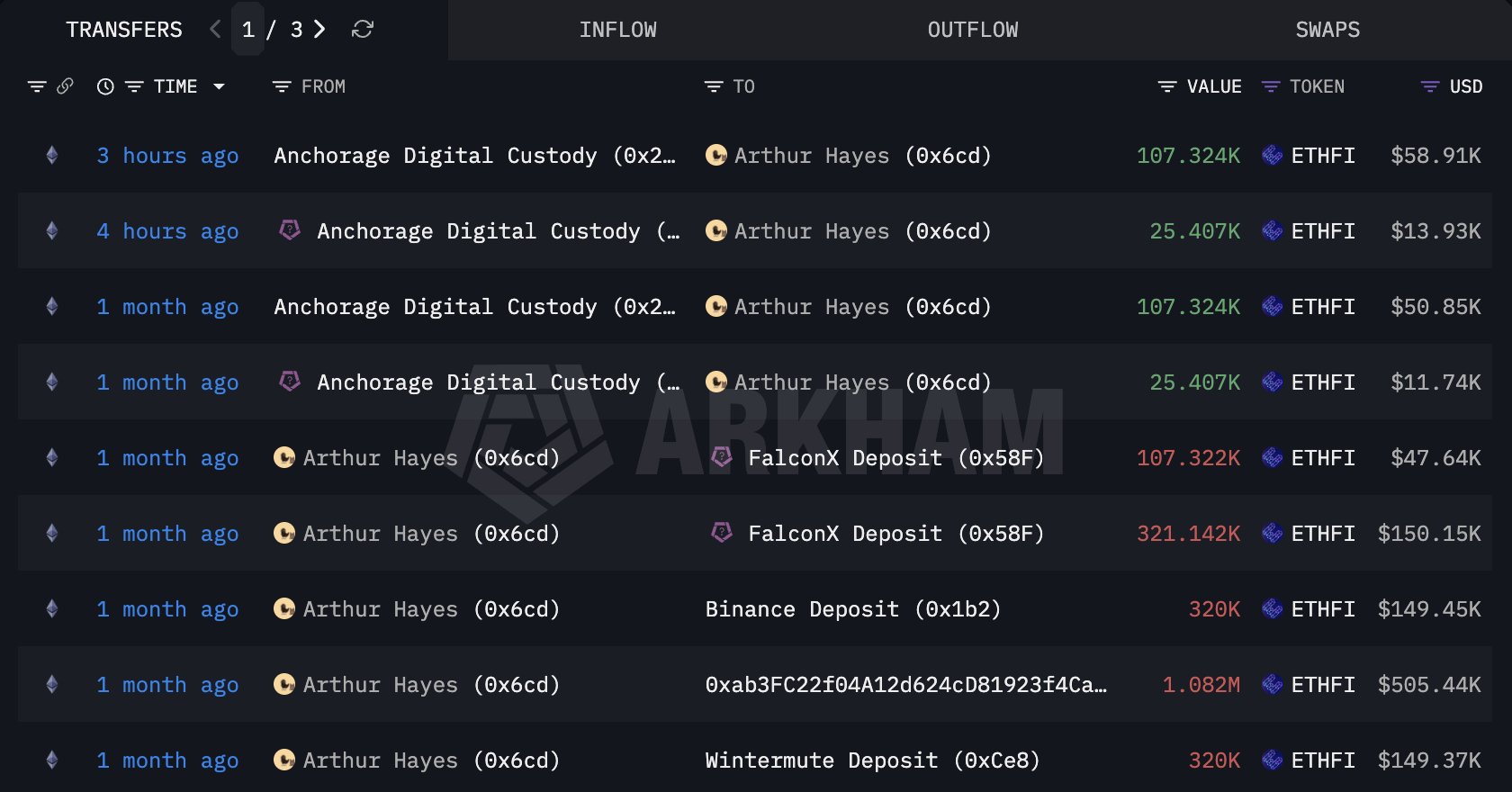
Arthur Hayes, co-founder of BitMEX and CIO of Maelstrom, purchased 132,730 ETHFI (worth approximately $72,800) just five hours before South Korea's largest crypto exchange, Upbit, announced its listing of the token. The well-timed trade has fueled allegations of insider trading, given the significant market impact of such a listing in a region known for strong retail participation. Data shows Hayes had previously moved large amounts of ETHFI and deployed over $3.4 million into various DeFi tokens earlier this year. The listing on Upbit included temporary trading restrictions, such as a brief buy freeze and limit-only orders during the initial phase.

EthereumFi [ETHFi] is grabbing eyeballs after a major exchange listing and a well-timed trade.

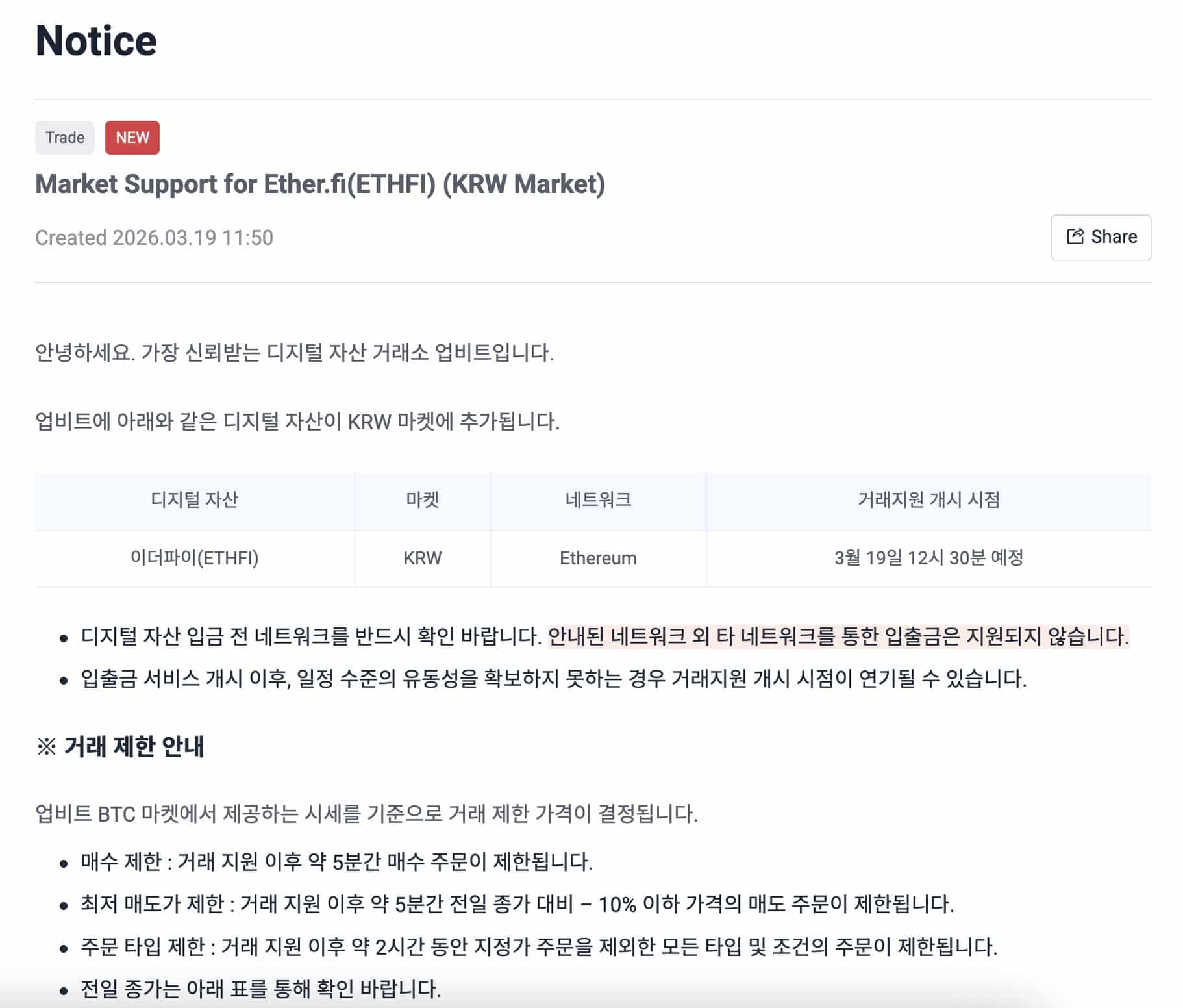
Just hours before South Korea’s Upbit announced an ETHFi listing, Arthur Hayes was seen buying the token. For context, this listing is quite significant, given South Korea’s strong retail participation and preference for altcoins.

Hayes and the insider trading allegations

Arthur Hayes, co-founder of BitMEX and CIO of Maelstrom, accumulated ETHFI shortly before a key listing on South Korea’s largest crypto exchange, Upbit.
Source: X

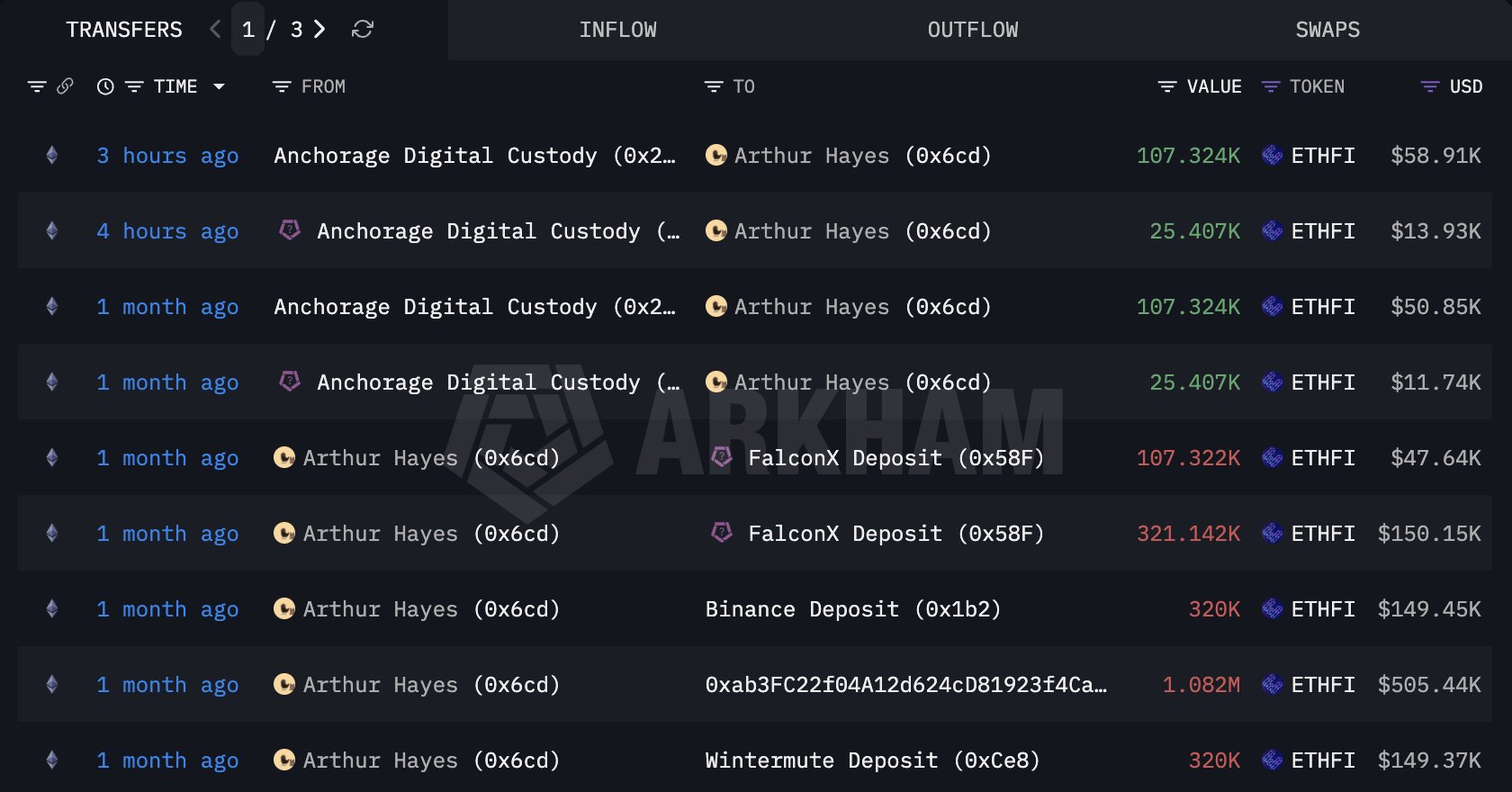
Per data from Lookonchain, Hayes received 132,730 ETHFI (approximately $72,800) from Anchorage Digital roughly five hours before the exchange confirmed the token’s addition to its KRW market.

The timing, of course, has added fuel to the insider trading narrative.
Source: X

Earlier this year, he deployed over $3.4 million across multiple DeFi tokens, including ETHFI. Data also revealed that about a month prior, Hayes moved 2.15 million ETHFI at around $0.47, which could be earlier distribution activity.

The latest acquisition occurred near $0.55 per token.

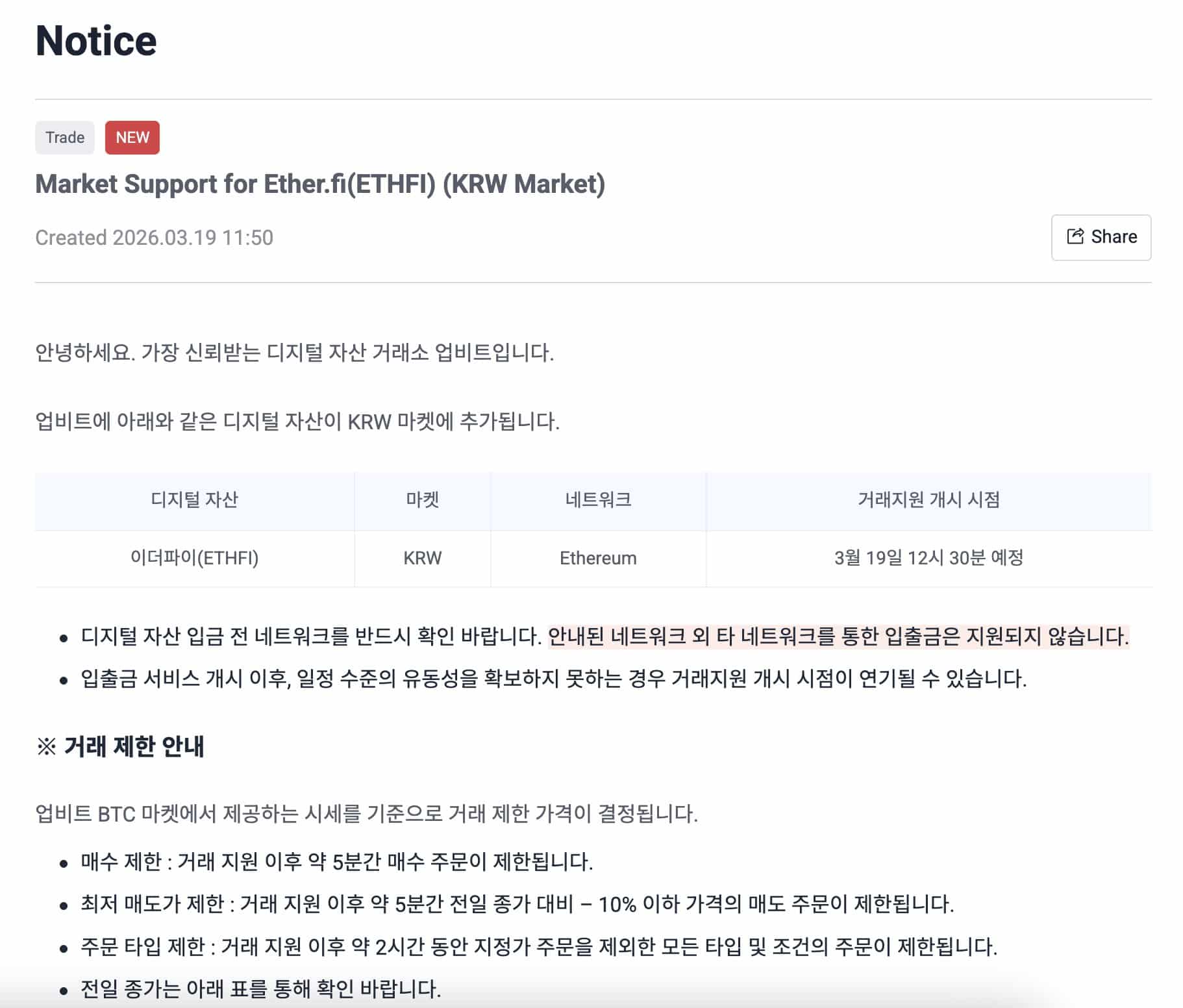
It is notable that as part of standard listing controls, Upbit temporarily restricted orders. This included a brief buy freeze and limits on low-priced sell orders, while enforcing limit-only trading during the initial phase.


A look at the big picture

Trending Cryptos

Related Questions

QWho is Arthur Hayes and what significant action did he take regarding ETHFI?

AArthur Hayes is the co-founder of BitMEX and CIO of Maelstrom. He bought 132,730 ETHFI (worth approximately $72,800) just five hours before it was listed on the South Korean exchange Upbit.

QWhy is the listing of ETHFi on Upbit considered significant for the market?

AThe listing is significant because South Korea has strong retail participation in cryptocurrency markets and a notable preference for trading altcoins, which can lead to substantial trading volume and price impact.

QWhat allegations have arisen from the timing of Arthur Hayes' ETHFI purchase?

AThe timing of his purchase, occurring just hours before the official Upbit listing announcement, has fueled allegations of insider trading.

QFrom which company did Arthur Hayes receive the ETHFI tokens, and what was the price per token?

AHe received the tokens from Anchorage Digital, and the latest acquisition occurred at a price of approximately $0.55 per token.

QWhat trading controls did Upbit implement as part of the standard listing process for ETHFI?

AUpbit temporarily restricted orders, which included a brief freeze on buy orders and limits on low-priced sell orders. It also enforced limit-only trading during the initial phase of the listing.

Related Reads

Kaito Reboots 'Talk-to-Earn Economy', but Many Are Hesitant to Install the New Plugin

Kaito AI has launched a new browser extension called Kaito Pulse, aiming to revitalize what the community terms the "talk-to-earn" or "social-fi" economy on X (formerly Twitter). The plugin displays users' on-chain trading activity, such as positions from platforms like Polymarket, directly within the X timeline. This aims to create a new "attention + behavior verification" system, shifting focus from who generates the most discussion to whose discussions are backed by credible, verifiable actions. However, the launch quickly sparked significant privacy concerns within the crypto community. Critics, led by an analysis from user "Ultra," allege the extension's code enables deep data collection. This includes potential device fingerprinting (using GPU, hardware, and audio data), tracking of X user behavior (browsing paths, clicks, engagement), and verification processes that could access sensitive data from third-party accounts like ChatGPT, Claude, and trading platforms. The debate centers on whether such extensive verification is necessary to combat fake engagement and AI-generated content, or if it constitutes an unacceptable privacy sacrifice. In response, Kaito founder Yu Hu stated the design follows data minimization principles. He claimed Kaito Pulse does not collect or store users' raw data but instead uses verification techniques, including zkTLS, to generate proofs of identity or behavior without exposing the underlying information. Yu Hu acknowledged that some permission descriptions could be misleading and promised improvements in future versions. The controversy highlights a core dilemma for social-fi projects: platforms need more user data to distinguish real influence from artificial hype, but users must decide how much privacy they are willing to trade for potential rewards and ranking within these new incentive systems.

Odaily星球日报1m ago

Kaito Reboots 'Talk-to-Earn Economy', but Many Are Hesitant to Install the New Plugin

Odaily星球日报1m ago

After Two and a Half Years of Entrepreneurship and Full AI Adoption, the Company Has Actually Become More 'Traditional'

"After 2.5 years of running my company, achieving near 100% AI adoption with Agents in roles like finance, HR, and operations, we've paradoxically become more 'traditional.' We learned that establishing a thick AI middle layer creates bottlenecks. Instead, we advocate for a 'thin platform, thick frontline' model, empowering employees closest to problems to use AI tools themselves, fostering ownership and initiative. The true foundation isn't the AI models, but the unique data and context a company accumulates—our most vital, irreplaceable asset, requiring diligent governance. As AI handles repetitive, describable tasks, human roles revert to their core: building genuine relationships, trust, and brand reputation through authentic communication, which AI cannot accelerate. A critical question is where the time saved by AI goes. It must be returned—to clients, to creative work, to employees' own lives—rather than just fueling higher output demands. For managers, AI strips away execution-focused busywork, exposing the necessity to define clear goals, make tough judgments, and take ultimate responsibility. Onboarding newcomers presents a challenge: while AI can generate 80% solutions instantly, we must deliberately design paths for them to develop judgment, understand context, and safely learn from mistakes. Ultimately, AI's organizational value isn't about replacing people but removing unnecessary friction, allowing more meaningful human connection. The real test of an 'AI-era' company isn't its tech stack, but how it treats people: delegating creative power, returning saved time, fostering growth, and upholding accountability. The core luxury and purpose of our work remains authentic human relationships."

marsbit9m ago

After Two and a Half Years of Entrepreneurship and Full AI Adoption, the Company Has Actually Become More 'Traditional'

marsbit9m ago

US Stock Market Trends (August 21): Long-Term Bond Repo Fails, Walmart's Warning Drags Dow Down 700 Points

**U.S. Market Trends (Aug 21): Long-Term Bond Relief Fizzles, Walmart Drags Dow Down 700 Points** U.S. stocks fell sharply, with the Dow plunging over 700 points, as relief from the Treasury's long-term bond buyback plan proved fleeting. Major indexes declined as long-end Treasury yields and oil prices resumed their upward climb, reigniting inflation fears and pressure on high-valuation assets. The key catalyst was the rapid reversal in the bond market. The Treasury's expanded buyback program briefly calmed markets, but 30-year yields quickly rebounded near 5.26%, approaching recent 20-year highs. This signaled that liquidity interventions cannot overcome structural pressures from massive U.S. debt, fiscal deficits, and competing capital demands from AI infrastructure spending. Simultaneously, rising oil prices (WTI +2.3%) on geopolitical tensions renewed inflation concerns, squeezing consumer spending power. This pressure was highlighted by Walmart's 9% stock plunge. Despite beating earnings estimates, its weak U.S. same-store sales growth and lowered annual guidance exposed caution among lower-income consumers. Tech stocks faced broad pressure. The "Magnificent Seven" giants broadly declined, with Moderna crashing over 23% a day after a massive rally on vaccine trial news, exemplifying swift profit-taking. However, select semiconductor names (e.g., Marvell, Micron) gained on specific AI-related catalysts, indicating a more discerning market moving beyond hype to scrutinize real cash flows and capital expenditure sustainability. Bitcoin surged past $72,000, while gold seesawed near $4,500/oz. Alibaba's earnings showed strong AI cloud revenue growth but significant cash outflow due to infrastructure investments. The market's core takeaway is that Treasury actions provide only temporary relief, not a trend reversal. Focus now shifts to whether long-term yields can stabilize below 5.3% and to upcoming Federal Reserve commentary for clues on the rate path. Sustainable equity recovery hinges on the bond market calming and major tech stocks showing concurrent strength.

marsbit10m ago

US Stock Market Trends (August 21): Long-Term Bond Repo Fails, Walmart's Warning Drags Dow Down 700 Points

marsbit10m ago

547 Million OP Tokens Transferred from User Airdrop to Ecosystem Fund: DAO Voting Becoming Sham Democracy

An Optimism governance vote approved the controversial transfer of 546.9 million OP tokens (12.7% of total supply, ~24% of circulating supply) from the remaining "User Airdrop" allocation to the Foundation-controlled "Strategic Ecosystem Fund." The vote passed with a decisive 849,000 OP vote from "Test in Prod," a core development team fully funded by the Optimism Collective, cast just 17 minutes before the deadline. The Foundation argued that broad user airdrops are ineffective for the current institutional expansion phase and that the funds are needed as a flexible "war chest" to secure enterprise clients like Bitpanda and Dunamu. Critics, including L2BEAT and researcher Polynya, opposed the move. They cited the Foundation's overly broad mandate, a lack of clear link to token holder interests, insufficient assessment of past ecosystem fund expenditures (~686M OP spent), and the rewriting of the original distribution promise made to users. The incident highlights deeper governance concerns beyond low voter turnout. It raises questions about the independence of votes from entities financially dependent on the Foundation and the ethical limits of DAO governance—specifically, whether a majority vote can legitimately redefine foundational promises and minority expectations. The move signals a shift from community-focused airdrops to enterprise-driven strategy, eroding user trust amid OP's significant price decline.

marsbit31m ago

547 Million OP Tokens Transferred from User Airdrop to Ecosystem Fund: DAO Voting Becoming Sham Democracy

marsbit31m ago

Trading

Spot

Hot Articles

Ether.fi Explained

Ether.fi aims to further engage in the staking ecosystem by building its own AVS.

28.4k Total ViewsPublished 2024.03.28Updated 2024.03.28

Ether.fi Explained

How to Buy ETHFI

Welcome to HTX.com! We've made purchasing ether.fi (ETHFI) simple and convenient. Follow our step-by-step guide to embark on your crypto journey.Step 1: Create Your HTX AccountUse your email or phone number to sign up for a free account on HTX. Experience a hassle-free registration journey and unlock all features.Get My AccountStep 2: Go to Buy Crypto and Choose Your Payment MethodCredit/Debit Card: Use your Visa or Mastercard to buy ether.fi (ETHFI) instantly.Balance: Use funds from your HTX account balance to trade seamlessly.Third Parties: We've added popular payment methods such as Google Pay and Apple Pay to enhance convenience.P2P: Trade directly with other users on HTX.Over-the-Counter (OTC): We offer tailor-made services and competitive exchange rates for traders.Step 3: Store Your ether.fi (ETHFI)After purchasing your ether.fi (ETHFI), store it in your HTX account. Alternatively, you can send it elsewhere via blockchain transfer or use it to trade other cryptocurrencies.Step 4: Trade ether.fi (ETHFI)Easily trade ether.fi (ETHFI) on HTX's spot market. Simply access your account, select your trading pair, execute your trades, and monitor in real-time. We offer a user-friendly experience for both beginners and seasoned traders.

3.4k Total ViewsPublished 2024.03.29Updated 2026.08.18

How to Buy ETHFI

Discussions

Welcome to the HTX Community. Here, you can stay informed about the latest platform developments and gain access to professional market insights. Users' opinions on the price of ETHFI (ETHFI) are presented below.

活动图片