Crypto Push In Korea: Hana Financial And Standard Chartered Unveil New Deal

bitcoinistPublicado em 2026-03-16Última atualização em 2026-03-16

Resumo

One of South Korea's largest financial groups, Hana Financial, has partnered with UK-based Standard Chartered to strengthen cooperation in global finance and crypto assets. The two institutions signed a memorandum of understanding (MOU) on March 15, aiming to develop stablecoins and digital assets as new growth drivers alongside their traditional banking operations. The agreement covers areas including stablecoins, deposit tokens, and tokenized financial instruments. Hana’s Chairman, Ham Young-joo, emphasized the importance of building a comprehensive ecosystem for won-denominated stablecoins, from issuance to circulation. Standard Chartered’s CEO, Bill Winters highlighted South Korea’s key role in Asian financial markets. This partnership reflects a broader trend among major Korean banks to develop regulated digital asset infrastructure—such as stablecoins and tokenized bonds—rather than focusing on retail crypto speculation. Both institutions have prior experience in the digital asset space, with Hana having established a crypto custody venture and Standard Chartered actively involved in tokenization projects and stablecoin initiatives in Asia.

One of the largest South Korean financial conglomerates has partenerd up with a major UK-based global bank to deepen cooperation in global finance and crypto assets.

A Transnational Crypto Deal

Incumbents are keen not to be left behind on the crypto curve, so much so that some of them are now joining forces. That seems to be the case for Hana Financial Group and Standard Chartered Group as on March 15th they announced the signing of a MOU (memorandum of understanding). By teaming up, the two lenders aim to turn stablecoins and other digital assets into a new growth engine alongside their existing international banking business.

Chairman Ham of Han Financial Group and Bill Winters, CEO of Standard Chartered Group, at the signing ceremony in Seoul. Source: Seoul Economic Daily.

According to The Korea Times, the signing ceremony took place at Hana’s Bank’s headquarters on March 13th. It was attended by Ham Young-joo, Chairman of Hana Financial Group, and Bill Winters, CEO of Standard Chartered Group. Seoul Economic Daily reports that Ham and Winters exchanged views on cooperation in global and digital assets. Chairman Ham stated that:

The partnership between Hana Financial Group and Standard Chartered Group, leveraging their extensive global networks and diverse financial know-how, will serve as a strong competitive edge in the global financial sector. We will create new growth opportunities by generating synergies in future financial domains, including digital assets.

Winters emphasized on the capital importance that South Korea has in Asian financial markets, regarding the country as a “key hub”.

Shared Goals

The MOU covers stablecoins, deposit-token experiments, and future tokenized instruments, tying in Hana’s domestic stablecoin plans and pilots.

The Seoul Economic Daily contextualizes this move with Chairman Ham views of stablecoins as “core future business”. His goal with Hana Financial points to the building of an “ecosystem encompassing the issuance, distribution, use and circulation of (won-denominated stable) coins”, as he stated in his New Year’s address in January. In 2024, Hana Bank, BitGo, and SK Telecom set up BitGo Korea as the local arm focused on institutional crypto custody. In 2025, the Korean lender had an all-time high net profit of ₩4 trillion.
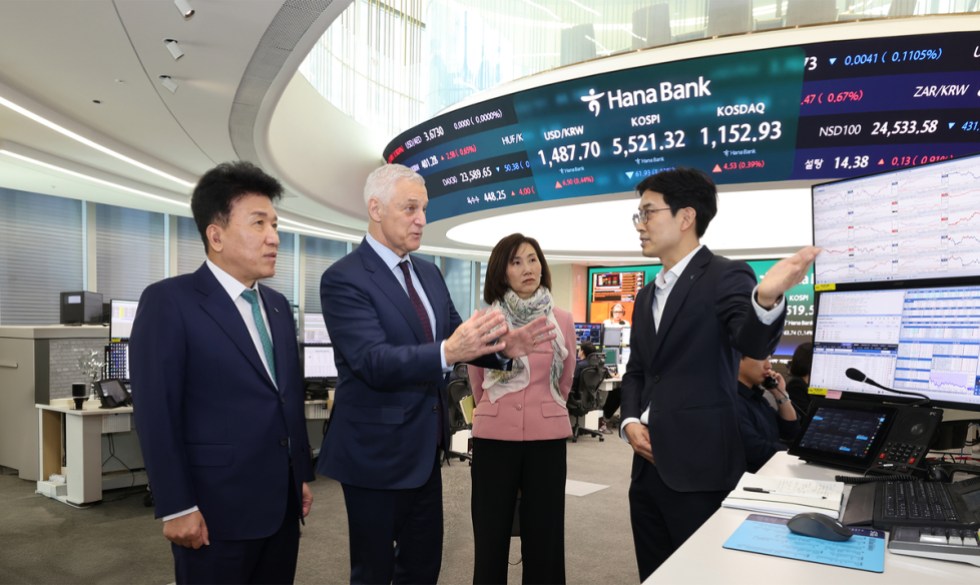
Chairman Ham and Bill Winters at Hana’s Bank’s headquarters, Source: Seoul Economic Daily.

Standard Chartered already has a growing crypto footprint, from institutional custody services to pilots with tokenized bonds and other blockchain-based assets. The bank has also backed several stablecoin ventures in markets like Hong Kong.

This is not the first time Hana Bank and Standard Chartered team up. In December 2025, the UK-based global bank announced that it was facilitating Hana Securities first venture with digital assets.

A Crypto Race

Instead of chasing pure spot exposure, the South Korea’s big banks are now racing to build compliant rails around stablecoins, tokenized notes, and digital bonds that can plug directly into the regulated financial system, nudging the market away from retail speculation toward more structured corporate and banking participation.

This new deal marks another milestone in the latest wave of efforts by TradFi institutions to keep up with a rapidly evolving digital financial system.
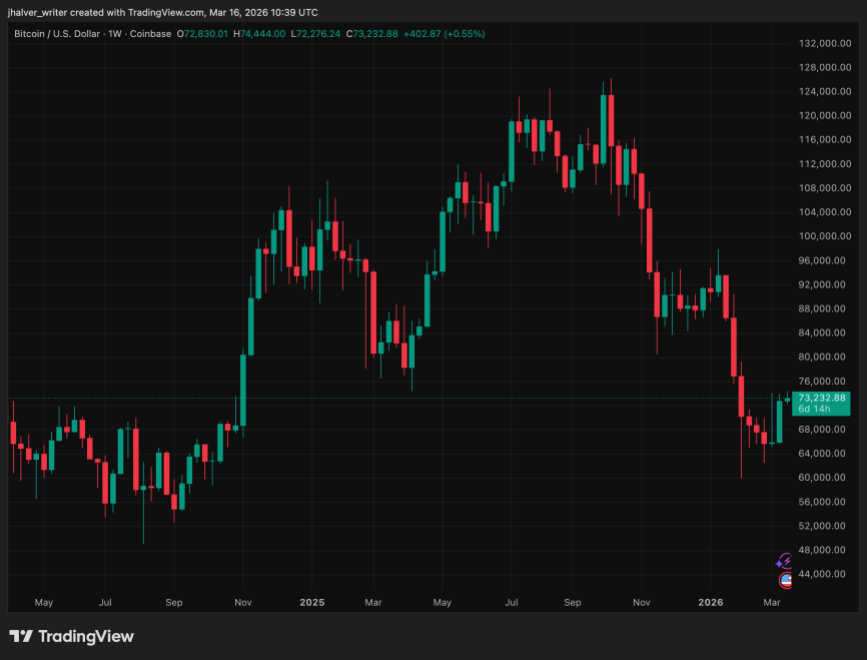
BTC’s price trends to the upside on the daily chart, reaching the $73K. Source: BTCUSD on Tradingview

Cover image from Perplexity, BTCUSD chart from Tradingview

Perguntas relacionadas

QWhat is the main purpose of the partnership between Hana Financial Group and Standard Chartered Group?

AThe partnership aims to deepen cooperation in global finance and crypto assets, turning stablecoins and other digital assets into a new growth engine alongside their existing international banking business.

QWhen and where did the signing ceremony of the MOU between Hana Financial Group and Standard Chartered take place?

AThe signing ceremony took place on March 13th at Hana Bank's headquarters in Seoul.

QWhat specific areas does the MOU between the two financial institutions cover?

AThe MOU covers stablecoins, deposit-token experiments, and future tokenized instruments, tying in Hana's domestic stablecoin plans and pilots.

QWhat did Chairman Ham of Hana Financial Group identify as a 'core future business' in his New Year's address?

AChairman Ham identified stablecoins as a 'core future business' and expressed his goal to build an ecosystem encompassing the issuance, distribution, use, and circulation of won-denominated stablecoins.

QHow is Standard Chartered Bank involved in the crypto space, according to the article?

AStandard Chartered has a growing crypto footprint, including institutional custody services, pilots with tokenized bonds and other blockchain-based assets, and backing several stablecoin ventures in markets like Hong Kong.

Leituras Relacionadas

US Stocks Suffer Worst Plunge Since 2025: Three Triggers Ignite Tech Stock Valuation Reset

The US stock market experienced its most severe sell-off since the 2025 tariff crisis on June 5th, 2025. The Nasdaq Composite plummeted 4.18%, the S&P 500 fell 2.64%, and the Dow Jones dropped 695 points. The panic stemmed from three converging factors. First, Broadcom's earnings report ignited fears of a slowdown in AI growth. While its AI chip revenue surged 143% YoY to $10.8B, its Q3 AI revenue guidance of $16B fell short of the $17.2B consensus. This triggered a massive sector-wide sell-off, with the Philadelphia Semiconductor Index crashing 10.26% and semiconductor stocks losing roughly $1.3 trillion in market value in a single day. Second, a shockingly strong May jobs report crushed hopes for Federal Reserve rate cuts. Non-farm payrolls added 172,000 jobs, doubling expectations. This robust data, combined with persistently high oil prices above $92/barrel due to the ongoing Iran war and blockade of the Strait of Hormuz, drastically increased market expectations for a potential Fed rate hike instead of a cut. Higher interest rates compress the valuations of growth-heavy tech stocks. Third, the prolonged Iran conflict continues to fuel inflationary pressures, complicating the Fed's policy decisions and undermining the "inflation is tamed" narrative. Together, these events challenged the twin pillars of the market rally: the "limitless AI growth" story and expectations for imminent monetary easing. The sell-off spread globally, impacting Asian and European markets and cryptocurrencies. The article posits this is likely a severe "valuation repricing" rather than the end of the AI story. The underlying demand for AI remains strong, but investor expectations for growth speed and the prices they are willing to pay are being recalibrated. Key upcoming factors include the June FOMC meeting, future AI company earnings, and developments in the Iran conflict.

marsbitHá 3h

US Stocks Suffer Worst Plunge Since 2025: Three Triggers Ignite Tech Stock Valuation Reset

marsbitHá 3h

From Madison Square Garden to Kalshi: Prediction Markets Break into the NBA Finals

From Madison Square Garden to Kalshi: Prediction Markets Break into the NBA Finals Prediction markets are playing a significant role in the 2026 NBA Finals, particularly around the New York Knicks' unexpected 2-0 series lead. Platforms like Kalshi and Polymarket have seen massive trading volumes, exceeding hundreds of millions of dollars on championship and related markets. Their influence extends beyond online trading. Kalshi's official partnership with Madison Square Garden has given it prominent physical branding at the arena. Furthermore, local businesses like The Jeffrey bar are using prediction market contracts to hedge the risk of game-result-based promotions, turning potential losses into manageable costs—a concept similar to the famous "Mattress Mack" strategy from traditional sports betting. These markets differentiate themselves by offering a wider, more entertainment-focused range of "event contracts" beyond typical game outcomes, such as predicting celebrity attendance. They also have broader accessibility across the U.S. compared to age- and location-restricted traditional sportsbooks. However, their rapid integration into sports raises regulatory and ethical questions. The NBA is cautiously engaging, discussing integrity frameworks with regulators like the CFTC. While the league permits minor investments like Giannis Antetokounmpo's stake in Kalshi, it advocates for strict rules to prevent insider trading. Many fans express concern on platforms like Reddit, fearing that the close ties between prediction markets, the league, and players could compromise the game's integrity. The NBA Finals has thus become a high-stakes testing ground, showcasing prediction markets' commercial potential while challenging traditional boundaries between financial trading, entertainment, and gambling.

marsbitHá 5h

From Madison Square Garden to Kalshi: Prediction Markets Break into the NBA Finals

marsbitHá 5h

Recursive Self-Improvement AI Gains Traction, Google Pours Cold Water, While DeepSeek and Others Approach the Fringes

The term "recursive self-improvement" (RSI), where AI improves itself autonomously, is gaining momentum in the AI industry. Startups like Recursive Superintelligence and projects such as Andrej Karpathy's Auto-Research aim to create systems where AI designs, implements, and validates its own research, moving toward superintelligence. While Google CEO Sundar Pichai cautions that such exponential acceleration is not yet a reality, progress is evident. For instance, Anthropic reported its Claude Code writes nearly 100% of the team's code, though it still lacks true self-direction. Analysts frame RSI development in stages: "adequacy" (systems functioning without humans), "parity" (matching human research quality), and "supremacy" (exceeding human-AI collaboration). Reaching parity could trigger rapid, unpredictable advancement due to AI's continuous operation. In China, companies like DeepSeek and Baidu incorporate self-optimization techniques without explicitly branding them as RSI, focusing on algorithmic efficiency and reinforcement learning. However, challenges remain, including "model collapse" from training on AI-generated data and the immense computational and open-collaboration requirements. Ultimately, RSI represents a trend of increasing automation in AI development, potentially reducing human oversight in the creation process itself.

marsbitHá 5h

Recursive Self-Improvement AI Gains Traction, Google Pours Cold Water, While DeepSeek and Others Approach the Fringes

marsbitHá 5h

Trading

Spot
Futuros

Artigos em Destaque

Como comprar PUSH

Bem-vindo à HTX.com!Tornámos a compra de Push Protocol (PUSH) simples e conveniente.Segue o nosso guia passo a passo para iniciar a tua jornada no mundo das criptos.Passo 1: cria a tua conta HTXUtiliza o teu e-mail ou número de telefone para te inscreveres numa conta gratuita na HTX.Desfruta de um processo de inscrição sem complicações e desbloqueia todas as funcionalidades.Obter a minha contaPasso 2: vai para Comprar Cripto e escolhe o teu método de pagamentoCartão de crédito/débito: usa o teu visa ou mastercard para comprar Push Protocol (PUSH) instantaneamente.Saldo: usa os fundos da tua conta HTX para transacionar sem problemas.Terceiros: adicionamos métodos de pagamento populares, como Google Pay e Apple Pay, para aumentar a conveniência.P2P: transaciona diretamente com outros utilizadores na HTX.Mercado de balcão (OTC): oferecemos serviços personalizados e taxas de câmbio competitivas para os traders.Passo 3: armazena teu Push Protocol (PUSH)Depois de comprar o teu Push Protocol (PUSH), armazena-o na tua conta HTX.Alternativamente, podes enviá-lo para outro lugar através de transferência blockchain ou usá-lo para transacionar outras criptomoedas.Passo 4: transaciona Push Protocol (PUSH)Transaciona facilmente Push Protocol (PUSH) no mercado à vista da HTX.Acede simplesmente à tua conta, seleciona o teu par de trading, executa as tuas transações e monitoriza em tempo real.Oferecemos uma experiência de fácil utilização tanto para principiantes como para traders experientes.

517 Visualizações TotaisPublicado em {updateTime}Atualizado em 2026.06.02

Como comprar PUSH

Discussões

Bem-vindo à Comunidade HTX. Aqui, pode manter-se informado sobre os mais recentes desenvolvimentos da plataforma e obter acesso a análises profissionais de mercado. As opiniões dos utilizadores sobre o preço de PUSH (PUSH) são apresentadas abaixo.

活动图片