1inch Team Accused of Dumping, On-Chain Data Reveals Sophisticated Trading Strategies of Large Positions

marsbitPublicado em 2026-01-29Última atualização em 2026-01-29

Resumo

Recent on-chain data from ARKHAM indicated that three wallets labeled as "1inch Team" sold 36.36 million 1INCH tokens, worth $5.04 million, causing the token's price to drop by 16.7% to around $0.1155. The tokens were initially acquired in late 2024 at approximately $0.42 each, meaning the sale resulted in a loss of over $10 million for the seller. This event sparked criticism and raised questions about whether the 1inch team was intentionally dumping tokens. However, the team’s historical trading behavior shows a pattern of strategic accumulation during market lows and gradual profit-taking during highs—not large-scale selling at a loss. For instance, earlier in the year, the team accumulated 1INCH at around $0.20 and sold portions at higher prices, realizing significant profits on 1INCH, ETH, and BTC positions. 1inch officially denied involvement, clarifying that the wallets in question were not controlled by the team or its multisig treasury and that the sell-off was likely executed by a third-party holder. The team emphasized that it does not influence independent token holders' decisions. Despite the clarification, the sell-off exacerbated the token’s already weak market performance. 1INCH has been in a prolonged downtrend since its all-time high of $6, now trading near $0.11. The incident highlights how on-chain labels can be misleading and how low liquidity magnifies the impact of large sales—often harming retail investors the most.

Author | Ethan(@ethanzhang_web3)
Large sales marked as "1inch team" have once again sparked criticism.

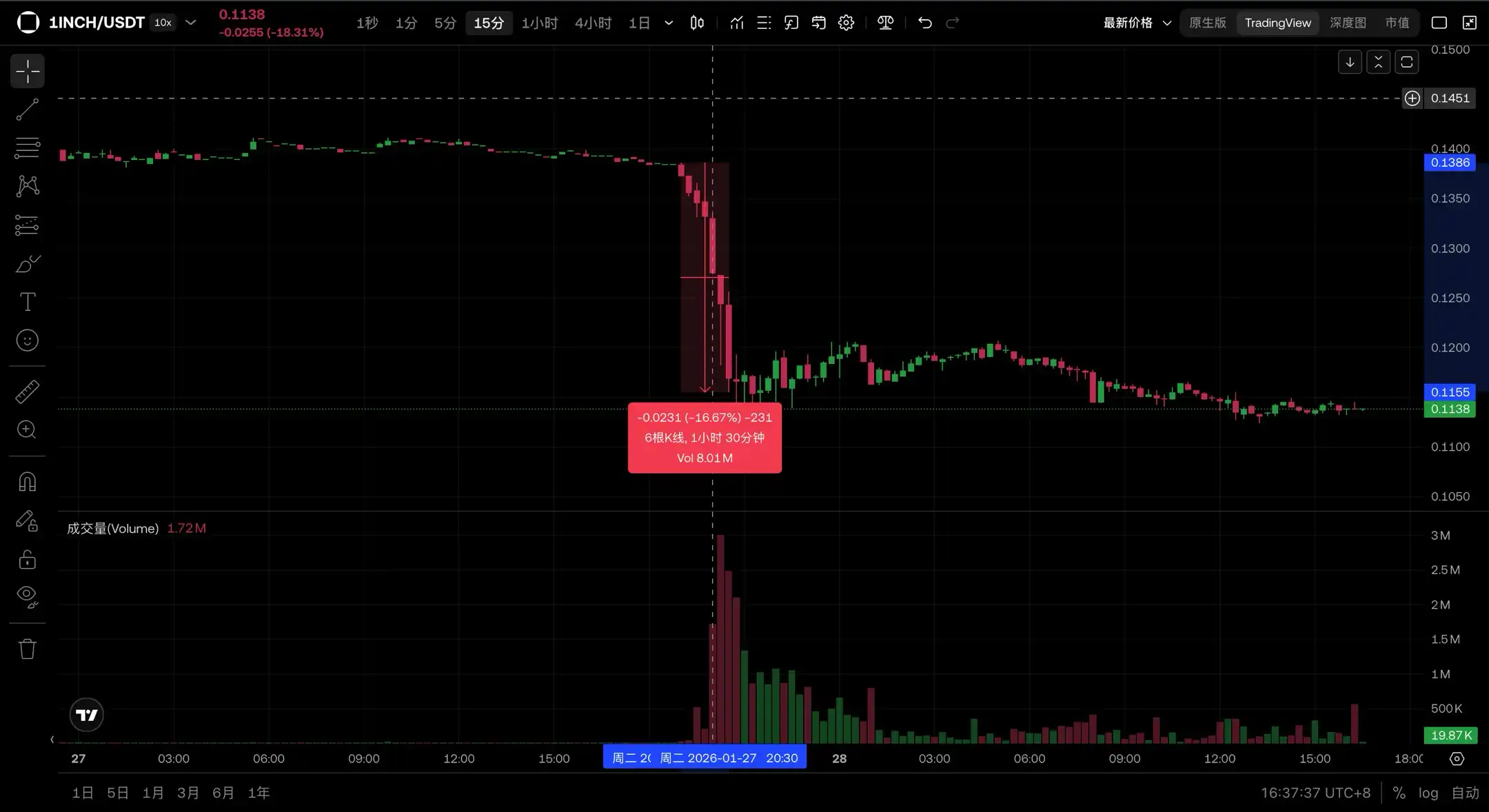
Recently, the on-chain data platform ARKHAM showed that three wallets marked as "1inch team" sold a total of 36.36 million 1INCH tokens, worth $5.04 million. According to OKX market data, affected by this, the price of 1INCH briefly fell by 16.7% to $0.1155, currently reported at $0.1164. A question quickly arose in the market: Is the project team really dumping the tokens themselves?

Looking at this sale alone, the outcome was not ideal. On-chain data shows that the above 1INCH tokens were mainly transferred to the relevant addresses in late November 2024. Based on the price at that time, the cost was approximately $0.42, corresponding to a total value of about $15.27 million. Before this sale, the price of 1INCH had already fallen to around $0.14. Combined with the slippage impact due to the large volume of the sale, the actual loss for this batch of positions may exceed $10 million.
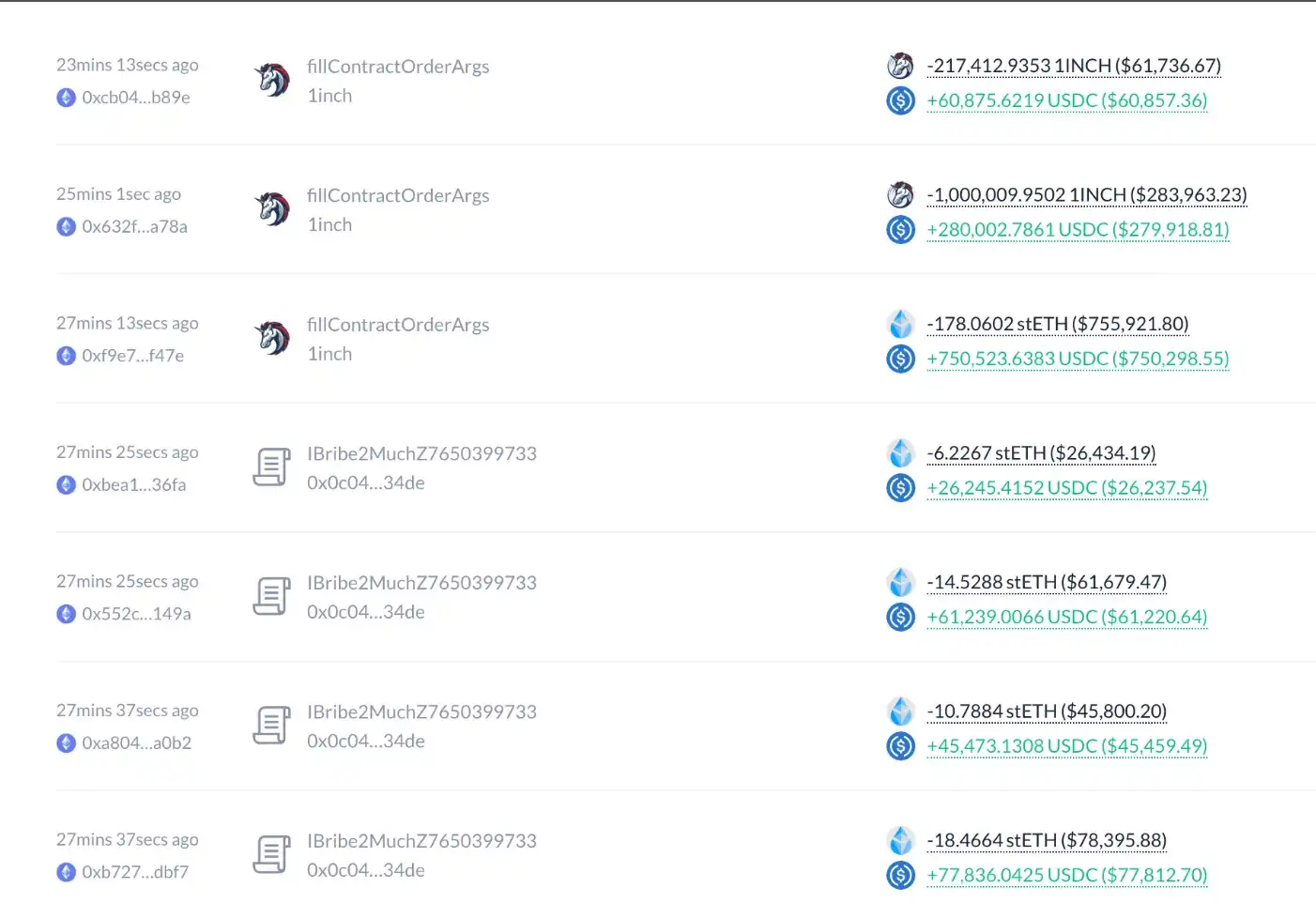
Reference: 1inch Team's Previous Trading Style

Previously, the on-chain operations of the 1inch team investment fund during multiple market fluctuations were regarded by the market as the presence of a "professional trading team."

As early as February to April, the 1inch team investment fund had already begun accumulating 1INCH at low levels. At that time, market sentiment had not yet recovered, and 1INCH had been lingering around $0.2. During this phase, the team invested a total of approximately $6.648 million to buy 33.19 million 1INCH tokens, with an average entry price of about $0.2.

However, this round of buying did not cause significant price fluctuations. What really caught the market's attention was the concentrated buying in early July. From July 6 to 9, the 1inch team investment fund made another move, investing an additional $4.4 million in just a few days to buy 22.99 million 1INCH tokens. As buying continued, the price of 1INCH rose from around $0.18 to $0.206, a short-term increase of about 14%. During this period, the team transferred 3 million USDC to Binance and withdrew 1INCH in batches to their own addresses. The funds were not used all at once, possibly waiting for opportunities, and continued buying.

After July 10, the pace of operations noticeably accelerated. On the afternoon of July 10, the team bought another 4.12 million 1INCH tokens for about $880,000, while also transferring 2 million USDT to Binance to prepare ammunition for subsequent trades. On the evening of July 11, on-chain monitoring showed that the team likely bought another 11.81 million 1INCH tokens at a higher price range, around $0.28. By this point, the address's holdings had increased to 83.97 million 1INCH tokens, with a book value exceeding $23 million. On July 13, the team continued to withdraw 6.334 million 1INCH tokens from Binance.

Looking back to early February, the 1inch team investment fund had cumulatively invested about $13.64 million since the beginning of the year to buy 55.85 million 1INCH tokens, with a comprehensive cost of about $0.244. With the price of 1INCH rising to above $0.39 in mid-July, these positions had already generated paper profits of several million dollars.

It is worth noting that the team was not "only buying and not selling." On the evening of July 13, they began to realize profits on a small scale, selling about 904,000 1INCH tokens at $0.33, exchanging them for $298,000; and in earlier stages, they had already sold some 1INCH tokens in batches at around $0.28.

At the same time, the team also took profits on another important position: ETH, which was bought in February at an average price of $2,577, began to be sold in batches above $4,200, with the ETH position alone realizing profits of millions of dollars.

On August 11, according to on-chain analyst Yu Jin's monitoring, the 1inch team investment fund began to realize some of its earlier positions on-chain. Data showed that they sold 5,000 ETH at an average price of $4,215, exchanging them for 21.07 million USDC; simultaneously, they sold 6.45 million 1INCH tokens at an average price of $0.28, exchanging them for about $1.8 million USDC.

Based on the entry costs, the above ETH was bought by the 1inch team in February this year at an average price of about $2,577; the corresponding 1INCH was mainly accumulated in July, with a comprehensive cost of about $0.253. Based solely on the sold ETH and 1INCH positions, the 1inch team investment fund has realized paper profits of about $8.36 million.
Looking further back, the 1inch team's operational path on BTC is equally clear: "buying against the trend, selling with the trend." During February to March this year, they bought 160.8 WBTC at an average price of about $88,000 during a BTC correction, and completed the sale when BTC approached the $100,000 mark again in May, realizing a total profit of nearly $1 million.

Combining the clues of BTC, ETH, and 1INCH assets, the on-chain operations of the 1inch team investment fund resemble a well-rehearsed capital strategy: completing accumulation during market adjustments, continuously adding positions during the upward trend, and realizing profits in batches when prices enter high ranges.

But This Time, Was It Really Them Operating?

It should be pointed out that comparing this large sale near $0.14 with the past on-chain operations of the 1inch team investment fund reveals: if this sale was indeed directly led by the team, its execution method itself significantly deviates from its past trading logic. Whether in historical operations of BTC, ETH, or 1INCH, the team's more common practice was to realize profits in batches after the price trend was confirmed, rather than selling concentratedly in an obvious low-liquidity range.

For this reason, some market participants began to question: did this selling behavior marked as "1inch team" really come from the team or wallets directly controlled by them.

Subsequently, 1inch official also responded to the related controversy. In a statement, they clearly stated that this selling behavior did not occur in any wallet controlled by the 1inch team, entity, or treasury multi-signature, and the team cannot interfere with the asset allocation and trading decisions of third-party holders.

In other words, the association indicated by on-chain labels does not equate to actual control. Judging from the execution rhythm and price range, this sale is more likely to come from a third-party holder who is no longer under the project's control, rather than a shift in the 1inch team's own trading logic.

In a stage of inherently limited liquidity, a single large sale being quickly equated to "team dumping" is itself an overly compressed interpretation of information. It ignores the natural disconnect between address labels and actual control rights after long-term token circulation.

Returning to 1inch itself. The official statement emphasized that this market fluctuation did not change its core business and long-term direction. Since 2019, 1inch has accumulated a trading volume of nearly $800 billion, and even during market downturns, it can maintain a daily trading scale of hundreds of millions of dollars. The team also stated that it plans to review the token economic model this year to improve overall resilience during periods of low liquidity and downturns. In this context, the discussion around "whether the 1inch team dumped tokens" is more like a misinterpretation amplified by on-chain labels, liquidity environment, and emotional interpretation.

However, even if it is eventually proven to be a misinterpretation, this sale still constituted a secondary impact on the already weakening price of 1INCH. Since the last cycle high of $6, 1INCH has experienced a long-term unilateral decline and is now hovering near $0.11.
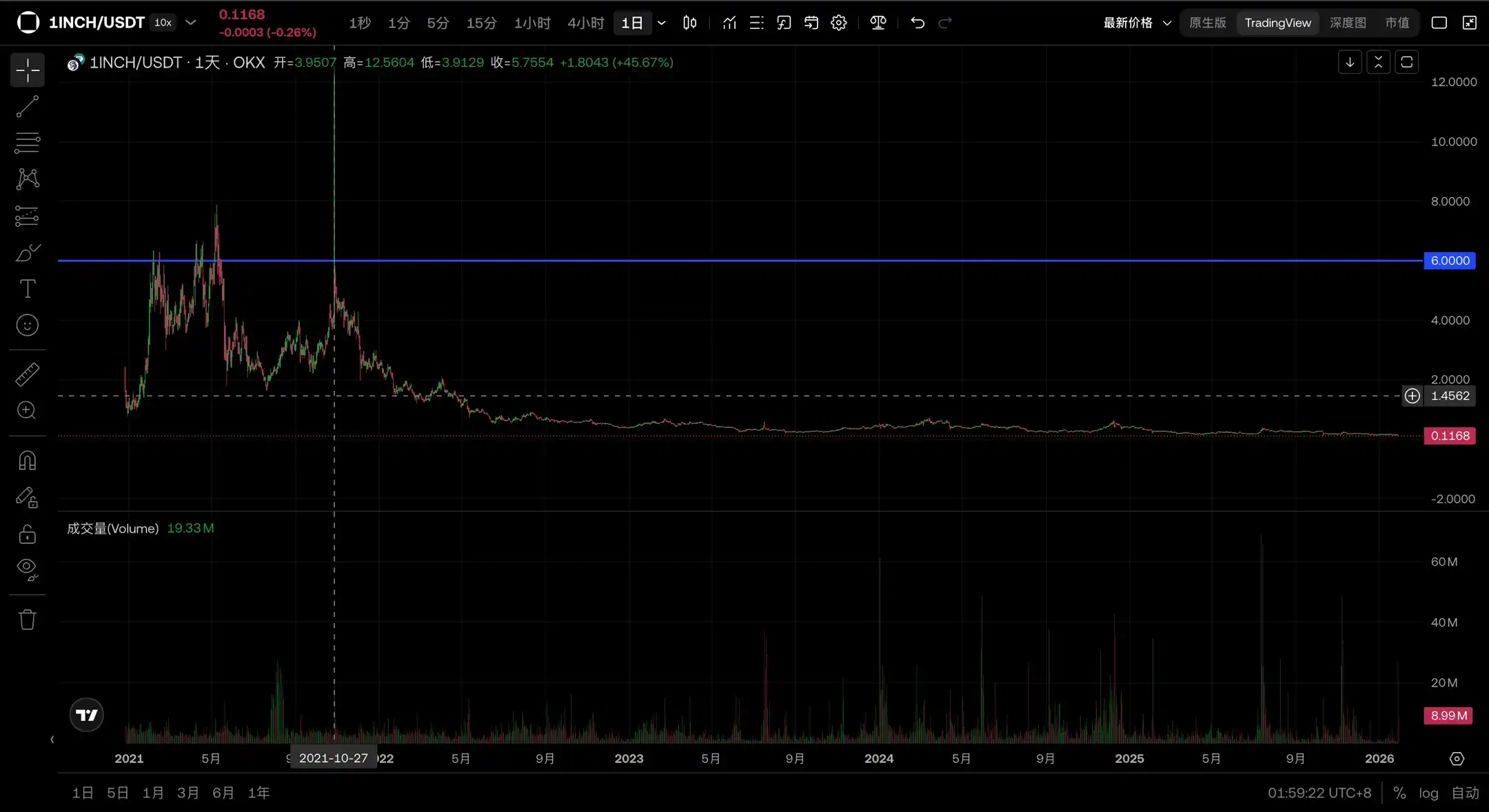
On such a trend, the market clearly no longer has enough buffer space to digest any sudden selling signals. This type of amplified selling event ultimately bears the brunt of emotional impact on the weakest end of risk tolerance—retail investors.


Perguntas relacionadas

QWhat was the recent event that sparked criticism towards the 1inch team, according to the article?

AThree wallets labeled as '1inch team' sold 36.36 million 1INCH tokens, worth $5.04 million, causing the token's price to drop by 16.7%.

QHow does the recent large sell-off at $0.14 contradict the 1inch team's historical trading strategy as described in the article?

AThe team's historical strategy was to accumulate during market adjustments, add positions during rallies, and take profits in batches at higher price ranges. The recent sell-off at a low liquidity price point of $0.14 deviates from this logic of selling after a confirmed uptrend.

QWhat was the official response from 1inch team regarding the sell-off incident?

AThe 1inch team stated that the selling did not occur from any wallet controlled by the 1inch team, entity, or treasury multisig, and that they cannot interfere with the asset allocation and trading decisions of third-party holders.

QWhat key point does the article make about the relationship between on-chain labels and actual control of wallets?

AThe article emphasizes that an on-chain label indicating an association does not equate to actual control. The sell-off was likely from a third-party holder, not the team itself.

QWhat is the long-term price trend for the 1INCH token mentioned in the article?

AThe 1INCH token has been in a long-term downtrend since its previous cycle high of $6 and was trading around $0.11 at the time of the article.

Leituras Relacionadas

US Stocks Suffer Worst Plunge Since 2025: Three Triggers Ignite Tech Stock Valuation Reset

The US stock market experienced its most severe sell-off since the 2025 tariff crisis on June 5th, 2025. The Nasdaq Composite plummeted 4.18%, the S&P 500 fell 2.64%, and the Dow Jones dropped 695 points. The panic stemmed from three converging factors. First, Broadcom's earnings report ignited fears of a slowdown in AI growth. While its AI chip revenue surged 143% YoY to $10.8B, its Q3 AI revenue guidance of $16B fell short of the $17.2B consensus. This triggered a massive sector-wide sell-off, with the Philadelphia Semiconductor Index crashing 10.26% and semiconductor stocks losing roughly $1.3 trillion in market value in a single day. Second, a shockingly strong May jobs report crushed hopes for Federal Reserve rate cuts. Non-farm payrolls added 172,000 jobs, doubling expectations. This robust data, combined with persistently high oil prices above $92/barrel due to the ongoing Iran war and blockade of the Strait of Hormuz, drastically increased market expectations for a potential Fed rate hike instead of a cut. Higher interest rates compress the valuations of growth-heavy tech stocks. Third, the prolonged Iran conflict continues to fuel inflationary pressures, complicating the Fed's policy decisions and undermining the "inflation is tamed" narrative. Together, these events challenged the twin pillars of the market rally: the "limitless AI growth" story and expectations for imminent monetary easing. The sell-off spread globally, impacting Asian and European markets and cryptocurrencies. The article posits this is likely a severe "valuation repricing" rather than the end of the AI story. The underlying demand for AI remains strong, but investor expectations for growth speed and the prices they are willing to pay are being recalibrated. Key upcoming factors include the June FOMC meeting, future AI company earnings, and developments in the Iran conflict.

marsbitHá 2h

US Stocks Suffer Worst Plunge Since 2025: Three Triggers Ignite Tech Stock Valuation Reset

marsbitHá 2h

From Madison Square Garden to Kalshi: Prediction Markets Break into the NBA Finals

From Madison Square Garden to Kalshi: Prediction Markets Break into the NBA Finals Prediction markets are playing a significant role in the 2026 NBA Finals, particularly around the New York Knicks' unexpected 2-0 series lead. Platforms like Kalshi and Polymarket have seen massive trading volumes, exceeding hundreds of millions of dollars on championship and related markets. Their influence extends beyond online trading. Kalshi's official partnership with Madison Square Garden has given it prominent physical branding at the arena. Furthermore, local businesses like The Jeffrey bar are using prediction market contracts to hedge the risk of game-result-based promotions, turning potential losses into manageable costs—a concept similar to the famous "Mattress Mack" strategy from traditional sports betting. These markets differentiate themselves by offering a wider, more entertainment-focused range of "event contracts" beyond typical game outcomes, such as predicting celebrity attendance. They also have broader accessibility across the U.S. compared to age- and location-restricted traditional sportsbooks. However, their rapid integration into sports raises regulatory and ethical questions. The NBA is cautiously engaging, discussing integrity frameworks with regulators like the CFTC. While the league permits minor investments like Giannis Antetokounmpo's stake in Kalshi, it advocates for strict rules to prevent insider trading. Many fans express concern on platforms like Reddit, fearing that the close ties between prediction markets, the league, and players could compromise the game's integrity. The NBA Finals has thus become a high-stakes testing ground, showcasing prediction markets' commercial potential while challenging traditional boundaries between financial trading, entertainment, and gambling.

marsbitHá 4h

From Madison Square Garden to Kalshi: Prediction Markets Break into the NBA Finals

marsbitHá 4h

Recursive Self-Improvement AI Gains Traction, Google Pours Cold Water, While DeepSeek and Others Approach the Fringes

The term "recursive self-improvement" (RSI), where AI improves itself autonomously, is gaining momentum in the AI industry. Startups like Recursive Superintelligence and projects such as Andrej Karpathy's Auto-Research aim to create systems where AI designs, implements, and validates its own research, moving toward superintelligence. While Google CEO Sundar Pichai cautions that such exponential acceleration is not yet a reality, progress is evident. For instance, Anthropic reported its Claude Code writes nearly 100% of the team's code, though it still lacks true self-direction. Analysts frame RSI development in stages: "adequacy" (systems functioning without humans), "parity" (matching human research quality), and "supremacy" (exceeding human-AI collaboration). Reaching parity could trigger rapid, unpredictable advancement due to AI's continuous operation. In China, companies like DeepSeek and Baidu incorporate self-optimization techniques without explicitly branding them as RSI, focusing on algorithmic efficiency and reinforcement learning. However, challenges remain, including "model collapse" from training on AI-generated data and the immense computational and open-collaboration requirements. Ultimately, RSI represents a trend of increasing automation in AI development, potentially reducing human oversight in the creation process itself.

marsbitHá 4h

Recursive Self-Improvement AI Gains Traction, Google Pours Cold Water, While DeepSeek and Others Approach the Fringes

marsbitHá 4h

Trading

Spot
Futuros

Artigos em Destaque

Como comprar 1INCH

Bem-vindo à HTX.com!Tornámos a compra de 1inch (1INCH) simples e conveniente.Segue o nosso guia passo a passo para iniciar a tua jornada no mundo das criptos.Passo 1: cria a tua conta HTXUtiliza o teu e-mail ou número de telefone para te inscreveres numa conta gratuita na HTX.Desfruta de um processo de inscrição sem complicações e desbloqueia todas as funcionalidades.Obter a minha contaPasso 2: vai para Comprar Cripto e escolhe o teu método de pagamentoCartão de crédito/débito: usa o teu visa ou mastercard para comprar 1inch (1INCH) instantaneamente.Saldo: usa os fundos da tua conta HTX para transacionar sem problemas.Terceiros: adicionamos métodos de pagamento populares, como Google Pay e Apple Pay, para aumentar a conveniência.P2P: transaciona diretamente com outros utilizadores na HTX.Mercado de balcão (OTC): oferecemos serviços personalizados e taxas de câmbio competitivas para os traders.Passo 3: armazena teu 1inch (1INCH)Depois de comprar o teu 1inch (1INCH), armazena-o na tua conta HTX.Alternativamente, podes enviá-lo para outro lugar através de transferência blockchain ou usá-lo para transacionar outras criptomoedas.Passo 4: transaciona 1inch (1INCH)Transaciona facilmente 1inch (1INCH) no mercado à vista da HTX.Acede simplesmente à tua conta, seleciona o teu par de trading, executa as tuas transações e monitoriza em tempo real.Oferecemos uma experiência de fácil utilização tanto para principiantes como para traders experientes.

200 Visualizações TotaisPublicado em {updateTime}Atualizado em 2026.06.02

Como comprar 1INCH

Discussões

Bem-vindo à Comunidade HTX. Aqui, pode manter-se informado sobre os mais recentes desenvolvimentos da plataforma e obter acesso a análises profissionais de mercado. As opiniões dos utilizadores sobre o preço de 1INCH (1INCH) são apresentadas abaixo.

活动图片