This report is written by Tiger Research. The drastic changes in X platform's API policy have led to the instantaneous collapse of the InfoFi ecosystem. As a leading project in the industry, if I were the founder of Kaito, what viable transformation paths are available at this juncture?
Core Insights
- Ecosystem Collapse in Three Days: X platform's policy adjustments destroyed the InfoFi ecosystem in just three days, fully exposing the structural fragility of Web3 projects' over-reliance on centralized platforms.
- Five Survival Paths: InfoFi projects currently face five choices: complete shutdown, transformation into a bounty funding platform, adoption of a Korean-style sponsorship model, multi-platform expansion, or evolution into a KOL management model akin to an MCN.
- Evolution of InfoFi 2.0: The future model will be more refined and controllable, shifting from "permissionless scaling" to "curated high-quality collaboration."
- Fundamental Challenge: Establishing a fair incentive compensation system and re-proving the intrinsic value of tokens remain chasms the industry must cross.
1. The "Collapse" of InfoFi in Three Days
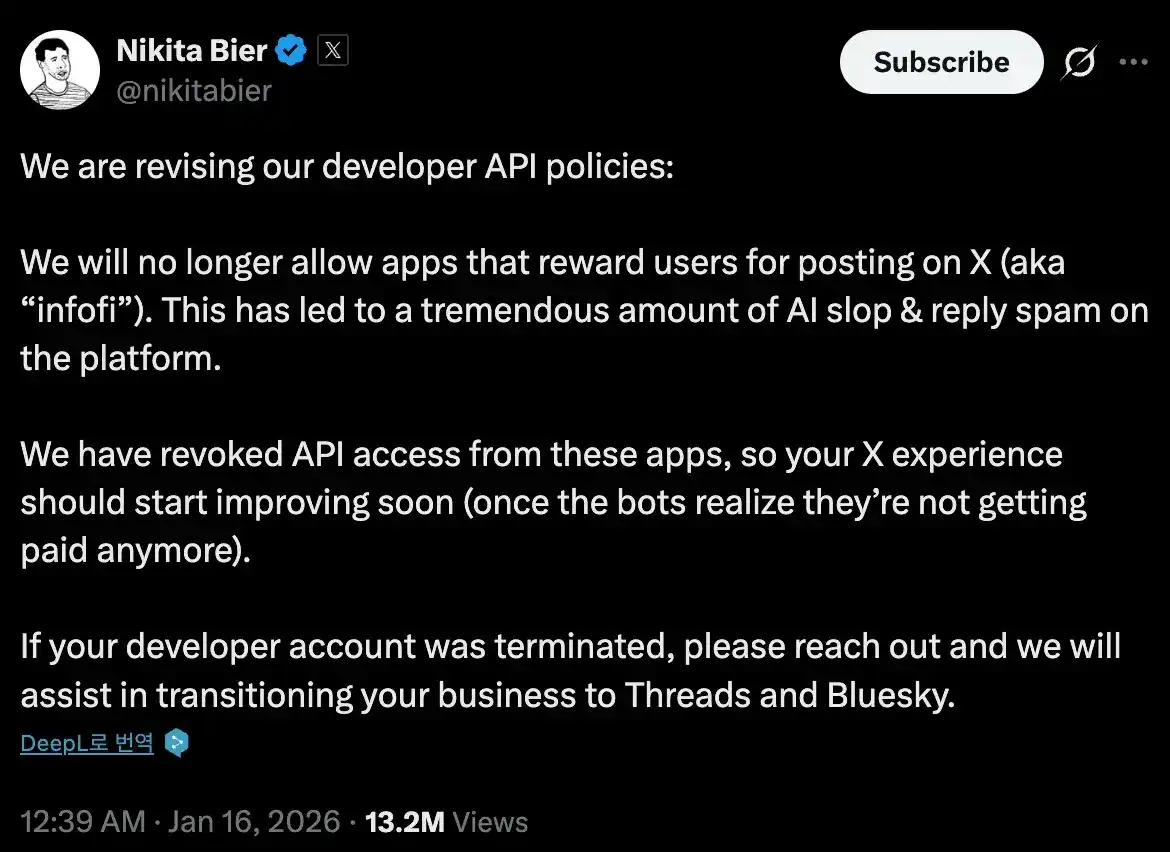
Source: X(@nikitabier)
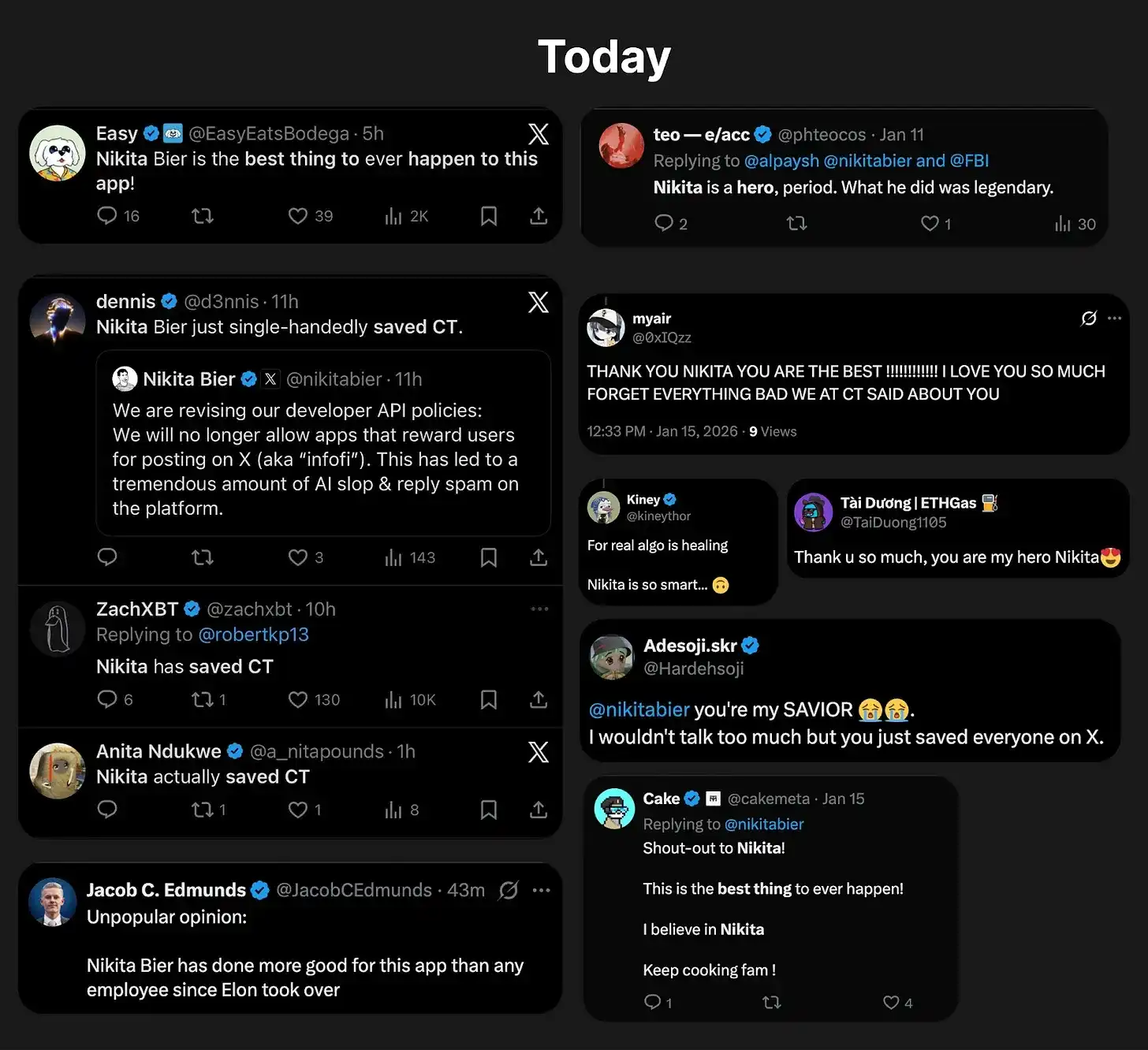
On January 15th, X platform's Product Lead, Nikita Bier, published a brief announcement stating that applications incentivizing user posts with rewards would no longer be permitted to operate on the platform. For the InfoFi sector, this was tantamount to a "death sentence."
According to the timeline disclosed by Kaito founder Yu Hu, the events unfolded as follows:
- January 13th: Kaito received an email from X platform hinting at a potential review and requesting clarification.
- January 14th: X platform sent a formal legal notice, to which Kaito submitted a legal response the same day.
- January 15th: The official statement was publicly released, and Kaito, along with the entire industry, learned of the final decision simultaneously.
The market reaction was extremely severe, with the $KAITO price plummeting. The community accused the team of failing to provide an early warning, despite claiming to have contingency plans. Kaito subsequently issued an emergency statement explaining that they had previously resolved similar disputes through legal channels multiple times, leading to a misjudgment of the negotiation room in this incident.
Lesson: A single decision by a centralized company ended an emerging Web3 category in just three days. This reality, where the "power of life and death" lies in the hands of others, is suffocating the entire ecosystem.
2. If I Were an InfoFi Founder Now
Does this mean InfoFi has reached a dead end? Projects like Kaito are already preparing their next development plans. However, what is needed now is not a continuation of the old path but a completely different "InfoFi 2.0" version.
If I were the founder of an InfoFi project like Kaito, what practical choices are actually available now? By examining these potential forward paths, we can begin to outline the contours of InfoFi's next phase.
2.1 Complete Shutdown
This is the simplest and most direct option: cease operations before funds are completely exhausted. In reality, many small and medium-sized projects may enter a "zombie phase"—largely inactive, occasionally posting some social media updates, and gradually fading from public view.
Since the previously established "Product-Market Fit" (PMF) around the X platform has now vanished, choosing to shut down might be more realistic than continuously burning cash in search of an elusive new direction. If the project still holds usable data assets, these could be sold to other companies to recover some residual value. Therefore, most smaller InfoFi projects will likely choose this path.
2.2 Bounty-Based Funding Platform
If access to X's API is no longer possible, another option is to revert to an earlier business model: KOLs directly apply for relevant activities, submit content for manual review, and receive rewards upon approval.
Source: Scribble
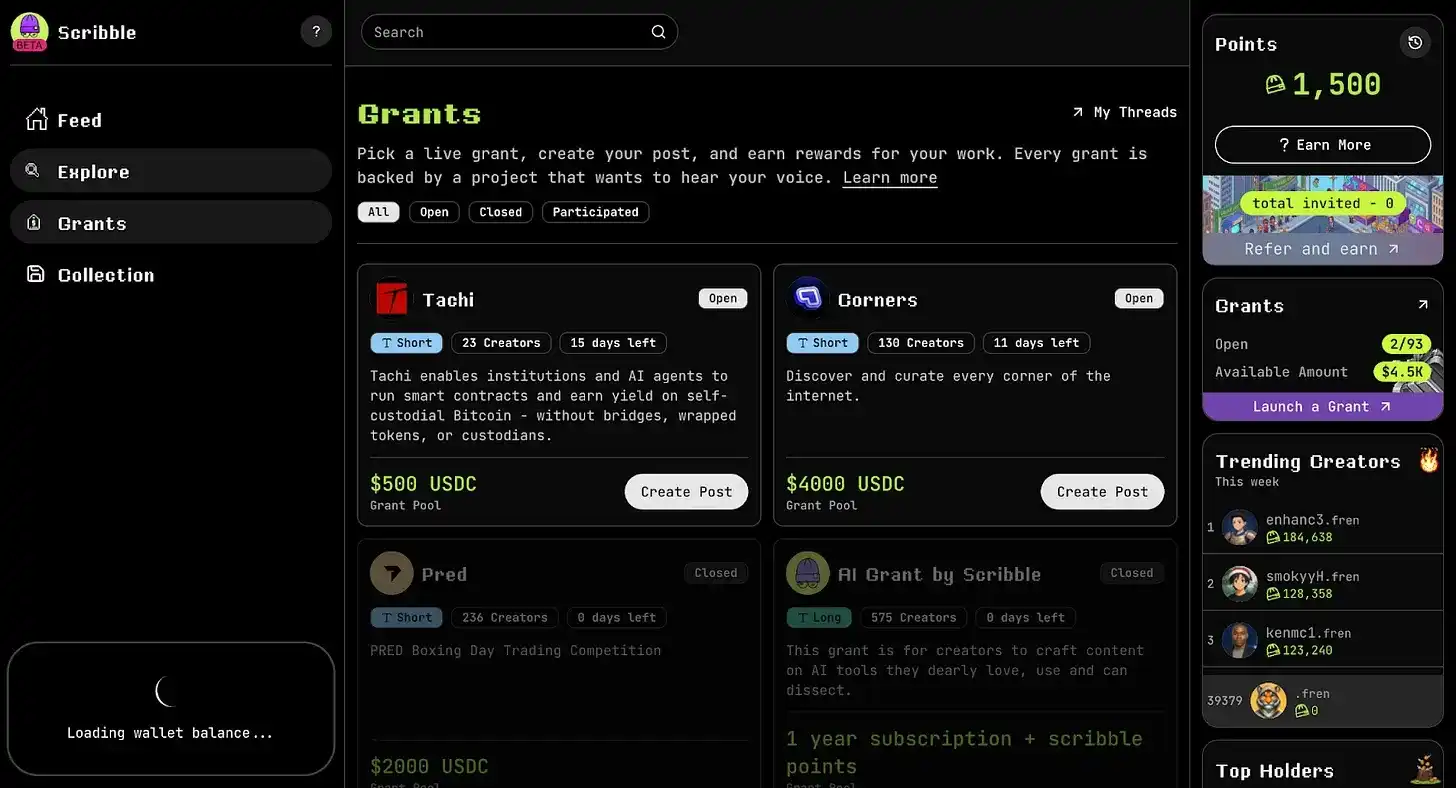
The model represented by Scribble is a typical example. Project parties post funding tasks in the form of bounties, KOLs create and submit content for platform review, and receive payment upon approval. This is a "submit first, review later" model, rather than relying on real-time API tracking.
This structure can be scaled as an open platform: the platform merely provides matching intermediation and infrastructure, while individual project parties manage their own campaigns. As more projects participate, the KOL pool expands accordingly; the growth of the KOL base, in turn, offers more choices for project parties. The drawback is the significant uncertainty for KOLs—if submitted content is rejected, the time and effort invested are wasted. After multiple failures, high-quality KOLs are likely to leave the platform.
2.3 Korean-Style Sponsored Blog Model
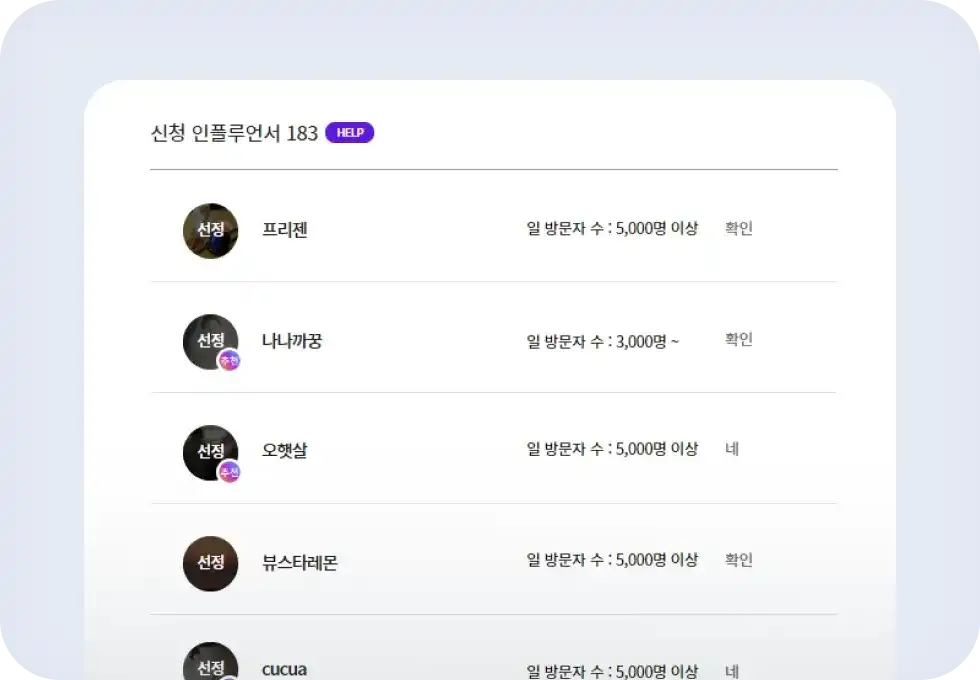
The Korean sponsored blog model follows a "select first, manage later" approach, rather than post-hoc review. Agencies like Revu have used this model for over a decade.
The process is very clear: the project party sets the target number of participants and launches a campaign, applicants submit their applications, and the project party selects suitable KOLs based on data like follower count and past performance. Selected KOLs receive clear creation guidelines, and after content is published, it is reviewed by operational staff. If it doesn't meet standards, revisions are requested; if deadlines are missed, corresponding penalties are applied.
In this model, KOLs can effectively avoid futile efforts. Once selected,报酬 is basically guaranteed as long as guidelines are followed. Unlike bounty-based systems, there is no risk of completing work only to be unreasonably rejected. From the project party's perspective, quality control becomes easier since only pre-vetted participants are chosen.
2.4 Multi-Platform Expansion
If X platform is no longer fertile ground, the next choice is inevitably to pivot to YouTube, TikTok, and Instagram. In the Web3 space, there is already a strong push to move beyond the X platform. The prevailing view is that real growth requires shifting from platforms dominated by crypto-native users to mainstream channels with a broader audience.
The main advantage of this path is a much larger potential user base than X platform, especially in emerging markets like Southeast Asia and Latin America, where TikTok and Instagram hold significant influence. Additionally, each platform runs on different algorithms, so even if one channel is restricted, overall operations can continue.
However, the trade-off is a dramatic increase in operational complexity. On X platform, reviewing text-based posts was usually sufficient; on YouTube, content length and production quality are paramount; on TikTok, the first three seconds of a video determine its performance; and on Instagram, the execution of Stories and format quality must be evaluated. This requires platform-specific expertise and may necessitate developing entirely new internal tools. Given the vastly different API policies and data collection methods across platforms, this is practically equivalent to rebuilding the entire project from scratch. Furthermore, policy risks still loom—any platform could change its rules abruptly, just like X did. However, dispersing activities across multiple platforms does significantly reduce reliance on any single one and is the only option that offers substantive scalability for larger projects.
2.5 MCN-Style KOL Management
In the Web2 MCN (Multi-Channel Network) model, the brand value of KOLs is crucial. In Web3, this influence is even more decisive: narratives drive capital, and a single comment from an opinion leader can directly impact token prices.
Successful InfoFi projects have typically cultivated an active and highly loyal group of KOLs, creators who have grown through months of deep engagement on the platform. The project party could retain this group and pivot them towards a data-driven management model, rather than starting from scratch to find creators. This differs from traditional Web2 MCNs that rely on continuously discovering new talent.
An MCN-style structure implies establishing formal contractual relationships, rather than loose, selective participation. With accumulated historical data and established relationships, the platform can wield stronger influence within the Web3 ecosystem and negotiate better business deals. For InfoFi projects, this requires a robust management system, with data becoming the core asset. If KOLs can be precisely guided through data, and project parties are provided with professional, data-driven GTM (Go-To-Market) strategies, this model will offer a lasting competitive advantage.
3. InfoFi 2.0
This collapse of the InfoFi ecosystem has left two profound lessons for the Web3 world:
- The Irony of Decentralization: Many Web3 projects were deeply dependent on the centralized X platform, and a single decision by X was enough to destroy the entire system.
- The Limitations of Incentive Design: Reward mechanisms successfully attracted a large number of participants but lacked effective methods to control content quality. The flood of spam content gave X platform a clear reason to intervene.
Source: X(@nikitabier)
Does this mean the road for InfoFi has come to an end?
Not entirely. A minority of projects that found "Product-Market Fit" might survive by altering their business form. They could pivot to multi-platform expansion, curate premium campaigns, or transform into MCN-style management.
InfoFi 2.0 will likely become smaller in scale, more controllable, and more focused on content quality. It will shift from an open, permissionless platform to a rigorously vetted professional network, its form more closely resembling an integrated marketing platform that combines native GTM efforts and components like offline advertising.
However, fundamental questions remain on the table. Joel Mun from Tiger Research House points out: once incentive mechanisms are introduced, participants inevitably find ways to exploit system loopholes, making fair incentive structures extremely difficult to design. This speculative behavior leads to low-quality content and creates a negative feedback loop that can破坏 the platform.
Furthermore, researcher David raises a more essential question: he believes that the value maintenance of InfoFi tokens in the past relied more on staking airdrop expectations and belief in a certain narrative, rather than the platform's actual performance. Now, both have lost relevance. This leads to a direct question: why should investors buy InfoFi tokens in the future?
For InfoFi 2.0 to truly survive, these questions must be answered clearly and convincingly. If a project cannot align its interests with those of its token holders, it cannot achieve genuine sustainable development.
Original article link