InfoFi Narrative Collapses, Kaito, Cookie, and Others Shut Down Related Products

marsbitPublished on 2026-01-15Last updated on 2026-01-15

Abstract

The InfoFi narrative, which gained significant traction in the crypto industry, experienced a sudden collapse following an announcement by X's product lead, Nikita Bier, regarding changes to the platform’s API policy. The new policy prohibits applications that reward users for posting on X, citing concerns over AI-generated spam and low-quality replies. This decision effectively undermines the core functionality of many InfoFi projects that rely on X’s API to access user data and distribute tokenized rewards. Key projects, Kaito and Cookie, quickly responded to the policy shift. Kaito announced it would pivot toward Kaito Studio, a more selective, brand-driven platform that moves beyond the crypto space. Its founder, Yu Hu, emphasized a broader focus beyond cryptocurrency. Similarly, Cookie decided to shut down its Snaps platform but is developing Cookie Pro, a real-time crypto market intelligence tool, while exploring potential future adaptations in line with X’s guidelines. The abrupt policy change highlights the vulnerability of InfoFi models that depend heavily on-platform engagement metrics. While some projects, such as those focused on monetizing narratives rather than direct posting rewards, may remain unaffected, the incident marks a significant shift for the attention economy within crypto. The evolution of InfoFi may continue in new forms, but its current iteration has been severely disrupted.

Author: Gu Yu, ChainCatcher

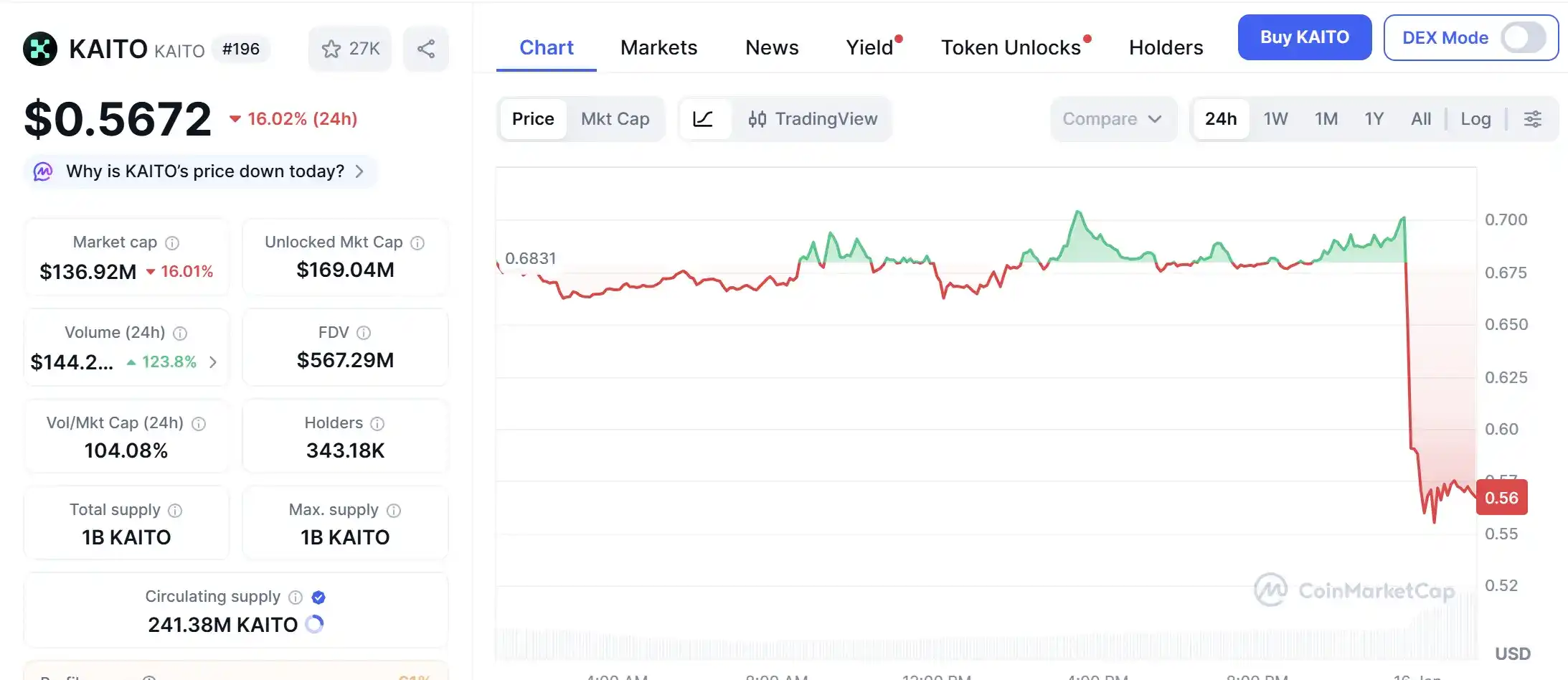
At 1:16 AM Beijing time on January 16, the crypto industry was once again as the highly popular InfoFi narrative suddenly collapsed. Kaito, Cookie, and others successively announced the shutdown of InfoFi-related products and attempted to pivot, with their token prices plummeting by nearly 20% at one point.
And this was all triggered by a tweet from X Product Lead Nikita Bier. Nikita Bier stated that the team is revising its developer API policy and will no longer allow any applications that reward users for posting on the X platform (e.g., "infofi"). This has led to the platform being flooded with a large amount of AI spam and reply spam.

"We have revoked the API access for these applications, so your X experience should start to improve soon (once the bots realize they are no longer being paid)." Nikita Bier said.

Since most InfoFi projects rely on the X product API to obtain user tweet data and determine reward schemes, once the API is disabled, the vast majority of content for such products will stop updating, losing their foundation.

An hour after the news was released, projects like Kaito and Cookie quickly issued response statements on their official Twitter accounts, showing that they had anticipated and prepared for this situation. Let's first see how they specifically responded.

Kaito: To Focus More on Areas Beyond Crypto

Kaito stated that in response to the large number of spam tweets, the project tried stricter eligibility reviews, higher leaderboard thresholds, social + on-chain screening mechanisms, and different incentive mechanisms. However, due to platform-wide X algorithm changes and the launch of other InfoFi projects with varying thresholds, the problem of low-quality and spam information remains widespread across the cryptocurrency field.

After discussions with the X team, both parties agreed that a completely permissionless distribution system is no longer feasible and does not meet the needs of high-quality brands, serious content creators, or X as a platform.

Next, Kaito will focus on launching Kaito Studio, which will be closer to a traditional tiered marketing platform where brands can selectively collaborate with creators based on established criteria and clear project scopes.

Kaito founder Yu Hu said that the past few months have been busy with the development of Kaito Studio, hence the low profile on social media and announcements, with little mention of project construction and strategic adjustments. Additionally, he personally met with some large brands outside the cryptocurrency field to learn from the successful experiences of traditional industry.

"We should no longer build and create for cryptocurrency, but for the broader world." Yu Hu believes that 2026 will be the year Kaito transcends CT as its main platform and cryptocurrency as its primary vertical.

Cookie: To Launch Real-Time Crypto Market Wallet Tool

Cookie posted that deciding to shut down the Snaps platform and all active creator campaigns was a difficult and sudden decision, but it was necessary to maintain the integrity of the Cookie data layer and products.

After discussions with the X team regarding its API and X usage policies, Cookie decided to immediately shut down Snaps and all ongoing activities.

However, the project still holds hope for the future of the Snaps product. "Currently, we are actively negotiating with X to determine if Snaps can continue to operate in a new form." Cookie believes, "We have always firmly believed that we fully comply with all of X's rules and policies. We will await confirmation and guidance from X on whether creator activities (such as Snaps) can operate in any form in the future."

At the same time, Cookie also proposed future product iteration plans, "For the past six months, we have been developing Cookie Pro—a real-time market intelligence tool for the cryptocurrency field, planned for official launch in the first quarter."

Has InfoFi Fallen?

It is undeniable that InfoFi has brought much vitality and change to the industry in recent years. It combines information and finance, creating a mechanism that evaluates user contributions based on the attention generated by their content (e.g., views, comments, and shares) and links it to token rewards.

In essence, InfoFi transforms attention from an abstract concept into quantifiable and tradable data. User participation shifts from simple content consumption to productive activity, and projects can more targetedly provide rewards to their content contributors.

However, when attention becomes the standard for rewards, the purpose of creating content now shifts from providing information or encouraging meaningful engagement to merely seeking rewards. And generative AI makes content creation easier, leading to the rapid spread of bulk content lacking real information or insight.

Several key members of the X team have mentioned the decline in Twitter content quality brought by InfoFi, so projects like Kaito have tried to optimize their algorithmic solutions, but never expected X to directly block this path from its foundation.

It is worth noting, however, that not all InfoFi projects incentivize users to post for rewards. For example, projects like xHunt and Ethos that rely on the X API primarily use the API to obtain tweet data for scoring and other operations. The impact of this X API policy adjustment on these projects is not yet known and requires further observation.

Additionally, some types of InfoFi projects mainly focus on the monetization of industry hotspot narratives, such as Noise and Narrative, and are expected to be largely unaffected.

Now that the InfoFi narrative has quickly collapsed, the attention economy and creator economy remain key focuses of the entire internet industry. In the future, InfoFi may reappear in front of the public in new forms and concepts.


Related Questions

QWhat major event led to the collapse of the InfoFi narrative and the shutdown of products like Kaito and Cookie?

AThe collapse was triggered by X's product lead Nikita Bier announcing a revision to the developer API policy, which no longer allows applications that reward users for posting on X (such as 'infofi') due to the proliferation of AI-generated spam and low-quality replies.

QHow did Kaito respond to X's API policy change, and what is their new strategic direction?

AKaito responded by shifting focus to Kaito Studio, a more traditional graded marketing platform where brands can selectively collaborate with creators based on set criteria. They aim to expand beyond the cryptocurrency领域 and target broader industries.

QWhat product did Cookie announce it was developing after shutting down its Snaps platform?

ACookie announced it is developing 'Cookie Pro,' a real-time market intelligence tool for the cryptocurrency space, planned for launch in the first quarter.

QWhy did X decide to restrict API access for InfoFi applications according to the article?

AX restricted API access because InfoFi applications incentivized users to post content primarily for rewards, leading to an influx of low-quality, AI-generated spam that degraded the overall user experience on the platform.

QAre all types of InfoFi projects affected equally by X's API policy change, as per the article?

ANo, not all InfoFi projects are equally affected. Projects like xHunt and Ethos that use X API for data scoring may be impacted, while others like Noise and Narrative, which focus on monetizing industry narratives, are expected to remain largely unaffected.

Related Reads

Uncovering the Truth About Agent Commerce, Payments, and Infrastructure

Decoding Agent Commerce, Payments, and Infrastructure: The Reality Over the past year, I've been building infrastructure for the Agent economy, engaging with major players like Stripe, Visa, Coinbase, Google, and dozens of startups. A clear conclusion emerges: true, large-scale demand does not yet exist. Startups face structural challenges. Data points illustrate this gap. Stripe's Agent commerce platform has over 1,000 merchants but only single-digit transacting agents. Visa's Agent payment token requires 9-month KYC and a $250M revenue threshold, accessible only to giants like Amazon. On-chain analysis reveals actual daily Agent transaction volume is around $17k, half of which are test transactions. The article analyzes four potential markets: **1. Agent-to-Merchant (A2M):** Current AI shopping UX is often inferior to traditional e-commerce for visual, comparison-heavy purchases (clothing, electronics). Chat interfaces are a step back. Real merchant interest is defensive "Agent Engine Optimization," fearing future obsolescence, not current demand. Potential exists in high-frequency, low-decision purchases (e.g., food delivery) or simplifying terrible UX (complex checkouts, non-native shoppers), but these require massive consumer distribution channels dominated by giants like DoorDash and Amazon. **2. Agent-to-API (A2A):** Developers already have subscriptions and billing for core APIs (compute, data). The argument for micro-payments via crypto for sub-dollar API calls is addressed by pre-paid balances today. The deeper issue is supplier resistance; major SaaS firms rely on enterprise contracts, not fractional cent pricing. Opportunity lies in the long tail of niche services, but this is a smaller market catering to developers, a historically low-paying group. **3. Agent-to-Agent (A2A):** This remains a theoretical long-term vision with near-zero current transaction volume. It involves unique challenges: discovery, trust, negotiation, dispute resolution. When it materializes, it will require a fundamentally new settlement infrastructure for high-speed, variable-value, multi-party transactions. It's a real long-term bet, but not the current market. **4. Agent-to-Finance (A2F):** This is the only category with existing, paying demand. Integrating AI into financial workflows (trading, portfolio management) is a natural evolution and enables new capabilities like autonomous rebalancing. However, competition favors incumbents with regulatory licenses, compliance infrastructure, and existing client relationships. **The Real Issue:** Why is infrastructure still being built? Incumbents can afford long-term bets, and payment companies see every problem as a nail for their payment hammer. However, payment is just one piece. The core challenge is *coordination*—orchestrating work between Agents and humans, verifying outcomes, and settling results. Payment is part of settlement, which is part of coordination. Companies that solve the coordination problem will subsume payments, not the other way around. Startups lack the infinite runway of giants and must find today's real market, which, after a year of exploration, lies outside these four categories—in an area with real, growing, and underserved activity.

marsbit6m ago

Uncovering the Truth About Agent Commerce, Payments, and Infrastructure

marsbit6m ago

Kalshi, MTS, and a16z's Ambition

The article "Kalshi, MTS, and a16z's Ambition" explores prediction markets as a focal point of excitement in 2025 for investors, crypto enthusiasts, and media. It traces their intellectual lineage from Friedrich Hayek's ideas on dispersed knowledge and market coordination to Robin Hanson's Logarithmic Market Scoring Rule (LMSR), which incentivizes truthful information sharing. The piece argues that a16z's significant investment in prediction market platform Kalshi (valued at $220B) transcends mere financial speculation. a16z frames prediction markets as a new form of "media" that provides "presence"—a way for individuals to actively engage with and influence world events through financial stakes, countering postmodern detachment. By wagering on outcomes, users become "super observers," and the market's aggregated probabilities gain authoritative power to define event truth and importance. The article uses media company MTS ("Monitoring The Situation") as a case study of a16z's "new media" strategy: rapidly producing high-intensity, multi-format content to "take over the timeline." However, prediction markets like Kalshi are presented as the ultimate piece in this media empire. Their real-money, crowd-sourced probabilities possess a unique "reality distortion field" and perceived objectivity, potentially swaying public opinion and granting a private company unprecedented interpretive power over reality. Ultimately, Kalshi's immense valuation is attributed not just to its exchange model, but to its role as a foundational component in a16z's envisioned new media landscape, where prediction markets define narrative and truth.

链捕手7m ago

Kalshi, MTS, and a16z's Ambition

链捕手7m ago

US Stocks Suffer Worst Plunge Since 2025: Three Triggers Ignite Tech Stock Valuation Reset

The US stock market experienced its most severe sell-off since the 2025 tariff crisis on June 5th, 2025. The Nasdaq Composite plummeted 4.18%, the S&P 500 fell 2.64%, and the Dow Jones dropped 695 points. The panic stemmed from three converging factors. First, Broadcom's earnings report ignited fears of a slowdown in AI growth. While its AI chip revenue surged 143% YoY to $10.8B, its Q3 AI revenue guidance of $16B fell short of the $17.2B consensus. This triggered a massive sector-wide sell-off, with the Philadelphia Semiconductor Index crashing 10.26% and semiconductor stocks losing roughly $1.3 trillion in market value in a single day. Second, a shockingly strong May jobs report crushed hopes for Federal Reserve rate cuts. Non-farm payrolls added 172,000 jobs, doubling expectations. This robust data, combined with persistently high oil prices above $92/barrel due to the ongoing Iran war and blockade of the Strait of Hormuz, drastically increased market expectations for a potential Fed rate hike instead of a cut. Higher interest rates compress the valuations of growth-heavy tech stocks. Third, the prolonged Iran conflict continues to fuel inflationary pressures, complicating the Fed's policy decisions and undermining the "inflation is tamed" narrative. Together, these events challenged the twin pillars of the market rally: the "limitless AI growth" story and expectations for imminent monetary easing. The sell-off spread globally, impacting Asian and European markets and cryptocurrencies. The article posits this is likely a severe "valuation repricing" rather than the end of the AI story. The underlying demand for AI remains strong, but investor expectations for growth speed and the prices they are willing to pay are being recalibrated. Key upcoming factors include the June FOMC meeting, future AI company earnings, and developments in the Iran conflict.

marsbit4h ago

US Stocks Suffer Worst Plunge Since 2025: Three Triggers Ignite Tech Stock Valuation Reset

marsbit4h ago

From Madison Square Garden to Kalshi: Prediction Markets Break into the NBA Finals

From Madison Square Garden to Kalshi: Prediction Markets Break into the NBA Finals Prediction markets are playing a significant role in the 2026 NBA Finals, particularly around the New York Knicks' unexpected 2-0 series lead. Platforms like Kalshi and Polymarket have seen massive trading volumes, exceeding hundreds of millions of dollars on championship and related markets. Their influence extends beyond online trading. Kalshi's official partnership with Madison Square Garden has given it prominent physical branding at the arena. Furthermore, local businesses like The Jeffrey bar are using prediction market contracts to hedge the risk of game-result-based promotions, turning potential losses into manageable costs—a concept similar to the famous "Mattress Mack" strategy from traditional sports betting. These markets differentiate themselves by offering a wider, more entertainment-focused range of "event contracts" beyond typical game outcomes, such as predicting celebrity attendance. They also have broader accessibility across the U.S. compared to age- and location-restricted traditional sportsbooks. However, their rapid integration into sports raises regulatory and ethical questions. The NBA is cautiously engaging, discussing integrity frameworks with regulators like the CFTC. While the league permits minor investments like Giannis Antetokounmpo's stake in Kalshi, it advocates for strict rules to prevent insider trading. Many fans express concern on platforms like Reddit, fearing that the close ties between prediction markets, the league, and players could compromise the game's integrity. The NBA Finals has thus become a high-stakes testing ground, showcasing prediction markets' commercial potential while challenging traditional boundaries between financial trading, entertainment, and gambling.

marsbit6h ago

From Madison Square Garden to Kalshi: Prediction Markets Break into the NBA Finals

marsbit6h ago

Trading

Spot
Futures

Hot Articles

How to Buy COOKIE

Welcome to HTX.com! We've made purchasing Cookie DAO (COOKIE) simple and convenient. Follow our step-by-step guide to embark on your crypto journey.Step 1: Create Your HTX AccountUse your email or phone number to sign up for a free account on HTX. Experience a hassle-free registration journey and unlock all features.Get My AccountStep 2: Go to Buy Crypto and Choose Your Payment MethodCredit/Debit Card: Use your Visa or Mastercard to buy Cookie DAO (COOKIE) instantly.Balance: Use funds from your HTX account balance to trade seamlessly.Third Parties: We've added popular payment methods such as Google Pay and Apple Pay to enhance convenience.P2P: Trade directly with other users on HTX.Over-the-Counter (OTC): We offer tailor-made services and competitive exchange rates for traders.Step 3: Store Your Cookie DAO (COOKIE)After purchasing your Cookie DAO (COOKIE), store it in your HTX account. Alternatively, you can send it elsewhere via blockchain transfer or use it to trade other cryptocurrencies.Step 4: Trade Cookie DAO (COOKIE)Easily trade Cookie DAO (COOKIE) on HTX's spot market. Simply access your account, select your trading pair, execute your trades, and monitor in real-time. We offer a user-friendly experience for both beginners and seasoned traders.

3.4k Total ViewsPublished 2025.07.23Updated 2026.06.02

How to Buy COOKIE

Discussions

Welcome to the HTX Community. Here, you can stay informed about the latest platform developments and gain access to professional market insights. Users' opinions on the price of COOKIE (COOKIE) are presented below.

活动图片