Behind the Rejection of the $17M CRV Grant: Founder's Proposal Power Weakened, Convex and Yearn Become Key Players

marsbitPublished on 2025-12-25Last updated on 2025-12-25

Abstract

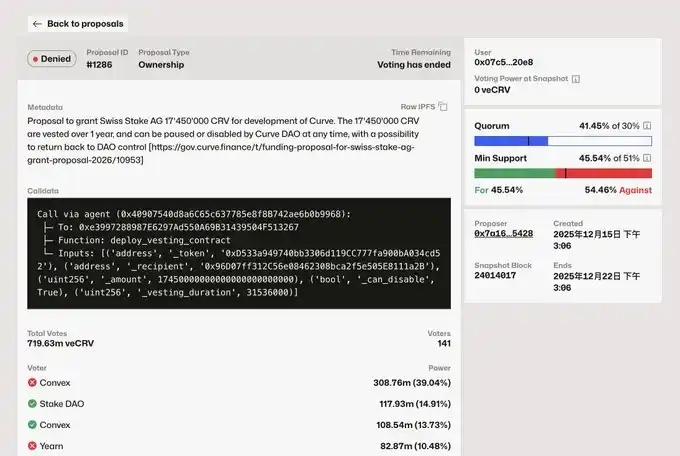
A proposal to grant 17 million CRV tokens (worth approximately $1.7 million) to Swiss Stake AG, a long-time core development team, was rejected in a Curve Finance governance vote. Major veCRV holders, including Convex and Yearn, voted against it, wielding enough voting power to determine the outcome. The rejection reflects two key shifts in DAO governance: First, communities are demanding greater accountability, transparency, and measurable results for treasury grants, moving beyond unconditional funding. Second, large veCRV holders, motivated by self-interest, are resistant to proposals that dilute their token value without clear, foreseeable benefits to them. The incident highlights the evolving power dynamics within Curve's governance. The veToken model, which ties voting rights to long-term locked capital, inherently concentrates power among large, capital-rich entities like Convex and Yearn. As users delegate their tokens to these protocols for yield and liquidity, governance is increasingly shifting from founders and communities to a form of "governance capitalism" dominated by major stakeholders.

A few days ago, a funding proposal on Curve was rejected, which involved allocating 17M $CRV to the development team (Swiss Stake AG) for development expenses. Both Convex and Yearn voted against it, and their voting power was sufficient to influence the final outcome.

Since the Aave governance issue began to gain attention, governance has started to be scrutinized by the market, and the habit of approving funding requests without question is being broken. This Curve proposal highlights two key points:

1. Some voices in the community are not opposed to funding AG, but they want clarity on how previous funds were used, how future funds will be utilized, whether the approach is sustainable, and whether it has generated returns for the project. At the same time, this overly simplistic grant model lacks accountability once funds are disbursed. In the future, the DAO needs to establish a Treasury, ensure transparency in income and expenditures, or add governance constraints.

2. The major veCRV holders do not want to dilute their value. This is a clear conflict of interest. If the projects supported by CRV grants cannot foreseeably benefit veCRV holders, they are unlikely to gain support. Of course, Convex and Yearn also have their own agendas and influence, but that’s a separate issue.

This proposal was initiated by Curve founder Mich. AG is one of the teams that has been maintaining the core codebase since 2020. The roadmap presented by AG for this funding includes advancing llamalend, supporting PT and LP, as well as expanding the on-chain foreign exchange market and crvUSD. These seem like worthwhile initiatives, but whether they justify a 17M $CRV grant is another calculation. Particularly, Curve’s governance differs significantly from Aave’s, with power distributed among several teams with distinct stances.

Comparing ve with conventional governance models:

First, the conclusion: most conventional governance models, by design, have little to no advantage. Of course, if a DAO is mature enough, traditional structures can function well, but unfortunately, no crypto project has reached that level of maturity yet, as even market-consensus leaders like Aave have encountered issues.

If we focus solely on model design, ve has some advanced aspects. Firstly, it generates cash flow and is backed by liquidity control rights. When there is external demand for liquidity, this power is subject to bribes. So even if you don’t want to lock your tokens long-term, you can delegate them to proxy projects like Convex/Yearn to earn yields.

Thus, ve is a model where voting rights are tied to cash flow. Its future evolution will likely follow the path of “governance capitalism.” Vetoken binds voting rights with “long-term locking,” essentially筛选 those with large capital, ability to bear liquidity loss, and capacity for long-term博弈. Over time, this means governance will shift from ordinary users to “capital groups.”

At the same time, due to the presence of proxy layers like Convex/Yearn, many ordinary users, even loyal ones, who want to retain liquidity and flexibility while earning yields, will gradually choose to delegate their governance to these projects.

This vote also offers some insight: in the future, Mich may not be the key player in Curve’s governance; instead, power lies with these major token holders. When Aave faced governance issues, some proposed the idea of “delegated governance/elite governance,” which is quite similar to Curve’s current structure. As for whether this is good or bad, only time will tell.
Related Questions

QWhy was the proposal to grant 17M $CRV to the development team Swiss Stake AG rejected by the Curve community?

AThe proposal was rejected primarily because major veCRV holders, such as Convex and Yearn, voted against it. They were concerned about the dilution of their token value and the lack of transparency and accountability regarding the use of funds. The community also demanded clearer details on past fund usage, future plans, and measurable benefits to the project before approving such a grant.

QWhat are the key concerns raised by the Curve community regarding grant proposals like this one?

AThe community emphasized the need for transparency in treasury management, including clear reporting on how funds are used and how they generate value for the project. They also called for sustainable and constrained grant models rather than unconditional funding, ensuring that grants align with the long-term interests of veCRV holders and the ecosystem.

QHow does Curve's ve token model differ from traditional governance models in crypto?

ACurve's ve (vote-escrowed) model binds voting rights to long-term token lockups, creating a system where governance power is coupled with financial incentives like yield and bribes. This contrasts with traditional governance models, which often lack built-in economic alignment. The ve model tends to concentrate governance influence among large, long-term capital providers rather than ordinary users.

QWhat role do Convex and Yearn play in Curve's governance structure?

AConvex and Yearn act as major vote aggregators in Curve's governance by accumulating veCRV tokens from users who delegate to them. They wield significant voting power, often enough to sway governance outcomes, as seen in the rejection of the 17M $CRV grant proposal. Their influence highlights the shift toward 'governance capitalism,' where large capital entities dominate decision-making.

QWhat does the rejection of this proposal indicate about the future of Curve's governance?

AThe rejection signals that Curve's governance is increasingly dominated by large veCRV holders and proxy platforms like Convex and Yearn, rather than individual founders or small stakeholders. This reflects a broader trend toward capital-driven governance, where decisions are made based on economic incentives and long-term value preservation for major stakeholders.

Related Reads

Uncovering the Truth About Agent Commerce, Payments, and Infrastructure

Decoding Agent Commerce, Payments, and Infrastructure: The Reality Over the past year, I've been building infrastructure for the Agent economy, engaging with major players like Stripe, Visa, Coinbase, Google, and dozens of startups. A clear conclusion emerges: true, large-scale demand does not yet exist. Startups face structural challenges. Data points illustrate this gap. Stripe's Agent commerce platform has over 1,000 merchants but only single-digit transacting agents. Visa's Agent payment token requires 9-month KYC and a $250M revenue threshold, accessible only to giants like Amazon. On-chain analysis reveals actual daily Agent transaction volume is around $17k, half of which are test transactions. The article analyzes four potential markets: **1. Agent-to-Merchant (A2M):** Current AI shopping UX is often inferior to traditional e-commerce for visual, comparison-heavy purchases (clothing, electronics). Chat interfaces are a step back. Real merchant interest is defensive "Agent Engine Optimization," fearing future obsolescence, not current demand. Potential exists in high-frequency, low-decision purchases (e.g., food delivery) or simplifying terrible UX (complex checkouts, non-native shoppers), but these require massive consumer distribution channels dominated by giants like DoorDash and Amazon. **2. Agent-to-API (A2A):** Developers already have subscriptions and billing for core APIs (compute, data). The argument for micro-payments via crypto for sub-dollar API calls is addressed by pre-paid balances today. The deeper issue is supplier resistance; major SaaS firms rely on enterprise contracts, not fractional cent pricing. Opportunity lies in the long tail of niche services, but this is a smaller market catering to developers, a historically low-paying group. **3. Agent-to-Agent (A2A):** This remains a theoretical long-term vision with near-zero current transaction volume. It involves unique challenges: discovery, trust, negotiation, dispute resolution. When it materializes, it will require a fundamentally new settlement infrastructure for high-speed, variable-value, multi-party transactions. It's a real long-term bet, but not the current market. **4. Agent-to-Finance (A2F):** This is the only category with existing, paying demand. Integrating AI into financial workflows (trading, portfolio management) is a natural evolution and enables new capabilities like autonomous rebalancing. However, competition favors incumbents with regulatory licenses, compliance infrastructure, and existing client relationships. **The Real Issue:** Why is infrastructure still being built? Incumbents can afford long-term bets, and payment companies see every problem as a nail for their payment hammer. However, payment is just one piece. The core challenge is *coordination*—orchestrating work between Agents and humans, verifying outcomes, and settling results. Payment is part of settlement, which is part of coordination. Companies that solve the coordination problem will subsume payments, not the other way around. Startups lack the infinite runway of giants and must find today's real market, which, after a year of exploration, lies outside these four categories—in an area with real, growing, and underserved activity.

marsbit18m ago

Uncovering the Truth About Agent Commerce, Payments, and Infrastructure

marsbit18m ago

Kalshi, MTS, and a16z's Ambition

The article "Kalshi, MTS, and a16z's Ambition" explores prediction markets as a focal point of excitement in 2025 for investors, crypto enthusiasts, and media. It traces their intellectual lineage from Friedrich Hayek's ideas on dispersed knowledge and market coordination to Robin Hanson's Logarithmic Market Scoring Rule (LMSR), which incentivizes truthful information sharing. The piece argues that a16z's significant investment in prediction market platform Kalshi (valued at $220B) transcends mere financial speculation. a16z frames prediction markets as a new form of "media" that provides "presence"—a way for individuals to actively engage with and influence world events through financial stakes, countering postmodern detachment. By wagering on outcomes, users become "super observers," and the market's aggregated probabilities gain authoritative power to define event truth and importance. The article uses media company MTS ("Monitoring The Situation") as a case study of a16z's "new media" strategy: rapidly producing high-intensity, multi-format content to "take over the timeline." However, prediction markets like Kalshi are presented as the ultimate piece in this media empire. Their real-money, crowd-sourced probabilities possess a unique "reality distortion field" and perceived objectivity, potentially swaying public opinion and granting a private company unprecedented interpretive power over reality. Ultimately, Kalshi's immense valuation is attributed not just to its exchange model, but to its role as a foundational component in a16z's envisioned new media landscape, where prediction markets define narrative and truth.

链捕手19m ago

Kalshi, MTS, and a16z's Ambition

链捕手19m ago

US Stocks Suffer Worst Plunge Since 2025: Three Triggers Ignite Tech Stock Valuation Reset

The US stock market experienced its most severe sell-off since the 2025 tariff crisis on June 5th, 2025. The Nasdaq Composite plummeted 4.18%, the S&P 500 fell 2.64%, and the Dow Jones dropped 695 points. The panic stemmed from three converging factors. First, Broadcom's earnings report ignited fears of a slowdown in AI growth. While its AI chip revenue surged 143% YoY to $10.8B, its Q3 AI revenue guidance of $16B fell short of the $17.2B consensus. This triggered a massive sector-wide sell-off, with the Philadelphia Semiconductor Index crashing 10.26% and semiconductor stocks losing roughly $1.3 trillion in market value in a single day. Second, a shockingly strong May jobs report crushed hopes for Federal Reserve rate cuts. Non-farm payrolls added 172,000 jobs, doubling expectations. This robust data, combined with persistently high oil prices above $92/barrel due to the ongoing Iran war and blockade of the Strait of Hormuz, drastically increased market expectations for a potential Fed rate hike instead of a cut. Higher interest rates compress the valuations of growth-heavy tech stocks. Third, the prolonged Iran conflict continues to fuel inflationary pressures, complicating the Fed's policy decisions and undermining the "inflation is tamed" narrative. Together, these events challenged the twin pillars of the market rally: the "limitless AI growth" story and expectations for imminent monetary easing. The sell-off spread globally, impacting Asian and European markets and cryptocurrencies. The article posits this is likely a severe "valuation repricing" rather than the end of the AI story. The underlying demand for AI remains strong, but investor expectations for growth speed and the prices they are willing to pay are being recalibrated. Key upcoming factors include the June FOMC meeting, future AI company earnings, and developments in the Iran conflict.

marsbit4h ago

US Stocks Suffer Worst Plunge Since 2025: Three Triggers Ignite Tech Stock Valuation Reset

marsbit4h ago

Trading

Spot
Futures

Hot Articles

Discussions

Welcome to the HTX Community. Here, you can stay informed about the latest platform developments and gain access to professional market insights. Users' opinions on the price of S (S) are presented below.

活动图片