Sony Bank To Launch Stablecoin For Games, Anime Payments

bitcoinist2025-12-02 tarihinde yayınlandı2025-12-02 tarihinde güncellendi

Özet

Sony Bank is planning a US stablecoin launch as early as fiscal year 2026, aiming to power low-fee payments for...

Trusted Editorial content, reviewed by leading industry experts and seasoned editors. Ad Disclosure

Sony Bank is planning a US stablecoin launch as early as fiscal year 2026, aiming to power low-fee payments for Sony games and anime.

Sony Bank To Issue Stablecoin As New Payment Method For Games & Anime

As reported by Nikkei Asia, Sony Bank could issue a stablecoin pegged to the US Dollar as early as fiscal year 2026. Sony Bank, a subsidiary of Sony Financial Holdings, is one of the largest online banks in Japan. It applied for a banking license in the US back in October.

The bank’s parent company went public in September and spun off into its own entity separate from Sony Group. The firm, however, is continuing to support the group’s business developments. The stablecoin project is one such avenue, as Sony Group envisions that the USD-pegged token will be used by customers to pay for content like games and anime in its ecosystem.

Sony Group is a well-known name around the world, controlling multiple large media-related businesses like Sony Interactive Entertainment, the company behind the PlayStation, and Sony Pictures Entertainment, a filmmaker.

In the fiscal year that ended in March 2025, US customers made up 30% of the group’s overall sales to external customers. With Sony Bank’s stablecoin, the multinational conglomerate is now hoping these users can start paying in the ecosystem with digital assets, cutting back on the transaction fees paid to credit card companies.

The bank has formed a partnership with Bastion, an American stablecoin infrastructure solutions provider, to help with the project. “The bank plans to establish a subsidiary to handle its stablecoin business,” noted Nikkei.

The move from Sony comes a few months after President Donald Trump signed the GENIUS Act, establishing a regulatory framework for stablecoins in the US. These cryptocurrencies have also been gaining momentum in other parts of the world recently. Hong Kong launched its stablecoin legislation in August and plans on handing out issuer licenses next year. Japan saw the launch of its first yen-backed coin in October.

Major European banks have come together to form a consortium to launch a euro-pegged stablecoin, aiming a rollout in the second half of 2026 in a bid to challenge the currently USD-dominated market. Over the past year, the fiat-tied cryptocurrencies have enjoyed some sharp growth, but in the last month, they have suffered a slowdown as part of the downturn in the digital assets sector as a whole.

Below is a chart from DeFiLlama that shows how the market cap of the stablecoins has changed over the last several years.
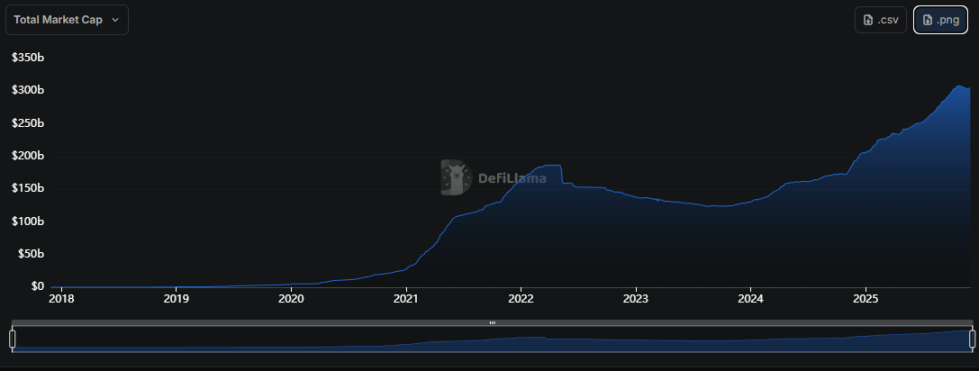
Stablecoins Market Cap

Looks like the metric has dropped into sideways movement in recent weeks | Source: DeFiLlama

The stablecoin market cap set a new record of $309 billion in late-October. Since then, the metric has seen a small decline to $306 billion. USDT and USDC, the two largest tokens in the space, alone account for about $261 billion of this figure.

Bitcoin Price

At the time of writing, Bitcoin is trading around $86,700, down nearly 6% over the last 24 hours.

Bitcoin Price Chart

The price of the coin seems to have plunged | Source: BTCUSDT on TradingView
Featured image from Nikita Kostrykin on Unsplash.com, DeFiLlama.com, chart from TradingView.com
Editorial Process for bitcoinist is centered on delivering thoroughly researched, accurate, and unbiased content. We uphold strict sourcing standards, and each page undergoes diligent review by our team of top technology experts and seasoned editors. This process ensures the integrity, relevance, and value of our content for our readers.

Keshav is a Physics graduate who has been employed as a writer with Bitcoinist since June 2021. He is passionate about writing and through the years, he has gained experience working in a variety of niches. Keshav holds an active interest in the cryptocurrency market, with on-chain analysis being an area he particularly likes to research and write about.

İlgili Okumalar

US Stocks Suffer Worst Plunge Since 2025: Three Triggers Ignite Tech Stock Valuation Reset

The US stock market experienced its most severe sell-off since the 2025 tariff crisis on June 5th, 2025. The Nasdaq Composite plummeted 4.18%, the S&P 500 fell 2.64%, and the Dow Jones dropped 695 points. The panic stemmed from three converging factors. First, Broadcom's earnings report ignited fears of a slowdown in AI growth. While its AI chip revenue surged 143% YoY to $10.8B, its Q3 AI revenue guidance of $16B fell short of the $17.2B consensus. This triggered a massive sector-wide sell-off, with the Philadelphia Semiconductor Index crashing 10.26% and semiconductor stocks losing roughly $1.3 trillion in market value in a single day. Second, a shockingly strong May jobs report crushed hopes for Federal Reserve rate cuts. Non-farm payrolls added 172,000 jobs, doubling expectations. This robust data, combined with persistently high oil prices above $92/barrel due to the ongoing Iran war and blockade of the Strait of Hormuz, drastically increased market expectations for a potential Fed rate hike instead of a cut. Higher interest rates compress the valuations of growth-heavy tech stocks. Third, the prolonged Iran conflict continues to fuel inflationary pressures, complicating the Fed's policy decisions and undermining the "inflation is tamed" narrative. Together, these events challenged the twin pillars of the market rally: the "limitless AI growth" story and expectations for imminent monetary easing. The sell-off spread globally, impacting Asian and European markets and cryptocurrencies. The article posits this is likely a severe "valuation repricing" rather than the end of the AI story. The underlying demand for AI remains strong, but investor expectations for growth speed and the prices they are willing to pay are being recalibrated. Key upcoming factors include the June FOMC meeting, future AI company earnings, and developments in the Iran conflict.

marsbit3 saat önce

US Stocks Suffer Worst Plunge Since 2025: Three Triggers Ignite Tech Stock Valuation Reset

marsbit3 saat önce

From Madison Square Garden to Kalshi: Prediction Markets Break into the NBA Finals

From Madison Square Garden to Kalshi: Prediction Markets Break into the NBA Finals Prediction markets are playing a significant role in the 2026 NBA Finals, particularly around the New York Knicks' unexpected 2-0 series lead. Platforms like Kalshi and Polymarket have seen massive trading volumes, exceeding hundreds of millions of dollars on championship and related markets. Their influence extends beyond online trading. Kalshi's official partnership with Madison Square Garden has given it prominent physical branding at the arena. Furthermore, local businesses like The Jeffrey bar are using prediction market contracts to hedge the risk of game-result-based promotions, turning potential losses into manageable costs—a concept similar to the famous "Mattress Mack" strategy from traditional sports betting. These markets differentiate themselves by offering a wider, more entertainment-focused range of "event contracts" beyond typical game outcomes, such as predicting celebrity attendance. They also have broader accessibility across the U.S. compared to age- and location-restricted traditional sportsbooks. However, their rapid integration into sports raises regulatory and ethical questions. The NBA is cautiously engaging, discussing integrity frameworks with regulators like the CFTC. While the league permits minor investments like Giannis Antetokounmpo's stake in Kalshi, it advocates for strict rules to prevent insider trading. Many fans express concern on platforms like Reddit, fearing that the close ties between prediction markets, the league, and players could compromise the game's integrity. The NBA Finals has thus become a high-stakes testing ground, showcasing prediction markets' commercial potential while challenging traditional boundaries between financial trading, entertainment, and gambling.

marsbit5 saat önce

From Madison Square Garden to Kalshi: Prediction Markets Break into the NBA Finals

marsbit5 saat önce

Recursive Self-Improvement AI Gains Traction, Google Pours Cold Water, While DeepSeek and Others Approach the Fringes

The term "recursive self-improvement" (RSI), where AI improves itself autonomously, is gaining momentum in the AI industry. Startups like Recursive Superintelligence and projects such as Andrej Karpathy's Auto-Research aim to create systems where AI designs, implements, and validates its own research, moving toward superintelligence. While Google CEO Sundar Pichai cautions that such exponential acceleration is not yet a reality, progress is evident. For instance, Anthropic reported its Claude Code writes nearly 100% of the team's code, though it still lacks true self-direction. Analysts frame RSI development in stages: "adequacy" (systems functioning without humans), "parity" (matching human research quality), and "supremacy" (exceeding human-AI collaboration). Reaching parity could trigger rapid, unpredictable advancement due to AI's continuous operation. In China, companies like DeepSeek and Baidu incorporate self-optimization techniques without explicitly branding them as RSI, focusing on algorithmic efficiency and reinforcement learning. However, challenges remain, including "model collapse" from training on AI-generated data and the immense computational and open-collaboration requirements. Ultimately, RSI represents a trend of increasing automation in AI development, potentially reducing human oversight in the creation process itself.

marsbit5 saat önce

Recursive Self-Improvement AI Gains Traction, Google Pours Cold Water, While DeepSeek and Others Approach the Fringes

marsbit5 saat önce

İşlemler

Spot
Futures

Popüler Makaleler

ANIME Nasıl Satın Alınır

HTX.com’a hoş geldiniz! Animecoin (ANIME) satın alma işlemlerini basit ve kullanışlı bir hâle getirdik. Adım adım açıkladığımız rehberimizi takip ederek kripto yolculuğunuza başlayın. 1. Adım: HTX Hesabınızı OluşturunHTX'te ücretsiz bir hesap açmak için e-posta adresinizi veya telefon numaranızı kullanın. Sorunsuzca kaydolun ve tüm özelliklerin kilidini açın. Hesabımı Aç2. Adım: Kripto Satın Al Bölümüne Gidin ve Ödeme Yönteminizi SeçinKredi/Banka Kartı: Visa veya Mastercard'ınızı kullanarak anında Animecoin (ANIME) satın alın.Bakiye: Sorunsuz bir şekilde işlem yapmak için HTX hesap bakiyenizdeki fonları kullanın.Üçüncü Taraflar: Kullanımı kolaylaştırmak için Google Pay ve Apple Pay gibi popüler ödeme yöntemlerini ekledik.P2P: HTX'teki diğer kullanıcılarla doğrudan işlem yapın.Borsa Dışı (OTC): Yatırımcılar için kişiye özel hizmetler ve rekabetçi döviz kurları sunuyoruz.3. Adım: Animecoin (ANIME) Varlıklarınızı SaklayınAnimecoin (ANIME) satın aldıktan sonra HTX hesabınızda saklayın. Alternatif olarak, blok zinciri transferi yoluyla başka bir yere gönderebilir veya diğer kripto para birimlerini takas etmek için kullanabilirsiniz.4. Adım: Animecoin (ANIME) Varlıklarınızla İşlem YapınHTX'in spot piyasasında Animecoin (ANIME) ile kolayca işlemler yapın.Hesabınıza erişin, işlem çiftinizi seçin, işlemlerinizi gerçekleştirin ve gerçek zamanlı olarak izleyin. Hem yeni başlayanlar hem de deneyimli yatırımcılar için kullanıcı dostu bir deneyim sunuyoruz.

458 Toplam GörüntülenmeYayınlanma 2025.06.18Güncellenme 2026.06.02

ANIME Nasıl Satın Alınır

Tartışmalar

HTX Topluluğuna hoş geldiniz. Burada, en son platform gelişmeleri hakkında bilgi sahibi olabilir ve profesyonel piyasa görüşlerine erişebilirsiniz. Kullanıcıların ANIME (ANIME) fiyatı hakkındaki görüşleri aşağıda sunulmaktadır.

活动图片