zkSync Founder 'Personally Fires' Core Team, the Former Ethereum Scaling Star Fully Pivots to Serving Banks

marsbitPublished on 2026-06-18Last updated on 2026-06-18

Abstract

zkSync founder Alex Gluchowski announced significant layoffs at Matter Labs, the company behind the Ethereum scaling solution, on June 17. This marks the second round of cuts in two years. The core strategic shift is the company's full focus on Prividium, a "permissioned" privacy blockchain designed specifically for regulated financial institutions like Deutsche Bank and UBS. This move represents a stark pivot from zkSync's original ethos of a public, permissionless network. Gluchowski, a self-described "freedom maximalist," is now steering the project toward a compliant, enterprise-focused model. The community reaction is divided, with many sharply questioning the use of the $458 million in total raised funds, given the ongoing layoffs. The native $ZK token has suffered heavily, trading around $0.019, down approximately 93% from its all-time high. Its value-capture mechanism appears disconnected from Matter Labs' new B2B licensing direction. This strategic turnaround is seen by some as a survival tactic in the highly competitive L2 landscape, where zkSync has faced significant user decline post its 2024 airdrop. The company is now betting on a niche, potentially more profitable market, but at the cost of alienating early supporters who believed in its decentralized promises.

Author: Claude, TechFlow

TechFlow Insight: Alex Gluchowski, founder of Matter Labs, the parent company of zkSync, announced another round of layoffs on June 17. The company is now fully betting on a 'permissioned' privacy chain called Prividium, specifically serving regulated financial institutions.

This is the company's second round of layoffs in two years. A founder who once called himself a 'freedom maximalist' is ultimately steering the project towards compliance, permissions, and banks. The community's reaction is divided, with the most pointed question being: after raising $458 million, where did the money go? The $ZK token is currently priced around $0.019, down approximately 93% from its all-time high.

The story of zkSync is heading in the opposite direction of its original promise.

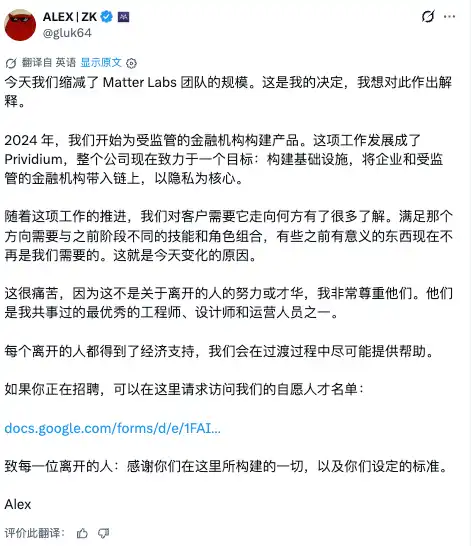
On June 17, Alex Gluchowski, founder and CEO of Matter Labs, posted on platform X, announcing a reduction in the company's team size. "Today we reduced the size of the Matter Labs team. This was my decision, and I wanted to explain it," he wrote at the beginning of the post.

The layoffs included senior engineers, designers, and operations staff, whom Gluchowski called "one of the strongest groups of people I've ever worked with." This is Matter Labs' second round of layoffs since September 2024, with the specific percentage not officially disclosed.

The real focus is not how many were laid off, but what this company has decided to become.
From 'Serving Everyone' to 'Serving Banks', A Complete Strategic Pivot

Gluchowski explained the logic behind the layoffs clearly in his post: the company has been building products for regulated financial institutions since 2024. This work later evolved into Prividium. "The entire company is now focused on one goal: building infrastructure for corporations and regulated financial institutions to go on-chain, with privacy at its core."

What is Prividium?

Simply put, it is a 'permissioned' blockchain, the opposite of the public, permissionless, anyone-can-use chain that zkSync has long championed. Permissioned means only approved institutions can access it; regular users cannot.

Matter Labs' website describes Prividium as an Ethereum platform for financial institutions and fintech companies, currently running pilots with Deutsche Bank and UBS.

The irony of this pivot lies in Gluchowski himself.

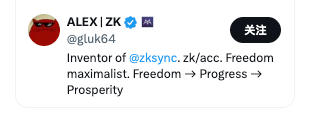
His X bio reads "Freedom maximalist," believing in "Freedom → Progress → Prosperity." zkSync's technology was previously treated by the crypto community as a public good. In 2024, when Matter Labs attempted to trademark "ZK," it faced collective opposition from zero-knowledge researchers and withdrew, arguing that such technology should not be monopolized by any single entity.

Now, this company is actively shifting its focus from a public chain for retail users and developers to a permissioned chain serving licensed banks.
The $458 Million Question, the Community Turns Instantly

Gluchowski probably anticipated the reactions under his post.

Matter Labs has raised approximately $458 million in total funding, backed by well-known institutions like Dragonfly and Blockchain Capital. Its Series C round in 2022 alone raised $200 million. The community's reaction is split. One side expresses excitement about the Prividium direction, while the other side directly questions where the money went. A widely shared comment reads: "Can you explain this? You raised $450 million to develop products. Where is the money? Why are you still fundraising while laying people off?"

This is not the first time Matter Labs has been questioned over layoffs.

In September 2024, the company laid off 16% of its staff, 24 employees, reducing total headcount to 126. At the time, the company repeatedly emphasized that its "financial situation remains strong," and the layoffs were to "stay lean," not due to lack of funds. The wording for both rounds of layoffs is highly similar, citing a "mismatch between team structure and current needs."

The problem is, when a company that has raised nearly half a billion dollars and is still fundraising conducts layoffs twice in two years, the persuasiveness of the "not due to lack of funds" claim gets repeatedly eroded.

$ZK Down 93%, Token Holders Bear the Brunt of the Pivot

The most direct cost of the strategic pivot falls on retail investors in the secondary market.

The $ZK token is currently priced around $0.019, while its all-time high shortly after launch in June 2024 was $0.27, a drop of approximately 93%. For the vast majority of its time since launch, the token has traded below its issuance price. Its current market cap is around $180 million, ranking it outside the top 150 cryptocurrencies.

The token's awkwardness lies in the fact that its value capture logic is disconnected from the company's new direction. Prividium serves banks, following an off-chain business model like "enterprise licensing fees."

A Survival Strategy in the L2 Red Ocean

Zooming out, Matter Labs' pivot is also a snapshot of the intense competition within the entire Ethereum L2 sector.

The Ethereum Layer 2 network space (scaling solutions running on top of the mainnet for faster and cheaper transactions) has seen a flood of players in recent years: Coinbase's Base, Arbitrum, Optimism, Polygon—all vying for the same pool of developers and users. zkSync was once the most active among ZK-based L2s, but after its airdrop in June 2024, users quickly fled. Active addresses dropped from a peak of over 200,000 in July to a 7-day average of around 30,000 by year-end. In a homogeneous, undifferentiated general-purpose track, pivoting to the higher-margin, less crowded niche market of "serving banks" is a commercially understandable decision.

But this decision comes at a cost. It means abandoning some of the earliest believers in the "permissionless, for everyone" narrative—those who held $ZK because of it. Matter Labs has chosen a more realistic and profitable path, at the cost of dismantling the very signpost it once erected.

Gluchowski ended his post by addressing those who left: "Thank you for everything you built here, and for the standard you set."

This sentence could also describe the company itself.

Trending Cryptos

Related Questions

QWhat major strategic shift did Matter Labs, the parent company of zkSync, announce according to the article?

AMatter Labs announced a complete strategic shift, pivoting its entire company focus from developing the public, permissionless zkSync L2 to building a 'permissioned' privacy-focused blockchain called Prividium, specifically designed to serve regulated financial institutions and banks.

QWhat specific criticism from the community is highlighted regarding Matter Labs' fundraising and recent layoffs?

AThe community strongly criticizes Matter Labs' financial management, questioning the use of the approximately $458 million in total funds it raised. Critics pointedly ask where the money went and why the company is conducting layoffs while reportedly still seeking more funding, casting doubt on the official claim that the layoffs are not due to financial distress.

QHow has the $ZK token performed in the market as of the article's reporting?

AThe $ZK token's price has declined severely. It is trading at approximately $0.019, which represents a drop of about 93% from its all-time high of around $0.27 reached shortly after its launch in June 2024.

QWhat is the core irony or contradiction noted in the article regarding Matter Labs' founder and the new direction?

AThe core irony is that founder Alex Gluchowski, who identifies as a 'Freedom maximalist' and whose project was built on principles of permissionless access and decentralization, is now leading the company towards a compliant, permissioned model that exclusively serves traditional, regulated banks—a direction fundamentally opposed to his stated personal ethos and zkSync's original promises.

QAccording to the article, what is one reason suggested for Matter Labs' strategic pivot to serving banks?

AOne reason suggested is the intense competition and homogenization in the Ethereum L2 (Layer 2) space. Facing a crowded market with players like Arbitrum and Base, zkSync struggled to retain users after its token airdrop. The pivot to the specialized, higher-margin niche of serving regulated financial institutions is presented as a logical, if controversial, business decision to find a less crowded and more profitable market.

Related Reads

CPU Makes a Comeback to the Table, A $170 Billion "Power Seizure" Drama Begins

A new era is dawning for the server CPU (Central Processing Unit), driven by the shift from AI model training to large-scale reasoning and the rise of Agentic AI. This article explores how the CPU is reclaiming a central role in the AI data center. For years, the focus has been on the GPU (Graphics Processing Unit) for AI training. However, as AI moves to the inference and Agent phase—where tasks involve complex, multi-step reasoning, tool calls, and data management—the workload balance is flipping. Studies show CPUs now handle over 70% of the workload in Agentic AI, up from 10-30% in training. This is because Agent tasks generate massive intermediate data (KV Cache) that exceeds GPU memory, forcing it to be offloaded to the CPU's larger, more scalable memory pools. This increased importance is translating into market changes. Major players are taking note: NVIDIA launched its first standalone CPU line, Vera, based on ARM architecture and optimized for Agent performance. AMD doubled its server CPU market forecast to over $1200 billion by 2030. Analyst reports project the total server CPU market could reach $1700 billion by 2030, with AI-driven demand being a primary driver. Furthermore, the classic ratio of CPUs to GPUs in AI servers is rapidly changing, converging from 1:8 toward 1:1 for Agent deployments. This surge in demand has led to a rare industry-wide price increase of 10-15% for server CPUs from Intel and AMD, breaking a decade-long trend of "more performance for the same price." Demand is bifurcating into high-core-count CPUs for in-rack GPU support and moderate-core CPUs for standalone Agent task orchestration. In China, this global trend presents an opportunity for domestic CPU manufacturers like Hygon (海光信息) and Huawei Kunpeng, who are bolstered by both growing AI infrastructure needs and national policies promoting technological self-reliance ("xin chuang"). The maturity of their software ecosystems is also accelerating, evidenced by faster adaptation to new AI models. In conclusion, the narrative is shifting from a GPU-centric view to one where CPU-GPU synergy is critical. The CPU is no longer a peripheral component but a performance-defining bottleneck and a key growth driver in the AI hardware stack, opening a massive new market estimated in the hundreds of billions of dollars.

marsbit10h ago

CPU Makes a Comeback to the Table, A $170 Billion "Power Seizure" Drama Begins

marsbit10h ago

TechFlow Intelligence: AMD AI Director Publicly Criticizes Claude Code for "Becoming Dumber and Lazier", Trump Claims Full Ceasefire in Hormuz But Strait Still Has 80 Unexploded Mines

TechFlow Intelligence Report: This daily digest covers key developments in AI, crypto, hardware, and geopolitics. In AI, SK Telecom faces US export control scrutiny over its partnership with Anthropic, while a Gemini user reports being misled in a scam scenario, sparking safety debates. China's Z.AI launches the GLM-5.2 model, rivaling Claude Opus without NVIDIA chips. In crypto, Bithumb lists ReProtocol, and Upbit delists KernelDAO. On the hardware front, MIT researchers build a custom OS to study chips, ASML denies US claims its advanced lithography machines are in China, and Amazon considers selling its in-house AI chips. Apple's future A21 Pro chip may use TSMC's latest N2P process. Major tech issues include 10,000 GitHub repositories distributing malware and Apple patching a critical eavesdropping flaw in Beats earbuds. US stocks rise, led by semiconductors, with Intel surging 10.6%, while SpaceX falls 3.5%. Geopolitically, despite a US-Iran deal, the Strait of Hormuz remains risky with ~80 uncleared mines, stalling 80M barrels of oil on standby tankers. Iran postpones Switzerland talks, and Trump calls the agreement an "unconditional surrender." The report highlights a contrast: temporary geopolitical calm versus the ongoing, fundamental restructuring of tech supply chains and chip independence.

marsbit10h ago

TechFlow Intelligence: AMD AI Director Publicly Criticizes Claude Code for "Becoming Dumber and Lazier", Trump Claims Full Ceasefire in Hormuz But Strait Still Has 80 Unexploded Mines

marsbit10h ago

Trading

Spot
Futures

Hot Articles

Discussions

Welcome to the HTX Community. Here, you can stay informed about the latest platform developments and gain access to professional market insights. Users' opinions on the price of ETH (ETH) are presented below.

活动图片