You Won’t Believe Which Company Is The Top XRP ETF Holder

bitcoinistPublished on 2026-03-15Last updated on 2026-03-15

Abstract

Institutional interest in XRP exchange-traded funds continues to grow, with cumulative inflows exceeding $1.4 billion. Regulatory filings reveal that Goldman Sachs is the largest known institutional holder of XRP ETFs, with a disclosed position of $153.8 million—equivalent to approximately 83.6 million XRP. This places the investment bank ahead of other major firms like Millennium Management and Citadel Advisors. Despite strong demand, the top 30 disclosed holders represent only a small portion of total investments, as many smaller funds and retail investors are not required to report holdings. The significant involvement of firms like Goldman Sachs may signal increasing institutional adoption of XRP ETFs in the future.

Institutional interest in XRP exchange-traded funds is still growing, and these ETFS have already taken in more than $1.4 billion in cumulative inflows since launch. Interestingly, the latest regulatory disclosures reveal a surprising name sitting at the top of the list of investors.

Goldman Sachs, one of Wall Street’s most influential investment banks, has quietly accumulated the largest known position in XRP ETFs, placing it ahead of hedge funds and crypto firms. The revelation comes as XRP ETF assets and inflows continue to grow, adding to the conversations about institutional exposure to XRP.

Goldman Sachs Appears As The Largest Known XRP ETF Holder

Regulatory disclosures have revealed a surprising name sitting at the top of the list of known institutional holders of Spot XRP ETFs. According to data compiled by Bloomberg Intelligence, Goldman Sachs currently holds the largest disclosed position in XRP ETFs among institutions required to report their holdings.

Filings show that Goldman Sachs holds roughly $153.8 million in XRP ETF exposure, representing around 83.6 million XRP worth of ETF shares. This puts the Wall Street giant well ahead of other institutional investors that have publicly disclosed their positions.

Behind Goldman Sachs, the next largest disclosed holders include Millennium Management, which holds more than $23 million in XRP ETF exposure, followed by firms such as Citadel Advisors and Logan Stone Capital, each with significantly smaller allocations. These figures come from 13F filings dated December 31, 2025, which provide details of institutional positions held at the end of the year.

XRPUSD now trading at $1.39. Chart: TradingView

According to Bloomberg Intelligence analyst James Seyffart, XRP ETF demand is still strong compared to the broader crypto market, which has been facing downward pressure since the beginning of the year. Notably, Bloomberg Intelligence data shows cumulative inflows into Spot XRP ETFs rising from roughly $150 million in mid-November 2025 to about $1.44 billion by March 4, 2026.
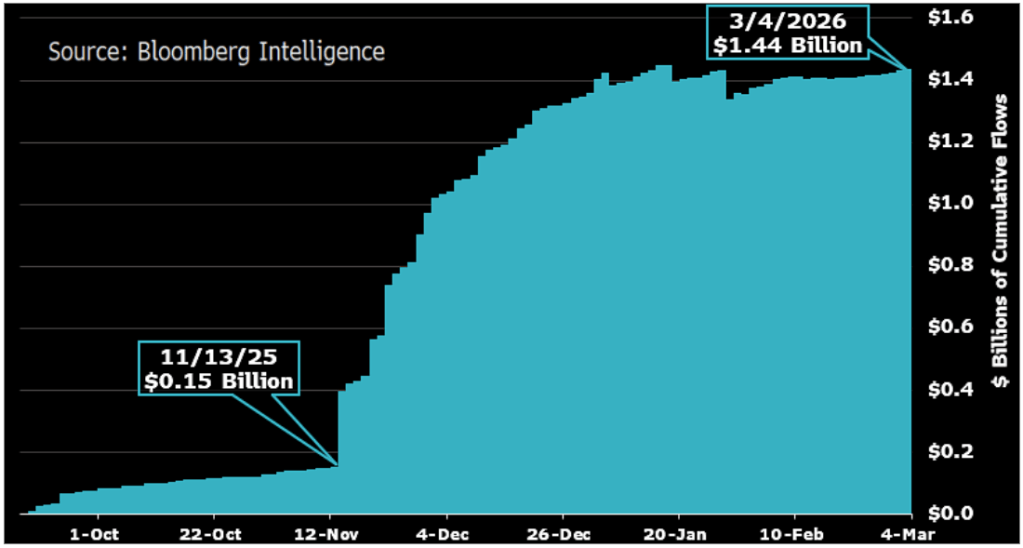
Cumulative Spot XRP ETF Flows. Source: @JSeyff On X

Most XRP ETF Buyers Are Still Unknown

Despite the insights provided by regulatory filings, the publicly disclosed holders represent only a fraction of the actual investor base behind XRP ETFs. Actually, the top 30 disclosed holders of Spot XRP ETF shares only collectively controlled about $211 million in positions at the time of the filings.

Many investors, including smaller funds, family offices, and retail participants, are not required to file 13F reports. As a result, the list of institutional holders revealed through filings captures only a small portion of the total ETF inflows.

Nonetheless, the presence of major firms like Goldman Sachs at the top of the known holder list is an interesting trend to look out for regarding the future of these Spot XRP ETFs. We could start to see more banking firms follow the same path as Goldman Sachs before the end of the year, and XRP ETFs could start playing a larger role in institutional crypto investments.

Featured image from Shutterstock, chart from TradingView

Trending Cryptos

Related Questions

QWhich company is the top XRP ETF holder according to the article?

AGoldman Sachs is the top XRP ETF holder.

QHow much XRP ETF exposure does Goldman Sachs hold?

AGoldman Sachs holds roughly $153.8 million in XRP ETF exposure.

QWhat is the cumulative inflow into Spot XRP ETFs as of March 4, 2026?

ACumulative inflows into Spot XRP ETFs reached about $1.44 billion by March 4, 2026.

QWhich other firms are mentioned as significant holders of XRP ETFs after Goldman Sachs?

AMillennium Management, Citadel Advisors, and Logan Stone Capital are mentioned as other significant holders, with Millennium holding over $23 million.

QWhy do regulatory filings only represent a fraction of the actual XRP ETF investor base?

AMany investors, such as smaller funds, family offices, and retail participants, are not required to file 13F reports, so the disclosed holders are only a small portion of the total.

Related Reads

Will the Fed Definitely Raise Interest Rates in September? How Will Crypto and U.S. Stocks Withstand the Pressure?

The market's expectation for a September Fed rate hike surged dramatically in early August, jumping from under 50% to over 80% within a week. This shift followed a contentious July FOMC meeting, where a 9-3 vote to hold rates revealed growing dissent from hawkish members advocating for an immediate hike to combat persistent inflation. The primary catalyst for this repricing is rising oil prices, driven by renewed geopolitical tensions around the Strait of Hormuz, which threaten global supply. Energy costs directly influence inflation metrics, making the upcoming July CPI report (due August 12th) a critical data point. If it shows inflation reaccelerating, the probability of a September hike will solidify. For Bitcoin and crypto assets, this is typically bearish news. Bitcoin continues to behave as a high-beta, liquidity-sensitive risk asset. A rate hike raises the opportunity cost of holding non-yielding assets and could drive capital toward money markets, pressuring crypto prices in the short term. However, historical patterns suggest that if a hike is perceived as the end of a tightening cycle rather than the start, any negative price impact may be brief. U.S. stocks, particularly crypto-linked equities like Coinbase and growth-oriented tech stocks, are also vulnerable. Higher rates increase discount rates in valuation models, putting pressure on high-multiple companies. This coincides with a pivotal tech earnings season where investor focus has shifted from massive AI capital expenditure to tangible revenue and cash flow generation. Companies with negative cash flow and weak growth narratives could face heightened volatility if borrowing costs rise in September. In summary, a September Fed hike has evolved into a mainstream market scenario. Key factors to watch are oil prices, the July CPI report, and Fed communications, which will determine the final decision and its impact on volatile crypto and equity markets.

marsbit7m ago

Will the Fed Definitely Raise Interest Rates in September? How Will Crypto and U.S. Stocks Withstand the Pressure?

marsbit7m ago

A 'Overlooked' Market Event: Joint US-Japan-South Korea Intervention, Rare US Treasury Involvement, and Bessent's Quiet 'Market Rescue'?

Summary: The United States, Japan, and South Korea executed their largest coordinated foreign exchange intervention in nearly 30 years. The action targeted depreciation pressure on the Japanese yen and South Korean won. This move is seen as a significant effort by the US to stabilize the financial markets of its key allies and prevent the spillover of risks. Key details: * Japan reportedly intervened on July 30 using approximately 8.45 trillion yen (about $52.8 billion). South Korean authorities also intervened that day, selling dollars to support the won. * Notably, the US Treasury Department intervened directly in yen markets for the first time in roughly 30 years. The New York Fed, reportedly acting on behalf of the Treasury, sold euros to buy yen via Goldman Sachs and Morgan Stanley on July 31. Analysts view the use of the euro-yen pair as a way to alleviate yen pressure without adding selling pressure to the US dollar. * Prior to the action, the New York Fed conducted "rate checks" on both USD/JPY and EUR/JPY, a newer signaling tool that falls between verbal and physical intervention. The intervention is interpreted as going beyond traditional currency stabilization. Analysts, such as Michael Hartnett of Bank of America, suggest it resembles a "Price Keeping Operation" for the AI era. The core US objectives are perceived to be: 1. Preventing rapid yen depreciation from triggering a sharp rise in Japanese government bond yields. 2. Containing financial stress from spreading across Asian markets like South Korea and Japan. 3. Reducing the risk of disorderly capital flows impacting the US bond market. This coordinated action underscores the importance of Japan and South Korea as critical partners in the US semiconductor and AI supply chain. Stabilizing their financial markets is seen as vital to mitigating risks to the broader tech industry and the US market itself. The intervention coincides with market pressures, including the KOSDAQ index hitting a low since October 2022. While seen as a move to control volatility, some analysts caution it may not fundamentally reverse existing market trends.

marsbit11m ago

A 'Overlooked' Market Event: Joint US-Japan-South Korea Intervention, Rare US Treasury Involvement, and Bessent's Quiet 'Market Rescue'?

marsbit11m ago

Will the Federal Reserve Definitely Raise Interest Rates in September? How Will Cryptocurrencies and US Stocks Bear the Pressure?

In early August 2024, market expectations for a September Federal Reserve rate hike surged dramatically, from below 50% to over 80%, driven by renewed inflation concerns. This shift followed a contentious July FOMC meeting where a 9-3 vote to hold rates revealed a growing hawkish faction advocating for an immediate hike, citing prolonged above-target inflation. The key catalyst is escalating conflict near the Strait of Hormuz, which has pushed oil prices up approximately 20% in July, threatening to reignite inflation. The next critical data point is the July CPI report on August 12th; a hot reading could solidify hike expectations. For crypto assets, particularly Bitcoin, this represents near-term pressure. Bitcoin continues to exhibit high-beta, risk-on characteristics, making it sensitive to tightening liquidity and higher opportunity costs. However, historical precedent suggests that if a hike is perceived as the cycle's end rather than its start, the negative impact may be brief, with markets quickly pivoting to anticipate future rate cuts. U.S. stocks, especially crypto-linked equities like Coinbase and high-valuation tech stocks, face amplified volatility. Higher rates increase discount rates in valuation models, pressuring growth stocks. This coincides with a pivotal tech earnings season where investor focus has shifted from massive AI capital expenditures to demonstrable revenue and cash flow generation. Companies with negative cash flows and weak growth narratives could see severe pressure if a September hike materializes, as financing costs would rise. Key indicators to watch include oil prices, upcoming inflation data, and Fed commentary at events like the Jackson Hole symposium.

Odaily星球日报11m ago

Will the Federal Reserve Definitely Raise Interest Rates in September? How Will Cryptocurrencies and US Stocks Bear the Pressure?

Odaily星球日报11m ago

Trading

Spot

Hot Articles

How to Buy T

Welcome to HTX.com! We've made purchasing Threshold Network Token (T) simple and convenient. Follow our step-by-step guide to embark on your crypto journey.Step 1: Create Your HTX AccountUse your email or phone number to sign up for a free account on HTX. Experience a hassle-free registration journey and unlock all features.Get My AccountStep 2: Go to Buy Crypto and Choose Your Payment MethodCredit/Debit Card: Use your Visa or Mastercard to buy Threshold Network Token (T) instantly.Balance: Use funds from your HTX account balance to trade seamlessly.Third Parties: We've added popular payment methods such as Google Pay and Apple Pay to enhance convenience.P2P: Trade directly with other users on HTX.Over-the-Counter (OTC): We offer tailor-made services and competitive exchange rates for traders.Step 3: Store Your Threshold Network Token (T)After purchasing your Threshold Network Token (T), store it in your HTX account. Alternatively, you can send it elsewhere via blockchain transfer or use it to trade other cryptocurrencies.Step 4: Trade Threshold Network Token (T)Easily trade Threshold Network Token (T) on HTX's spot market. Simply access your account, select your trading pair, execute your trades, and monitor in real-time. We offer a user-friendly experience for both beginners and seasoned traders.

12.7k Total ViewsPublished 2024.03.29Updated 2026.06.02

How to Buy T

Discussions

Welcome to the HTX Community. Here, you can stay informed about the latest platform developments and gain access to professional market insights. Users' opinions on the price of T (T) are presented below.

活动图片