XRP Velocity Rallies Back To Yearly Highs After Months Of Cooling – What This Means

bitcoinistPublished on 2026-02-05Last updated on 2026-02-05

Abstract

XRP Ledger transaction velocity has surged to a yearly high of 0.013, matching previous peaks from 2025, indicating heightened network activity and usage despite a recent price decline to $1.43. This increased velocity suggests growing economic engagement, such as trading, payments, or DeFi activity, rather than dormant holding. Analyst Xaif Crypto notes this level often signals critical market turning points and potential redistribution. Concurrently, large holders (whales with至少1 million XRP) are accumulating again, adding over 42 addresses since January 2026, bringing the count to 2,016. This whale activity, holding over $2 million in XRP, reflects underlying confidence not yet mirrored in price action, with trading volume rising 30% amid the downturn.

The XRP Ledger is currently operating at a rapid level as transactions and usage continue to climb, pointing to growing demand for block space and network utility beneath the surface. With this significant usage, the Ledger’s transaction velocity has spiked to record levels.

Transaction Velocity On The XRP Ledger climbs

While prices are trending downward due to the current volatile state of the cryptocurrency market, XRP’s on-chain momentum is steadily picking up pace. Currently, XRP Ledger transaction velocity is rising again after months of a slowdown.

Following an analysis of the chart, Xaif Crypto, a market expert and investor, has found that the XRP velocity has risen to 0.013, which matches the yearly highs last seen in 2025. The rise indicates that the token is moving more actively around the network, which is indicative of increased engagement and usage rather than dormant holding behavior.

Increased velocity steadily indicates growing economic activity, whether it is fueled by trade, payments, or Decentralized Finance (DeFi) involvement. Even if price action has not yet completely reflected the shift, this metric’s return to high territory indicates that interest in using XRP on-chain is growing.
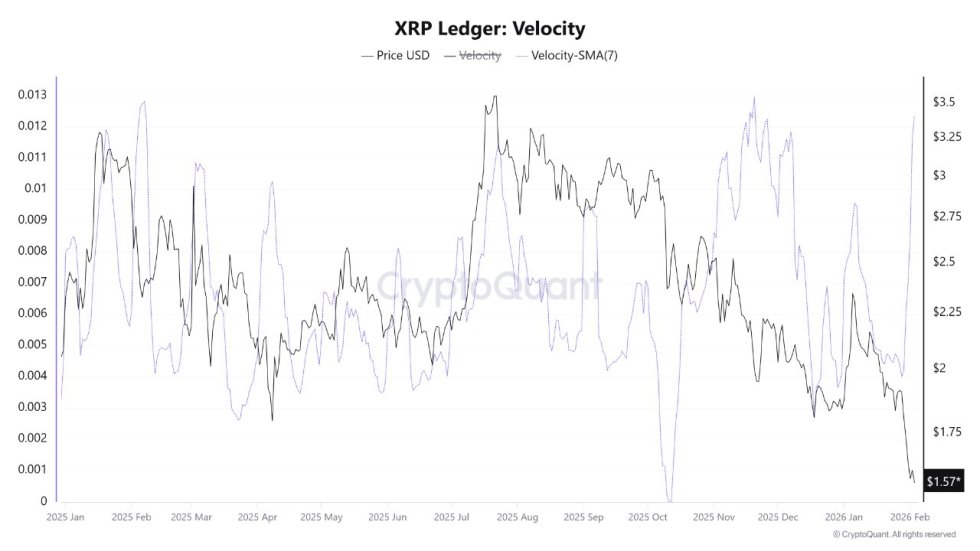
Source: Chart from Xaif Crypto on X

A major insight from the increased velocity is that the network turnover is at its peak with price sitting at $1.57, suggesting high on-chain circulation during a decline. Xaif Crypto highlighted that the development, which the analyst flagged as a high-friction event, suggests an impending major redistribution phase.

In the past, the current 0.013 level often denotes critical turning points for the market. As a result, the expert believes that it is worth monitoring the trend for potential capitulation signals.

Large Holders Are Returning, And Are Steadily Buying

Despite the ongoing pullback in price, a crucial shift in sentiment is being observed among XRP investors, especially the large holders. From the data shared by Xaif Crypto, whales are showing renewed conviction in the altcoin as they start to accumulate once again.

This renewed buying activity is being conducted by wallet addresses holding at least 1 million XRP. After a period of relative inactivity, the number of these key investors is growing for the first time since September 2025. Such a trend implies that these investors might be preparing themselves ahead of possible market shifts in the future.

Data shows that more than 42 whale wallet addresses have been added since January 1, 2026, which brings the total number of whale addresses to about 2,016. Interestingly, these wallet addresses now contain over $2 million in XRP. This fresh buying activity, which is reshaping the token’s supply dynamics, frequently appears at subtle phases when underlying confidence is not reflected in price behavior.

At the time of writing, the altcoin’s price was trading at $1.43 after dropping by more than 10% in the last 24 hours. Despite declining price action, its trading volume has risen by over 30% in the past day.

XRP trading at $1.43 on the 1D chart | Source: XRPUSDT on Tradingview.com

Related Questions

QWhat has the XRP Ledger's transaction velocity risen to, according to market expert Xaif Crypto?

AThe XRP Ledger's velocity has risen to 0.013, which matches the yearly highs last seen in 2025.

QWhat does an increase in XRP's velocity typically indicate about network activity?

AAn increase in velocity indicates that the token is moving more actively around the network, which is indicative of increased engagement, usage, and growing economic activity rather than dormant holding behavior.

QWhat critical shift in sentiment is being observed among XRP investors, specifically large holders?

ADespite the price pullback, large holders (whales) are showing renewed conviction and have started to accumulate XRP again after a period of inactivity.

QHow many new whale wallet addresses (holding at least 1 million XRP) have been added since January 1, 2026?

AMore than 42 whale wallet addresses have been added since January 1, 2026, bringing the total to about 2,016.

QWhat was the price of XRP and its 24-hour trading volume change at the time of writing?

AAt the time of writing, XRP's price was $1.43 after dropping by more than 10% in the last 24 hours, while its trading volume had increased by over 30% in the same period.

Related Reads

OpenAI Post-Training Engineer Weng Jiayi Proposes a New Paradigm Hypothesis for Agentic AI

OpenAI engineer Weng Jiayi's "Heuristic Learning" experiments propose a new paradigm for Agentic AI, suggesting that intelligent agents can improve not just by training neural networks, but also by autonomously writing and refining code based on environmental feedback. In the experiment, a coding agent (powered by Codex) was tasked with developing and maintaining a programmatic strategy for the Atari game Breakout. Starting from a basic prompt, the agent iteratively wrote code, ran the game, analyzed logs and video replays to identify failures, and then modified the code. Through this engineering loop of "code-run-debug-update," it evolved a pure Python heuristic strategy that achieved a perfect score of 864 in Breakout and performed competitively with deep reinforcement learning (RL) algorithms in MuJoCo control tasks like Ant and HalfCheetah. This approach, termed Heuristic Learning (HL), contrasts with Deep RL. In HL, experience is captured in readable, modifiable code, tests, logs, and configurations—a software system—rather than being encoded solely into opaque neural network weights. This offers potential advantages in explainability, auditability for safety-critical applications, easier integration of regression tests to combat catastrophic forgetting, and more efficient sample use in early learning stages, as demonstrated in broader tests on 57 Atari games. However, the blog acknowledges clear limitations. Programmatic strategies struggle with tasks requiring long-horizon planning or complex perception (e.g., Montezuma's Revenge), areas where neural networks excel. The future vision is a hybrid architecture: specialized neural networks for fast perception (System 1), HL systems for rules, safety, and local recovery (also System 1), and LLM agents providing high-level feedback and learning from the HL system's data (System 2). The core proposition is that in the era of capable coding agents, a significant portion of an AI's learned experience could be maintained as an auditable, evolving software system.

marsbit27m ago

OpenAI Post-Training Engineer Weng Jiayi Proposes a New Paradigm Hypothesis for Agentic AI

marsbit27m ago

Your Claude Will Dream Tonight, Don't Disturb It

This article explores the recent phenomenon of AI companies increasingly using anthropomorphic language—like "thinking," "memory," "hallucination," and now "dreaming"—to describe machine learning processes. Focusing on Anthropic's newly announced "Dreaming" feature for its Claude Agent platform, the piece explains that this function is essentially an automated, offline batch processing of an agent's operational logs. It analyzes past task sessions to identify patterns, optimize future actions, and consolidate learnings into a persistent memory system, akin to a form of reinforcement learning and self-correction. The article draws parallels to similar features in other AI agent systems like Hermes Agent and OpenClaw, which also implement mechanisms for reviewing historical data, extracting reusable "skills," and strengthening long-term memory. It notes a key difference from human dreaming: these AI "dreams" still consume computational resources and user tokens. Further context is provided by discussing the technical challenges of managing AI "memory" or context, highlighting the computational expense of large context windows and innovations like Subquadratic's new model claiming drastically longer contexts. The core critique argues that this strategic use of human-centric vocabulary does more than market products; it subtly reshapes user perception. By framing algorithms with terms associated with consciousness, companies blur the line between tool and autonomous entity. This linguistic shift can influence user expectations, tolerance for errors, and even perceptions of responsibility when systems fail, potentially diverting scrutiny from the companies and engineers behind the technology. The article concludes by speculating that terms like "daydreaming" for predictive task simulation might be next, continuing this trend of embedding the idea of an "inner life" into computational processes.

marsbit29m ago

Your Claude Will Dream Tonight, Don't Disturb It

marsbit29m ago

Trading

Spot
Futures

Hot Articles

What is XRP 2.0

XRP 2.0: A New Frontier in the Cryptocurrency Landscape Introduction to XRP 2.0 In the ever-evolving realm of cryptocurrency, new projects continuously emerge, vying for attention and adoption. One such promising initiative is XRP 2.0, a novel cryptocurrency project designed to leverage advanced blockchain technology and robust encryption methodologies. While the name draws parallels with Ripple’s XRP, it’s crucial to note that XRP 2.0 operates independently, focusing on enhancing transaction security, privacy, and scalability. As the digital financial landscape increasingly embraces decentralized solutions, XRP 2.0 aims to contribute meaningfully to web3 and the overall expansion of crypto projects. What is XRP 2.0? At its core, XRP 2.0 is a cryptocurrency project that aims to create a secure and decentralized digital currency ecosystem. Its foundational technology integrates sophisticated blockchain principles with cutting-edge encryption techniques. The overarching goal of XRP 2.0 is to establish itself as a reliable and efficient platform enabling swift transaction execution while prioritizing enhanced privacy protections for its users. The project is promoted as a solution to many limitations faced by existing cryptocurrencies, proposing a system that can handle a higher volume of transactions with improved speed and privacy. This versatility positions XRP 2.0 as a significant contender in a marketplace riddled with various digital currencies. Who is the Creator of XRP 2.0? The identity of the creator behind XRP 2.0 has been flagged as ‘Wilbur.’ However, comprehensive details regarding Wilbur or their associated entity remain elusive. The anonymity of many cryptocurrency creators is not an uncommon phenomenon in the industry, often designed to maintain a degree of privacy and security. Who are the Investors of XRP 2.0? As of now, specific information related to the investment foundations or organizations supporting XRP 2.0 is not publicly available. In the cryptocurrency sector, the backing by reputed investors can significantly influence a project's credibility and success, yet the transparency regarding the financial supporters of XRP 2.0 has not been established. How Does XRP 2.0 Work? XRP 2.0 stands out by employing a combination of blockchain technology and advanced encryption algorithms that ensures secure and decentralized transactions. Its innovative structure includes unique features designed to foster user engagement and broaden functionalities beyond conventional cryptocurrency transactions. Among these features, XRP 2.0 incorporates AI-powered capabilities, such as text-to-image and text-to-speech functionalities. These additions are designed to enhance the interactive experience for users, promoting broader applicability across various sectors. By bridging technological advancements with user-centered design, XRP 2.0 aims to capture the attention of a diverse range of individuals and enterprises looking to integrate cryptocurrency solutions into their operational frameworks. Timeline of XRP 2.0 Understanding XRP 2.0 requires examining the milestones that have defined its journey thus far: July 23, 2023: XRP 2.0 is introduced as a novel cryptocurrency project, aiming to revolutionize secure and decentralized transaction capabilities in the blockchain domain. September 8, 2023: The launching of another project, XRP20, occurs, marking the emergence of an ERC-20 token on the Ethereum blockchain that remains unrelated to XRP 2.0. November 13, 2023: The XRP Ledger undergoes a significant update with the release of rippled server software version 2.0.0. It is essential to note that this development is disconnected from the XRP 2.0 cryptocurrency project. Key Points About XRP 2.0 To distill the essence of XRP 2.0, several critical factors emerge: Unique Features: The inclusion of features like AI-powered text-to-image and text-to-speech further diversifies the potential applications of XRP 2.0. Blockchain Technology: The framework utilizes advanced blockchain mechanisms and encryption protocols, ensuring a secure and decentralized environment for transactions. Scalability and Privacy: XRP 2.0 prioritizes enhanced privacy protections in transaction processes and the scalability necessary to accommodate a growing user base. No Affiliation with Ripple: Importantly, despite its name, XRP 2.0 does not have any allegiance or collaboration with Ripple’s XRP, distinguishing its operational framework and objectives within the cryptocurrency ecosystem. Conclusion XRP 2.0 represents an ambitious venture into the cryptocurrency sphere, aiming to offer a combination of security, privacy, and efficiency in digital transactions. By integrating sophisticated technologies and user-friendly features, the project sets out to broaden the horizons of what cryptocurrency can achieve in today's digital economy. While the anonymity of its creator and lack of disclosed investors might raise questions for some, XRP 2.0's focus on advanced functionalities and decentralisation enhances its appeal amidst an increasingly crowded crypto market. As the cryptocurrency landscape continues to evolve, XRP 2.0 may yet emerge as a pivotal player in the expansion of secure and scalable blockchain solutions.

941 Total ViewsPublished 2024.04.01Updated 2024.12.03

What is XRP 2.0

Discussions

Welcome to the HTX Community. Here, you can stay informed about the latest platform developments and gain access to professional market insights. Users' opinions on the price of XRP (XRP) are presented below.

活动图片















