XRP Supply On Exchanges Crash To 8-Year Lows, But Why Is Price Still Below $2?

bitcoinistPublished on 2026-01-01Last updated on 2026-01-01

Abstract

XRP's supply on cryptocurrency exchanges has plummeted to an eight-year low of 1.6 million tokens, a 57% decline from late 2025. This significant reduction in readily available supply, typically a bullish signal, has not translated into a sustained price increase. Despite the potential for a supply shock, XRP's price remains stuck below $2, struggling to maintain upward momentum. The article attributes this disconnect to persistent selling pressure, negative investor sentiment, weaker demand, and repeated rejections at key resistance levels. Furthermore, over half of the circulating supply is held at a loss, increasing the risk of panic selling. These factors, combined with a broader market slowdown affecting major cryptocurrencies, have kept XRP in a downward trend with no immediate rebound in sight.

XRP is reportedly showing signs of tightening supply, with exchange balances falling to levels not seen in years. Despite this shift, the cryptocurrency’s price remains stuck below $2, highlighting an unusual disconnect between shrinking availability, slow demand, and weak price performance.

XRP Exchanges Balances Crashes To New Lows

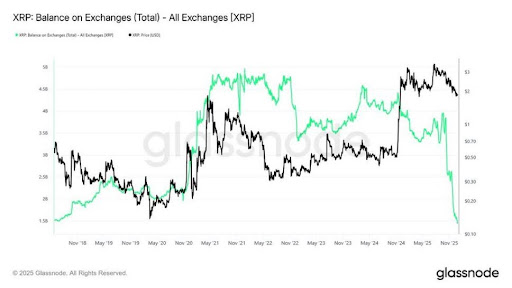
The supply of XRP on crypto exchanges has dropped to an eight-year low, yet the token continues to trade below $2. According to Glassnode data, XRP supply held on exchanges has fallen to 1.6 million tokens. This marks a roughly 57% decline from the 3.76 billion XRP recorded on October 8, 2025, representing the lowest level since 2018.

From a basic economic standpoint, a lower supply combined with rising demand often triggers a price surge in assets. For example, when coins are moved off crypto exchanges into private wallets, they are less available for immediate sale, which can limit supply and potentially support price appreciation. Analysts like X Finance Bull also see declines in exchange balances as a bullish signal that could create a supply shock and potentially spark a rally.
Source: Glassnode

However, despite exchange balances reaching multi-year lows in this cycle, the XRP price has struggled to maintain upward momentum and has continued to hover around $1.8. This choppy action suggests that reduced supply alone has not been sufficient to sustain a recovery or alleviate ongoing selling pressure.

Why The Price Remains Stuck Below $2

Although XRP saw a sharp rally that briefly pushed its price above $3 earlier in 2025, that move was short-lived. Constant distributions, negative investor sentiment, and general market volatility have erased much of the gains, pushing the cryptocurrency almost 50% below its former highs.

XRP continues to struggle to rise above $2 because its repeated breakout attempts have been rejected, keeping it below key resistance levels. This behavior points to weaker demand and lower buyer participation. Persistent selling pressure has also weighed heavily on price. In recent months, accelerated sell-offs have intensified market declines, preventing any meaningful or sustained reversal.

On-chain metrics also provide extra context for the ongoing weakness. Notably, the portion of XRP’s supply currently in profit has also declined. Over half of the circulating supply is now underwater, increasing the risk of panic selling and reinforcing the ongoing downtrend.

Broader market conditions also appear to be amplifying XRP’s price struggles. Major cryptocurrencies, such as Bitcoin, Ethereum, Dogecoin, and Solana, are trending lower, reflecting a broader market slowdown that has also weighed on the price.

The combination of these market factors and declining investor sentiment has significantly affected the XRP price, driving it into a downward spiral. While market analysts remain optimistic about the cryptocurrency’s potential for a strong price recovery, XRP remains in the red, having closed 2025 lower and extending its downtrend into 2026 with no immediate rebound in sight.

Price moving sideways | Source: XRPUSDT on Tradingview.com

Trending Cryptos

Related Questions

QAccording to the article, what has happened to the supply of XRP on exchanges and what is this level compared to?

AThe supply of XRP on crypto exchanges has dropped to an eight-year low, falling to 1.6 million tokens. This is the lowest level since 2018.

QFrom a basic economic standpoint, what should a lower supply combined with rising demand trigger? Why hasn't this happened for XRP?

AA lower supply combined with rising demand should trigger a price surge. However, for XRP, the price remains stuck because of weaker demand, persistent selling pressure, and negative investor sentiment, meaning the reduced supply alone has not been sufficient to drive a sustained recovery.

QWhat on-chain metric is mentioned as providing context for XRP's ongoing price weakness?

AThe article mentions that the portion of XRP's supply currently in profit has declined, with over half of the circulating supply now 'underwater', which increases the risk of panic selling.

QHow have broader market conditions affected the price of XRP?

ABroader market conditions have amplified XRP's price struggles. Major cryptocurrencies like Bitcoin, Ethereum, Dogecoin, and Solana are all trending lower, reflecting a broader market slowdown that has also weighed on the price of XRP.

QWhat was the short-lived price peak for XRP in 2025, and how much has it fallen from that high?

AXRP saw a sharp rally that briefly pushed its price above $3 earlier in 2025. The cryptocurrency has since fallen almost 50% below that former high.

Related Reads

Bitcoin Mining Farms Are Becoming AI Factories

Bitcoin mines are transforming into AI factories. This shift is driven by the convergence of three key assets from the previous crypto cycle: infrastructure, talent, and capital. Crypto mining companies like Crusoe, CoreWeave, and Bitdeer are repurposing their core competency—securing power, land, and grid connections in remote locations—to build data centers for AI clients. These firms are signing multi-billion dollar, long-term contracts with companies like Anthropic, AWS, and Microsoft, as AI's demand for reliable, high-capacity compute surpasses the profitability of Bitcoin mining. Simultaneously, crypto entrepreneurs and engineers are applying their skills to new AI ventures. Examples include OpenSea's co-founder launching OpenRouter (an AI model aggregator), and former Coinbase engineers building Fal.ai (a generative media infrastructure platform). Their experience in building scalable, global software networks translates effectively to the AI space. Furthermore, capital accumulated during the crypto boom is now fueling AI. Figures like Jed McCaleb (co-founder of Ripple) funded Voltage Park, a large-scale GPU cloud provider. Notably, some crypto investments, like FTX's early bets on Anthropic and Cursor, have generated astronomical paper returns, demonstrating how high-risk crypto capital flowed into AI before it became mainstream. The transition is not just about repurposing hardware, but about redirecting critical resources—power infrastructure, distributed systems expertise, and venture funding—to the next technological frontier: artificial intelligence.

链捕手10m ago

Bitcoin Mining Farms Are Becoming AI Factories

链捕手10m ago

Morpho Launches Fixed-Rate Product Midnight: Lenders and Borrowers Set Their Own Rates, Ending the Era of Interest Rate Models

Morpho Launches Fixed-Rate Product Midnight: Lenders and Borrowers Set Their Own Rates, Ending the Era of Algorithmic Interest Models On-chain lending has grown to $60 billion but remains minuscule compared to traditional finance's $200 trillion annual credit volume. Morpho identifies the lack of fixed rates and maturity dates as key bottlenecks. Institutions need predictability, not the passive floating rates set by algorithmic models. Midnight allows lenders and borrowers to directly quote rates, set terms, and become price makers, not takers. Fixed-rate lending is now viable due to cheaper, faster blockchains and the entry of institutions demanding control and certainty over returns, costs, and duration. Morpho Blue previously gave users control over risk; Midnight adds control over interest rates. Past attempts at on-chain fixed-rate lending failed primarily because they were built on top of floating-rate pools (creating unpredictability) or lacked sufficient active participants. Midnight avoids these pitfalls as a standalone primitive with fixed rates at its core, built upon Morpho Blue's existing large and active user base. Midnight offers distinct value: institutions gain predictable term structures and full control; fintech companies can offer tailored fixed-rate products; lenders/borrowers achieve predictability and efficiency; and curators can now differentiate by configuring both risk and interest rates. Morpho Midnight is not a replacement for Morpho Blue. The Morpho network will now feature two complementary market structures: floating-rate/open-term (Blue) for flexibility and fixed-rate/fixed-term (Midnight) for predictability. Liquidity can flow between them. The launch will be gradual, prioritizing security. Initially, it will support direct lending on Base network with one trading pair (cbBTC/USDC) and limited maturity dates. Advanced features like auto-rollovers will be introduced later.

marsbit10m ago

Morpho Launches Fixed-Rate Product Midnight: Lenders and Borrowers Set Their Own Rates, Ending the Era of Interest Rate Models

marsbit10m ago

human.tech Launches Clean SDK for Privacy-First Web3 Apps

human.tech has launched the Clean SDK, a toolkit enabling developers to build privacy-first Web3 applications with transparent accountability. Released alongside Aztec's version 5, the SDK provides components for integrating zero-knowledge identity verification, sanctions screening, and private transactions, without developers handling sensitive user data or building compliance infrastructure from scratch. It uses zero-knowledge proofs and programmable verification to allow apps to confirm user legitimacy and sanctions compliance while keeping identities confidential. The first application built on the SDK, Shield, a privacy bridge to Aztec, also launched. It allows users to transfer assets privately while proving a unique human is behind each transfer and that funds have passed sanctions checks, as verified by a May 2026 audit. The SDK offers three core verification techniques: Proof of Innocence (sanctions screening against 23 sources), Proof of Personhood (simpler verification via Human Passport), and Proof of Clean Hands (higher-assurance zero-knowledge government ID checks). This allows apps to authenticate users and transactions without exposing personal data. Designed for Aztec builders, the SDK lets developers add programmable privacy to decentralized apps, eliminating the need to create their own verification and ZK infrastructure. Shield demonstrates its practical use for private bridges, but the SDK aims to enable a wider ecosystem of private, accountable financial apps and services. The launch addresses growing demand for infrastructure that balances privacy and accountability. The SDK avoids traditional identity databases, storing encrypted data off-chain, screening at both entry and exit points, and including a gated disclosure mechanism for legal requests. human.tech's products, including the Clean SDK, focus on using zero-knowledge technology to enable verifiable personhood and privacy in digital systems.

TheNewsCrypto47m ago

human.tech Launches Clean SDK for Privacy-First Web3 Apps

TheNewsCrypto47m ago

Unlocking $100 Million in Liquidity? Pump.fun's New Policy Tests the 5-Minute Pump Technique

Pump.fun, a popular meme coin launchpad, has introduced a new standard mechanism called BOOST. It aims to address a significant capital efficiency issue: when a newly launched token graduates from its initial bonding curve to a liquidity pool (LP), roughly 20% of its liquidity becomes permanently locked as "dead liquidity," estimated to waste over $100 million annually. Instead of locking these funds permanently, BOOST repurposes them. Upon a token's migration, approximately 20% of the settlement funds (e.g., 17.6 SOL or ~$2516 USDC) are used to buy back the token on the open market over a 5-minute period via a Time-Weighted Average Price (TWAP) mechanism. All purchased tokens are immediately burned. This creates a brief, systematic buy pressure immediately after migration, potentially generating a short-term price surge ("pump") while permanently reducing the token's circulating supply. The goal is to enhance the immediate post-launch trading experience, potentially increasing trader retention and sustainable protocol revenue, which funds ongoing token buybacks. However, concerns exist that this artificial 5-minute boost could lower the barrier for launching low-quality tokens and lead to steeper price crashes once the buy pressure stops, if followed by large sell-offs. The feature automatically applies to tokens migrating after July 21, 2024, but not to previously migrated tokens or those launched via the Mayhem AI Agent lab.

marsbit54m ago

Unlocking $100 Million in Liquidity? Pump.fun's New Policy Tests the 5-Minute Pump Technique

marsbit54m ago

Trading

Spot

Hot Articles

What is XRP 2.0

XRP 2.0: A New Frontier in the Cryptocurrency Landscape Introduction to XRP 2.0 In the ever-evolving realm of cryptocurrency, new projects continuously emerge, vying for attention and adoption. One such promising initiative is XRP 2.0, a novel cryptocurrency project designed to leverage advanced blockchain technology and robust encryption methodologies. While the name draws parallels with Ripple’s XRP, it’s crucial to note that XRP 2.0 operates independently, focusing on enhancing transaction security, privacy, and scalability. As the digital financial landscape increasingly embraces decentralized solutions, XRP 2.0 aims to contribute meaningfully to web3 and the overall expansion of crypto projects. What is XRP 2.0? At its core, XRP 2.0 is a cryptocurrency project that aims to create a secure and decentralized digital currency ecosystem. Its foundational technology integrates sophisticated blockchain principles with cutting-edge encryption techniques. The overarching goal of XRP 2.0 is to establish itself as a reliable and efficient platform enabling swift transaction execution while prioritizing enhanced privacy protections for its users. The project is promoted as a solution to many limitations faced by existing cryptocurrencies, proposing a system that can handle a higher volume of transactions with improved speed and privacy. This versatility positions XRP 2.0 as a significant contender in a marketplace riddled with various digital currencies. Who is the Creator of XRP 2.0? The identity of the creator behind XRP 2.0 has been flagged as ‘Wilbur.’ However, comprehensive details regarding Wilbur or their associated entity remain elusive. The anonymity of many cryptocurrency creators is not an uncommon phenomenon in the industry, often designed to maintain a degree of privacy and security. Who are the Investors of XRP 2.0? As of now, specific information related to the investment foundations or organizations supporting XRP 2.0 is not publicly available. In the cryptocurrency sector, the backing by reputed investors can significantly influence a project's credibility and success, yet the transparency regarding the financial supporters of XRP 2.0 has not been established. How Does XRP 2.0 Work? XRP 2.0 stands out by employing a combination of blockchain technology and advanced encryption algorithms that ensures secure and decentralized transactions. Its innovative structure includes unique features designed to foster user engagement and broaden functionalities beyond conventional cryptocurrency transactions. Among these features, XRP 2.0 incorporates AI-powered capabilities, such as text-to-image and text-to-speech functionalities. These additions are designed to enhance the interactive experience for users, promoting broader applicability across various sectors. By bridging technological advancements with user-centered design, XRP 2.0 aims to capture the attention of a diverse range of individuals and enterprises looking to integrate cryptocurrency solutions into their operational frameworks. Timeline of XRP 2.0 Understanding XRP 2.0 requires examining the milestones that have defined its journey thus far: July 23, 2023: XRP 2.0 is introduced as a novel cryptocurrency project, aiming to revolutionize secure and decentralized transaction capabilities in the blockchain domain. September 8, 2023: The launching of another project, XRP20, occurs, marking the emergence of an ERC-20 token on the Ethereum blockchain that remains unrelated to XRP 2.0. November 13, 2023: The XRP Ledger undergoes a significant update with the release of rippled server software version 2.0.0. It is essential to note that this development is disconnected from the XRP 2.0 cryptocurrency project. Key Points About XRP 2.0 To distill the essence of XRP 2.0, several critical factors emerge: Unique Features: The inclusion of features like AI-powered text-to-image and text-to-speech further diversifies the potential applications of XRP 2.0. Blockchain Technology: The framework utilizes advanced blockchain mechanisms and encryption protocols, ensuring a secure and decentralized environment for transactions. Scalability and Privacy: XRP 2.0 prioritizes enhanced privacy protections in transaction processes and the scalability necessary to accommodate a growing user base. No Affiliation with Ripple: Importantly, despite its name, XRP 2.0 does not have any allegiance or collaboration with Ripple’s XRP, distinguishing its operational framework and objectives within the cryptocurrency ecosystem. Conclusion XRP 2.0 represents an ambitious venture into the cryptocurrency sphere, aiming to offer a combination of security, privacy, and efficiency in digital transactions. By integrating sophisticated technologies and user-friendly features, the project sets out to broaden the horizons of what cryptocurrency can achieve in today's digital economy. While the anonymity of its creator and lack of disclosed investors might raise questions for some, XRP 2.0's focus on advanced functionalities and decentralisation enhances its appeal amidst an increasingly crowded crypto market. As the cryptocurrency landscape continues to evolve, XRP 2.0 may yet emerge as a pivotal player in the expansion of secure and scalable blockchain solutions.

1.2k Total ViewsPublished 2024.04.01Updated 2024.12.03

What is XRP 2.0

Discussions

Welcome to the HTX Community. Here, you can stay informed about the latest platform developments and gain access to professional market insights. Users' opinions on the price of XRP (XRP) are presented below.

活动图片















