XRP Regime Check: What On-Chain Data Suggests Right Now

bitcoinistPublished on 2025-12-29Last updated on 2025-12-29

Abstract

CryptoQuant analyst Darkfost highlights a significant increase in XRP selling pressure, evidenced by a sharp rise in exchange inflows, particularly on Binance. Since December 15, daily inflows surged, peaking at 116 million XRP on December 19, indicating intensified distribution rather than accumulation. This suggests profit-taking by older holders and capitulation from recent buyers. The broader crypto market faces liquidity constraints, with stablecoin inflows to exchanges dropping significantly and overall sentiment turning bearish. Darkfost notes that without a reduction in these inflows, the current correction may deepen and prolong. At the time of writing, XRP was trading at $1.90.

The current XRP drawdown is accompanied by a notable jump in exchange inflows, a setup CryptoQuant analyst Darkfost (@Darkfost_Coc) says is consistent with rising sell pressure and a market that has not yet transitioned into accumulation.

XRP Selling Pressure Intensifies

In an X post, Darkfost wrote that “recent data point to a clear intensification of selling pressure on XRP,” placing it in the context of a sharp drawdown. “This dynamic comes in the context of a sharp correction, with the price dropping by around 50%, falling from a peak near $3.66 to an area around $1.85,” he said.

Darkfost’s main signal is exchange inflows, with an emphasis on Binance, which he called the venue that “continues to concentrate the largest trading volumes among all exchanges.” The underlying idea is simple but often effective: when inflows ramp up quickly, the market is seeing more coins positioned where they can be sold.

“One way to visualize this selling pressure is by analyzing XRP inflows to exchanges, particularly Binance,” he wrote. “These inflows are generally interpreted as a potential intent to sell, especially when they increase rapidly.”

He described the shift as starting mid-month. “After a relatively calm period marked by moderate and stable inflows, the situation shifted noticeably starting on December 15,” he said. “Since then, XRP inflows to Binance have risen sharply, with daily volumes ranging from 35 million XRP to a significant peak of 116 million XRP recorded on December 19.”
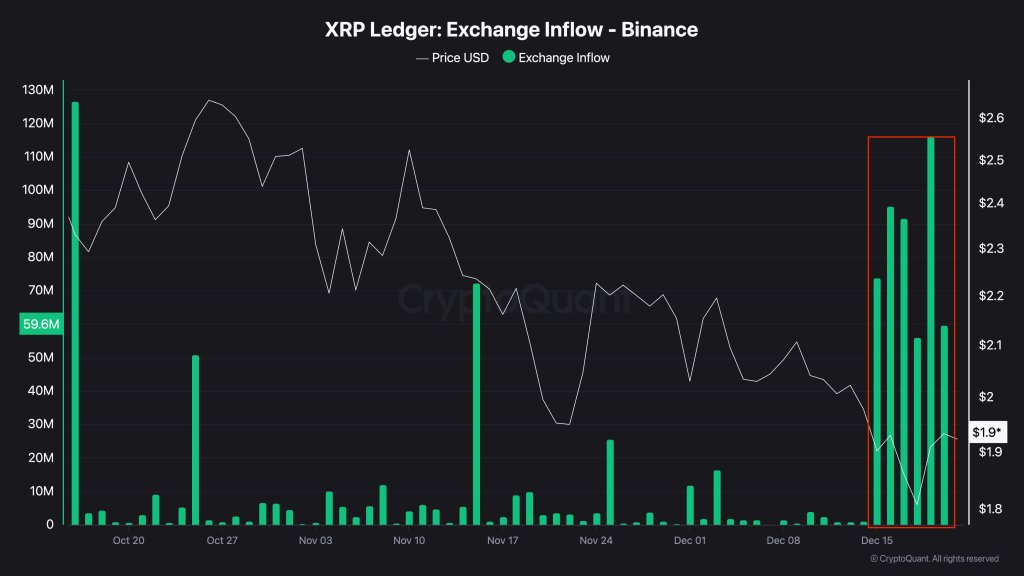
XRP Ledger Exchange Inflow Binance | Source: X @Darkfost_Coc

The implication is less about a single spike and more about the persistence of elevated prints. In that framing, repeated large inflows during a drawdown tend to read like ongoing distribution rather than a clean washout.

Darkfost argued the inflow regime also maps to a behavioral change across cohorts. “This change in dynamics also suggests a shift in investor behavior,” he wrote. “While a large portion of the market had been following a holding strategy since October, the trend over the past two weeks points to a move toward profit taking for older positions, as well as capitulation and loss selling from more recent entrants.”

He was explicit about what would need to change before “accumulation” becomes a defensible label. “As long as these elevated inflows persist or intensify further, it will be difficult for XRP to establish a true accumulation phase,” he said. “If this selling pressure continues, the current correction could not only extend in time but also deepen further.”

The Macro Backdrop

In separate posts, Darkfost tied the XRP signal to a wider market condition he characterized as liquidity constrained. “The crypto market continues to suffer from a lack of liquidity,” he wrote, adding that “the market cap of the main stablecoins has been stagnating for the past few weeks.”

He offered a specific interpretation of what that means for marginal demand. “There is no longer any fresh liquidity entering the market (fiat → crypto),” he said, while also arguing that “liquidity is still present within the market and is not leaving it.” The catch, in his view, is that available liquidity is staying sidelined: “However, this liquidity is not being deployed either, if we look at current stablecoin inflows to exchanges.”

Darkfost quantified the slowdown using exchange inflow averages. “Between September and today, the average monthly inflow to exchanges has been cut in half, dropping from $136B to around $70B,” he wrote, adding that “the annual average has also started to decline over the past few weeks.”
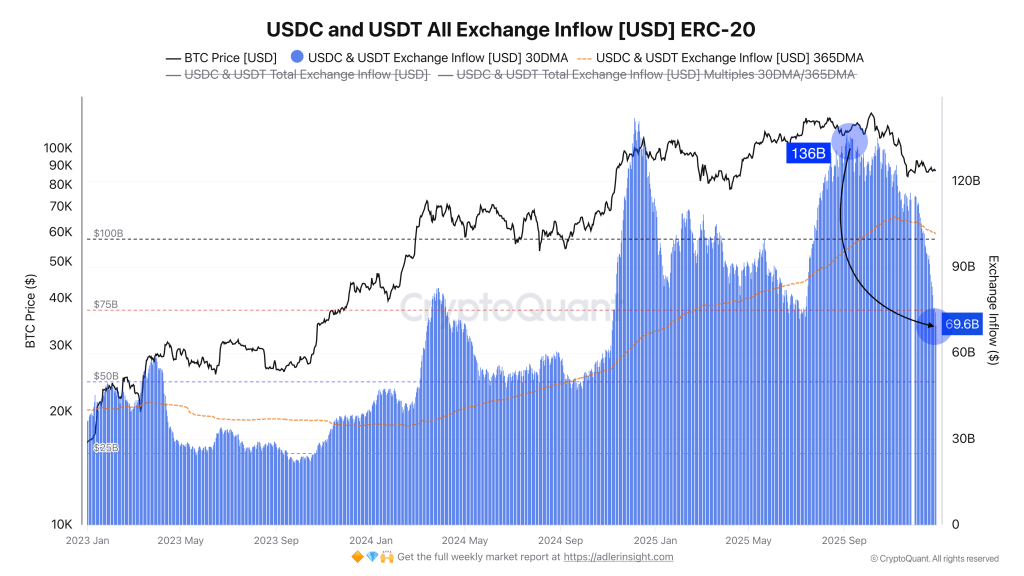
USDC and USDT All Exchange Inflow ERC20 | Source: X @Darkfost_Coc

Sentiment Turning Bearish

Darkfost also said sentiment in the entire crypto market has swung negative, based on a composite he tracks. “The general consensus has turned bearish,” he wrote, saying the indicator is “based on media articles, data from X, and several other sentiment indicators.” He noted that “when a shared consensus forms, the market tends to reverse and prove the majority wrong,” citing similar setups he observed between July and October 2024 and between February and April 2025.
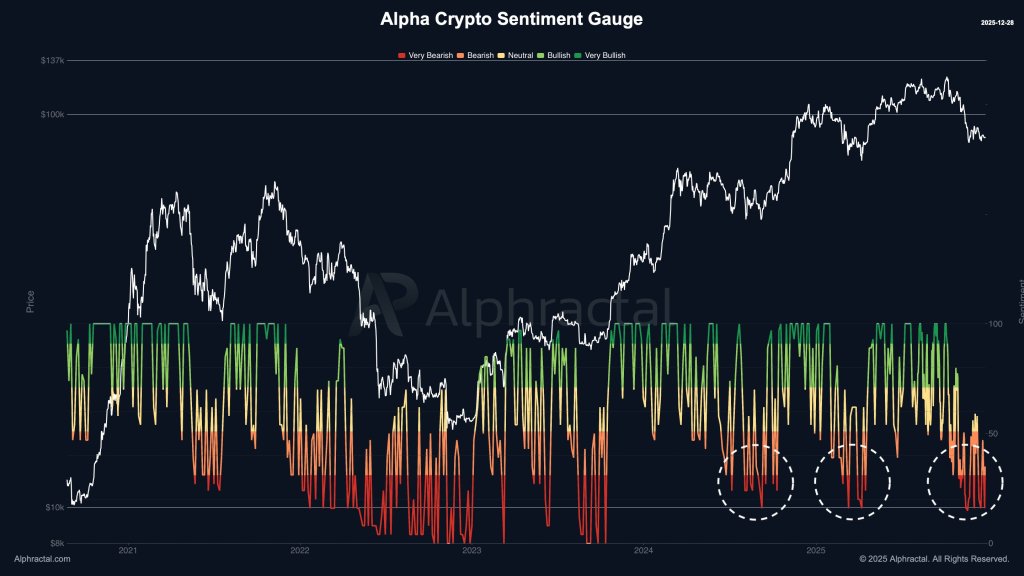
Alpha Crypto Sentiment Gauge | Source: X @Darkfost_Coc

At the same time, he warned against treating the signal as a timing tool, especially if broader conditions deteriorate. “These phases can last for some time, especially when the market enters a prolonged bear market phase,” he wrote. “We have only started to enter this period since early November, so there is no need to rush, but it is probably already a bit late to turn bearish.”

At press time, XRP traded at $1.90.
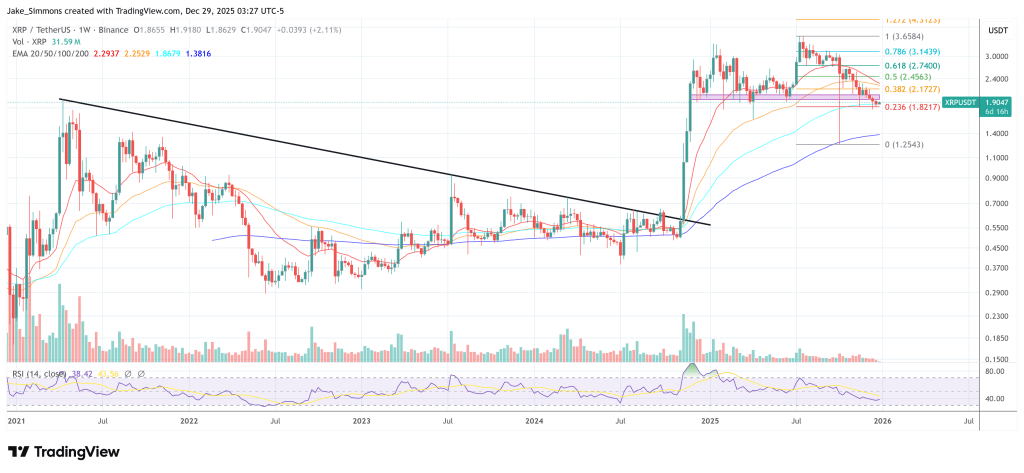
XRP falls below key support, 1-week chart | Source: XRPUSDT on TradingView.com

Trending Cryptos

Related Questions

QAccording to CryptoQuant analyst Darkfost, what on-chain data suggests a clear intensification of selling pressure on XRP?

AA notable jump in exchange inflows, particularly to Binance, suggests a clear intensification of selling pressure. Daily volumes ranged from 35 million XRP to a peak of 116 million XRP.

QWhat two specific investor behaviors does Darkfost attribute to the recent shift in XRP's on-chain dynamics?

AThe shift points to profit-taking from older positions and capitulation and loss selling from more recent entrants.

QWhat broader market condition does Darkfost link the XRP signals to, and what is the specific state of stablecoin liquidity?

AHe links it to a wider liquidity-constrained market. While liquidity is present and not leaving the market, it is not being deployed, as shown by stagnating stablecoin market cap and declining exchange inflows.

QBased on the sentiment gauge, what is the current general consensus in the crypto market, and what historical periods does Darkfost compare it to?

AThe general consensus has turned bearish. This is compared to similar setups observed between July and October 2024 and between February and April 2025.

QWhat condition must be met for XRP to establish a true accumulation phase, according to the analysis?

AThe elevated exchange inflows must subside. As long as they persist or intensify, it will be difficult to establish a true accumulation phase.

Related Reads

Podcast Notes | Conversation with GSR Asset Management Head: To Determine if This Crypto Rally is Real, Just Watch the Lending Rates on Aave

Podcast Summary: Dialogue with GSR's Head of Asset Management: To Determine if This Crypto Rally is Real, Just Check Lending Rates on Aave Andy Baehr, Managing Director of Asset Management at GSR, discusses the current crypto market, characterizing it as stuck in a state of "ambivalence" with short-lived, unsustainable rallies. He outlines a simple framework: the market moves between "ambivalence" and "conviction" (sustained upward momentum). Currently, every rally resembles a single-stage rocket booster that quickly fizzles out. Baehr identifies three key signals to watch: 1) DeFi lending rates, 2) the potential passage of the CLARITY Act, and 3) the market forming a consensus on the "Fed hawkish peak." He emphasizes that the most immediate indicator for the sustainability of the recent CPI-triggered rally is the USDC borrowing rate on Aave, currently around 3.75%—close to U.S. Treasury yields. The absence of a credit spread indicates low leverage demand and a lack of market energy. He explains that a healthy, sustained rally requires layered buying pressure. Last year's rally progressed from an ETH short squeeze to crypto-native trader influx and finally to ETF inflows. Currently, this structure is missing. Other potential structural buyers like Digital Asset Treasury (DAT) companies are absent, and ETF flows have proven transient. Baehr notes that while small-cap crypto tokens outperformed large caps in Q2—a potential sign of capitation in major assets—capital is also flowing to more exciting opportunities like AI stocks and tech IPOs, leaving crypto sidelined. Regarding DeFi, he highlights that platforms like Aave provide a clear, real-time signal of leverage demand through their supply/demand-driven interest rates. A significant, sustained rate increase would signal genuine market conviction. He also observes the quiet emergence of fixed-income-like products and vaults in DeFi. On regulation, the probability of the CLARITY Act passing before the August 7th deadline has dropped linearly from 75% to below 40% on Polymarket. Baehr suggests its passage would be treated as a bullish surprise, a potent driver for price movement. However, political hurdles, including ethical clause debates and disclosures about the First Family's crypto profits, remain significant obstacles. Ultimately, the market awaits clarity on the Fed's terminal rate under Chair Warsh. Until the "Fed Solstice"—the point where the market collectively understands the peak of hawkish policy—sustained conviction will be difficult to achieve.

marsbit4m ago

Podcast Notes | Conversation with GSR Asset Management Head: To Determine if This Crypto Rally is Real, Just Watch the Lending Rates on Aave

marsbit4m ago

7 Months After the Collapse of Huiwang, Southeast Asia's Escrow Platforms Undergo a Major Reshuffle

Following the collapse of Huione Pay—dubbed the "Alipay of Southeast Asia"—seven months ago, the region's underground financial guarantee platform sector is undergoing a significant reshuffle. This power vacuum has been swiftly filled by emerging platforms such as XinBi, Tiger/Navigator, JinBei (renamed JinBo), Dali/Tiancheng, and FullyLight. These platforms, operating largely via Telegram and offering services like escrow for illicit transactions, have absorbed the vast user base and markets left behind by Huione. While positioning themselves as "trust intermediaries," their primary clientele consists of networks involved in online scams, money laundering, illegal gambling, and even human trafficking. For instance, the Tiger/Navigator platform explicitly provides "escrow" services for kidnapping-for-ransom operations ("强押车交易"). Data underscores the immense scale: Huione alone processed over $103 billion in cryptocurrency payments and facilitated over $31 billion through its escrow market before its downfall, linking it to Cambodia's notorious Prince Group. Since its collapse, competitors have seen explosive growth. For example, the XinBi platform has accumulated over $1.6 billion in total USDT revenue, while platforms like NewPay, OkPay (under Dali), and FullyLight Wallet collectively processed over $4.8 billion in USDT in a single year. This ecosystem thrives in regions like Cambodia and Myanmar, where regulatory gaps allow these platforms to act as critical financial infrastructure for sprawling cybercrime industries, from scam compounds to online casinos. The article concludes that the moniker "Southeast Asian Alipay" is a misnomer, obscuring the platforms' fundamental role in enabling serious criminal enterprises rather than representing legitimate financial innovation.

Odaily星球日报1h ago

7 Months After the Collapse of Huiwang, Southeast Asia's Escrow Platforms Undergo a Major Reshuffle

Odaily星球日报1h ago

The Changing Landscape: What Are Crypto VCs Experiencing?

Title: The Shifting Landscape of Crypto Venture Capital The era of dedicated crypto venture capital funds is undergoing a significant transformation. Once essential for navigating the sector's complexity and high risk, these specialized funds are now facing an identity crisis as the market matures. This shift mirrors historical patterns in other specialized investment classes like cleantech and SPACs, where initial information advantages dissipate as technologies become mainstream and integrated into existing industry frameworks. The article argues that crypto is reaching a critical inflection point, transitioning from a "building phase" to an "integration phase." Major players like Stripe, BlackRock, and Visa now engage with crypto not for its novel mechanics but as a foundational financial infrastructure. Their needs—regulatory compliance, banking partnerships, distribution channels—align with traditional fintech, a domain easily understood by large, generalist funds like Sequoia and Founders Fund. This evolution creates a "barbell effect" within the VC landscape. On one end are massive, diversified platforms that can incorporate crypto as one vertical among many. On the other are small, nimble funds focused on niche, experimental projects. The middle ground—medium-sized dedicated crypto funds—is being squeezed out. Their typical fund size makes it impossible to generate sufficient returns solely from early-stage crypto bets, yet they cannot compete with giants for later-stage deals. Consequently, leading crypto-native firms like Paradigm and Framework Ventures are expanding into AI, robotics, and other sectors, driven partly by LP pressure for better returns amid a broader VC DPI crisis. Others, like Dragonfly and a16z, have narrowed their crypto focus predominantly to financial infrastructure like stablecoins, reframing the sector's core narrative. For crypto entrepreneurs, this consolidation presents challenges. While generalist funds offer larger checks and broader resources, crypto projects now compete fiercely with AI for attention and capital within these firms. Furthermore, the long-term, non-commercial foundational work that built the ecosystem—funded by dedicated crypto VCs—is less likely to attract generalist capital focused on direct returns. The conclusion is that "crypto investor" as a standalone category is becoming obsolete, akin to "internet investor." Crypto is becoming a baseline infrastructure layer. The future will see a barbell structure: large-scale growth financing handled by generalist funds, while pioneering, speculative projects are funded by small, specialized vehicles. The dedicated crypto funds of the 2017-2021 boom, which incubated core infrastructure, are giving way to this new, bifurcated reality.

Foresight News1h ago

The Changing Landscape: What Are Crypto VCs Experiencing?

Foresight News1h ago

Trading

Spot

Hot Articles

What is XRP 2.0

XRP 2.0: A New Frontier in the Cryptocurrency Landscape Introduction to XRP 2.0 In the ever-evolving realm of cryptocurrency, new projects continuously emerge, vying for attention and adoption. One such promising initiative is XRP 2.0, a novel cryptocurrency project designed to leverage advanced blockchain technology and robust encryption methodologies. While the name draws parallels with Ripple’s XRP, it’s crucial to note that XRP 2.0 operates independently, focusing on enhancing transaction security, privacy, and scalability. As the digital financial landscape increasingly embraces decentralized solutions, XRP 2.0 aims to contribute meaningfully to web3 and the overall expansion of crypto projects. What is XRP 2.0? At its core, XRP 2.0 is a cryptocurrency project that aims to create a secure and decentralized digital currency ecosystem. Its foundational technology integrates sophisticated blockchain principles with cutting-edge encryption techniques. The overarching goal of XRP 2.0 is to establish itself as a reliable and efficient platform enabling swift transaction execution while prioritizing enhanced privacy protections for its users. The project is promoted as a solution to many limitations faced by existing cryptocurrencies, proposing a system that can handle a higher volume of transactions with improved speed and privacy. This versatility positions XRP 2.0 as a significant contender in a marketplace riddled with various digital currencies. Who is the Creator of XRP 2.0? The identity of the creator behind XRP 2.0 has been flagged as ‘Wilbur.’ However, comprehensive details regarding Wilbur or their associated entity remain elusive. The anonymity of many cryptocurrency creators is not an uncommon phenomenon in the industry, often designed to maintain a degree of privacy and security. Who are the Investors of XRP 2.0? As of now, specific information related to the investment foundations or organizations supporting XRP 2.0 is not publicly available. In the cryptocurrency sector, the backing by reputed investors can significantly influence a project's credibility and success, yet the transparency regarding the financial supporters of XRP 2.0 has not been established. How Does XRP 2.0 Work? XRP 2.0 stands out by employing a combination of blockchain technology and advanced encryption algorithms that ensures secure and decentralized transactions. Its innovative structure includes unique features designed to foster user engagement and broaden functionalities beyond conventional cryptocurrency transactions. Among these features, XRP 2.0 incorporates AI-powered capabilities, such as text-to-image and text-to-speech functionalities. These additions are designed to enhance the interactive experience for users, promoting broader applicability across various sectors. By bridging technological advancements with user-centered design, XRP 2.0 aims to capture the attention of a diverse range of individuals and enterprises looking to integrate cryptocurrency solutions into their operational frameworks. Timeline of XRP 2.0 Understanding XRP 2.0 requires examining the milestones that have defined its journey thus far: July 23, 2023: XRP 2.0 is introduced as a novel cryptocurrency project, aiming to revolutionize secure and decentralized transaction capabilities in the blockchain domain. September 8, 2023: The launching of another project, XRP20, occurs, marking the emergence of an ERC-20 token on the Ethereum blockchain that remains unrelated to XRP 2.0. November 13, 2023: The XRP Ledger undergoes a significant update with the release of rippled server software version 2.0.0. It is essential to note that this development is disconnected from the XRP 2.0 cryptocurrency project. Key Points About XRP 2.0 To distill the essence of XRP 2.0, several critical factors emerge: Unique Features: The inclusion of features like AI-powered text-to-image and text-to-speech further diversifies the potential applications of XRP 2.0. Blockchain Technology: The framework utilizes advanced blockchain mechanisms and encryption protocols, ensuring a secure and decentralized environment for transactions. Scalability and Privacy: XRP 2.0 prioritizes enhanced privacy protections in transaction processes and the scalability necessary to accommodate a growing user base. No Affiliation with Ripple: Importantly, despite its name, XRP 2.0 does not have any allegiance or collaboration with Ripple’s XRP, distinguishing its operational framework and objectives within the cryptocurrency ecosystem. Conclusion XRP 2.0 represents an ambitious venture into the cryptocurrency sphere, aiming to offer a combination of security, privacy, and efficiency in digital transactions. By integrating sophisticated technologies and user-friendly features, the project sets out to broaden the horizons of what cryptocurrency can achieve in today's digital economy. While the anonymity of its creator and lack of disclosed investors might raise questions for some, XRP 2.0's focus on advanced functionalities and decentralisation enhances its appeal amidst an increasingly crowded crypto market. As the cryptocurrency landscape continues to evolve, XRP 2.0 may yet emerge as a pivotal player in the expansion of secure and scalable blockchain solutions.

1.2k Total ViewsPublished 2024.04.01Updated 2024.12.03

What is XRP 2.0

Discussions

Welcome to the HTX Community. Here, you can stay informed about the latest platform developments and gain access to professional market insights. Users' opinions on the price of XRP (XRP) are presented below.

活动图片















