XRP Pundit Shares Why You Shouldn’t Get Tricked By The Price Rebound

bitcoinistPublished on 2026-03-25Last updated on 2026-03-25

Abstract

A crypto analyst, CasiTrades, warns that the recent XRP price rebound may be a temporary bounce and a potential bull trap. Despite the uptrend driven by positive macro conditions and Bitcoin's rise above $70,000, XRP has broken below a key bullish trendline, which is now acting as resistance. This break suggests the recovery could be a short-lived "subwave 2 bounce," often followed by further declines. If rejected at resistance levels of $1.40-$1.41 or $1.51-$1.55, the price could crash around 40% to major support near $0.87. The analyst concludes that unless XRP breaks and holds above $1.65 resistance, a significant downturn is likely.

Recently, the XRP price has been in an uptrend, spurred on by the improving macro political climate and the Bitcoin price crossing $70,000. But while this move has brought some much-needed positive sentiment back into the market, one analyst is calling for caution during this time. The call points to the fact that the move above $1.4 might be only temporary and that the price downtrend will resume in short succession, trapping investors in their positions.

The XRP Trendline To Watch For A Lower Break

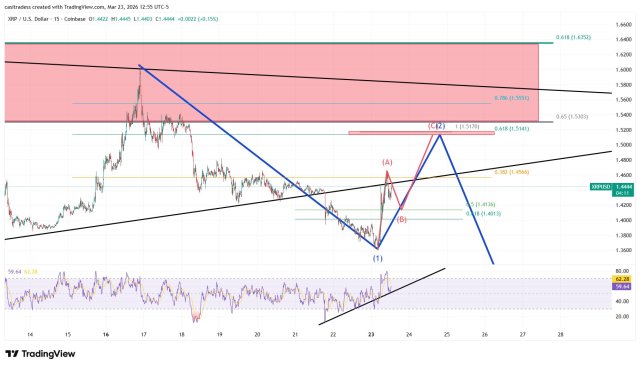
Over the last few weeks, the XRP price had formed an interesting trendline, which crypto analyst CasiTrades had called out. At a point, the XRP price was still trading above the trendline, suggesting that the trend was still very bullish. However, the digital asset has now seen its price fall below this trendline, putting it in a very perilous position.

CasiTrades explains that the price break below this trendline has seen it begin to act more like resistance at this level. If that is the case, it means that the price might not be able to break out of it, and if it is pushed down, then it could trigger another wave down.

The recent price recovery, the crypto analyst explains, could be a subwave 2 bounce. Such a bounce is historically short-lived and actually tends to give way to more declines. As a result, at the first sign of resistance, it is possible that the XRP price will be harshly rejected, triggering the next move down.
Source: X

Such a move would eventually see no support above the $1, and this would leave room for the bears to drag the price further down. In fact, the crypto analyst says that the next major support on the leg down lies around $0.87. This would constitute a 40% crash from current levels at the time of writing.

As for levels to watch, CasiTrades says to keep an eye on $1.40-$1.41 for the B wave. For the C wave, the major levels to watch are $1.51-$1.55, and these targets are for the short-term. “Either we head down to $0.87, or we somehow break and hold $1.65 resistance,” the analyst stated.

Price resumes uptrend | Source: XRPUSDT on Tradingview.com

Trending Cryptos

Related Questions

QAccording to the analyst CasiTrades, what is the significance of XRP's price falling below the identified trendline?

AThe price break below the trendline suggests it has begun to act as resistance, indicating a potential failure to break out and a possible trigger for another downward wave.

QWhat does the analyst refer to as a 'subwave 2 bounce' and what is its typical outcome?

AA 'subwave 2 bounce' is a short-lived price recovery that historically tends to give way to more declines, often resulting in a harsh rejection at the first sign of resistance.

QWhat is the next major support level for XRP if the price downtrend resumes, and what percentage drop would that represent from the current price mentioned?

AThe next major support level is around $0.87, which would constitute a 40% crash from the current price levels at the time of writing.

QWhat are the two possible price targets for the short-term B wave and C wave that investors should watch, according to the analysis?

AFor the B wave, watch $1.40-$1.41. For the C wave, watch $1.51-$1.55.

QWhat two ultimate price scenarios does the analyst CasiTrades outline for XRP?

AThe two scenarios are: the price heads down to $0.87, or it breaks and holds above the $1.65 resistance level.

Related Reads

Rubin Ultra Makes Major Cuts, Even Nvidia Can't Handle Memory Price Hikes?

NVIDIA's Rubin Ultra, the top-tier variant of the newly announced Rubin AI accelerators, has reportedly seen significant specification downgrades, according to an industry report from SemiAnalysis. Initially designed with four compute dies (4-die), the Rubin Ultra is now said to be reduced to a 2-die design. Key changes highlighted in the report include: * **No increase in peak theoretical compute performance**, remaining at 35 PFLOPs like the standard Rubin. * **Severe reduction in memory capacity** to 192GB using 8-Hi HBM stacks, which is less than the standard Rubin's 288GB using 12-Hi stacks. * **Negligible memory bandwidth improvement** of only 1 TB/s. * **Slightly higher chip-level power consumption**. * The **primary upgrade is a massive increase in scale-up interconnect capacity**, supporting connections for up to 576 GPUs via NVLink, compared to 72 for the standard Rubin. The report suggests the redesign is primarily a cost-optimization move driven by the sharp rise in HBM (High-Bandwidth Memory) prices. By reducing the expensive HBM content and shifting investment towards enhanced system-scale networking, NVIDIA aims to maintain the platform's value for large-scale AI training clusters while managing soaring material costs. The news reportedly triggered a sell-off in South Korean memory stocks, with SK Hynix and Samsung shares falling around 8%, as markets grew concerned that NVIDIA—a major HBM buyer—might be reducing its reliance on high-capacity memory, potentially capping future pricing power for memory makers.

Odaily星球日报11m ago

Rubin Ultra Makes Major Cuts, Even Nvidia Can't Handle Memory Price Hikes?

Odaily星球日报11m ago

Can Generative Models Finally Be Trained End-to-End? The Core Is a For Loop

This article introduces a novel training paradigm for generative models called Explorative Modeling (XM), which enables true end-to-end training. Traditionally, powerful generative models like autoregressive and diffusion models are not trained end-to-end. They are trained to predict a single small step but require iterative multi-step sampling for inference. This "exposure bias" leads to error accumulation and limits performance. The core challenge XM addresses is "mode blurring." In generative tasks, a single input (e.g., "generate a dog") corresponds to many valid outputs (multiple modes). Standard training objectives like reconstruction loss force the model to average these modes, producing unrealistic, blurry outputs. To avoid this, existing models break generation into many small, almost deterministic steps, sacrificing end-to-end training. XM tackles this by restructuring the training loop itself. Its key insight is to amplify "generative expressivity." For each training input, instead of generating one sample, the model generates K candidate outputs. Only the candidate closest to the real data is used for computing the loss and updating the model via backpropagation. This simple "best-of-K" mechanism is implemented as a short for-loop. By exploring multiple possibilities, the model learns to distribute its guesses across different modes rather than collapsing to their uninformative average. The paper demonstrates that "exploration" acts as a new, powerful scaling axis. Gains from XM increase with model size, data scale, and compute. Experiments show improvements in FID scores for image generation and significant efficiency gains, sometimes outperforming larger models without exploration. When pushed to the limit, XM enables fully single-step, end-to-end generative models. In robotics tasks, an "Explorative Policy" matched the performance of a 100-step Diffusion Policy with a single forward pass, drastically improving inference speed. While the best-of-K concept is not entirely new, the authors' contribution lies in formally understanding it as a direct method to boost generative expressivity without fragmenting the generation process. This work suggests that as models scale, enhancing exploration during training may become crucial for overcoming fundamental performance bottlenecks.

marsbit1h ago

Can Generative Models Finally Be Trained End-to-End? The Core Is a For Loop

marsbit1h ago

Trading

Spot

Hot Articles

How to Buy T

Welcome to HTX.com! We've made purchasing Threshold Network Token (T) simple and convenient. Follow our step-by-step guide to embark on your crypto journey.Step 1: Create Your HTX AccountUse your email or phone number to sign up for a free account on HTX. Experience a hassle-free registration journey and unlock all features.Get My AccountStep 2: Go to Buy Crypto and Choose Your Payment MethodCredit/Debit Card: Use your Visa or Mastercard to buy Threshold Network Token (T) instantly.Balance: Use funds from your HTX account balance to trade seamlessly.Third Parties: We've added popular payment methods such as Google Pay and Apple Pay to enhance convenience.P2P: Trade directly with other users on HTX.Over-the-Counter (OTC): We offer tailor-made services and competitive exchange rates for traders.Step 3: Store Your Threshold Network Token (T)After purchasing your Threshold Network Token (T), store it in your HTX account. Alternatively, you can send it elsewhere via blockchain transfer or use it to trade other cryptocurrencies.Step 4: Trade Threshold Network Token (T)Easily trade Threshold Network Token (T) on HTX's spot market. Simply access your account, select your trading pair, execute your trades, and monitor in real-time. We offer a user-friendly experience for both beginners and seasoned traders.

12.7k Total ViewsPublished 2024.03.29Updated 2026.06.02

How to Buy T

Discussions

Welcome to the HTX Community. Here, you can stay informed about the latest platform developments and gain access to professional market insights. Users' opinions on the price of T (T) are presented below.

活动图片