XRP Pundit Points Out Interesting ‘Scam’ Trend On Google

bitcoinistPublished on 2026-02-06Last updated on 2026-02-06

Abstract

A crypto analyst, Leo Handjiloizou, has identified a recurring trend linking XRP price rallies with a surge in Google searches for terms like “Ripple scam” and “XRP scam.” Analysis of Google Trends data shows that these scam-related queries consistently spike during periods of rapid price appreciation, such as in 2018, 2021, and notably in 2026. This pattern often precedes a significant price downturn for XRP. The analyst and community members debate whether these accusations are organic, a form of coordinated market manipulation to suppress the price, or simply a result of increased scam activity targeting investors during times of FOMO-driven market excitement.

It is well-known that bullish interest in XRP often rises during major price moves. However, a new analysis suggests that Google search data shows that scam-related queries for the cryptocurrency also surge during periods of rapid growth. A crypto analyst has highlighted that this unique trend appears repeatedly across XRP’s major market rallies.

Google Trend Links XRP Rallies To Scam Searches

Crypto market analyst Leo Handjiloizou said in an X post that he recently analyzed Google Trends data for the search terms “Ripple scam” and “XRP scam.” He compared these search trends to XRP’s historical price chart and discovered some intriguing patterns. Handjiloizou said this was the first time he had examined both datasets side by side, so the overlap stood out immediately.

According to the analyst, the data shows that Google searches accusing Ripple or XRP of being a scam tend to surge during periods of rapid price appreciation. Shortly after this spike in online interest, XRP’s price historically entered a long corrective phase.

Handjiloizou’s chart shows this unique pattern appearing multiple times across different market cycles, including major market rallies in 2018, 2021, 2025, and the most recent price expansion in 2026. Each instance shows a sharp increase in scam-related searches coinciding closely with XRP market tops. This suggests that XRP attracts more scrutiny when it outperforms the broader market.
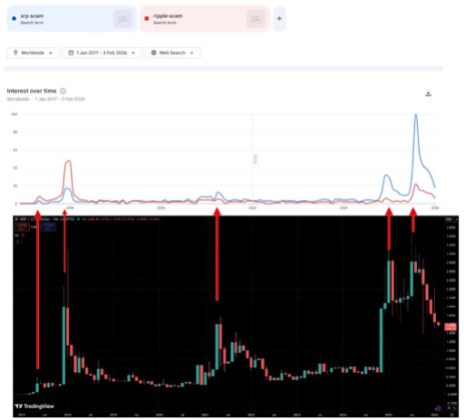
Source: Google

As price momentum builds, negative narratives seem to gain traction, seemingly aimed at keeping XRP’s upward movement in check. Handjiloizou supports this view, questioning whether these scam accusations are organic or coordinated. He noted that the consistency of the pattern increases the likelihood that organized narratives were intentionally deployed during key periods of market strength to influence XRP’s price action.

Crypto Community Members Weigh In On Rising Scam Accusations

Handjiloizou’s post on X has sparked discussion among the crypto community, with some believing the scam accusations may be intentionally orchestrated and others offering less negative explanations for the recurring trend.

One member suggested that the spike in scam accusations during XRP price rallies could be a form of market manipulation. Some noted that XRP often attracts both positive and negative attention and sentiment whenever its price rises. In contrast, others argued that the recurring trend could also indicate that scam activities tend to spike during periods of heightened momentum and price surges.

This reasoning is not entirely unfounded, particularly given that XRP often attracts investor attention during price rallies. Usually, when XRP’s market value rises, Google searches for the cryptocurrency increase and news spreads quickly, attracting investors motivated by FOMO eager to ride the bullish wave. During periods of heightened emotions, scammers can more easily target unsuspecting investors, which could help explain why scam claims often rise alongside price increases.

Bears take total control of price | Source: XRPUSDT on Tradingview.com

Related Questions

QWhat does the analysis of Google Trends data reveal about searches for 'Ripple scam' and 'XRP scam' in relation to price movements?

AThe analysis reveals that Google searches for 'Ripple scam' and 'XRP scam' tend to surge during periods of rapid price appreciation for XRP, and these spikes in negative searches historically coincide with market tops, followed by long corrective phases in the price.

QAccording to analyst Leo Handjiloizou, what is a possible explanation for the consistent pattern of rising scam accusations during XRP rallies?

ALeo Handjiloizou suggests that the consistency of the pattern increases the likelihood that organized narratives were intentionally deployed during key periods of market strength to influence XRP's price action, questioning whether these accusations are organic or coordinated.

QWhat alternative explanation did some community members provide for the increase in scam-related searches during price rallies?

ASome community members argued that the recurring trend could indicate that actual scam activities tend to spike during periods of heightened momentum and price surges, as scammers can more easily target unsuspecting investors motivated by FOMO (Fear Of Missing Out).

QDuring which specific market cycles did the analyst's chart show this pattern of scam searches coinciding with XRP market tops?

AThe analyst's chart showed this pattern appearing during major market rallies in 2018, 2021, 2025, and the most recent price expansion in 2026.

QWhat is the potential consequence for XRP's price after a spike in scam-related Google searches, as indicated by the historical data?

AAccording to the historical data, shortly after a spike in scam-related Google searches, XRP's price has historically entered a long corrective phase.

Related Reads

How Many Tokens Away Is Yang Zhilin from the 'Moon Chasing the Light'?

The article explores the intense competition between two leading Chinese AI companies, DeepSeek and Kimi (Moon Dark Side), and the mounting pressure on Yang Zhilin, the founder of Kimi. While DeepSeek re-emerged after 15 months of silence with its powerful V4 model—boasting 1.6 trillion parameters and low-cost, long-context capabilities—Kimi has been focusing on long-context processing and multi-agent systems with its K2.6 model. Yang faces a threefold challenge: technological rivalry, commercialization pressure, and investor expectations. Despite Kimi’s high valuation (reaching $18 billion), its revenue heavily relies on a single product with low paid conversion rates, while DeepSeek’s strategic silence and open-source influence have strengthened its market position and valuation prospects, now targeting over $20 billion. Both companies reflect broader trends in China’s AI ecosystem: Kimi aims for global influence through open-source contributions and agent-based advancements, while DeepSeek prioritizes foundational innovation and hardware independence, notably shifting to Huawei’s chips. Their competition is seen as vital for China’s AI progress, with the gap between top Chinese and U.S. models narrowing to just 2.7% on the Elo rating scale. Ultimately, the article argues that this rivalry, though anxiety-inducing for leaders like Zhilin, is essential for driving innovation and solidifying China’s role in the global AI landscape.

marsbit3h ago

How Many Tokens Away Is Yang Zhilin from the 'Moon Chasing the Light'?

marsbit3h ago

TechFlow Intelligence Bureau: ChatGPT Helps Amateur Mathematician Crack 60-Year-Old Problem, CFTC Sues New York Regulator Over Coinbase and Gemini

An amateur mathematician, with the assistance of ChatGPT, has solved a combinatorial mathematics puzzle originally proposed by Hungarian mathematician Paul Erdős in the 1960s. This marks another milestone in AI-aided mathematical research, demonstrating the evolving capabilities of large language models in formal reasoning. In other AI developments, OpenAI introduced a new privacy filter tool for enterprise API usage, automatically screening sensitive data. Meanwhile, the Qwen3.6-27B model achieved 100 tokens per second on a single RTX 5090 GPU using quantization, significantly lowering the cost barrier for local AI deployment. In crypto and Web3, the U.S. CFTC sued New York’s financial regulator, challenging its oversight of Coinbase and Gemini—a first-of-its-kind federal-state regulatory clash. Following a vulnerability, KelpDAO and major DeFi protocols established a recovery fund. Tether froze $344 million in assets linked to Iran’s central bank upon U.S. Treasury request, highlighting the centralized control risks in stablecoins. Separately, Litecoin underwent a 3-hour chain reorganization to undo a privacy-layer exploit. In the U.S., former President Trump invoked the Defense Production Act to address power grid bottlenecks affecting AI data centers and dismissed the entire National Science Board, raising concerns over research independence. A retail trader gained 250% on a $600k Intel options bet amid AI-related speculation. Xiaomi announced its first performance electric vehicle, targeting rivals like Tesla. Meanwhile, iPhone users reported devices automatically reinstalling a hidden app daily, suspected to be MDM-related. A Chinese securities report noted that A-share institutional crowding has reached its second-longest streak since 2007, signaling high valuations and potential style rotation. The day’s developments reflect a dual narrative: AI is enabling unprecedented individual breakthroughs, while centralized power structures—whether governmental or corporate—are becoming more assertive, underscoring that decentralization is as much a political-economic challenge as a technical one.

marsbit3h ago

TechFlow Intelligence Bureau: ChatGPT Helps Amateur Mathematician Crack 60-Year-Old Problem, CFTC Sues New York Regulator Over Coinbase and Gemini

marsbit3h ago

Trading

Spot
Futures

Hot Articles

What is XRP 2.0

XRP 2.0: A New Frontier in the Cryptocurrency Landscape Introduction to XRP 2.0 In the ever-evolving realm of cryptocurrency, new projects continuously emerge, vying for attention and adoption. One such promising initiative is XRP 2.0, a novel cryptocurrency project designed to leverage advanced blockchain technology and robust encryption methodologies. While the name draws parallels with Ripple’s XRP, it’s crucial to note that XRP 2.0 operates independently, focusing on enhancing transaction security, privacy, and scalability. As the digital financial landscape increasingly embraces decentralized solutions, XRP 2.0 aims to contribute meaningfully to web3 and the overall expansion of crypto projects. What is XRP 2.0? At its core, XRP 2.0 is a cryptocurrency project that aims to create a secure and decentralized digital currency ecosystem. Its foundational technology integrates sophisticated blockchain principles with cutting-edge encryption techniques. The overarching goal of XRP 2.0 is to establish itself as a reliable and efficient platform enabling swift transaction execution while prioritizing enhanced privacy protections for its users. The project is promoted as a solution to many limitations faced by existing cryptocurrencies, proposing a system that can handle a higher volume of transactions with improved speed and privacy. This versatility positions XRP 2.0 as a significant contender in a marketplace riddled with various digital currencies. Who is the Creator of XRP 2.0? The identity of the creator behind XRP 2.0 has been flagged as ‘Wilbur.’ However, comprehensive details regarding Wilbur or their associated entity remain elusive. The anonymity of many cryptocurrency creators is not an uncommon phenomenon in the industry, often designed to maintain a degree of privacy and security. Who are the Investors of XRP 2.0? As of now, specific information related to the investment foundations or organizations supporting XRP 2.0 is not publicly available. In the cryptocurrency sector, the backing by reputed investors can significantly influence a project's credibility and success, yet the transparency regarding the financial supporters of XRP 2.0 has not been established. How Does XRP 2.0 Work? XRP 2.0 stands out by employing a combination of blockchain technology and advanced encryption algorithms that ensures secure and decentralized transactions. Its innovative structure includes unique features designed to foster user engagement and broaden functionalities beyond conventional cryptocurrency transactions. Among these features, XRP 2.0 incorporates AI-powered capabilities, such as text-to-image and text-to-speech functionalities. These additions are designed to enhance the interactive experience for users, promoting broader applicability across various sectors. By bridging technological advancements with user-centered design, XRP 2.0 aims to capture the attention of a diverse range of individuals and enterprises looking to integrate cryptocurrency solutions into their operational frameworks. Timeline of XRP 2.0 Understanding XRP 2.0 requires examining the milestones that have defined its journey thus far: July 23, 2023: XRP 2.0 is introduced as a novel cryptocurrency project, aiming to revolutionize secure and decentralized transaction capabilities in the blockchain domain. September 8, 2023: The launching of another project, XRP20, occurs, marking the emergence of an ERC-20 token on the Ethereum blockchain that remains unrelated to XRP 2.0. November 13, 2023: The XRP Ledger undergoes a significant update with the release of rippled server software version 2.0.0. It is essential to note that this development is disconnected from the XRP 2.0 cryptocurrency project. Key Points About XRP 2.0 To distill the essence of XRP 2.0, several critical factors emerge: Unique Features: The inclusion of features like AI-powered text-to-image and text-to-speech further diversifies the potential applications of XRP 2.0. Blockchain Technology: The framework utilizes advanced blockchain mechanisms and encryption protocols, ensuring a secure and decentralized environment for transactions. Scalability and Privacy: XRP 2.0 prioritizes enhanced privacy protections in transaction processes and the scalability necessary to accommodate a growing user base. No Affiliation with Ripple: Importantly, despite its name, XRP 2.0 does not have any allegiance or collaboration with Ripple’s XRP, distinguishing its operational framework and objectives within the cryptocurrency ecosystem. Conclusion XRP 2.0 represents an ambitious venture into the cryptocurrency sphere, aiming to offer a combination of security, privacy, and efficiency in digital transactions. By integrating sophisticated technologies and user-friendly features, the project sets out to broaden the horizons of what cryptocurrency can achieve in today's digital economy. While the anonymity of its creator and lack of disclosed investors might raise questions for some, XRP 2.0's focus on advanced functionalities and decentralisation enhances its appeal amidst an increasingly crowded crypto market. As the cryptocurrency landscape continues to evolve, XRP 2.0 may yet emerge as a pivotal player in the expansion of secure and scalable blockchain solutions.

941 Total ViewsPublished 2024.04.01Updated 2024.12.03

What is XRP 2.0

Discussions

Welcome to the HTX Community. Here, you can stay informed about the latest platform developments and gain access to professional market insights. Users' opinions on the price of XRP (XRP) are presented below.

活动图片















