XRP Open Interest Falls to Lowest Level Since 2024: Market Reset Or Warning Signal?

bitcoinistPublished on 2026-02-04Last updated on 2026-02-04

Abstract

XRP is undergoing a significant market reset as its open interest in derivatives has dropped to approximately 902 million, the lowest level since 2024, indicating a broad unwinding of leveraged positions. This decline, observed across major exchanges like Binance, reflects a market-wide de-risking trend rather than a mere shift between platforms. The reduction in leverage suggests a move away from speculative trading, potentially leading to slower but more deliberate price action. Currently, XRP is testing critical support near $1.60 after breaking below the key $1.80 level, signaling structural weakness. Trading below major moving averages, the asset shows a bearish trend with lower highs and lower lows. While the volume remains muted, indicating a controlled unwind rather than panic selling, holding the $1.55–$1.60 zone is crucial for stabilization. A breakdown could lead to a deeper retracement toward $1.30–$1.40. Analysts are watching for a rebound in open interest alongside improving price momentum as a potential early signal of a new trend.

XRP has entered a critical phase after losing the $1.80 level and sliding toward the $1.60 zone, where price is now attempting to find short-term support. The move comes amid broader weakness across the crypto market, but XRP’s structure shows an additional layer of stress that goes beyond spot price action. According to a recent report from CryptoQuant, the derivatives side of the XRP market is undergoing a sharp contraction in leverage, signaling a meaningful shift in trader behavior.

Data shows that open interest across all XRP derivatives platforms has fallen to roughly 902 million, marking its lowest level since 2024. This is a stark contrast to conditions seen during 2025, when open interest consistently hovered between 2.5 and 3.0 billion. The magnitude of this decline suggests that leverage is being actively unwound rather than merely rotating between exchanges, pointing to a broader risk-off adjustment.
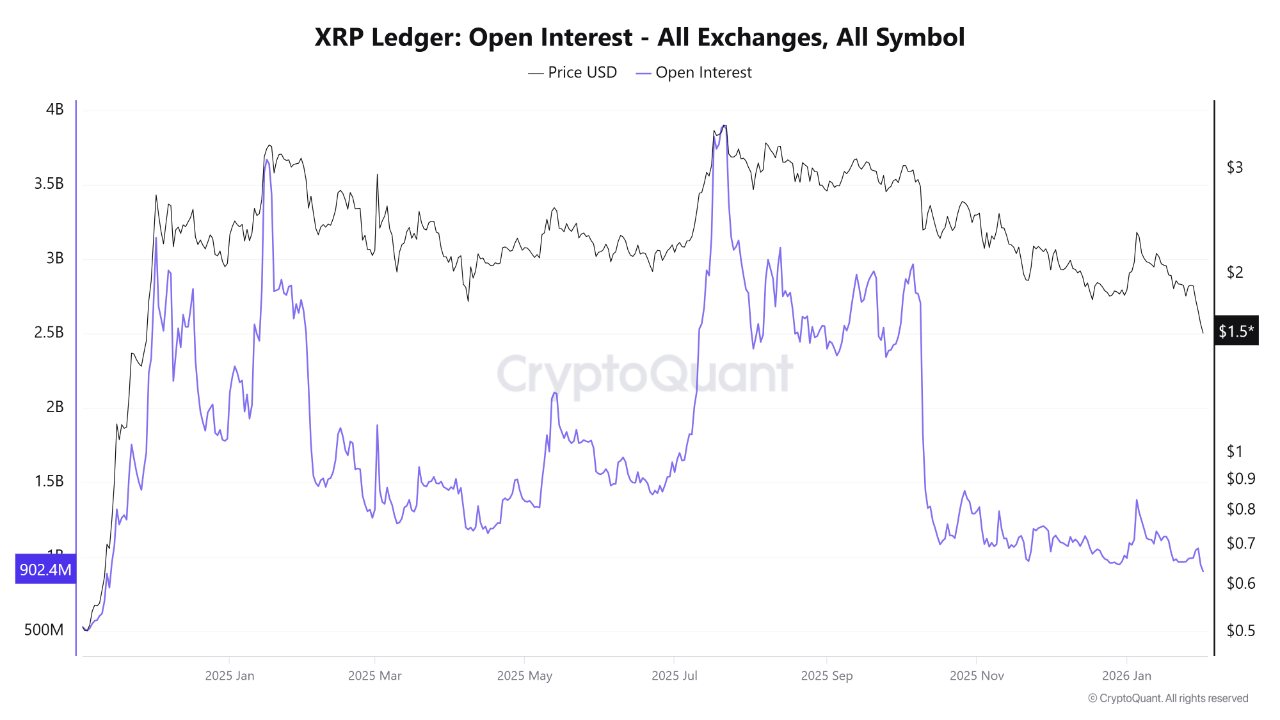
XRP Ledger Open Interest | Source: CryptoQuant

Such contractions often reflect a market that is de-risking after extended volatility. With fewer leveraged positions in play, price movements tend to become slower but more deliberate, as speculative excess is flushed out. As XRP tests the $1.60 area, analysts are closely watching whether this leverage reset lays the groundwork for stabilization—or signals deeper downside still ahead.

The report adds important color by breaking down where the leverage reduction is taking place. On Binance, open interest in XRP derivatives has fallen to around 458 million. While this figure remains above the levels observed last December, it still represents a sharp contraction from the highs seen earlier in the cycle.

Crucially, this decline on Binance mirrors what is happening across other major trading venues, reinforcing the view that the market is undergoing a broad deleveraging phase rather than a simple migration of positions between exchanges.

From a structural standpoint, this matters. When open interest compresses simultaneously across platforms, it typically reflects traders actively reducing risk and closing leveraged exposure. This kind of environment often precedes periods of price consolidation, as the market digests prior volatility and searches for a new equilibrium. In past cycles, these phases have frequently led to the formation of base structures, particularly when selling pressure fades and volatility compresses.

Looking ahead, analysts note that any recovery in open interest will be critical to monitor. A rebound in leverage that coincides with improving price momentum could serve as an early signal that a new trend is developing.

For now, however, the drop in open interest to its lowest level since 2024 points to a clear market cleanup. While this reset may appear quiet on the surface, it can provide a healthier foundation for future moves—provided risk management remains front and center in the next phase of XRP’s market evolution.

XRP Price Showing Weakness

XRP price action continues to reflect structural weakness as the asset trades decisively below its key moving averages and tests the $1.60 zone for support. The chart shows a clear transition from a prior uptrend into a sustained downtrend, marked by lower highs and lower lows since the October peak near the $3.50–$3.60 region. Momentum has steadily deteriorated, with each rebound failing below the declining short- and medium-term moving averages, signaling persistent seller control.
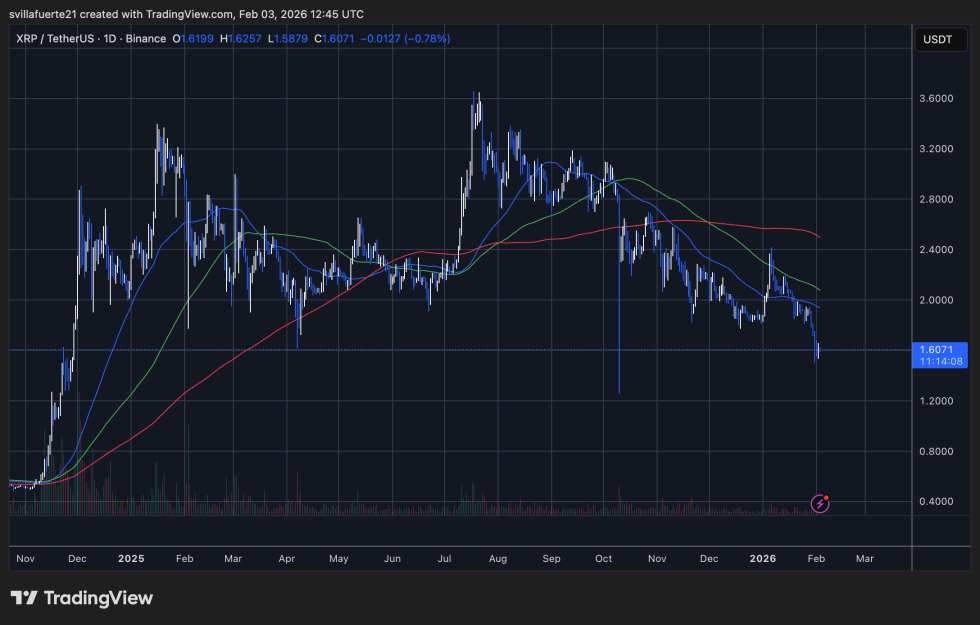
XRP testing critical demand level | Source: XRPUSDT chart on TradingView

The loss of the $1.80 level is technically significant. This zone previously acted as a consolidation base and demand area, but the clean breakdown suggests that buyers have stepped aside rather than aggressively defending the price. XRP is now trading below the 50-day and 100-day moving averages, while the 200-day moving average above continues to slope downward, reinforcing a bearish medium-term structure.

Volume remains relatively muted compared to earlier distribution phases, which aligns with the derivatives data showing a contraction in leverage rather than panic-driven liquidation. This supports the view that the current move is more of a controlled unwind than a capitulation event.

As long as price holds the $1.55–$1.60 region, XRP may attempt to stabilize and form a base. However, a failure to hold this area would expose the market to a deeper retracement toward prior demand zones near $1.30–$1.40.

Featured image from ChatGPT, chart from TradingView.com

Related Questions

QWhat is the current level of XRP open interest and why is it significant?

AXRP open interest has fallen to roughly 902 million, marking its lowest level since 2024. This is significant because it represents a sharp contraction from the 2.5-3.0 billion levels seen during 2025, indicating a broad deleveraging phase and a meaningful shift in trader behavior away from speculative excess.

QAccording to the article, what does a simultaneous decline in open interest across multiple exchanges typically indicate?

AA simultaneous decline in open interest across multiple exchanges typically indicates that traders are actively reducing risk and closing leveraged exposure, rather than simply moving positions between venues. This often reflects a broad market de-risking and can precede periods of price consolidation.

QWhat key price level did XRP lose that the article describes as 'technically significant'?

AThe article describes the loss of the $1.80 level as technically significant. This zone previously acted as a consolidation base and demand area, and its clean breakdown suggests that buyers have stepped aside rather than aggressively defending the price.

QWhat potential price levels are identified as critical support and next downside targets for XRP?

AThe $1.55–$1.60 region is identified as critical short-term support. If this area fails to hold, the article states it would expose the market to a deeper retracement toward prior demand zones near $1.30–$1.40.

QHow does the article characterize the nature of the price decline based on volume and derivatives data?

AThe article characterizes the decline as a controlled unwind rather than a capitulation event. This is supported by relatively muted volume compared to earlier distribution phases and derivatives data showing a contraction in leverage instead of panic-driven liquidations.

Related Reads

What Happens to Ethereum Developer Tools After the Grants Run Out?

On February 27th, the Ethereum Foundation (EF) announced Project Odin, a structured sustainability support program designed for a select group of strategic, previously grant-funded teams. Unlike a standard grant, Odin offers a long-term advisory mechanism focused on helping these teams establish credible, sustainable paths within a two-year framework, thereby reducing long-term dependence on single funding sources. The program addresses a critical post-grant challenge: how essential public goods, especially major developer tools, can achieve financial sustainability beyond initial funding. While grants from EF and programs like Gitcoin or RetroPGF remain vital for startups and research, they often fall short for mature, widely-used infrastructure. Tools like compilers, languages, and network stacks are deeply embedded but struggle with monetization, trapped between being too foundational to lose and too public to generate natural revenue. Project Odin provides teams with a dedicated Strategic Advisor to guide them through a three-phase process: 1) analyzing current funding and realistic options, 2) validating potential paths with stakeholders, and 3) executing plans, which may include crafting support contracts, service agreements, or other recurring revenue models. The first pilot participant is Vyper, a critical smart contract language for the EVM, highlighting the need for sustainable models for core infrastructure. The initiative reframes the public goods conversation from "who should be funded" to "how do already-proven teams avoid perpetual funding crises?" It encourages ecosystem participants—protocols and projects that depend on these tools—to view sustainable support not just as charity, but as essential risk management for their own operational supply chains.

marsbit16m ago

What Happens to Ethereum Developer Tools After the Grants Run Out?

marsbit16m ago

MARA Reports Q1 Revenue Below Expectations, Net Loss of $1.3 Billion, Stock Plunges After Hours

Bitcoin mining firm MARA Holdings reported disappointing Q1 2024 results, causing its stock to erase all daily gains and fall 3.44% in after-hours trading. Revenue dropped 18% year-over-year to $174.6 million, missing Wall Street estimates of $192.7 million. The company posted a net loss of $1.3 billion, a significant increase from a $533.4 million loss a year ago, primarily driven by unrealized losses on its holdings of 38,689 Bitcoin, which depreciated in value during the quarter. MARA also sold over 15,100 BTC in late March to repurchase debt at a discount. The broader mining environment remains challenging due to a 35% decline in Bitcoin's price from its all-time high and a nearly 30% increase in mining difficulty over the past year. MARA's market cap ranking among U.S. miners has slipped to seventh. Critically, the company announced a strategic pivot away from Bitcoin mining expansion. It stated it has no plans to purchase new mining equipment and is fully transitioning toward AI data centers. Its strategy involves retrofitting existing mining sites for AI and high-performance computing (HPC) and leveraging its recent $1.5 billion acquisition of Long Ridge Energy & Power, a gas-fired power plant and data center. This infrastructure could eventually support 600 MW of AI compute capacity, allowing MARA to redeploy up to 90% of its non-custodial mining power for AI and IT workloads.

marsbit17m ago

MARA Reports Q1 Revenue Below Expectations, Net Loss of $1.3 Billion, Stock Plunges After Hours

marsbit17m ago

The AI Investment Landscape Is Being Reshaped: Beyond the 'Magnificent Seven', What Opportunities Lie in the Semiconductor Supply Chain?

AI Investment Map is Reshaping: Opportunities Beyond the 'Magnificent Seven' Since ChatGPT ignited the AI wave, investment initially focused on the "Magnificent Seven" tech giants dominating cloud infrastructure. However, the rise of DeepSeek and debates on AI capital expenditure effectiveness are shifting this dynamic. Investors now recognize opportunities deeper in the supply chain—the companies providing the essential "picks and shovels." Early concerns about an AI investment "arms race" and potential low returns were partly alleviated by strong Q1 earnings from cloud providers, validating robust compute demand. This has highlighted a more certain investment thesis: regardless of which AI applications ultimately win, massive capital expenditure will first fuel demand for semiconductors and related components. This "pick-and-shovel" logic has driven semiconductor ETFs to record highs. Key beneficiaries include: * **Memory Chipmakers (e.g., SK Hynix, Samsung, Micron)**: High Bandwidth Memory (HBM) is a critical bottleneck for AI training. * **Photonics Companies**: Crucial for high-speed data transfer within AI data centers. * **The Broader "AI-11" Semiconductor Ecosystem**: This encompasses foundries & lithography (TSMC, ASML), logic & custom chips (AMD, Broadcom, Intel, Marvell), and enterprise storage (SanDisk, Western Digital). Every dollar of AI infrastructure spending flows through this chain. While the "Magnificent Seven" remain dominant in market size, their earnings growth premium over the rest of the S&P 500 ("S&P 493") is narrowing. Market attention and marginal investment are shifting towards the expanding semiconductor supply chain. The investment narrative is evolving from "betting on the ultimate AI winner" to "investing in the certainty of the infrastructure build-out." Understanding this shift from the demand side to the supply side is key to identifying future AI investment opportunities.

marsbit46m ago

The AI Investment Landscape Is Being Reshaped: Beyond the 'Magnificent Seven', What Opportunities Lie in the Semiconductor Supply Chain?

marsbit46m ago

Trading

Spot
Futures

Hot Articles

What is XRP 2.0

XRP 2.0: A New Frontier in the Cryptocurrency Landscape Introduction to XRP 2.0 In the ever-evolving realm of cryptocurrency, new projects continuously emerge, vying for attention and adoption. One such promising initiative is XRP 2.0, a novel cryptocurrency project designed to leverage advanced blockchain technology and robust encryption methodologies. While the name draws parallels with Ripple’s XRP, it’s crucial to note that XRP 2.0 operates independently, focusing on enhancing transaction security, privacy, and scalability. As the digital financial landscape increasingly embraces decentralized solutions, XRP 2.0 aims to contribute meaningfully to web3 and the overall expansion of crypto projects. What is XRP 2.0? At its core, XRP 2.0 is a cryptocurrency project that aims to create a secure and decentralized digital currency ecosystem. Its foundational technology integrates sophisticated blockchain principles with cutting-edge encryption techniques. The overarching goal of XRP 2.0 is to establish itself as a reliable and efficient platform enabling swift transaction execution while prioritizing enhanced privacy protections for its users. The project is promoted as a solution to many limitations faced by existing cryptocurrencies, proposing a system that can handle a higher volume of transactions with improved speed and privacy. This versatility positions XRP 2.0 as a significant contender in a marketplace riddled with various digital currencies. Who is the Creator of XRP 2.0? The identity of the creator behind XRP 2.0 has been flagged as ‘Wilbur.’ However, comprehensive details regarding Wilbur or their associated entity remain elusive. The anonymity of many cryptocurrency creators is not an uncommon phenomenon in the industry, often designed to maintain a degree of privacy and security. Who are the Investors of XRP 2.0? As of now, specific information related to the investment foundations or organizations supporting XRP 2.0 is not publicly available. In the cryptocurrency sector, the backing by reputed investors can significantly influence a project's credibility and success, yet the transparency regarding the financial supporters of XRP 2.0 has not been established. How Does XRP 2.0 Work? XRP 2.0 stands out by employing a combination of blockchain technology and advanced encryption algorithms that ensures secure and decentralized transactions. Its innovative structure includes unique features designed to foster user engagement and broaden functionalities beyond conventional cryptocurrency transactions. Among these features, XRP 2.0 incorporates AI-powered capabilities, such as text-to-image and text-to-speech functionalities. These additions are designed to enhance the interactive experience for users, promoting broader applicability across various sectors. By bridging technological advancements with user-centered design, XRP 2.0 aims to capture the attention of a diverse range of individuals and enterprises looking to integrate cryptocurrency solutions into their operational frameworks. Timeline of XRP 2.0 Understanding XRP 2.0 requires examining the milestones that have defined its journey thus far: July 23, 2023: XRP 2.0 is introduced as a novel cryptocurrency project, aiming to revolutionize secure and decentralized transaction capabilities in the blockchain domain. September 8, 2023: The launching of another project, XRP20, occurs, marking the emergence of an ERC-20 token on the Ethereum blockchain that remains unrelated to XRP 2.0. November 13, 2023: The XRP Ledger undergoes a significant update with the release of rippled server software version 2.0.0. It is essential to note that this development is disconnected from the XRP 2.0 cryptocurrency project. Key Points About XRP 2.0 To distill the essence of XRP 2.0, several critical factors emerge: Unique Features: The inclusion of features like AI-powered text-to-image and text-to-speech further diversifies the potential applications of XRP 2.0. Blockchain Technology: The framework utilizes advanced blockchain mechanisms and encryption protocols, ensuring a secure and decentralized environment for transactions. Scalability and Privacy: XRP 2.0 prioritizes enhanced privacy protections in transaction processes and the scalability necessary to accommodate a growing user base. No Affiliation with Ripple: Importantly, despite its name, XRP 2.0 does not have any allegiance or collaboration with Ripple’s XRP, distinguishing its operational framework and objectives within the cryptocurrency ecosystem. Conclusion XRP 2.0 represents an ambitious venture into the cryptocurrency sphere, aiming to offer a combination of security, privacy, and efficiency in digital transactions. By integrating sophisticated technologies and user-friendly features, the project sets out to broaden the horizons of what cryptocurrency can achieve in today's digital economy. While the anonymity of its creator and lack of disclosed investors might raise questions for some, XRP 2.0's focus on advanced functionalities and decentralisation enhances its appeal amidst an increasingly crowded crypto market. As the cryptocurrency landscape continues to evolve, XRP 2.0 may yet emerge as a pivotal player in the expansion of secure and scalable blockchain solutions.

941 Total ViewsPublished 2024.04.01Updated 2024.12.03

What is XRP 2.0

Discussions

Welcome to the HTX Community. Here, you can stay informed about the latest platform developments and gain access to professional market insights. Users' opinions on the price of XRP (XRP) are presented below.

活动图片











