XRP Locked In DeFi Continues To Rise Across The Ecosystem – Here’s How Much

bitcoinistPublished on 2026-02-03Last updated on 2026-02-03

Abstract

With the DeFi ecosystem growing, a significant amount of XRP is being moved into decentralized applications, liquidity pools, and on-chain financial products. According to Mason Versluis, over 222.2 million XRP are now locked in DeFi, indicating rising confidence in XRP-based infrastructure and a shift beyond basic transfers toward yield generation and liquidity provision. This increased utilization may reduce selling pressure and support long-term demand. Additionally, Ripple has achieved a major regulatory milestone by acquiring a full Electronic Money Institution license in Luxembourg, strengthening its position in Europe and enabling compliant payment services across the EU. This, along with over 75 global licenses, could boost institutional adoption for XRP and Ripple's stablecoin RLUSD.

With the DeFi ecosystem experiencing continued growth, a notable amount of XRP is being seen across the sector. After a period of reduced demand, more of the token has been moved into several areas of the ecosystem, such as decentralized applications (dApps) and on-chain finance products.

More XRP Moves Into DeFi Ecosystem

XRP is becoming a pillar for on-chain utilization. A recent report shows that the quantity of XRP in circulation inside the Decentralized Finance (DeFi) ecosystem is continuously growing, indicating a significant change in the way the asset is utilized throughout the network.

According to Mason Versluis, a builder and YouTuber on the X platform, there are now more than 222.2 million XRP in the DeFi ecosystem. More coins are migrating into decentralized applications, liquidity pools, and on-chain financial products, reflecting rising confidence in XRP-based DeFi infrastructure.

Such a massive supply implies that XRP is becoming more involved in yield production and on-chain liquidity, going beyond basic transfers. Furthermore, the growing DeFi network may become increasingly significant in determining the long-term demand and usefulness of the leading altcoin.
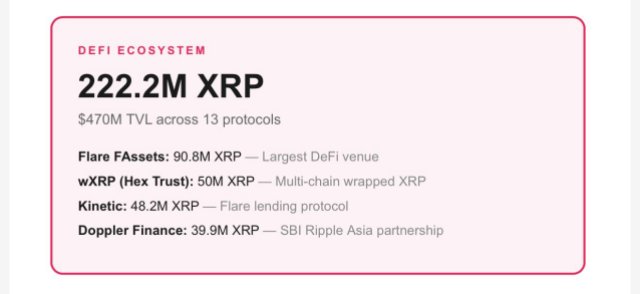
Source: Chart from Mason Versluis on X

Versluis has also underscored the significance of the development to XRP. Why this is amazing is that if the token is being used, it is likely not going to be sold. Currently, the builder highlighted that there is a need for many people to buy, hold, and not sell their tokens. “Get back to the basics of how crypto goes up,” Versluis added. However, the analyst is unsure if there is enough retail money left to raise the token to the level that cryptocurrency players desire.

In the meantime, mega wealth is steadily investing in the altcoin. A clear example is the Exchange-Traded Funds (ETFs), which are great because they are bought at a higher price than small or retail investors can access.

Ripple New Milestone To Bolster Adoption

Ripple continues to make bold steps that could extremely bolster the company’s status and spur fresh interest for XRP and its ecosystem. Paul Barron, a technologist and crypto investor, has unveiled the payment firm’s latest achievement in the financial landscape, which is making waves across the community.

The post discloses that the company has hit a major regulatory milestone after formally acquiring its full Electronic Money Institution (EMI) license from Luxembourg. Ripple’s regulatory position in Europe is strengthened by the approval, which enables it to provide e-money and payment services that are compliant throughout the EU under a well-defined legal framework.

By addressing some confusion about the acquisition, Barron stated that Ripple now holds over 75 global licenses, including the two most critical financial hubs, which are London and Luxembourg. With complete “passporting” privileges in all 27 EU countries, XRP and Ripple’s stablecoin RLUSD are now officially open for institutional adoption. Once this happens in the US with Clarity, institutional interest might skyrocket.

XRP trading at $1.61 on the 1D chart | Source: XRPUSDT on Tradingview.com

Trending Cryptos

Related Questions

QAccording to the article, how much XRP is currently locked in the DeFi ecosystem?

AThere are now more than 222.2 million XRP in the DeFi ecosystem.

QWhat does Mason Versluis suggest is the significance of XRP being used in DeFi?

AHe suggests that if the token is being used, it is likely not going to be sold, which is a basic principle for how the value of a cryptocurrency increases.

QWhat major regulatory milestone did Ripple recently achieve in Europe?

ARipple formally acquired its full Electronic Money Institution (EMI) license from Luxembourg, strengthening its regulatory position in Europe.

QWhat new capability does Ripple's EMI license provide it in the European Union?

AThe license provides Ripple with complete 'passporting' privileges, allowing it to offer compliant e-money and payment services across all 27 EU countries.

QBesides XRP, which other Ripple asset is mentioned as being opened up for institutional adoption in the EU?

ARipple's stablecoin, RLUSD, is also now officially open for institutional adoption in the EU.

Related Reads

Agent Race Ends, Super Workbench Takes Over

The era of fragmented AI agents is ending. Over the past month, China's tech giants—Tencent, Alibaba, and ByteDance—have simultaneously shifted strategy: instead of launching new, standalone AI agents, they are consolidating their various agent projects into unified "super workbenches." Tencent integrated its QClaw teams into WorkBuddy, a strategic product hailed as a potential third flagship after QQ and WeChat. Alibaba is merging its QoderWork, Wukong, and MuleRun agents into a new "Qianwen Office" platform under DingTalk's leadership. ByteDance rebranded its TRAE SOLO coding agent to TRAE Work, signaling a broader focus on workflow collaboration. This convergence marks a pivotal industry consensus. The initial exploration phase, where companies rapidly built numerous overlapping agents for different scenarios, proved costly and inefficient. With open-source tools eroding technical barriers, competition has shifted from agent creation to resource consolidation and cost control. Historically, platform wars are won not by creating more products, but by simplifying them—as seen with browsers unifying web access and super-apps consolidating services. Now, the "super workbench" aims to become the unified AI entry point for work. This reflects a deeper market realization: the primary audience for AI is no longer just programmers (a market in the tens of millions) but all knowledge workers (a market of billions). The real opportunity lies in augmenting everyday tasks—managing emails, documents, data, and meetings—across the entire workday. The core battleground is becoming control over the primary AI entry point that employees use daily. Tencent's WorkBuddy leverages WeChat and Tencent Docs; Alibaba's Qianwen Office taps into DingTalk's organizational data; ByteDance's TRAE Work integrates with Feishu's workflows. Whoever owns this "super workbench" gains strategic control over orchestrating enterprise data and APIs. This shift is redefining enterprise software. Traditional SaaS applications, valued for their user interfaces, will recede into the background. Their core functionalities will be exposed as standardized "Skills" or APIs for the super workbench's agents to invoke. Software value will shift from selling user seats to charging based on API calls and outcomes delivered. The evolution of agents is moving through clear stages: first as novel standalone products, then as consolidated primary work entry points, and finally as pervasive, invisible capabilities embedded into the digital fabric. The recent moves by major tech firms signal the transition from the first stage into the second, accelerating toward the third. In the end, the most successful agent technology may become invisible—like electricity or the HTTP protocol—a fundamental, unnamed infrastructure powering work itself.

marsbit18m ago

Agent Race Ends, Super Workbench Takes Over

marsbit18m ago

Michael Saylor: 110 Reasons to Oppose BIP-110

Michael Saylor presents 110 arguments against Bitcoin Improvement Proposal (BIP) 110, a soft fork aimed at restricting certain non-monetary data storage uses (like inscriptions) on the Bitcoin blockchain. He acknowledges the proponents' valid concerns—such as node costs, fee pressure, and preserving Bitcoin's monetary focus—but fundamentally disagrees with the proposed solution. Saylor argues that BIP 110 represents a dangerous precedent of using consensus rules to enforce value judgments on transaction validity, moving away from Bitcoin's core principles of neutrality and permissionless innovation. His key objections are organized into eleven categories: 1) It violates neutrality and hard consensus by banning currently valid transactions. 2) It fails to meet the high burden of proof required for a consensus change, lacking concrete data on the alleged crisis. 3) Its seven bundled technical restrictions are overly broad, targeting generic script functionalities and blocking future upgrade paths. 4) It sacrifices compatibility and future optionality by closing off designed upgrade hooks. 5) Its temporary rules add significant complexity (grandfathering, expiry states) without sufficient justification. 6) The economic and security impacts, particularly on miner revenue and fee markets, are uncertain and unmodeled. 7) Superior, market-based tools (fee markets, relay/mining policies) already exist to manage blockchain load. 8) It stifles innovation by creating a chilling effect for developers. 9) Its modified activation mechanism (55% threshold, forced signaling) is aggressive and risks network splits. 10) The precedent it sets—using consensus to suppress disliked but legal uses—is more dangerous than the problem it aims to solve. 11) A better path exists: improving measurements, refining resource-based policies, and allowing market forces to work. Saylor concludes that Bitcoin's strength lies in its neutral rules, open markets, and hard consensus. Changing these foundational elements to target specific use cases is an unnecessary and risky "iatrogenic" intervention. He advocates for guarding Bitcoin's neutrality rather than acting as its redeemer.

marsbit34m ago

Michael Saylor: 110 Reasons to Oppose BIP-110

marsbit34m ago

Trading

Spot

Hot Articles

What is XRP 2.0

XRP 2.0: A New Frontier in the Cryptocurrency Landscape Introduction to XRP 2.0 In the ever-evolving realm of cryptocurrency, new projects continuously emerge, vying for attention and adoption. One such promising initiative is XRP 2.0, a novel cryptocurrency project designed to leverage advanced blockchain technology and robust encryption methodologies. While the name draws parallels with Ripple’s XRP, it’s crucial to note that XRP 2.0 operates independently, focusing on enhancing transaction security, privacy, and scalability. As the digital financial landscape increasingly embraces decentralized solutions, XRP 2.0 aims to contribute meaningfully to web3 and the overall expansion of crypto projects. What is XRP 2.0? At its core, XRP 2.0 is a cryptocurrency project that aims to create a secure and decentralized digital currency ecosystem. Its foundational technology integrates sophisticated blockchain principles with cutting-edge encryption techniques. The overarching goal of XRP 2.0 is to establish itself as a reliable and efficient platform enabling swift transaction execution while prioritizing enhanced privacy protections for its users. The project is promoted as a solution to many limitations faced by existing cryptocurrencies, proposing a system that can handle a higher volume of transactions with improved speed and privacy. This versatility positions XRP 2.0 as a significant contender in a marketplace riddled with various digital currencies. Who is the Creator of XRP 2.0? The identity of the creator behind XRP 2.0 has been flagged as ‘Wilbur.’ However, comprehensive details regarding Wilbur or their associated entity remain elusive. The anonymity of many cryptocurrency creators is not an uncommon phenomenon in the industry, often designed to maintain a degree of privacy and security. Who are the Investors of XRP 2.0? As of now, specific information related to the investment foundations or organizations supporting XRP 2.0 is not publicly available. In the cryptocurrency sector, the backing by reputed investors can significantly influence a project's credibility and success, yet the transparency regarding the financial supporters of XRP 2.0 has not been established. How Does XRP 2.0 Work? XRP 2.0 stands out by employing a combination of blockchain technology and advanced encryption algorithms that ensures secure and decentralized transactions. Its innovative structure includes unique features designed to foster user engagement and broaden functionalities beyond conventional cryptocurrency transactions. Among these features, XRP 2.0 incorporates AI-powered capabilities, such as text-to-image and text-to-speech functionalities. These additions are designed to enhance the interactive experience for users, promoting broader applicability across various sectors. By bridging technological advancements with user-centered design, XRP 2.0 aims to capture the attention of a diverse range of individuals and enterprises looking to integrate cryptocurrency solutions into their operational frameworks. Timeline of XRP 2.0 Understanding XRP 2.0 requires examining the milestones that have defined its journey thus far: July 23, 2023: XRP 2.0 is introduced as a novel cryptocurrency project, aiming to revolutionize secure and decentralized transaction capabilities in the blockchain domain. September 8, 2023: The launching of another project, XRP20, occurs, marking the emergence of an ERC-20 token on the Ethereum blockchain that remains unrelated to XRP 2.0. November 13, 2023: The XRP Ledger undergoes a significant update with the release of rippled server software version 2.0.0. It is essential to note that this development is disconnected from the XRP 2.0 cryptocurrency project. Key Points About XRP 2.0 To distill the essence of XRP 2.0, several critical factors emerge: Unique Features: The inclusion of features like AI-powered text-to-image and text-to-speech further diversifies the potential applications of XRP 2.0. Blockchain Technology: The framework utilizes advanced blockchain mechanisms and encryption protocols, ensuring a secure and decentralized environment for transactions. Scalability and Privacy: XRP 2.0 prioritizes enhanced privacy protections in transaction processes and the scalability necessary to accommodate a growing user base. No Affiliation with Ripple: Importantly, despite its name, XRP 2.0 does not have any allegiance or collaboration with Ripple’s XRP, distinguishing its operational framework and objectives within the cryptocurrency ecosystem. Conclusion XRP 2.0 represents an ambitious venture into the cryptocurrency sphere, aiming to offer a combination of security, privacy, and efficiency in digital transactions. By integrating sophisticated technologies and user-friendly features, the project sets out to broaden the horizons of what cryptocurrency can achieve in today's digital economy. While the anonymity of its creator and lack of disclosed investors might raise questions for some, XRP 2.0's focus on advanced functionalities and decentralisation enhances its appeal amidst an increasingly crowded crypto market. As the cryptocurrency landscape continues to evolve, XRP 2.0 may yet emerge as a pivotal player in the expansion of secure and scalable blockchain solutions.

1.2k Total ViewsPublished 2024.04.01Updated 2024.12.03

What is XRP 2.0

Discussions

Welcome to the HTX Community. Here, you can stay informed about the latest platform developments and gain access to professional market insights. Users' opinions on the price of XRP (XRP) are presented below.

活动图片












