XRP Ledger Transactions Are Surging Again, Here Are The Numbers

bitcoinistPublished on 2026-04-22Last updated on 2026-04-22

Abstract

XRP Ledger is experiencing a significant surge in activity, particularly in AccountSet transactions, which are used to configure account settings and indicate backend or institutional activity rather than simple transfers. These transactions recently hit an all-time high of over 120,000, reflecting infrastructure development. This is part of a broader increase in network usage, with daily transactions reaching nearly 3 million in 2026, up from around 1 million in mid-2025. The number of non-empty wallets has also surpassed 7.7 million. Despite this growth, the price of XRP remains below its 2025 peak, with analysts suggesting regulatory clarity, such as the CLARITY Act, may be needed for a price repricing.

A quiet corner of the XRP Ledger is suddenly lighting up. After years of relatively flat activity, a specific transaction type, the AccountSet, is now spiking to levels never seen before, adding to a surge in on-chain usage across the network.

The increase in activity is playing out alongside rising transaction counts, expanding wallet activity, and growing institutional involvement in 2026, hinting that something more structural may be taking shape.

New Numbers On The XRP Ledger

What was once a rarely used function has now turned into one of the fastest-growing transaction categories on the ledger, with activity going on a huge vertical spike in 2026. Recent data shows that XRPL AccountSet transactions recently spiked to an all-time high, marking a break in years of muted activity and flat movement.

To understand why this matters, it is important to know what AccountSet transactions actually do, as they are not ordinary transfers or trades. They are used to configure an account’s settings on the XRP Ledger. This includes permissions, setting operational flags, linking identity domains, and preparing accounts for features.

Because of that, spikes in AccountSet transactions are a reflection of backend activity. They show that accounts are being set up, adjusted, or prepared for more advanced use cases. In practical terms, it points to infrastructure being built, not just coins being moved.
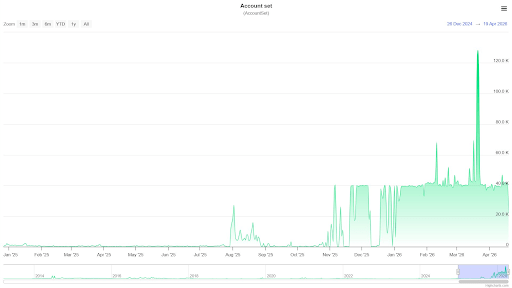
Source: Chart from Xaif Crypto on X

In this instance, AccountSet transactions climbed past 120,000, and this is a scale of activity that normal users cannot produce.

The Broader Transaction Surge: Nearly Three Million Daily

The AccountSet spike is part of a wider explosion in ledger activity that the numbers make difficult to dismiss. Daily transaction volume on the XRP Ledger recently surged to almost 3 million, a near-tripling of the approximately 1 million transactions recorded per day in mid-2025, according to data published by Evernorth, the largest public XRP treasury company.

The trajectory of that growth was not a straight line upward. Monthly average transactions fluctuated between 800,000 and 950,000 from May through August 2025, before declining to lows around 700,000. However, monthly averages moved past 1 million early in 2026 and continued rising, and consistent high-volume days above 3 million are now the norm.

Furthermore, the ledger’s total wallet count recently breached a threshold not seen in its 13-year existence, as non-empty addresses have now crossed above 7.7 million.

There is a disconnect between all of this activity and the XRP token price, which is well below its 2025 peak of $3.65. That disconnect has become a key point of focus among many crypto market participants. According to Zach Pandl, Head of Research at Grayscale Investments, regulatory clarity, specifically the passage of the CLARITY Act, could be the factor that leads to the anticipated repricing of XRP.

XRP trading at $1.43 on the 1D chart | Source: XRPUSDT on Tradingview.com

Trending Cryptos

Related Questions

QWhat specific type of transaction on the XRP Ledger is experiencing a significant spike in activity?

AAccountSet transactions.

QAccording to the data from Evernorth, what was the recent peak in daily transaction volume on the XRP Ledger?

ANearly 3 million transactions.

QWhat is the primary purpose of an AccountSet transaction on the XRP Ledger?

AThey are used to configure an account’s settings, including permissions, setting operational flags, linking identity domains, and preparing accounts for features.

QWhat key milestone did the number of non-empty XRP Ledger wallets recently achieve?

AThey crossed above 7.7 million.

QAccording to Zach Pandl of Grayscale, what could be the factor that leads to a repricing of the XRP token?

ARegulatory clarity, specifically the passage of the CLARITY Act.

Related Reads

Misjudged A-Shares: Resilience, Expectations, and Confidence

China's A-share market recently faced selling pressure, especially in tech sectors, initially triggered by a global tech sell-off that began in South Korea. However, the article argues this is a case of "mistaken injury" and highlights the market's underlying resilience. This resilience stems from three main pillars: **1) Tech Sector Fundamentals:** Unlike Korea's market dominated by a few memory chip stocks, China's tech sector is diversified across computing, communications, electronics, and semiconductors, supported by dual narratives of global AI supply chains and domestic substitution. Core areas like optical modules and fiber optics continue to show strong earnings growth. **2) "National Team" Support:** State-backed institutions and large corporations have made significant market purchases and announced buybacks, providing liquidity and signaling confidence. This is seen as a stabilizing policy signal, often associated with market bottoms. **3) Broader Market Pillars:** Other major sectors are showing endogenous recovery momentum. Consumer stocks benefit from stabilizing CPI and signs of sector recovery (e.g., liquor price hikes). Cyclical sectors like aluminum have high earnings, potential price increases due to tight supply, and low valuations. The financial sector offers stable dividends and low valuations. The conclusion is that the sell-off was driven by external contagion, not a collapse in fundamentals. With strong policy support and recovering momentum across key sectors, the A-share market possesses the toughness to regain stability.

marsbit5m ago

Misjudged A-Shares: Resilience, Expectations, and Confidence

marsbit5m ago

The Clarity Act's Journey Through Congress: The Thorny Path of Bipartisan Compromise in the U.S.

The U.S. Congress is struggling to advance the crypto market structure bill known as the Clarity Act, with bipartisan compromise proving difficult. Key hurdles include unresolved disputes over "yield" products and, more critically, the inclusion of strong ethics provisions for elected officials—a non-negotiable demand for many Democrats. While a compromise on yield was reached in May, securing only limited Democratic support in committee, the separate Senate Agriculture Committee version later passed with no Democratic votes due to the ethics impasse. As Republicans push for a full Senate vote in July, demands for ethics rules have expanded, and other contentious issues like developer protections and concerns from law enforcement and large banks further complicate negotiations. Despite consensus on the need for legislation, the path forward is unclear. Recent discussions between senators and White House officials aim to find acceptable ethics language. Some lawmakers question whether a compromise text can garner enough bipartisan support, with one Democrat stating the current proposal lacks the strong ethics provisions required for their vote. Potential short-term goals for the crypto community include symbolic Senate action before the August recess, a longer-term aim for passage by 2026, or establishing a detailed framework that addresses ethics and other compromises. The process remains arduous, relying on the traditional, vote-by-vote effort to build bipartisan support.

marsbit24m ago

The Clarity Act's Journey Through Congress: The Thorny Path of Bipartisan Compromise in the U.S.

marsbit24m ago

Are Kalshi and Polymarket Founders at Odds? This Business Rivalry Is More Brutal Than You Think

"The Rivalry Between Kalshi and Polymarket Founders Turns Bitter and Litigious" The intense feud between Tarek Mansour, CEO of Kalshi, and Shayne Coplan, founder of Polymarket, has escalated far beyond typical business competition into personal animosity and regulatory battles. Both lead billion-dollar prediction market platforms, but their approaches differ sharply. Kalshi positions itself as the compliant operator, securing U.S. regulatory approval before launching. In contrast, Polymarket initially operated offshore, allowing U.S. users to access its platform via VPN, which drew regulatory scrutiny. The conflict reached a peak in November 2024 when FBI agents raided Coplan's New York apartment. While Coplan publicly blamed political motives, his team privately suspected Kalshi was involved. According to sources, Kalshi's lawyers had previously reported Polymarket's operations to federal prosecutors, highlighting its accessibility to U.S. users despite a ban. This incident fueled mutual accusations and underhanded tactics, including social media smear campaigns and attempts to sabotage each other's major business deals. Their rivalry also played out in Washington, influencing regulatory debates. Kalshi actively lobbied against Polymarket's practices, framing them as illegal and unethical. Polymarket, after facing a CFTC fine and investigation, later acquired a licensed U.S. firm to launch a domestic app, regaining a foothold. Despite the hostility, both companies have seen massive growth, with combined trading volumes soaring. However, increased regulatory scrutiny, particularly around insider trading on Polymarket's platform, continues to pose challenges. The founders' deep-seated mutual disdain ensures their battle for market dominance remains as much a personal vendetta as a commercial one.

marsbit33m ago

Are Kalshi and Polymarket Founders at Odds? This Business Rivalry Is More Brutal Than You Think

marsbit33m ago

Trading

Spot

Hot Articles

What is XRP 2.0

XRP 2.0: A New Frontier in the Cryptocurrency Landscape Introduction to XRP 2.0 In the ever-evolving realm of cryptocurrency, new projects continuously emerge, vying for attention and adoption. One such promising initiative is XRP 2.0, a novel cryptocurrency project designed to leverage advanced blockchain technology and robust encryption methodologies. While the name draws parallels with Ripple’s XRP, it’s crucial to note that XRP 2.0 operates independently, focusing on enhancing transaction security, privacy, and scalability. As the digital financial landscape increasingly embraces decentralized solutions, XRP 2.0 aims to contribute meaningfully to web3 and the overall expansion of crypto projects. What is XRP 2.0? At its core, XRP 2.0 is a cryptocurrency project that aims to create a secure and decentralized digital currency ecosystem. Its foundational technology integrates sophisticated blockchain principles with cutting-edge encryption techniques. The overarching goal of XRP 2.0 is to establish itself as a reliable and efficient platform enabling swift transaction execution while prioritizing enhanced privacy protections for its users. The project is promoted as a solution to many limitations faced by existing cryptocurrencies, proposing a system that can handle a higher volume of transactions with improved speed and privacy. This versatility positions XRP 2.0 as a significant contender in a marketplace riddled with various digital currencies. Who is the Creator of XRP 2.0? The identity of the creator behind XRP 2.0 has been flagged as ‘Wilbur.’ However, comprehensive details regarding Wilbur or their associated entity remain elusive. The anonymity of many cryptocurrency creators is not an uncommon phenomenon in the industry, often designed to maintain a degree of privacy and security. Who are the Investors of XRP 2.0? As of now, specific information related to the investment foundations or organizations supporting XRP 2.0 is not publicly available. In the cryptocurrency sector, the backing by reputed investors can significantly influence a project's credibility and success, yet the transparency regarding the financial supporters of XRP 2.0 has not been established. How Does XRP 2.0 Work? XRP 2.0 stands out by employing a combination of blockchain technology and advanced encryption algorithms that ensures secure and decentralized transactions. Its innovative structure includes unique features designed to foster user engagement and broaden functionalities beyond conventional cryptocurrency transactions. Among these features, XRP 2.0 incorporates AI-powered capabilities, such as text-to-image and text-to-speech functionalities. These additions are designed to enhance the interactive experience for users, promoting broader applicability across various sectors. By bridging technological advancements with user-centered design, XRP 2.0 aims to capture the attention of a diverse range of individuals and enterprises looking to integrate cryptocurrency solutions into their operational frameworks. Timeline of XRP 2.0 Understanding XRP 2.0 requires examining the milestones that have defined its journey thus far: July 23, 2023: XRP 2.0 is introduced as a novel cryptocurrency project, aiming to revolutionize secure and decentralized transaction capabilities in the blockchain domain. September 8, 2023: The launching of another project, XRP20, occurs, marking the emergence of an ERC-20 token on the Ethereum blockchain that remains unrelated to XRP 2.0. November 13, 2023: The XRP Ledger undergoes a significant update with the release of rippled server software version 2.0.0. It is essential to note that this development is disconnected from the XRP 2.0 cryptocurrency project. Key Points About XRP 2.0 To distill the essence of XRP 2.0, several critical factors emerge: Unique Features: The inclusion of features like AI-powered text-to-image and text-to-speech further diversifies the potential applications of XRP 2.0. Blockchain Technology: The framework utilizes advanced blockchain mechanisms and encryption protocols, ensuring a secure and decentralized environment for transactions. Scalability and Privacy: XRP 2.0 prioritizes enhanced privacy protections in transaction processes and the scalability necessary to accommodate a growing user base. No Affiliation with Ripple: Importantly, despite its name, XRP 2.0 does not have any allegiance or collaboration with Ripple’s XRP, distinguishing its operational framework and objectives within the cryptocurrency ecosystem. Conclusion XRP 2.0 represents an ambitious venture into the cryptocurrency sphere, aiming to offer a combination of security, privacy, and efficiency in digital transactions. By integrating sophisticated technologies and user-friendly features, the project sets out to broaden the horizons of what cryptocurrency can achieve in today's digital economy. While the anonymity of its creator and lack of disclosed investors might raise questions for some, XRP 2.0's focus on advanced functionalities and decentralisation enhances its appeal amidst an increasingly crowded crypto market. As the cryptocurrency landscape continues to evolve, XRP 2.0 may yet emerge as a pivotal player in the expansion of secure and scalable blockchain solutions.

1.2k Total ViewsPublished 2024.04.01Updated 2024.12.03

What is XRP 2.0

Discussions

Welcome to the HTX Community. Here, you can stay informed about the latest platform developments and gain access to professional market insights. Users' opinions on the price of XRP (XRP) are presented below.

活动图片















