XRP Ledger Activates Token Escrow: Here’s What XLS-85 Unlocks

bitcoinistPublished on 2026-02-13Last updated on 2026-02-13

Abstract

The XRP Ledger has activated the Token Escrow (XLS-85) amendment on its mainnet, extending its native escrow functionality beyond XRP to include Trustline-based tokens (IOUs) and Multi-Purpose Tokens (MPTs). This enables secure, conditional, on-chain settlements for assets like stablecoins and real-world assets. The feature requires specific issuer flags for tokens to be escrowed and includes authorization rules for secure transactions. It supports time-based, conditional, and combination escrows, though it involves transaction fees and requires an expiration time for token escrows. Use cases include vesting, conditional payments, treasury workflows, and tokenized rights, providing a native "lock until X" mechanism without relying on third-party custodians.

The XRP Ledger has activated Token Escrow (XLS-85) on mainnet on Feb.12, extending the network’s native escrow mechanics beyond XRP to Trustline-based tokens (IOUs) and Multi-Purpose Tokens (MPTs). The amendment was enabled today with 88% consensus (30/34 validators) and was introduced in rippled v2.5.0 under the XLS-85 specification.

Escrow, But For Every Asset On XRP Ledger

RippleX framed the change as a broadening of XRPL’s settlement primitives from one native asset to the wider token stack via X:

“Token Escrow (XLS-85) is now live on XRPL Mainnet! This feature extends native escrow functionality beyond XRP to all Trustline-based tokens (IOUs) and Multi-Purpose Tokens (MPTs). From stablecoins like RLUSD to Real World Assets, the XRPL now supports secure, conditional, onchain settlement for all assets.” It added: “The toolbox for Institutional DeFi just got bigger.”

XRPL.org describes escrow in familiar terms, then emphasizes what the ledger automates: “Traditionally, an escrow is a contract between two parties to facilitate financial transactions... The XRP Ledger takes escrow a step further, replacing the third party with an automated system built into the ledger.” With the TokenEscrow amendment, that same approach now applies to fungible tokens, not just XRP.

For Trust Line Tokens, the issuing account must enable the Allow Trust Line Locking flag so the issued token can be escrowed. For MPTs, the issuer must set Can Escrow and Can Transfer flags at issuance so those tokens can both be held in escrow and transferred when released. One notable constraint: issuers cannot create escrows using their own issued tokens, though they can receive escrowed tokens as recipients.

Authorization gating also matters. If a token requires authorization, the sender must be pre-authorized by the issuer before creating an escrow, and must be authorized to receive the tokens back if an expired escrow is canceled—regardless of who submits the cancellation. Separately, the recipient must be pre-authorized before an escrow can be finished.

XRPL supports time-based, conditional, and combination escrows. The flow is anchored around EscrowCreate to lock funds, EscrowFinish to release them when conditions are met, and EscrowCancel to return funds once an escrow expires. For token escrows specifically, an expiration time is mandatory.

The feature is not free. XRPL.org flags that escrow “requires two transactions” and that Crypto-Conditions increase fees. While the ledger supports Crypto-Conditions, it currently only supports PREIMAGE-SHA-256, and fulfillment verification raises EscrowFinish costs. The documentation gives a concrete minimum: an EscrowFinish with a fulfillment requires at least 330 drops of XRP plus an additional amount based on fulfillment size, with the formula scaling if fee settings change.

RippleX highlighted use cases spanning vesting and grants, conditional payments and OTC-style swaps, treasury workflows like legal holds and collateral, and tokenized rights and RWA-style unlocks. The common thread is a native, on-ledger “lock until X” mechanism now available to the token layer, useful for structured settlement, compliance-shaped flows, and predictable release conditions without relying on a third-party custodian or purely off-chain coordination.

At press time, XRP traded at $1.35.
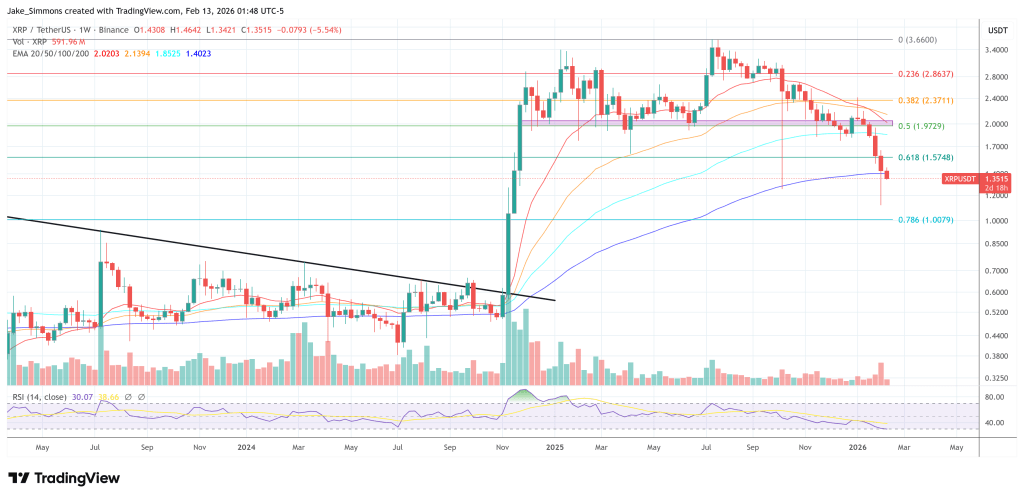
XRP drops below the 200-week EMA, 1-week chart | Source: XRPUSDT on TradingView.com

Trending Cryptos

Related Questions

QWhat is the main feature activated on the XRP Ledger mainnet on February 12, as described in the article?

AThe main feature activated is Token Escrow (XLS-85), which extends the network's native escrow functionality beyond XRP to include Trustline-based tokens (IOUs) and Multi-Purpose Tokens (MPTs).

QAccording to the article, what are the two types of tokens that the new Token Escrow feature now supports?

AThe Token Escrow feature now supports Trustline-based tokens (IOUs) and Multi-Purpose Tokens (MPTs).

QWhat specific flags must an issuer set for a Multi-Purpose Token (MPT) to be eligible for escrow?

AFor an MPT to be eligible for escrow, the issuer must set the Can Escrow and Can Transfer flags at the time of issuance.

QWhat are the three primary transaction types involved in the XRPL escrow flow?

AThe three primary transaction types are EscrowCreate (to lock funds), EscrowFinish (to release funds when conditions are met), and EscrowCancel (to return funds once an escrow expires).

QBesides time-based escrows, what other types of escrow does the XRPL support, as mentioned in the article?

ABesides time-based escrows, the XRPL also supports conditional escrows and combination escrows.

Related Reads

Dialogue with Jia Hang | Looking Back at Two Decades of Chinese Payment Going Global

**Summary: A Conversation with Jia Hang on Two Decades of China's Payment Globalization** Jia Hang, a veteran with over twenty years in payments, reflects on China's attempts to build a global payment network through three key phases: UnionPay (card networks), Alipay+ (digital wallets), and now, stablecoins. His journey began at UnionPay International, aiming to establish China's card network abroad. While successful in following Chinese tourists ("where Chinese go, UnionPay goes"), it struggled to achieve true global scale. The core lesson: card networks like Visa/Mastercard's unassailable advantage isn't just technical standards, but their deeply entrenched **governance and profit-sharing models** that create powerful network effects. Competing as the "same species" is nearly impossible. At Ant Group, he led Alipay+, a strategy to bypass card networks by interconnecting local e-wallets worldwide. While innovative, it faced a similar ceiling. Mobile QR payments and card swipes were essentially **the same species competing for the same pie**, lacking a disruptive value proposition for users or a sustainable new incentive model to replace the card networks' established flywheel. Today, at Singapore's DCS, Jia focuses on stablecoin-based payments. He argues stablecoins represent a fundamental shift. They are not competing with Visa for consumer payments but challenging the **traditional banking and account system for value movement**. Products like "U Cards" (stablecoin-linked payment cards) are transitional, leveraging existing card networks for acceptance while building new rails. The real potential lies in stablecoins enabling seamless, low-cost global value transfer, potentially reorganizing the financial infrastructure around **accounts rather than cards**. Jia believes stablecoin adoption for local retail payments, cross-border transactions, and as high-yield savings vehicles is becoming irreversible. This could gradually reduce reliance on traditional fiat channels, especially in regions with weak currencies or capital controls. The quest for the "next global payment network" continues, now centered on whether stablecoins can successfully bridge Web2 and Web3, establish new governance, and create compelling user value beyond mere cost reduction.

marsbit12m ago

Dialogue with Jia Hang | Looking Back at Two Decades of Chinese Payment Going Global

marsbit12m ago

Circle's Stock Price Plunges 76%, Hong Kong Dollar Stablecoin Set to Launch Within Two Weeks

Circle's stock price has plunged approximately 76% from its 2023 peak, reflecting a major market revaluation. Despite this, Circle President Heath Tarbert emphasized the company's focus on long-term execution and its dominant position with USDC's $73 billion circulation across 34 blockchains. The competitive landscape is intensifying. A new consortium-backed stablecoin, Open USD, is attempting to challenge incumbents by sharing reserve yields with partners. More significantly, Visa's new stablecoin platform, initially supporting Open USD while also being compatible with USDC, could erode Circle's network effects. In response, Circle is expanding into real-world payments through partnerships like the one with Japan's JCB. Separately, Tether (USDT) faces a two-year compliance window under new U.S. regulations, requiring it to adjust its reserve composition away from assets like Bitcoin and loans towards cash and U.S. Treasuries. Meanwhile, in Hong Kong, Standard Chartered-backed fintech firm Dian Dian is poised to launch a licensed HKD-pegged stablecoin (HKDAP), moving the industry into a phase where the real test is integrating licensed stablecoins into actual payment flows and corporate treasury systems. The sharp decline in Circle's stock underscores a broader shift: the stablecoin market is moving from a winner-takes-all dynamic to a multi-player competitive arena where execution, compliance, and real-world utility are becoming paramount.

marsbit13m ago

Circle's Stock Price Plunges 76%, Hong Kong Dollar Stablecoin Set to Launch Within Two Weeks

marsbit13m ago

Amidst Capital's Encirclement, Decentralization is the Sole Defense for Public Blockchains

In a landscape dominated by power and profit motives, the author argues that decentralization is not merely one desirable feature among many in blockchain design—it is the singular, non-negotiable defense against corporate and capital capture. The article adopts a Machiavellian, realist perspective on human institutions, positing that businesses will inevitably attempt to co-opt any valuable network to protect their profits and dominance. While external attacks like 51% forks are often discussed, the greater existential risk is internal capture—the gradual erosion of a protocol’s neutrality by vested interests, as seen historically with platforms like Visa and Google. The piece critiques permissioned chains, highly centralized “permissionless” layer-1s, and layer-2s without sufficient decentralization (e.g., single sequencers) as inherently vulnerable. These compromised systems, promoted by established financial players, are framed as delaying tactics to stifle truly open networks that threaten existing high-fee, inefficient business models. Real-world examples, such as closed enterprise consortiums that exclude competitors, illustrate how such systems cement oligopolies rather than foster innovation. The author concludes that while decentralized protocols like Ethereum are imperfect and costly to operate, they represent the only viable long-term equilibrium. In a market where value naturally flows to the most secure and neutral settlement layer, only maximally decentralized public blockchains can resist being subsumed by capital and powerful incumbents.

Foresight News23m ago

Amidst Capital's Encirclement, Decentralization is the Sole Defense for Public Blockchains

Foresight News23m ago

Who Decides the Rules of Bitcoin? BIP-110 Ignites Governance Debate

Bitcoin's governance is once again at the center of a heated debate, this time ignited by BIP-110, the "Reduced Data Temporary Softfork." This proposal aims to curb non-monetary data (like inscriptions and Runes) by introducing seven new consensus-layer restrictions over a year, such as limiting new output scripts to 34 bytes and restoring the OP_RETURN cap to 83 bytes. The controversy stems from BIP-110's fundamental shift: it moves the battle against "spam" from node relay and miner policies to the consensus layer, rendering currently valid transactions invalid. Supporters, arguing that default policy governance has failed (highlighted by Bitcoin Core v30's relaxation of OP_RETURN limits), see this as necessary to protect node resources and Bitcoin's monetary focus. Opponents, led by figures like Michael Saylor and Adam Back, warn it dangerously centralizes governance. Saylor listed 110 reasons against it, criticizing its low 55% miner activation threshold and potential for chain splits. Back emphasized Bitcoin's "permissionless" ethos, arguing no single group should impose value judgments via consensus rules. Further complicating matters, technical critiques suggest BIP-110 may be technically circumventable, and a "BlockSlop" vulnerability in its upgrade path poses a consensus risk. The debate has drawn in diverse stakeholders: miners (with pools like Ocean signaling support and Foundry polling clients), node operators (like Bitcoin Knots), and new players like corporate treasury holder MicroStrategy (Saylor), whose market influence adds a novel dimension. Ultimately, BIP-110 acts as a governance stress test, exposing the unresolved question: who decides Bitcoin's rules? It pits the authority of miners, node operators, developers, and capital holders against each other, with each side claiming to defend Bitcoin's core principles of neutrality and security.

marsbit40m ago

Who Decides the Rules of Bitcoin? BIP-110 Ignites Governance Debate

marsbit40m ago

Trading

Spot

Hot Articles

What is XRP 2.0

XRP 2.0: A New Frontier in the Cryptocurrency Landscape Introduction to XRP 2.0 In the ever-evolving realm of cryptocurrency, new projects continuously emerge, vying for attention and adoption. One such promising initiative is XRP 2.0, a novel cryptocurrency project designed to leverage advanced blockchain technology and robust encryption methodologies. While the name draws parallels with Ripple’s XRP, it’s crucial to note that XRP 2.0 operates independently, focusing on enhancing transaction security, privacy, and scalability. As the digital financial landscape increasingly embraces decentralized solutions, XRP 2.0 aims to contribute meaningfully to web3 and the overall expansion of crypto projects. What is XRP 2.0? At its core, XRP 2.0 is a cryptocurrency project that aims to create a secure and decentralized digital currency ecosystem. Its foundational technology integrates sophisticated blockchain principles with cutting-edge encryption techniques. The overarching goal of XRP 2.0 is to establish itself as a reliable and efficient platform enabling swift transaction execution while prioritizing enhanced privacy protections for its users. The project is promoted as a solution to many limitations faced by existing cryptocurrencies, proposing a system that can handle a higher volume of transactions with improved speed and privacy. This versatility positions XRP 2.0 as a significant contender in a marketplace riddled with various digital currencies. Who is the Creator of XRP 2.0? The identity of the creator behind XRP 2.0 has been flagged as ‘Wilbur.’ However, comprehensive details regarding Wilbur or their associated entity remain elusive. The anonymity of many cryptocurrency creators is not an uncommon phenomenon in the industry, often designed to maintain a degree of privacy and security. Who are the Investors of XRP 2.0? As of now, specific information related to the investment foundations or organizations supporting XRP 2.0 is not publicly available. In the cryptocurrency sector, the backing by reputed investors can significantly influence a project's credibility and success, yet the transparency regarding the financial supporters of XRP 2.0 has not been established. How Does XRP 2.0 Work? XRP 2.0 stands out by employing a combination of blockchain technology and advanced encryption algorithms that ensures secure and decentralized transactions. Its innovative structure includes unique features designed to foster user engagement and broaden functionalities beyond conventional cryptocurrency transactions. Among these features, XRP 2.0 incorporates AI-powered capabilities, such as text-to-image and text-to-speech functionalities. These additions are designed to enhance the interactive experience for users, promoting broader applicability across various sectors. By bridging technological advancements with user-centered design, XRP 2.0 aims to capture the attention of a diverse range of individuals and enterprises looking to integrate cryptocurrency solutions into their operational frameworks. Timeline of XRP 2.0 Understanding XRP 2.0 requires examining the milestones that have defined its journey thus far: July 23, 2023: XRP 2.0 is introduced as a novel cryptocurrency project, aiming to revolutionize secure and decentralized transaction capabilities in the blockchain domain. September 8, 2023: The launching of another project, XRP20, occurs, marking the emergence of an ERC-20 token on the Ethereum blockchain that remains unrelated to XRP 2.0. November 13, 2023: The XRP Ledger undergoes a significant update with the release of rippled server software version 2.0.0. It is essential to note that this development is disconnected from the XRP 2.0 cryptocurrency project. Key Points About XRP 2.0 To distill the essence of XRP 2.0, several critical factors emerge: Unique Features: The inclusion of features like AI-powered text-to-image and text-to-speech further diversifies the potential applications of XRP 2.0. Blockchain Technology: The framework utilizes advanced blockchain mechanisms and encryption protocols, ensuring a secure and decentralized environment for transactions. Scalability and Privacy: XRP 2.0 prioritizes enhanced privacy protections in transaction processes and the scalability necessary to accommodate a growing user base. No Affiliation with Ripple: Importantly, despite its name, XRP 2.0 does not have any allegiance or collaboration with Ripple’s XRP, distinguishing its operational framework and objectives within the cryptocurrency ecosystem. Conclusion XRP 2.0 represents an ambitious venture into the cryptocurrency sphere, aiming to offer a combination of security, privacy, and efficiency in digital transactions. By integrating sophisticated technologies and user-friendly features, the project sets out to broaden the horizons of what cryptocurrency can achieve in today's digital economy. While the anonymity of its creator and lack of disclosed investors might raise questions for some, XRP 2.0's focus on advanced functionalities and decentralisation enhances its appeal amidst an increasingly crowded crypto market. As the cryptocurrency landscape continues to evolve, XRP 2.0 may yet emerge as a pivotal player in the expansion of secure and scalable blockchain solutions.

1.2k Total ViewsPublished 2024.04.01Updated 2024.12.03

What is XRP 2.0

Discussions

Welcome to the HTX Community. Here, you can stay informed about the latest platform developments and gain access to professional market insights. Users' opinions on the price of XRP (XRP) are presented below.

活动图片