X Supports Memes, Is the Meme Season Really Coming?

marsbitPublished on 2026-04-23Last updated on 2026-04-23

Abstract

X has introduced a new "Custom Timeline" feature, allowing Premium users on iOS to pin specific topics—including a dedicated "meme" category—to their main tab. The meme section, represented by a Flork logo, sparked a 17x price surge for the Ethereum-based meme token FLORK. Meme content is crucial for X: 66% of all content with over 100k impressions in 2026 were meme-based, and such content drives significant engagement, especially among users aged 18–34. Memes also influence politics and brand marketing, as seen in Trump’s 2024 campaign and KitKat’s viral response to a theft incident. While the new feature includes a "Cryptocurrency" category, the meme section is designed primarily for high-quality meme content rather than directly promoting meme coins. However, meme coin accounts that focus on organic, engaging content—without explicitly pushing token tickers—may benefit from increased visibility and user conversion through this dedicated timeline.

On April 22, X Product Lead and Solana Advisor Nikita Bier announced a new X feature called "Custom Timeline" this morning. This feature allows users to pin specific topics to their main homepage tab and supports over 75 interest topics, helping users delve into niche content areas. In its promotional video, the meme topic section features a Flork image as its logo.
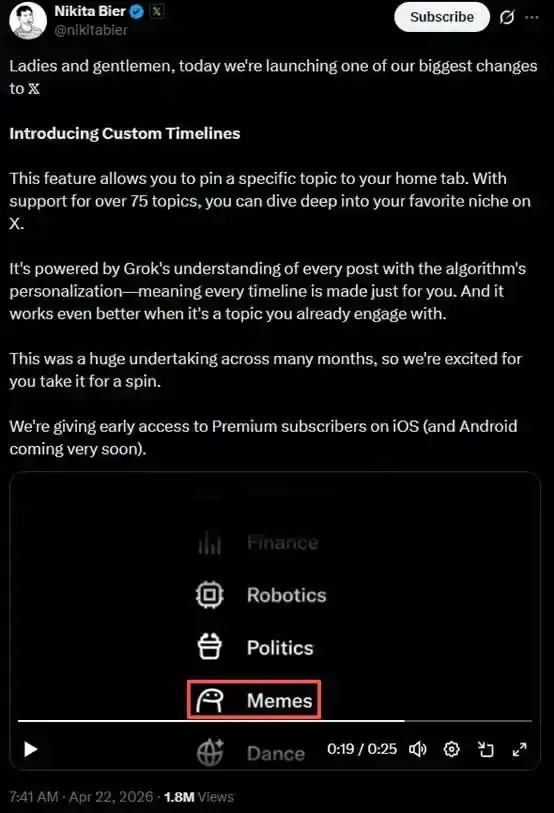
Currently, X Premium members using the iOS client can already add this custom timeline:

Since the meme topic section uses a Flork image as its logo, the Ethereum ecosystem's meme coin of the same name surged by 17 times in half a day. According to GMGN market data, FLORK's market cap is now reported at $8.4 million.

The timing of this meme-heavy feature coincides with the hype around "Space Dog" Asteroid, which has sparked a meme coin frenzy on the Ethereum mainnet. Combined with the earlier Cashtag feature, which allows users to directly check stock and crypto asset data in their timeline, players' sentiment is becoming optimistic again:

This time, will there really be a meme season?

To answer this question, we need to take a comprehensive look at why X is launching this feature.

Memes Are Important to X

According to data from Amra & Elma, in 2026, with X's brand overhaul and comprehensive algorithm reforms, meme-based posts now account for 66% of all content with over 100,000 impressions. Among them, memes on political and cultural topics spread the fastest, with each viral post being shared an average of 4,200 times. Meme content holds a significant position on X, with about 60% of viral tweets being meme-based.

In fact, memes are important not just for X but for all social media platforms. According to a Forms.app 2025 report, over one million memes are shared daily on Instagram alone. A report from MemE Gen AI states that 70% of TikTok users actively engage with meme-like videos.

Memes appear and spread across various social media platforms and chat apps, becoming an integral part of contemporary life, especially for young people. They serve as daily entertainment while also conveying emotions, culture, and even fashion.

Whoever stands at the top of the meme dissemination chain wins the favor of the youth. According to a meme-gen.ai report, most meme users are between the ages of 18 and 34, accounting for about 65% of all meme viewers.

In March of this year, X Product Lead Nikita Bier criticized the act of spreading misinformation in a tweet that misrepresented gaming videos as war footage, also highlighting his emphasis on meme content:
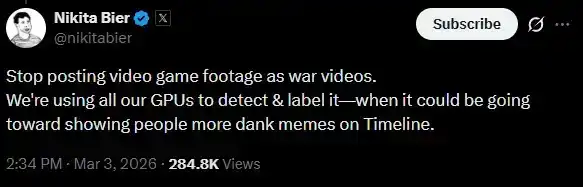
"Stop posting gaming videos pretending they're war footage. All our GPUs are being used to detect and flag these fake videos, GPUs that could otherwise be used to show more interesting memes on the timeline."

Memes can influence politics. When Trump survived an assassination attempt during a 2024 campaign rally, the image of him bloodied but raising a fist and shouting "Fight!" instantly became the hottest meme on X. Supporters used it to symbolize "resilience," greatly reinforcing Trump's "fighter" image, quickly boosting his poll numbers, and making it a core visual symbol of his 2024 campaign.

Memes are one of the trendiest and most effective ways to do brand promotion. In late March 2026, a truck transporting about 12 tons (413,793 bars) of limited-edition F1 KitKat chocolates from Italy to Poland went missing after being stolen.
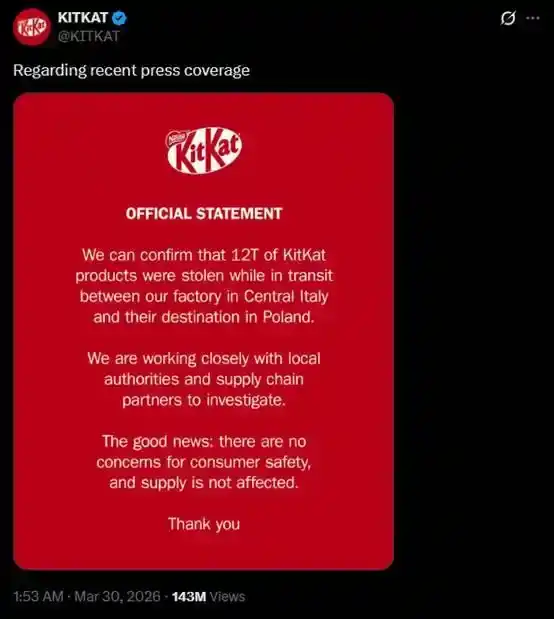
Unexpectedly, this incident became one of the hottest memes on X at the time, with a flood of meme creations "searching for the culprit." For example, the tweet below received over 137,000 likes and 13,000 retweets.
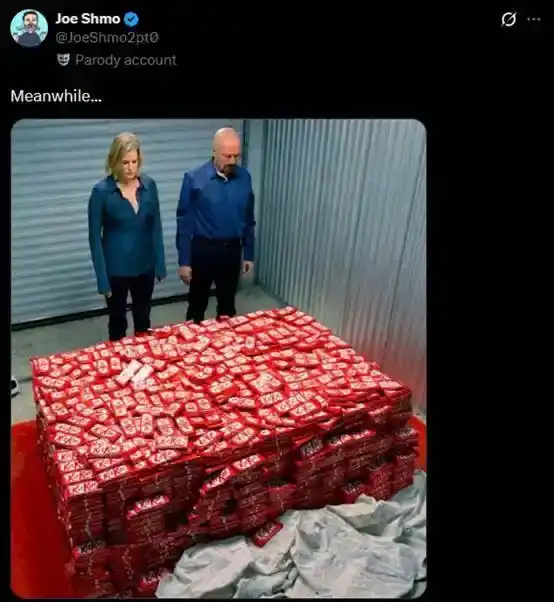
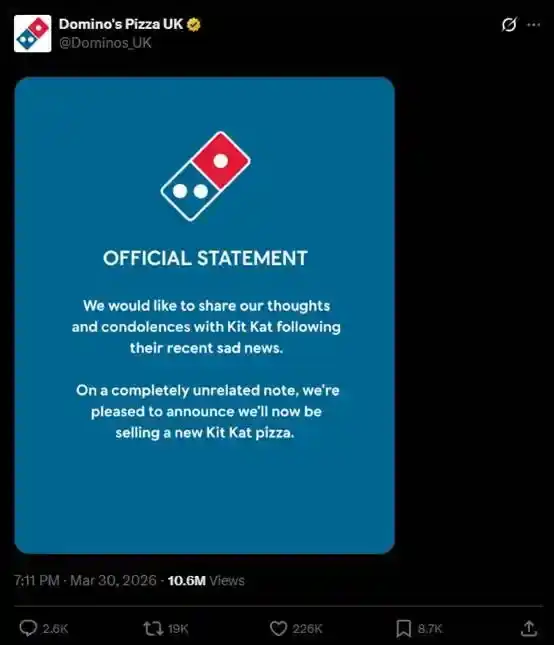
Other brands also joined the "KitKat Heist" with meme-style cross-brand interactions. For instance, Domino's UK X account jokingly announced they would start selling KitKat pizza, a tweet that garnered 226,000 likes and 19,000 retweets.
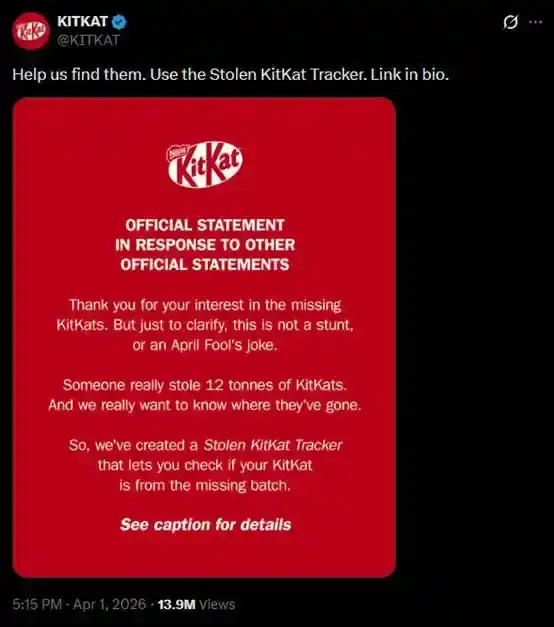
KitKat's official X account also seized the moment by launching a "Stolen KitKat Barcode Tracker," allowing users to scan their chocolate bars to check if they were from the stolen batch, turning a unfortunate theft into an interactive marketing campaign.
Memes are important, but what about meme coins? Is this good news for them?

Good News for Meme Coins?

First, the newly updated custom timeline feature on X actually includes a direct "Cryptocurrency" category.

This means that the meme category is not directly related to meme coins but is more inclined to show users high-quality meme content to retain them.

After all, we are all now accustomed to the quick browsing mode where we swipe to see the next piece of content, and X previously wasn't intuitive enough in this regard. Users typically had to rely on searches to browse content they were interested in and build their feed. If they had specific browsing preferences, the search bar only offered three broad choices: trending, news, and sports.

Now, by moving this feature directly to the timeline, it means that as soon as users log in, the content they see is immediately centered around their interests, and it's more detailed—for example, if you're just a basketball fan, you no longer need to sift through irrelevant football, baseball, etc., tweets in the broad "sports" section.

So, will the meme timeline not benefit meme coins at all? Not exactly; it will still provide some benefits.

This will particularly benefit meme accounts that are skilled at creating meme images/videos and have been operating long-term. On my meme timeline, tweets from meme coins like wojak/joe/neet have appeared:
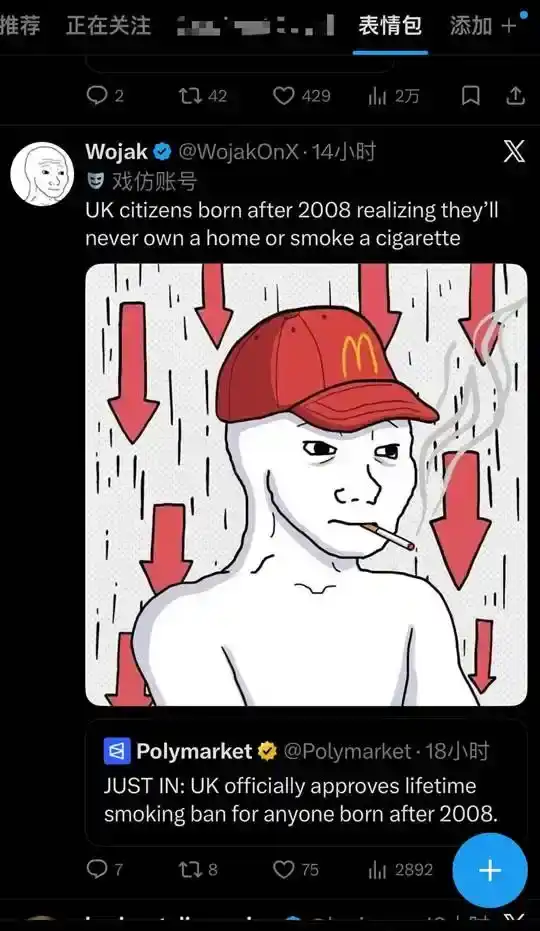
However, the commonality of these accounts is that they almost never directly mention their token tickers in their tweets. Instead, they focus on consistently producing high-quality meme content to attract views and followers, ultimately converting them.

For this type of token, the emergence of the meme category timeline will provide a more direct traffic entry point, potentially increasing the viewer/holder conversion rate.


Related Questions

QWhat new feature did X launch on April 22, and what is its purpose?

AX launched the 'Custom Timeline' feature, which allows users to pin specific topics to their home tab and supports over 75 interest themes to help users explore niche content areas.

QWhy is meme content particularly important for X according to the article?

AMeme-based posts account for 66% of all content with over 100,000 impressions on X. Memes are crucial for engaging users, especially younger demographics, and play a significant role in political, cultural, and marketing contexts.

QHow did the launch of X's meme-themed timeline directly impact the cryptocurrency market?

AThe meme-themed timeline, featuring Flork as its logo, caused the Ethereum-based meme token FLORK to surge by 17 times in half a day, reaching a market cap of $8.4 million.

QWhat broader trend in social media does the article highlight regarding memes?

AMemes are a dominant form of content across social media platforms. For example, over 1 million memes are shared daily on Instagram, and 70% of TikTok users actively engage with meme-like videos.

QHow might X's custom timeline feature benefit meme-based cryptocurrencies in the long term?

AIt provides a direct traffic entry point for high-quality meme content creators who consistently produce engaging memes without directly promoting their tokens, potentially increasing viewer-to-holder conversion rates.

Related Reads

ETH Bull and Bear Views Compilation: Can Ethereum's Value Flow Back to ETH?

Titled "ETH Bull and Bear Views: Can Ethereum's Value Flow Back to ETH?", this article synthesizes the current heated debate around Ethereum's native token, ETH, following Bankless co-founder David Hoffman's decision to sell his entire ETH holdings. The **bullish case**, represented by figures like Tom Lee (BitMine CEO) and Raoul Pal, argues that ETH's core thesis remains intact. They contend Ethereum is the essential, secure, and neutral foundational layer for future finance—encompassing stablecoins, RWA, DeFi, L2s, and Agentic AI. Bulls bet on ETH's long-term revaluation as institutional adoption of on-chain finance grows, with significant buying activity from entities like BitMine and Consensys cited as evidence. Conversely, the **bearish perspective**, led by Hoffman and analysts like Markus Thielen, questions ETH's value capture mechanism. They acknowledge Ethereum's network success but argue that the value created by L2s, DeFi, and applications does not sufficiently accrue to the ETH token itself. Bears point to ETH's prolonged underperformance versus the broader crypto market, lack of traditional cash flows, weakening "ultrasound money" narrative, and apparent institutional retreat (e.g., Harvard Management Company exiting its ETH ETF position) as key concerns. The debate highlights a pivotal shift: ETH is no longer just a community belief asset. The central question is whether ETH can transition from being a "**used infrastructure**" to a "**continuously bought and held core asset**" as more value enters the Ethereum ecosystem. The market is now critically examining the direct link between network growth and ETH's value.

marsbit37m ago

ETH Bull and Bear Views Compilation: Can Ethereum's Value Flow Back to ETH?

marsbit37m ago

Crypto is dead, Perps are forever

The crypto industry is shifting from a focus on creating native assets (like altcoins and protocol tokens) to becoming a "global asset pipeline." Native cryptocurrencies, except for Bitcoin, are seen as failing in their value storage and utility promises, with demand driven largely by speculation. Attention and liquidity are now moving toward real-world assets (RWAs) like U.S. stocks, bonds, gold, and oil traded on-chain via perpetual contracts (Perps). Stablecoins like USDT and USDC set the precedent, proving blockchain's core strength is efficient global settlement and transfer, not inventing new monetary systems. Meanwhile, assets like Ethereum and many DeFi tokens struggle as their narratives weaken against tangible traditional assets and the rapid real-world progress of AI. Perpetual contracts have emerged as a pivotal innovation. They simplify trading by offering pure price exposure to any asset, bypassing complexities of ownership, custody, and traditional market hours. Projects like Hyperliquid gained traction by combining CEX-like efficiency with on-chain transparency, capitalizing on post-FTX distrust, macroeconomic volatility, and the surge in demand for 24/7 stock trading. In conclusion, while the era of speculative native "crypto assets" may be over, perpetual contracts persist as the industry's most potent financial instrument—transforming all assets into globally accessible, constantly tradable instruments centered on price speculation.

marsbit43m ago

Crypto is dead, Perps are forever

marsbit43m ago

Tencent, Alibaba, ByteDance in a Battle for the Skill Store

Skill is becoming a key concept in the AI field, essentially serving as a structured "instruction manual" for AI Agents that specifies tool calls, decision logic, and output standards. This allows Agents to execute predefined tasks. As the number of Skills grows, distribution platforms have emerged. Major tech companies are swiftly entering this space. In March, Tencent, Alibaba, and ByteDance launched Skill stores within their respective Agent platforms. Subsequently, players like Zhipu AI, Meituan, and Xiaohongshu joined the fray. This competition for the "Skill store" is fundamentally a battle for the AI-era user entry point; whoever controls distribution controls the users. While ByteDance's Coze has experimented with paid Skills, most platforms offer them for free. The real value lies not in the stores themselves but in using them to attract and retain users within an ecosystem, driving revenue from services like cloud computing, model calls, or advertising. The landscape features three main player types: 1) **Internet giants** (e.g., Alibaba, ByteDance, Tencent, Meituan), leveraging Skills to drive traffic and monetize through their broader ecosystems (cloud services, transactions, ads). 2) **Large model companies** (e.g., Zhipu AI, Moonshot AI), using Skill stores to increase user engagement and monetize model API calls. 3) **Content platforms** (e.g., Xiaohongshu), treating Skills as a new content format to generate traffic and ad revenue. However, transforming Skill stores into a sustainable business faces significant hurdles. Key challenges include: the **difficulty in pricing Skills** due to inconsistent outputs across different models and contexts; **lack of cost transparency** (varying token consumption); **security risks** like Skill poisoning; and the **absence of standardized protocols** for development and evaluation. Unlike standardized mobile apps, Skills are often personalized workflows resistant to uniformity, which hinders the establishment of a reliable review and monetization system akin to the App Store. While there is genuine user demand for paid Skills—particularly in enterprise (e.g., contract review) and certain personal productivity scenarios—current platforms offer developers limited and unpredictable distribution. The future of Skill stores depends on overcoming these standardization, evaluation, and safety challenges to make acquiring a Skill as straightforward as downloading an app. For now, the stores function more as display shelves than robust marketplaces.

marsbit43m ago

Tencent, Alibaba, ByteDance in a Battle for the Skill Store

marsbit43m ago

The Crypto Scene Is Dead, Perpetual Swaps Are Eternal

The crypto industry is undergoing a fundamental shift. The era defined by minting novel, native digital assets (altcoins) is fading. These assets, lacking real-world cash flows or clear value, are losing relevance as attention and capital flow elsewhere. Two powerful external forces are reshaping the space. First, traditional assets like U.S. stocks, bonds, gold, and oil are being tokenized and traded on-chain. Second, the explosive growth of AI, with its tangible products, has overshadowed crypto's once-dominant "future narrative." This marks a critical pivot: crypto is transitioning from being a "factory for new assets" to becoming a "global conduit for existing assets." Its validated utility is not complex financial reinvention but efficient global settlement, transfer, and trading—the original promise of blockchain. Stablecoins like USDT and USDC exemplify this, offering faster dollar movement rather than replacing it. Consequently, native ecosystems like Ethereum face profound challenges. While still crucial infrastructure, ETH struggles to capture value as users interact with Layer 2s or trade traditional assets without needing to hold it. DeFi's grand narrative of rebuilding finance has narrowed to core needs like cheap transfers and deep liquidity. The true breakout innovation is the perpetual contract (Perp). It brilliantly bypasses the complexities of direct asset ownership (custody, compliance, dividends) by creating pure price exposure. Users can speculate on the price movement of *any* asset—NVIDIA, gold, oil—24/7, globally, and with leverage. This "price casino" model, while risky and ethically fraught, delivers unmatched liquidity and accessibility. Projects like Hyperliquid succeeded not by inventing new mechanics but by perfecting the timing and execution of this model. Key drivers included making on-chain Perps feel like centralized exchanges, post-FTX trust migration towards transparency, and rising demand to trade macro assets and equities round-the-clock. In conclusion, the crypto world's most enduring successes are the dollar (via stablecoins), Bitcoin, and trading. Its new frontier is not creating alternative assets but providing a seamless, perpetual trading layer—a new API—for the world's existing financial system. The age of native altcoins is over; the age of perpetual synthetic exposure has begun.

Odaily星球日报52m ago

The Crypto Scene Is Dead, Perpetual Swaps Are Eternal

Odaily星球日报52m ago

Trading

Spot
Futures

Hot Articles

Discussions

Welcome to the HTX Community. Here, you can stay informed about the latest platform developments and gain access to professional market insights. Users' opinions on the price of MEME (MEME) are presented below.

活动图片