WSJ Reveals: UAE Royal Family Secretly Invested in WLFI, Exchanging for Top U.S. AI Chips

marsbitPublished on 2026-02-02Last updated on 2026-02-02

Abstract

A Wall Street Journal investigation reveals that days before Donald Trump's presidential inauguration, an Abu Dhabi royal, Sheikh Tahnoon bin Zayed Al Nahyan, secretly invested $500 million to acquire a 49% stake in Trump's crypto venture, World Liberty Financial (WLFI). The deal, signed by Trump's son Eric, involved an initial $250 million payment, with $187 million going directly to Trump family entities. Sheikh Tahnoon, a powerful figure overseeing a $1.3 trillion empire, sought access to restricted U.S. AI chips, which had been limited under the Biden administration due to concerns over potential technology transfer to China. Following Trump's election, his administration negotiated a deal to supply the UAE with advanced AI chips, with about one-fifth allocated to Tahnoon's AI company, G42. The investment and subsequent chip deal have raised significant ethical and legal concerns, with experts suggesting it may violate constitutional emoluments clauses. The report also details connections between Tahnoon's investment vehicle, WLFI's stablecoin project, a $2 billion investment in Binance, and the eventual pardon of Binance founder Changpeng Zhao.

By: Sam Kessler, Rebecca Ballhaus, Eliot Brown, Angus Berwick, The Wall Street Journal

Compiled by: Luffy, Foresight News

According to company documents and informed sources, four days before Donald Trump's presidential inauguration last year, an aide to an Abu Dhabi royal family member secretly signed an agreement with the Trump family to acquire a 49% stake in their startup cryptocurrency venture for $500 million. The buyer paid half upfront, with $187 million transferred directly to Trump family entities.

This deal with World Liberty Financial, previously unreported, was signed by the president's son, Eric Trump. Documents show that at least an additional $31 million was directed to entities linked to the family of co-founder Steve Witkoff, who had been appointed as a U.S. Middle East envoy just weeks earlier.

Informed sources stated that the investment was backed by Sheikh Tahnoon bin Zayed Al Nahyan, an Abu Dhabi royal who has been lobbying the U.S. for access to tightly controlled artificial intelligence chips. Sometimes called the "spy chief," Tahnoon is the brother of the UAE president, the country's national security advisor, and also heads its largest sovereign wealth fund. He controls a business empire valued at over $1.3 trillion, funded by both personal wealth and state funds, spanning sectors from fish farms and artificial intelligence to surveillance technology, making him one of the world's most powerful individual investors.

This transaction is unprecedented in U.S. political history: a foreign government official acquired a significant stake in a company owned by the incoming U.S. president.

During the Biden administration, Tahnoon's efforts to obtain AI hardware were largely stymied due to concerns about sensitive technology potentially flowing to China. U.S. intelligence officials and lawmakers were particularly alarmed by Tahnoon's AI company, G42, which had close ties to sanctioned tech giant Huawei and other Chinese companies, raising multiple red flags. Although G42 claimed it severed its Chinese connections by the end of 2023, U.S. concerns persisted.

Trump's election victory reopened the door for Tahnoon. Informed sources said that in the months following, Tahnoon met repeatedly with Trump, Witkoff, and other U.S. officials, including during a March visit to the White House, where the Sheikh expressed to U.S. officials his eagerness to cooperate with the U.S. in AI and other fields.

Two months after the March meeting, the Trump administration committed to providing the Gulf state with approximately 500,000 of the most advanced AI chips annually, enough to build one of the world's largest AI data center clusters. As previously reported by The Wall Street Journal, the framework agreement stipulated that about one-fifth of these chips would go to G42.

This agreement is widely seen as a major victory for the UAE's ruling family, breaking through long-standing U.S. national security concerns and allowing the country to compete on the cutting edge of AI alongside the world's strongest economies. Supporters of the deal praised it for attracting massive investment to the U.S. and helping to establish global standards for U.S. technology.

What was not previously known publicly was this: Tahnoon's envoy had signed an agreement that previous January to acquire a 49% stake in World Liberty Financial.
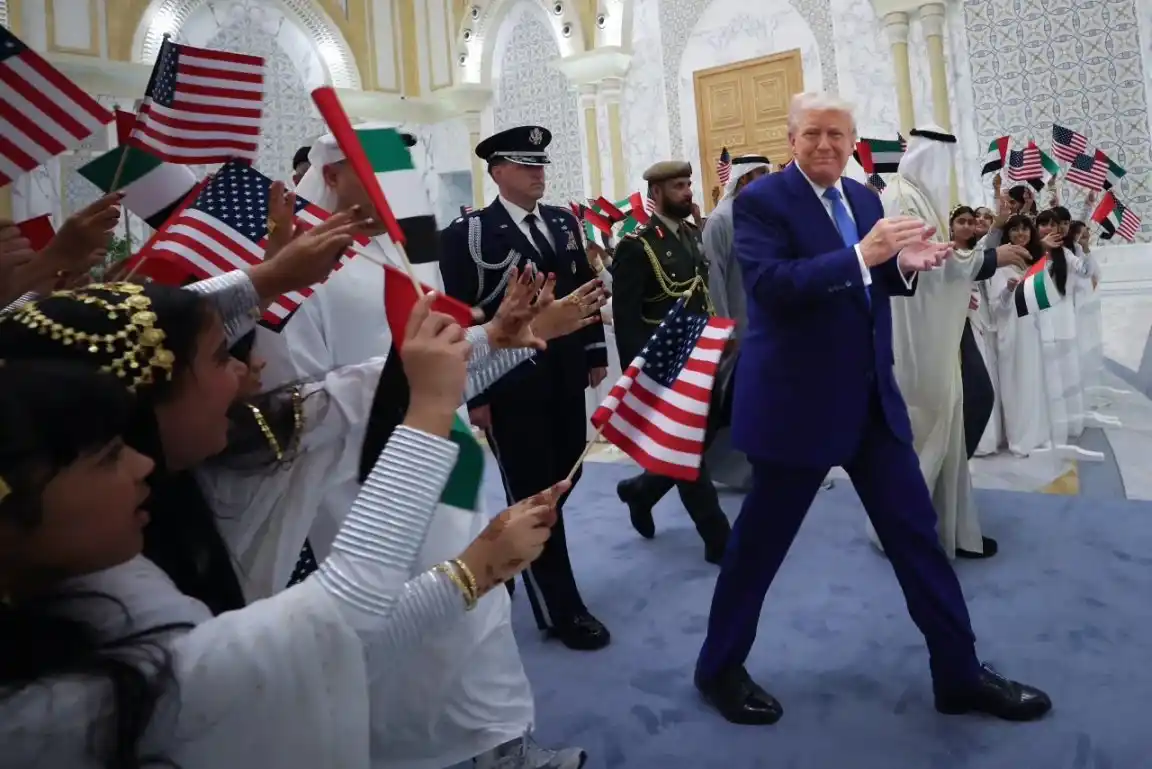
Trump visited Abu Dhabi in May last year
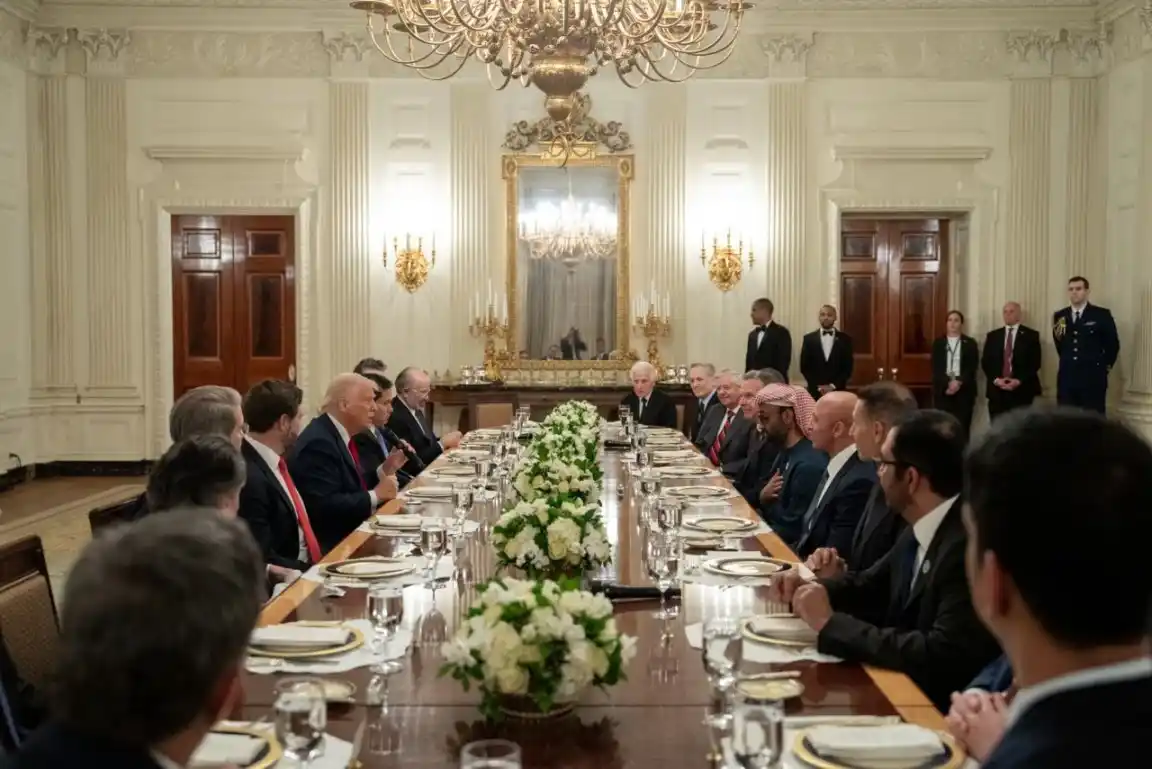
Tahnoon met with Trump and other U.S. officials at the White House in March last year

Details of the $500 Million Deal

Documents show that of the initial $250 million paid by the Tahnoon-backed company Aryam Investment 1, $187 million was transferred directly to Trump family entities DT Marks DEFI LLC and DT Marks SC LLC. Beyond the money directed to Witkoff family entities, another $31 million was transferred to entities associated with co-founders Zak Folkman and Chase Herro. The Wall Street Journal has not determined the specific allocation of the remaining $250 million investment that Aryam is due to pay by July 15, 2025.

The agreement made Aryam the largest shareholder in World Liberty Financial and the only known external investor besides the company's founders. Documents show the deal secured Aryam two seats on World Liberty Financial's five-person board; the two Aryam executives appointed as directors also hold senior positions at Tahnoon's G42. Board members at the time included Eric Trump and Zach Witkoff (son of Steve Witkoff).

Since Trump's election victory, his real estate company has sought deals with foreign firms, and the president himself has accepted gifts from foreign governments, including a $400 million luxury jet from Qatar. But the World Liberty Financial deal is the only known instance of a foreign government official purchasing a large stake in a Trump-owned company after his election victory.

Disclosures on World Liberty Financial's website show the Trump family's equity share dropped from 75% last year to 38%, indicating an external party bought shares, but the company never disclosed the buyer's identity.

Weeks before the U.S.-UAE chip deal was announced in May last year, World Liberty Financial CEO Zach Witkoff announced that Tahnoon's investment vehicle MGX would use a stablecoin issued by World Liberty Financial to complete a $2 billion investment in cryptocurrency exchange Binance. The G42 executives who joined World Liberty Financial's board are also directors at MGX, which is jointly owned with G42.

Zach Witkoff promoted the MGX stablecoin collaboration as an endorsement of World Liberty Financial's technology, without disclosing that MGX and World Liberty Financial are led by the same people.

World Liberty Financial spokesman David Wachsman, regarding the Aryam investment, stated: "We made this deal because we firmly believe it is in the best interest of the company's continued development. The idea that a U.S. private company must adhere to special standards in fundraising that other similar companies do not is both absurd and un-American."

He said that President Trump and Steve Witkoff were not involved in this transaction and have not been involved in World Liberty Financial affairs since taking office, and that Witkoff never held an operational role at the company. He added that the deal does not grant any party access to government decision-making or influence policy, "We comply with the exact same rules and regulations as everyone else in our industry."

A person familiar with Tahnoon's investment said that Tahnoon and his team conducted "months of assessment" of World Liberty Financial's plans before investing, and he completed the investment in the company with "several co-investors," stating that no G42 funds were used. "At no point during due diligence or thereafter was this investment discussed with President Trump." The person said Tahnoon is a "significant investor" in cryptocurrency businesses.

White House spokeswoman Anna Kelly said: "President Trump acts solely in the best interests of the American public." She said the president's assets are held in a trust managed by his children, "there is no conflict of interest," and stated that Witkoff is working to "advance President Trump's global peace goals."

White House Counsel David Warrington said: "The President is not involved in any business transactions that may involve his constitutional duties."

He said Witkoff strictly adheres to government ethics rules, "He has not and will not participate in any official matters that could affect his financial interests," adding that Witkoff has "divested his relevant interests in World Liberty Financial."

A person close to Witkoff said the envoy was not involved in AI chip negotiations related to G42 but was briefed on the discussions.

A Trump Organization spokesperson said the company "takes its ethical obligations extremely seriously and is firmly committed to preventing conflicts of interest," and complies with all applicable laws.

The "Sheikh's" AI Chip Offensive
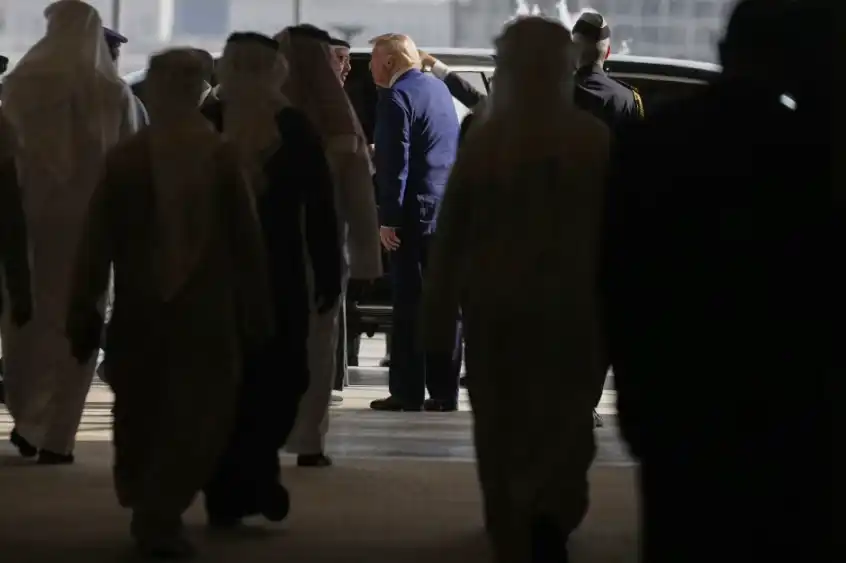
Trump posed with UAE President Mohammed during his visit to the UAE last May

After Trump's election victory, the UAE side hoped for a more cooperative partner in the U.S.

For Tahnoon, obtaining U.S. chips was a top priority. Tasked by his brother, he leads the UAE's push to become a global leader in AI. During the Biden administration, citing concerns chips could reach China, the U.S. allowed the country only limited access to chips. Although G42 said it cut ties with China by the end of 2023, other UAE entities, including within Tahnoon's business empire, maintained close links with China.

Tahnoon sought approval for a massive additional allocation of chips to build one of the world's largest AI data center clusters, requiring electricity equivalent to two Hoover Dams. Tahnoon and his aides planned a full-court press to secure support from Trump's new administration.

Tahnoon already had business ties to the Trump family through Trump's son-in-law Jared Kushner, whose investment firm raised $1.5 billion in 2024 from a Tahnoon-backed company and Qatar.

Shortly after the election victory, Trump appointed his longtime friend and golfing buddy, Steve Witkoff, as a Middle East envoy. Witkoff moved quickly, informing Biden administration officials he planned to contact his Middle East connections and would travel to the UAE, Qatar, Saudi Arabia, and Israel before the inauguration.

A December 2024 trip to the UAE had both diplomatic and cryptocurrency purposes. Witkoff, who helped found World Liberty Financial in September, attended a cryptocurrency conference in Abu Dhabi, mingling with crypto heavyweights and Eric Trump in a VIP room. Eric Trump declared to the UAE crowd in a keynote speech: "Our family loves you."

As previously reported by The Wall Street Journal, Witkoff also met with Tahnoon, part of a series of regional talks that included issues like a Gaza ceasefire.

About a week after Witkoff's trip, two entities were registered within two days, one in Delaware and one in Abu Dhabi, disclosing no ownership information, both sharing the same name: Aryam Investment 1.

Company records reviewed by The Wall Street Journal show the Delaware Aryam is managed by executives from Tahnoon's G42; the Abu Dhabi entity shares a UAE office address with numerous other companies in the Sheikh's business empire.

Weeks later, on January 16, 2025, Aryam's representatives signed the $500 million deal with Trump and Witkoff's World Liberty Financial.

The Network of Interests Behind the Deal

At the time of the investment, World Liberty Financial had no products, having only $82 million from issuing a token called WLFI. Documents show Aryam's investment did not grant it rights to future WLFI token sales, meaning the Tahnoon-backed entity was excluded from the company's only revenue stream at the time.

The agreement for Aryam to acquire the World Liberty Financial stake was signed by G42 General Counsel Martin Edelman, a core advisor to Tahnoon, and G42 CEO Peng Xiao. The deal also involved Tahnoon's personal investment company, Royal Group, for which Edelman also serves as an advisor.

Edelman and Xiao joined the World Liberty Financial board, but the company's website does not list them in the team roster.

The two played key roles in the UAE's lobbying of the Trump administration for chips.

G42's head of crypto and blockchain, Fiacc Larkin, joined World Liberty Financial in January 2025 as chief strategy advisor. His LinkedIn profile shows he also advises the Abu Dhabi Department of Economic Development, a government agency.

For years, G42 has been closely watched by Biden administration officials and Republican lawmakers. In 2024, Republican lawmakers called for an investigation into the risk of China acquiring U.S. technology through the company.

Peng Xiao, born in China, attended university in Washington, obtained U.S. citizenship, then relinquished it to become a UAE national. He himself came under scrutiny during the Biden administration.

In 2024, a Republican committee chairman, in a letter requesting an investigation from the Commerce Department, said documents showed a "vast network" of UAE and Chinese companies behind Peng Xiao.
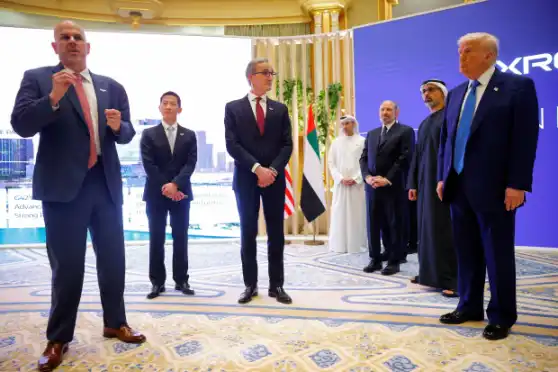
Trump met with Mohammed during his visit last May. Peng Xiao, CEO of Tahnoon's artificial intelligence company G42, was present (second from left)

G42 denied the allegations in the letter at the time, stating the company had ceased cooperation with Chinese companies.

Edelman is a prominent New York real estate lawyer who has cultivated connections in the UAE for decades. He advises the UAE royal family and serves on the boards of G42, MGX, and other Tahnoon companies. He is also a longtime friend of Witkoff and publicly praised Witkoff after the election.

The share acquisition deal, according to company documents reviewed by The Wall Street Journal, brought huge windfalls for World Liberty Financial's founders, with Trump family, Witkoff family, Folkman, and Herro-linked entities all receiving quick payouts. Trump's disclosure filings show he personally held a 70% stake in DT Marks DEFI as of the end of 2024, with the remaining 30% held by other family members; he did not disclose the ownership structure of DT Marks SC.

Ethical and Legal Controversies
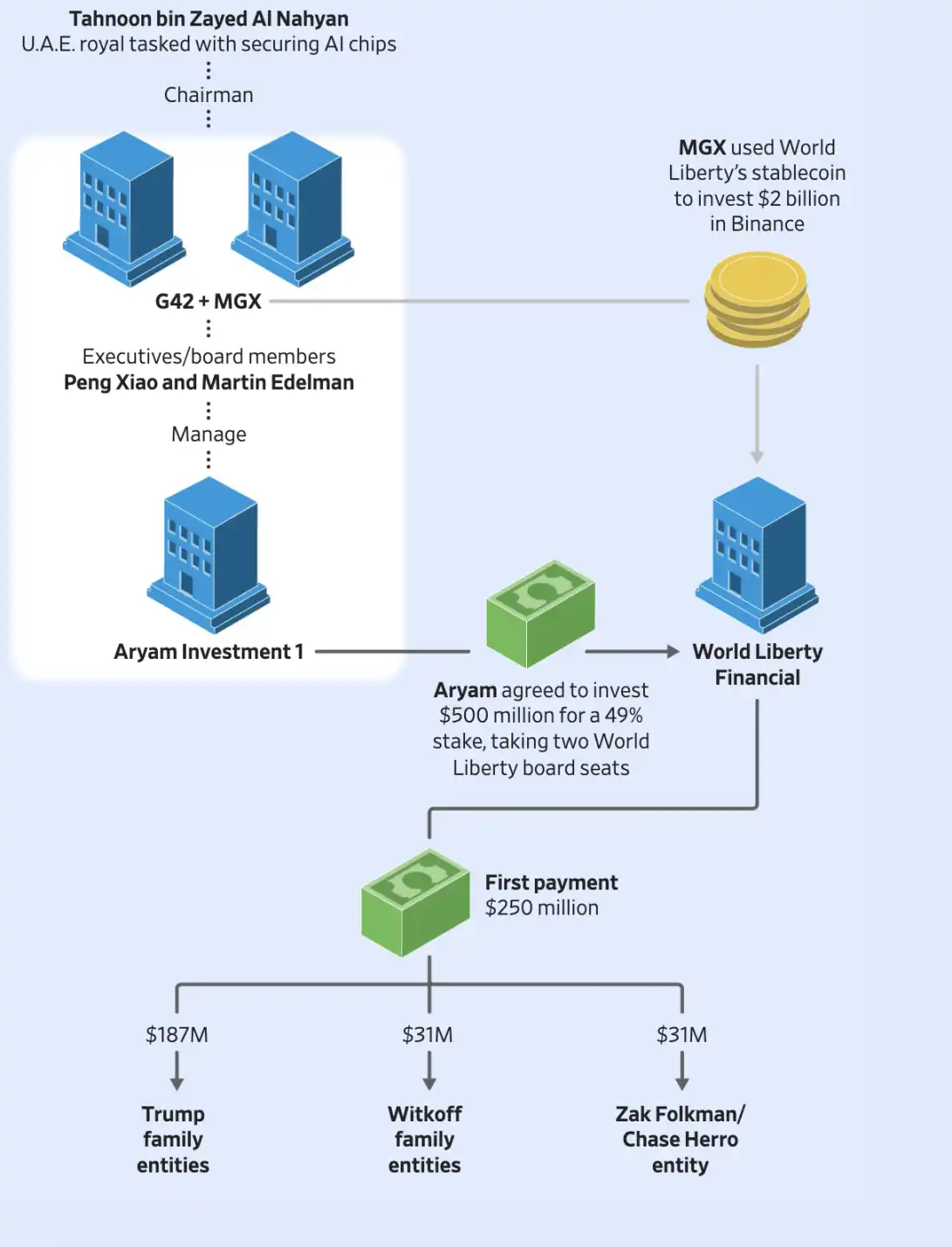
Analysis of the investment deal details

Trump has long been criticized for retaining control of his private business empire while in office and profiting from overseas. During his first term, Democratic lawmakers sued Trump, alleging he violated the Constitution's "Emoluments Clause" by profiting from foreign governments patronizing his businesses. Trump called it a political witch hunt, and the Justice Department argued Trump's profit-sharing did not constitute an emolument; the Supreme Court ultimately declined to hear the case.

In his second term, Trump's real estate holding company, the Trump Organization, said it would not sign new contracts with foreign governments during the presidency but did not rule out new deals with foreign private companies, a loosening compared to the first term. The company said it would donate profits from identifiable foreign government officials at its hotels and other businesses to the U.S. Treasury. World Liberty Financial made no such promise.

Legal experts said the deal with Aryam could violate the Emoluments Clause, and the proximity in timing between the UAE chip deal and the World Liberty Financial transaction represents a significant conflict of interest.

Kathleen Clark, a law professor at Washington University and former government ethics lawyer in Washington D.C., said the clause is designed to prevent any government official from being "bought off" by a foreign government. "This looks like a clear violation of the foreign emoluments clause, and more importantly, it looks like a bribe."

She said the deal "should be a five-alarm fire for the sale of the federal government."

Ty Cobb, who served as senior White House counsel during Trump's first term, said Trump's conflicts of interest far exceed those of any predecessor, "It's like complaining about a kayak when a B52 flies overhead." "As an ethics lawyer, my advice would be very clear: Don't do business deals with the families of foreign national leaders. It taints U.S. foreign policy."

A White House official said World Liberty Financial's business is separate from Trump, so any emoluments-related claims are "false and irrelevant." White House Counsel Warrington said Trump "fulfills his constitutional duties in an ethical manner."

From Chip Deal to Binance Pardon
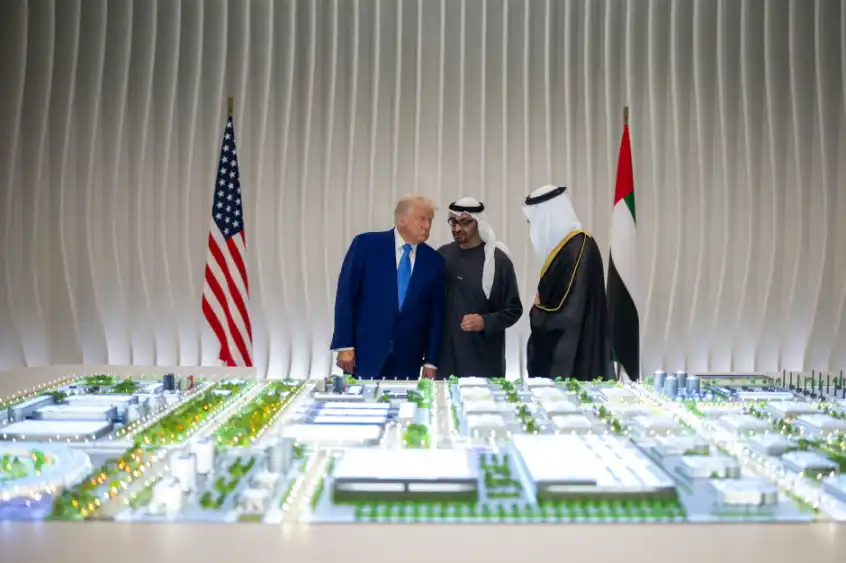
Trump and Mohammed examined a model of an AI data center project during the visit in May last year

After taking a stake in World Liberty Financial, Tahnoon's campaign for AI chips accelerated.

The Sheikh hosted CEOs of the world's top tech and finance firms at royal estates in Abu Dhabi, often posting meeting photos on Instagram, most taken on a set of white sofas. He was prepared to commit huge sums of money to the U.S. and emphasize the UAE's alignment with the U.S. in AI.

On Trump's first day in office (five days after Aryam signed the deal with World Liberty Financial), the president announced at the White House that OpenAI and SoftBank planned a $500 billion AI data center project, with Tahnoon's MGX being one of two other designated investors. The project has not advanced to date.

Last spring, Trump administration officials began discussing the framework of the chip deal with the UAE. Some officials did not see a national security risk, but others shared the previous administration's concerns that the technology could ultimately reach China. Informed sources said they discussed plans to restrict control of the chips in the deal, one option being to exclude UAE companies like G42 from direct access, requiring the technology to be held by U.S. partners like Microsoft and OpenAI.

In March, Tahnoon led a delegation to Washington, planning to push for faster U.S. government reviews of UAE investments in the U.S., among other issues, in addition to the chip deal. He met with Trump in the Oval Office and promised the UAE would invest $1.4 trillion in the U.S. over a decade. One informed source said the promise excited the president, though government officials struggled to understand its specifics.

On March 18, Trump hosted a dinner at the White House for Tahnoon and his delegation, inviting the vice president and cabinet members including the secretaries of state, commerce, and treasury. Tahnoon sat next to Witkoff, Edelman at the end of the table. Trump later posted photos on Truth Social, touting the "bonds of friendship" between the two countries, saying they discussed strengthening cooperation in technology and the economy.

Former national security officials expressed shock at the level of access Tahnoon received. During the Biden administration, visiting foreign officials typically met with their U.S. counterparts, not the president and six cabinet members.

Meanwhile, Tahnoon's ties to World Liberty Financial grew tighter. In May, Zach Witkoff announced at a cryptocurrency conference in Dubai that the Sheikh's investment vehicle MGX would use the stablecoin USD1, issued by World Liberty Financial, to complete a $2 billion investment in Binance, the largest single investment in a cryptocurrency company ever. Zach Witkoff smiled, thanking MGX for "their trust in us."

The move placed USD1 among the world's largest stablecoins, boosting its financial credibility, and brought World Liberty Financial $2 billion in cash reserves. The company held these funds as collateral to maintain the stablecoin's 1:1 peg to the dollar and invested them in U.S. Treasury bonds to earn interest, potentially generating about $80 million in收益 over a year.

MGX told The Wall Street Journal last year it evaluated stablecoins across platforms and chose USD1 after considering factors like "business suitability." A World Liberty Financial spokesman called USD1 a "superior product."

Neither company ever disclosed that MGX and World Liberty Financial shared management.

In fact, the Aryam deal laid the groundwork for the launch of USD1. The investment was split between two newly formed World Liberty Financial entities, one to operate the new stablecoin product and the other to manage the rest of the company's business.

A person close to the company said G42's Larkin led the USD1 project at World Liberty Financial.

Tahnoon's $2 billion investment in Binance through MGX meant he had a financial interest in pushing for a pardon for Binance founder Changpeng Zhao. Such a move could pave the way for Binance's return to the U.S. market. In 2023, Binance and Zhao pleaded guilty to violating anti-money laundering rules and were barred from operating in the U.S.

Zhao now resides in Abu Dhabi, having obtained UAE citizenship several years ago. He is close to Tahnoon and has built strong ties with the UAE royal family.

Informed sources said individuals close to the royal family lobbied the Trump administration for Zhao's pardon, arguing it would help the world's largest cryptocurrency exchange return to the U.S. Pardoning Zhao would also open the door for UAE authorities to grant Binance a full regulatory license, completing plans for Binance to make Abu Dhabi its new global headquarters and boosting the capital's global financial ambitions.

Binance itself was also seeking a return to the U.S. through the pardon. As previously reported by The Wall Street Journal, the company took several steps to advance World Liberty Financial's business. Zhao denied having a business relationship with Trump's cryptocurrency company, and Binance said it did not control the stablecoin chosen by MGX and had "limited involvement" with World Liberty Financial-related products. World Liberty Financial denied playing any role in the pardon, its lawyer saying dealings with Binance were routine. A person close to Steve Witkoff said he was not involved in matters related to Zhao's pardon.

Zhao's lawyer, Teresa Goody Guillén, said the pardon for her client did not get Binance into the U.S. market and that the UAE has been broadly attracting cryptocurrency companies. She said interpreting Zhao pardon negatively is an "illegal usurpation of the presidential pardon power."

On May 8 last year, the U.S. Treasury Department announced the launch of a fast-track pilot program for foreign investors, precisely the accelerated investment review process the UAE had sought.

During Trump's visit to Abu Dhabi that month, he announced the two countries had reached "a very significant agreement" for the UAE to purchase U.S. AI chips. Months later, after further negotiations, the Trump administration approved the sale of 35,000 chips to G42, less than the UAE had hoped for.

During a May presentation at the royal palace, Trump examined a bright 3D model of a large AI data center project G42 planned to develop, with Steve Witkoff and Tahnoon watching. Trump repeatedly mentioned Tahnoon at the local meeting, telling UAE President Mohammed that his "good brother" had recently visited Washington; Tahnoon posted photos with Trump and Witkoff on Instagram.

Trump predicted the relationship between the two countries "will only get closer and better." He told Mohammed: "Our relationship couldn't be any better."

In September, under an agreement negotiated by the Trump administration, MGX was selected as one of the few investors to operate TikTok's U.S. business.
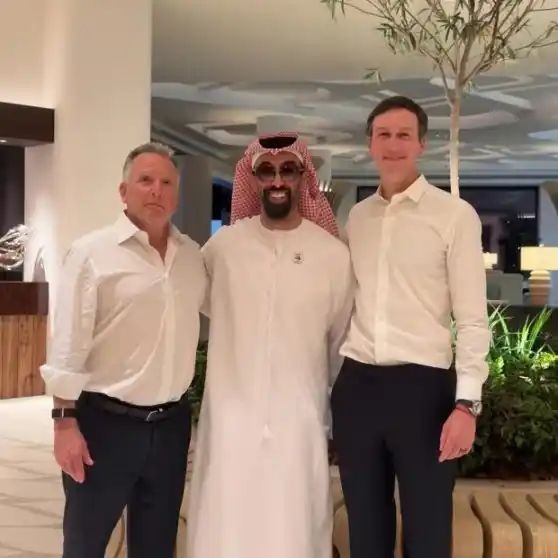
On October 22 last year, Steve Witkoff, Jared Kushner, and Tahnoon posted a photo on social media

The following month, Trump pardoned Zhao, sparking anger from Democratic lawmakers who accused him of selling pardons to the highest bidder.

On October 22, the day before the White House confirmed Trump signed the pardon, a White House official said Witkoff and Kushner returned to Abu Dhabi to discuss Gaza, Israel, and Trump's peace commission plans. Their meeting was with none other than Tahnoon.


Related Questions

QWhat was the nature of the $500 million deal between the Trump family's cryptocurrency venture and the Abu Dhabi royal family's entity?

AThe deal involved Aryam Investment 1, backed by Sheikh Tahnoon bin Zayed Al Nahyan, acquiring a 49% stake in the Trump-affiliated cryptocurrency startup World Liberty Financial. The initial payment of $250 million included $187 million transferred directly to Trump family entities.

QWho is Sheikh Tahnoon bin Zayed Al Nahyan and what was his primary objective in pursuing this investment and relationship with the Trump administration?

ASheikh Tahnoon is a senior Abu Dhabi royal, the UAE's national security adviser, and chairman of a major sovereign wealth fund. His primary objective was to gain access to advanced U.S. AI chips, which had been restricted under the Biden administration due to concerns about potential technology leakage to China.

QWhat major U.S. government decision benefited the UAE's AI ambitions shortly after this investment was made?

AThe Trump administration committed to providing the UAE with approximately 500,000 of the most advanced AI chips annually, with about one-fifth of them designated for Tahnoon's AI company, G42. This was a significant policy shift from the previous administration's restrictions.

QWhat ethical and legal concerns were raised by experts regarding this transaction?

ALegal experts argued the deal potentially violated the Constitution's Emoluments Clause, which prohibits U.S. officials from receiving benefits from foreign governments. The timing of the chip deal so close to the investment was cited as a major conflict of interest, with some experts describing it as appearing like a bribe.

QHow did the investment entity Aryam and Tahnoon's company MGX further intertwine with World Liberty Financial's business after the initial deal?

AMGX, another Tahnoon-backed company, announced it would use a stablecoin (USD1) issued by World Liberty Financial to execute a $2 billion investment into Binance. This provided significant financial backing and credibility to the stablecoin. Furthermore, MGX was later selected as one of the investors to operate TikTok's U.S. operations under a deal negotiated by the Trump administration.

Related Reads

Trading

Spot
Futures

Hot Articles

What is LINON

Linde plc Tokenized Stock (Ondo): Revolutionizing Traditional Equity Access Through Blockchain Innovation The emergence of Linde plc Tokenized Stock (Ondo), represented by the ticker $LINON, signifies a monumental shift in the fusion of traditional financial structures and decentralized finance (DeFi). This innovative financial instrument showcases the tremendous potential of blockchain technology to democratize access to traditional equity markets while ensuring the security and regulatory compliance necessary for institutional-grade financial products. Through Ondo Finance's pioneering tokenization platform, $LINON provides a seamless pathway for global investors to engage with one of the world's leading industrial gas companies, Linde plc, creating a blockchain-native representation of the underlying equity. Introduction to Linde plc Tokenized Stock The landscape of financial markets is witnessing a groundbreaking transformation through the tokenization of real-world assets. Linde plc Tokenized Stock (Ondo) epitomizes this revolutionary approach by bridging the gap between conventional stock ownership and blockchain-enabled financial infrastructure. The $LINON token allows investors to gain exposure to one of the prominent industrial companies worldwide through decentralized technology. Operating within Ondo Finance's comprehensive ecosystem, $LINON symbolizes a practical application of tokenization technology that enhances accessibility, efficiency, and global connectivity in traditional financial markets. By leveraging blockchain infrastructure, this tokenized stock enables international investors to participate in U.S. equity markets, overcoming traditional barriers associated with cross-border investing. The significance of $LINON goes beyond technological innovation; it represents a fundamental shift in asset structuring, distribution, and trading in the digital age. This tokenized stock maintains all the economic benefits associated with traditional Linde plc shares while offering improved liquidity, programmable compliance features, and seamless integration with decentralized finance protocols. The development of $LINON indicates a growing acceptance of blockchain technology as a viable means for traditional finance, exemplifying how even well-established assets like Linde plc can integrate into blockchain systems. This approach preserves the core attributes that appeal to investors while introducing advanced capabilities that enhance the overall investment proposition. Project Overview and Objectives Linde plc Tokenized Stock (Ondo) encapsulates a strategic effort to democratize access to traditional equity markets through advanced blockchain technologies. The primary objective of $LINON is to provide approved global investors seamless access to the economic exposure associated with Linde plc shares, furthering an effort to create a more inclusive financial ecosystem. Beyond the digital representation of traditional assets, $LINON endeavors to eliminate barriers of geography and time zones that limit investor participation. Its design ensures that blockchain technology can elevate traditional investment vehicles without undermining the security or compliance requirements expected by investors. Key goals of the project include enhanced liquidity provision, programmable compliance mechanisms, and interoperability with other blockchain networks. Each $LINON token is fortified by actual Linde plc securities housed at U.S.-registered broker-dealers, allowing holders to reap economic advantages akin to traditional stockholders, such as dividend reinvestment. Furthermore, $LINON aims to establish new industry standards for institutional-grade tokenized securities, paving the way for traditional assets to embrace blockchain technology while remaining compliant with regulatory frameworks. By associating itself with a company as reputable as Linde plc, the project opens avenues for exploring tokenized equities catering to both conservative institutional players and daring retail investors. Project Creator and Development Team The vision for Linde plc Tokenized Stock (Ondo) comes from Nathan Allman, founder and CEO of Ondo Finance. His background in traditional finance coupled with expertise in blockchain technology positions him uniquely to navigate the complexities of asset tokenization. Allman's academic journey began at Brown University, focusing on Economics and Biology, equipping him with valuable analytical skills. His time at Goldman Sachs in the Digital Assets division strengthened his understanding of the interplay between financial institutions and emerging technologies, laying the groundwork for his later endeavors in alternative investment strategies. Under Allman's guidance, Ondo Finance has emerged as a leader in asset tokenization, launching $LINON as a flagship example of the company's larger mission towards revolutionizing traditional financial systems using blockchain technology. His commitment to leveraging blockchain for creating institutional-grade financial products has shaped the landscape of real-world asset tokenization. Investment and Funding Structure The growth of Ondo Finance, the platform powering Linde plc Tokenized Stock (Ondo), is bolstered by robust financial backing from prestigious venture capital firms and strategic investors. This strong investment foundation underpins the development of the key infrastructure essential for compliant tokenized securities like $LINON. In August 2021, Ondo Finance secured $4 million in seed funding led by a major venture capital firm, which enabled the company to commence platform development and establish the necessary regulatory processes for tokenizing real-world assets. This early investment cemented Ondo Finance's credibility within the industry. The Series A funding round followed, garnering $20 million with participation from renowned firms committed to transformative technology companies. This backing demonstrated substantial institutional confidence in Ondo Finance's vision, allowing it to hone its approach to asset tokenization through mechanisms that ensure compliance and accessibility. Noteworthy contributors, including institutional investors and experienced partners, have added significant value to Ondo Finance’s development efforts. Their involvement underscores the confidence across sectors in Ondo Finance's approach to bridging traditional finance with blockchain innovations. Technical Infrastructure and Innovation The technical architecture that underpins Linde plc Tokenized Stock (Ondo) represents a sophisticated melding of traditional finance systems and cutting-edge blockchain technology. The architecture's foundation is built on the Ethereum network, renowned for its security and programmability—both critical for intricate financial instruments. The $LINON tokenization process comprises creating a blockchain-native representation of Linde plc shares that preserves economic benefits while augmenting investor capabilities. Each token corresponds to actual shares held at U.S.-registered broker-dealers, creating a compliant custody structure that legitimizes the asset's existence and value. Automated compliance systems are integrated into the tokenization process, managing critical components such as know-your-customer (KYC) verification and anti-money laundering (AML) protocols. This incorporation of programmable compliance empowers $LINON to uphold regulatory standards essential for institutional proliferation. Cross-chain interoperability characterizes the advanced technical features of $LINON. While initially deployed on Ethereum, the framework is designed for expansion to other networks such as Solana and BNB Chain. This adaptability enhances liquidity and accessibility, allowing investors to select their preferred blockchain ecosystems. Historical Timeline and Development Crafting the history of Linde plc Tokenized Stock (Ondo) unfolds in parallel with the evolution of Ondo Finance's tokenization platform. The timeline's inception dates back to March 2021 when Nathan Allman laid the foundations for creating institutional-grade financial products on blockchain infrastructure. The initial funding round in August 2021 provided crucial resources for developing the platform and establishing partnerships necessary for effective tokenization. By January 2023, Ondo Finance launched its tokenized treasury products, establishing mechanisms that would facilitate future tokenized equities such as $LINON. A pivotal milestone arose in February 2025 when Ondo Chain—a Layer 1 blockchain designed specifically for asset tokenization—was introduced. This infrastructure enhances capabilities vital for institutional markets, demonstrating Ondo Finance's long-term commitment to tokenization. Subsequently, the launch of Ondo Global Markets in September 2025 marked the official debut of $LINON. This milestone showcased the successful transition from development to active trading, enabling investors around the world to access American financial markets seamlessly. Ongoing development plans include a targeted expansion of available tokenized assets to over 1,000 by the end of 2025, pointing to a bright future for Ondo Finance's ecosystem and its mission to broaden tokenized equity accessibility. Regulatory Compliance and Legal Framework The legal architecture governing Linde plc Tokenized Stock (Ondo) emphasizes a sophisticated approach to regulatory compliance, allowing tokenized securities to be implemented within a blockchain-based framework. The legal structure governing $LINON spans multiple jurisdictions while maintaining a robust legal footing. Compliance systems ensure that only eligible investors can access the token, enforced through automated verification that aligns with international regulations. This innovative regulatory technology promises real-time enforcement of complex requirements, considerably enhancing efficiency in operating within the regulatory landscape. The custody framework undergirding $LINON ensures that the underlying shares are securely held at U.S.-registered broker-dealers, complying with necessary regulations while delivering blockchain-driven access to investors. The token maintains its economic equivalency and security through this carefully structured custody arrangement. KYC and AML compliance systems are embedded within the smart contract architecture, ensuring integrity and adherence to regulatory practices while fostering transparency for investors. The jurisdictional restrictions mark a commitment to navigating the evolving landscape of international securities laws. Market Impact and Industry Significance The advent of Linde plc Tokenized Stock (Ondo) holds profound implications for the broader financial landscape, symbolizing a clear shift towards blockchain-enabled markets. $LINON serves as a proof-of-concept for integrating traditional companies into blockchain ecosystems, showcasing the potential benefits such as broader accessibility and improved efficiency. The market's response to $LINON indicates a growing acceptance of tokenization among institutional investors, contributing to the emergence of an expanding sector wherein traditional assets can be interconnected with blockchain innovations. The success of $LINON further solidifies market confidence, indicating an overarching shift towards recognizing asset tokenization as a transformative force in finance. Future Development and Expansion Plans The future trajectory for Linde plc Tokenized Stock (Ondo) centers around the expansion of the tokenization ecosystem and enhanced infrastructure supporting blockchain-enabled financial services. Plans for cross-chain integration usher in new opportunities for liquidity and flexibility within the investment framework, with existing capabilities poised for continuous enhancement. With the introduction of Ondo Chain, Ondo Finance aims to transition $LINON to an optimized blockchain environment specifically designed for asset tokenization. This new infrastructure heralds exciting prospects for the development of institutional-grade financial products, ensuring ongoing compatibility with contemporary investment strategies. Further integration with decentralized finance protocols signifies a commitment to empowering $LINON holders through advanced financial strategies. The anticipated expansion of available tokenized assets promises to broaden investor access, enhancing the utility and appeal of the platform. In alignment with ambitions for regulatory expansion, ongoing efforts to secure approvals for new jurisdictions will enhance investor access, further positioning $LINON at the forefront of the burgeoning tokenization market. Conclusion Linde plc Tokenized Stock (Ondo), as represented by the $LINON token, stands at the intersection of traditional finance and blockchain innovation. It embodies a transformative milestone in how financial assets are structured, distributed, and engaged within modern investment ecosystems. The technical sophistication behind $LINON, combined with its regulatory compliance framework, illustrates that asset tokenization can improve financial infrastructure rather than simply digitizing existing products. This pioneering effort not only enhances investor access to U.S. equity markets but also signifies an evolution of how traditional financial services can integrate blockchain technology. As the asset tokenization market grows exponentially, with prospects suggesting significant valuation increases, $LINON paves the way for a future where tokenized securities become standard fixtures in the financial landscape. The trajectory of $LINON will undoubtedly influence how traditional finance adapts to a transformed, blockchain-powered world.

2.7k Total ViewsPublished 2025.12.05Updated 2025.12.05

What is LINON

What is CRMON

Salesforce Tokenized Stock (Ondo): Revolutionising Traditional Equity Access Through Blockchain Innovation The emergence of Salesforce Tokenized Stock (CRMON) marks a pivotal advancement in integrating traditional financial markets with blockchain technology. This innovative approach offers investors unprecedented access to equity exposure through tokenisation. Developed by Ondo Finance, CRMON provides tokenholders with economic exposure equivalent to holding Salesforce stock (CRM) while automatically reinvesting dividends. This effectively bridges the gap between conventional equity markets and decentralised finance (DeFi). Introduction and Comprehensive Overview of Salesforce Tokenized Stock In recent years, the financial landscape has dramatically transformed due to blockchain technology, fundamentally altering how investors access and interact with traditional assets. The development of Salesforce Tokenized Stock (CRMON) is a prime example of this evolution, representing a sophisticated fusion of conventional equity markets with cutting-edge distributed ledger technology. CRMON is a tokenised version of Salesforce stock, emerging from the innovative work of Ondo Finance, a leading platform in the real-world asset tokenisation sector that positions itself as a bridge between traditional finance and decentralised systems. Designed to provide tokenholders with economic exposure that mirrors the performance of the underlying Salesforce stock, CRMON incorporates automatic dividend reinvestment mechanisms. This eliminates many traditional barriers associated with international equity investment, such as complex brokerage relationships, currency conversion challenges, and restricted trading hours. The tokenisation process reimagines stock ownership as a blockchain-native asset while maintaining its economic equivalence with the underlying security, offering enhanced portability and integration capabilities within decentralised finance ecosystems. CRMON transcends its individual utility as an investment instrument to represent a fundamental shift in how financial markets can operate in an increasingly digital world. By maintaining full backing through U.S.-registered broker-dealers and implementing robust compliance frameworks, CRMON demonstrates that tokenised securities can achieve the regulatory standards necessary for institutional adoption while delivering the technological advantages of blockchain infrastructure. Understanding Tokenized Real-World Assets and CRMON's Strategic Position Tokenised real-world assets signify one of the most significant innovations in modern finance, fundamentally reimagining how traditional securities are represented, traded, and utilised within digital ecosystems. CRMON operates as a tokenised equity instrument correlating directly with Salesforce stock while optimising accessibility and efficiency. This aligns with Ondo Finance's broader mission to democratise access to institutional-grade financial products through innovative tokenisation strategies. The tokenisation process guarantees complete economic equivalence with the underlying Salesforce equity. Each CRMON token represents a proportional claim on Salesforce stock held by qualified custodians, with dividend payments automatically reinvested to maintain continuous exposure to total return performance. This structure simplifies dividend management and ensures that tokenholders receive the full economic benefit of their equity exposure, encompassing both capital appreciation and income generation. Ondo Finance's strategy in tokenising Salesforce stock demonstrates its expertise in creating compliant, institutional-grade products that meet traditional financial markets' stringent requirements. The platform’s focus on merging regulatory compliance with blockchain benefits positions it at the forefront of decentralised finance, captivating both institutional and retail investors seeking blockchain-native solutions. The Technology and Innovation Framework Behind CRMON The technological infrastructure supporting CRMON integrates blockchain technology with traditional financial mechanisms, delivering institutional-grade security and compliance while maintaining the operational advantages of decentralised systems. Built on the Ethereum blockchain, CRMON utilises robust smart contract capabilities to ensure transparent, secure operations. The smart contract architecture incorporates layered security and compliance mechanisms, enabling automated compliance checks and real-time asset backing verification. Integration with oracle services maintains accurate pricing and dividend information, ensuring CRMON reflects the underlying Salesforce stock's accurate performance. This architecture delivers automated dividend reinvestments and other corporate actions, eliminating manual processing requirements and directly enhancing tokenholder benefits. Ondo Finance ensures CRMON's security structure includes daily third-party verification of holdings, independent collateral agents, and a multiple-layer custody system through partnerships with established financial institutions. This framework safeguards tokenholder interests against operational risks while providing robust asset backing. The user interface enhances integration capabilities, allowing seamless interaction between CRMON and various decentralised finance protocols, as well as cryptocurrency exchanges. This interoperability enables users to leverage their tokenised equity across multiple platforms, creating sophisticated investment strategies that marry traditional equity characteristics with blockchain-native innovation. Leadership and Corporate Structure of Ondo Finance The leadership team behind CRMON and Ondo Finance blends expertise from traditional finance and blockchain technology, presenting a robust combination of skills essential for successfully bridging conventional markets with decentralised finance. Nathan Allman, the founder and CEO, emerged from a distinguished financial background before establishing Ondo Finance in 2021. Allman's experience includes notable roles at major financial institutions, including significant contributions to developing cryptocurrency market services. His insights into regulatory compliance were paramount in developing products like CRMON that successfully unify traditional securities with blockchain technology. With a team of professionals boasting substantial experience in both conventional finance and blockchain sectors, Ondo Finance's leadership comprises diverse expertise that covers every aspect of tokenised asset development. Justin Schmidt serves as President and COO, contributing unique operational expertise, while Chris Tyrell brings essential compliance knowledge. Investment Landscape and Funding History The investment landscape surrounding Ondo Finance reflects significant institutional confidence in its mission to tokenise real-world assets. The company has raised substantial funds through various investment rounds, attracting leading venture capital firms and strategic investors that recognise the transformative potential of tokenised securities like CRMON. Notably, Ondo Finance completed a successful Series A funding round in 2022, led by well-known venture capital firms. This funding success validates Ondo Finance's innovative approach to creating compliant, institutional-grade tokenised products. In total, Ondo Finance has successfully secured substantial funding, raising significant capital for product development and market expansion, including a noteworthy token sale that reinforced its governance structure through the establishment of the ONDO token. The diverse composition of investors reflects broad market confidence in Ondo Finance's business model, demonstrating support from both traditional and blockchain-native organisations. Operational Mechanics and Technical Implementation The operational framework supporting CRMON exemplifies sophisticated integration of traditional financial mechanisms with blockchain technology. The technical implementation introduces multiple layers of security, compliance, and operational efficiency to meet institutional standards while enhancing accessibility. The tokenisation process begins by acquiring actual Salesforce stock through U.S.-registered broker-dealers, ensuring each CRMON token maintains direct correlation with the underlying equity performance. Smart contracts automate operational processes, including dividend reinvestment and corporate action processing, facilitating a streamlined user experience. The Minting and redemption processes allow authorised participants to manage CRMON tokens effectively. During U.S. trading hours, institutions can mint new tokens by depositing stablecoins that are used to purchase corresponding Salesforce equity. This structure maintains a tight correlation with underlying assets, enhancing liquidity and price discovery. Additionally, the infrastructure supports twenty-four-hour token transfer capabilities, providing CRMON holders with operations outside traditional market hours. This represents a significant advantage over conventional securities ownership, thus promoting integration with decentralised finance applications. Plans for cross-chain compatibility through partnerships signal further ambitions for CRMON's market reach. By expanding to other blockchain networks, Ondo Finance aims to enhance accessibility and user engagement with tokenised equity products. Timeline and Historical Development of Tokenized Equity Innovation The timeline of CRMON's development and Ondo Finance's broader tokenised capabilities demonstrates a systematic innovation process beginning with the company's founding in 2021. 2021: Ondo Finance is founded by Nathan Allman and co-founders, launching initial products focused on structured vault offerings on the Ethereum blockchain. 2022: The company completes substantial funding rounds—both equity and token sales—totaling significant capital and launching initial tokenised U.S. Treasury products. 2023-2024: Ondo Finance experiences substantial growth, establishing partnerships with major financial institutions while expanding its product offerings beyond fixed-income securities. February 2025: Ondo Global Markets is announced, marking the transition into equity tokenisation with plans for accessing over one hundred U.S. stocks and ETFs. September 2025: The official launch of Ondo Global Markets includes CRMON alongside other tokenised equity offerings, marking a significant evolution in Ondo Finance's product ecosystem. This timeline highlights the organisation's rapid growth and its capability to adapt its technological and compliance frameworks to accommodate different asset classes effectively while maintaining security and regulatory integrity. Regulatory Framework and Compliance Approach Ondo Finance's regulatory framework showcases a sophisticated compliance strategy, essential for achieving institutional adoption in the tokenised securities market. The company's strong partnerships with U.S.-registered broker-dealers promote adherence to Securities and Exchange Commission regulations and apply robust investor protections. Acquisitions, such as Oasis Pro—a registered broker-dealer—significantly enhance Ondo Finance's compliance capabilities, ensuring thorough alignment with existing regulatory structures. The company employs independent verification procedures that foster transparency, aiming for a solid performance standards reputation. Furthermore, Ondo Finance's commitment extends to international regulatory compliance, ensuring token access remains restricted to eligible investors while adhering to pertinent cross-border securities regulations. Comprehensive attention to tax implications and reporting requirements fortifies the security and compliance landscape of CRMON, ensuring that investor obligations remain manageable. Future Prospects and Market Positioning The forward-looking landscape for CRMON and Ondo Finance illustrates substantial growth opportunities driven by institutional adoption of blockchain technology and escalating demand for efficient alternatives to conventional securities ownership. Market projections indicate the tokenised asset sector could value multiple trillion dollars by 2030. With plans to scale CRMON offerings significantly and integrate it with a dedicated blockchain infrastructure—Ondo Chain—Ondo Finance aims to elevate its institutional-grade tokenised asset operations. Additionally, the development of strategic partnerships enhances distribution capabilities while establishing the company's credibility in the financial market. Furthermore, the integration of tokenised equity with decentralised finance protocols offers new potential for innovative financial products and strategies previously impossible with traditional securities. These factors underscore CRMON's positioning to effectively capture increased market share and deliver innovative solutions for international investment exposure. Conclusion Salesforce Tokenized Stock (CRMON) symbolises a transformative development within financial markets, successfully bridging traditional equity ownership with blockchain technology to create unprecedented accessibility for global investors. Through Ondo Finance's sophisticated tokenisation framework, CRMON provides complete economic exposure to Salesforce equity performance while enhancing operational advantages that exceed traditional ownership. The launch of CRMON reflects the broader evolution of financial markets towards blockchain infrastructures that maintain regulatory compliance while delivering increased efficiency. Ondo Finance's extensive approach to regulatory adherence, institutional-grade security, and technological innovation solidifies CRMON as a model for future tokenised securities, delivering access previously unattainable in conventional brokerage structures. As the tokenised asset sector continues to develop, CRMON is well-positioned to address historical inefficiencies in capital markets while providing investors with innovative solutions for accessing traditional securities. The outlook for CRMON looks exceptionally promising, supported by ambitious expansion plans, technological innovations, and strategic partnerships, thereby representing a pioneering model of modern financial infrastructure evolving through blockchain integration.

2.7k Total ViewsPublished 2025.12.05Updated 2025.12.05

What is CRMON

What is SHOPON

Shopify Tokenized Stock (Ondo): A Comprehensive Analysis of Real-World Asset Tokenization in Web3 This article delves into the Shopify Tokenized Stock (Ondo), recognised by its ticker symbol $SHOPON, exploring its implications at the intersection of traditional finance and blockchain technology. As a part of Ondo Finance's tokenized securities platform, Shopify’s tokenized stock exemplifies advancements in democratizing access to global capital markets through innovative digital assets. Introduction and Overview of Shopify Tokenized Stock (Ondo) Shopify Tokenized Stock (Ondo), or $SHOPON, portrays a pivotal innovation in the realm of tokenized securities, allowing investors to gain economic exposure akin to directly owning shares of Shopify Inc. This token, developed under the umbrella of Ondo Finance, not only provides investors with the ability to hold digital representations of the company’s stock but also integrates features such as automatic reinvestment of dividends. This advancement represents a substantial shift in the landscape of decentralized finance (DeFi), linking conventional equity markets with blockchain solutions designed to enhance accessibility, transparency, and liquidity. By eliminating geographical barriers and enabling 24/7 trading capabilities, $SHOPON is positioned as a bridge connecting traditional financial instruments and the emerging Web3 ecosystem. What is Shopify Tokenized Stock (Ondo), $SHOPON? The $SHOPON token serves as a digital manifestation of Shopify Inc.'s shares, engineered to provide a direct correlation to the underlying asset's performance. Through the utilization of blockchain technology, the token gives holders a mechanism to participate in the economic benefits associated with equity ownership, including capital appreciation and dividend distribution. The unique aspect of $SHOPON lies in its automatic dividend reinvestment mechanism, which allows returns to compound without necessitating active management by the investor. This feature inherently enhances its attractiveness as an investment vehicle, particularly for individuals seeking passive income growth alongside exposure to high-performing equities. The tokenization process is facilitated by the custody of actual Shopify shares through regulated intermediaries, ensuring that every $SHOPON token is verifiably backed by real equity. This structure empowers investors with the dual advantages of both traditional financial characteristics and the innovative benefits tied to blockchain technology. Who is the Creator of Shopify Tokenized Stock (Ondo)? The creator of Shopify Tokenized Stock (Ondo), Nathan Allman, is an experienced figure in the finance sector, formerly associated with Goldman Sachs. His rich background includes significant expertise in digital asset development, bridging the gap between traditional finance and cryptocurrencies. Allman’s educational journey, marked by studies at Brown University, provided him with a deep understanding of economics and biology, equipping him with analytical skills that inform his strategic vision. In 2021, he founded Ondo Finance, committing to developing tokenized securities that meet institutional-grade standards while leveraging blockchain's transformative capabilities. Under Allman's leadership, Ondo Finance has focused on creating compliant and innovative financial products that empower a diverse investor base. Who are the Investors of Shopify Tokenized Stock (Ondo)? The investment landscape surrounding Shopify Tokenized Stock (Ondo) is notably robust, underpinned by significant institutional support. Primarily, Pantera Capital stands out as a strategic partner through the Ondo Catalyst initiative, a $250 million commitment aimed at accelerating the development of on-chain capital markets. This partnership not only signifies institutional confidence in the potential of tokenized assets but also reinforces Ondo Finance's operational capabilities and market positioning. The funding pathways have included earlier rounds that amassed millions in seed funding and further structural investments, solidifying relationships with both venture capital firms and private investors. Moreover, the financial framework is complemented by strategic partnerships with established financial institutions and technology companies, enhancing Ondo’s infrastructure and operational expertise. How Does Shopify Tokenized Stock (Ondo), $SHOPON Work? At the core of $SHOPON's operational framework is a sophisticated system integrating traditional finance mechanisms with blockchain technology. The custody of actual Shopify shares ensures that token holders retain authentic economic exposure, safeguarding their investments in line with recognized legal structures. The smart contracts employed in managing $SHOPON handle various functions, including automatic dividend reinvestment and ownership transfer, offering instant settlement and increased liquidity, marking a significant departure from conventional trading systems plagued by multi-day settlement delays. By providing interoperability with other decentralized finance applications, $SHOPON empowers holders with potentially lucrative opportunities for advanced investment strategies, including lending and automated market making. This complex integration presents a unique value proposition, catering to both traditional and crypto-native investors. The innovative structure of $SHOPON also allows for real-time settlements and transactions documented on the blockchain, delivering unparalleled transparency and security—a major advancement over standard equity trading practices. Timeline of Shopify Tokenized Stock (Ondo) March 2021: Nathan Allman establishes Ondo Finance, initially focusing on decentralized finance yield optimization. August 2021: Completion of a $4 million seed funding round led by Pantera Capital. January 2023: Launch of initial tokenized treasury security products, laying the groundwork for future equity tokenization. July 2025: Announcement of the Ondo Catalyst initiative, a strategic investment program valued at $250 million, aimed at propelling the development of tokenization in capital markets. September 3, 2025: Launch of Ondo Global Markets featuring over 100 tokenized U.S. stocks and ETFs, including $SHOPON. Technical Implementation and Blockchain Infrastructure Shopify Tokenized Stock (Ondo) operates on a technical architectural framework that marries blockchain protocols with traditional financial custody arrangements. The ecosystem leverages Ethereum's smart contract capabilities, providing seamless transaction management while ensuring compliance with regulatory standards through established financial custodians. Central to this architecture are security measures and transparent transaction records that affirm the legitimacy of each tokenholder's economic stake. With automated features managed by intricate smart contracts, $SHOPON not only streamlines ownership transfers but also allows for the tactical reinvestment of dividends—a hallmark of modern investment strategies. Moreover, the incorporation of LayerZero technology facilitates cross-chain interoperability, making $SHOPON accessible across multiple blockchain environments while preserving its functional robustness. This forward-thinking technical design positions $SHOPON as an adaptable asset within the larger DeFi milieu. Regulatory Framework and Compliance Architecture $SHOPON's regulatory framework is built upon the meticulous navigation of existing financial regulations that govern securities. The custody arrangements for the underlying Shopify shares are managed by U.S.-regulated broker-dealers, ensuring compliance and protection for investors. By maintaining a separation between the blockchain tokenization process and traditional custody, $SHOPON adheres to legal requirements while offering innovative functionalities that challenge conventional constraints. This dual-layered compliance approach enhances investor confidence and underscores Ondo Finance's commitment to regulatory integrity. Notably, the availability of $SHOPON is tailored to international investors from regions such as Asia-Pacific, Europe, and Africa, as regulatory parameters in the U.S. and U.K. present challenges in accessing tokenized securities. Market Access and Global Distribution Strategy The distribution strategy of $SHOPON is keenly designed to optimize global access while conforming to regulatory standards. The platform aims to establish comprehensive coverage for eligible investors across multiple regions, effectively dismantling traditional barriers through the implementation of blockchain technology. Integration with various cryptocurrency wallets and exchanges also promotes user-friendliness and accessibility, establishing a streamlined experience for investors to manage their holdings. Moreover, the 24/7 trading capabilities afforded by the tokenized model allow participants to react promptly to market shifts, fundamentally transforming how global equities are accessed and traded. Technology Integration and Cross-Chain Functionality The remarkable technological underpinnings of $SHOPON propagate its multi-chain functionality, set to expand its reach beyond Ethereum to networks such as Solana and BNB Chain. Such cross-chain capabilities allow users flexibility when navigating between blockchains, concurrently leveraging distinct network attributes to optimize their trading experience. LayerZero serves as the backbone for ensuring decentralized transfers between networks while providing the requisite security and speed, quintessential for maintaining investor trust. This comprehensive interoperability illustrates $SHOPON's commitment to being a versatile, user-centric asset in the evolving investment landscape. Ecosystem Integration and DeFi Compatibility Incorporating $SHOPON into broader DeFi protocols signifies its potential beyond traditional stock ownership. Token holders can leverage their holdings for various sophisticated strategies and applications, enhancing investment returns and liquidity management. By establishing a presence in lending protocols and automated trading systems, $SHOPON effectively democratizes access to advanced financial strategies previously limited to institutional investors. Such integration contributes to a more competitive and dynamic financial landscape, where individual investors can capitalize on tools typically reserved for larger entities. Risk Management and Security Framework Security remains paramount in the operational infrastructure of $SHOPON. The tokenization framework employs multiple layers of protection—beginning with regulated custody of the underlying Shopify shares. The operational protocols establish rigorous auditing, key management, and transaction monitoring standards, thus safeguarding against potential vulnerabilities. Moreover, meticulous adherence to evolving regulatory requirements provides an extra layer of security, fortifying investor protections and institutional compliance. Market Impact and Industry Implications The introduction of Shopify Tokenized Stock (Ondo) heralds a transformative shift in how financial markets operate, emphasizing the potential of tokenized securities to reshape traditional investment paradigms. The successful integration of $SHOPON encapsulates the efficiencies inherent in blockchain technology and opens avenues for new user demographics previously barred from extensive market participation. The impact extends beyond the immediate benefits to token holders, indicating broader trends that may challenge the status quo of investment services, particularly in addressing geographic restrictions and operational costs typically associated with traditional brokerage platforms. Undeniably, $SHOPON encapsulates the potential for traditional institutions to innovate further, leveraging the increasing demand for seamless blockchain access to complement existing financial infrastructure. Future Development Roadmap and Strategic Vision As Ondo Finance looks forward, the trajectory of $SHOPON rests on ambitious goals aimed at broadening the spectrum of available tokenized assets significantly. Over the next few years, plans are in place to expand to more than 1,000 tokenized securities, further enhancing market participation and investment options for individuals worldwide. Continued integration with traditional financial actors, development of specialized institutional products, and enhancements in automated trading capabilities will ensure that $SHOPON maintains its position at the forefront of financial innovation. Regulatory collaboration will also remain a focal point, establishing a framework that not only supports the compliance requirements but also promotes a healthy environment for tokenized asset proliferation. Conclusion and Market Significance In summary, Shopify Tokenized Stock (Ondo), represented by the ticker $SHOPON, is more than merely a tokenized equity offering; it embodies the innovation possible when traditional finance collides with modern blockchain applications. With a robust technical architecture, a commitment to compliance, and a clear strategic vision, $SHOPON exemplifies the potential for tokenized assets to enhance liquidity, accessibility, and functionality in capital markets. As the global investment landscape evolves, the transformative implications of $SHOPON extend beyond individual investors to revolutionize how financial instruments are perceived, traded, and utilized within both traditional and decentralized frameworks.

2.8k Total ViewsPublished 2025.12.05Updated 2025.12.05

What is SHOPON

Discussions

Welcome to the HTX Community. Here, you can stay informed about the latest platform developments and gain access to professional market insights. Users' opinions on the price of WLFI (WLFI) are presented below.

活动图片












