Will Solana Flip Ethereum? Revenue Numbers Show Disturbing Trend

bitcoinistPublished on 2025-12-22Last updated on 2025-12-22

Abstract

Solana is on track to surpass Ethereum in annual revenue for the first time, with $1.4 billion year-to-date compared to Ethereum's $522 million. This represents a significant shift, as Ethereum's revenue has declined by around 90% over five years, while Solana's has surged by approximately 5,000%. Key contributors to Solana's growth include dApps like Pump.fun, Jupiter, and Phantom, along with user base fees. Solana co-founder Anatoly Yakovenko emphasized the importance of providing a superior execution layer for decentralized applications. Despite a recent drop in meme coin trading activity, which previously drove user engagement, analysts suggest growing stablecoin usage and tokenized equities—such as those from Galaxy Digital and Visa's planned USDC settlements—may sustain Solana's momentum. Critics point to reduced monthly traders, but proponents believe new user bases will emerge.

Solana is set to flip Ethereum in revenue numbers for the first time ever. Solana co-founder Anatoly Yakovenko commented on this development, highlighting the gap between both networks while also questioning how they could sustain this trend.

Solana On Course To Flip Ethereum In Yearly Revenue

In an X post, the Solana treasury company DeFi Development Corporation (DFDV) revealed that SOL is on course to surpass ETH in annual revenue for the first time. The company stated that this is not just a milestone but “instead a regime shift.” DFDV added that SOL stands as the revenue chain, where the decentralized applications (dApps) of tomorrow will live, scale, and breathe.

The accompanying chart shows that SOL has recorded annual revenue of $1.4 billion year-to-date (YTD), while the Ethereum network has recorded $522 million. As DFDV noted, this marks a significant shift, given that ETH surpassed SOL in previous years. In 2024, Ethereum recorded an annual revenue of $2.5 billion, while SOL recorded $1.42 billion.
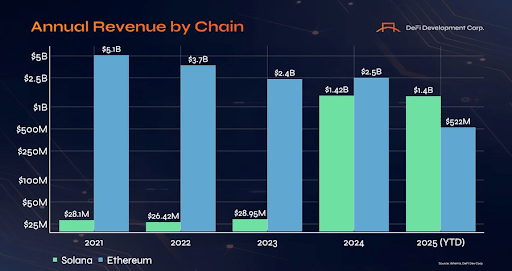
Source: Chart from Defi Dev Corps on X

Notably, Ethereum’s revenue is down around 90% in 5 years, while Solana’s revenue has increased around 5,000% in the same period. DeFiLlama data shows that dApps such as Pump.fun, Axiom, Meteroa, Jupiter, and Phantom have actively contributed to the revenue recorded on SOL. Meanwhile, the network has also generated base fees paid by users.

Commenting on this milestone, Solana’s co-founder stated that it has been a “crazy year” and noted that whether open permissionless protocols can actually grow and maintain revenue remains an open question. Yakovenko further remarked that he believes the entire crypto market cap will continue to grow and, eventually, will have to be split by revenue.

He also stated that Solana and Ethereum’s only shot at this is in the execution layer. Yakovenko explained that providing the best execution layer will mean global decentralized, low-latency, and high-throughput censorship resistance.

“SOL Is Dying”

Amid Solana’s revenue milestone over Ethereum, DeFi maxi Scribbler has declared that Solana is dying. In an X post, he noted that over 30 million people were trading on the network each month between November last year and February this year. However, since then, the network has struggled to average 1 million traders monthly.

This is likely due to the slowdown in meme coin trading on the SOL network, which gained it a lot of traction last year and at the start of this year, when U.S. President Donald Trump launched his meme coin, TRUMP. However, crypto commentator Marty doesn’t believe that this is the end for Solana, stating that equity traders and stablecoin users will replace the meme coin traders.

Notably, Galaxy Digital and Forward Industries have tokenized their stocks on SOL, while the network is also seeing increasing activity in stablecoin transactions. Visa just recently announced plans to begin USDC stablecoin settlements on Solana for U.S. banks.

SOL trading at $126 on the 1D chart | Source: SOLUSDT on Tradingview.com

Trending Cryptos

Related Questions

QAccording to the article, what is the projected annual revenue for Solana (SOL) and Ethereum (ETH) year-to-date (YTD)?

AYear-to-date, Solana has recorded an annual revenue of $1.4 billion, while the Ethereum network has recorded $522 million.

QWhat significant trend does the article highlight regarding the 5-year revenue change for Ethereum and Solana?

AEthereum's revenue is down around 90% in the last 5 years, while Solana's revenue has increased by approximately 5,000% in the same period.

QWhat reason is suggested for the recent decline in the number of monthly traders on the Solana network?

AThe decline is likely due to a slowdown in meme coin trading, which had previously given the network a lot of traction.

QWhat did Solana co-founder Anatoly Yakovenko identify as the 'only shot' for Solana and Ethereum's success?

AHe stated that their only shot is in the execution layer, which means providing a global, decentralized, low-latency, and high-throughput censorship-resistant platform.

QWhat recent development did Visa announce regarding the Solana network?

AVisa announced plans to begin USDC stablecoin settlements on Solana for U.S. banks.

Related Reads

Supporters of Bitcoin BIP-110 Update Have Prepared a 'Last Resort' Plan If the Proposal Is Not Adopted: It Could Radically Change BTC's Value

Supporters of the BIP-110 update for Bitcoin have prepared a contingency plan in case the proposal is not adopted, a move that could radically alter BTC's value. Developer Chris Guida has adapted a proof-of-work code originally created by Luke Dashjr in 2017 for the current version of Bitcoin Knots. This adaptation is described as a last-resort measure to be activated if miners do not signal readiness for BIP-110. The proposal itself is a soft fork aimed at temporarily limiting the storage of arbitrary data in Bitcoin transactions. It introduces stricter limits on new transaction outputs, OP_RETURN fields, and witness data, with rules designed to expire after approximately one year. Guida stated this option needs to remain open if miners were to "conspire to betray Bitcoin." Should the contingency code be used, it could change Bitcoin's current mining algorithm. This change would likely prevent existing ASIC miners from generating blocks on the new chain, leading to a large-scale reorganization of the Bitcoin mining network. Luke Dashjr, another Bitcoin Knots developer, contributed to the code and expressed hope it would not be needed, but sees its existence as useful for a potential crisis. A supporter known as Mechanic argued that the mere possibility of a proof-of-work change could act as a deterrent, emphasizing that Bitcoin's rules should be set by participants and node operators, not miners. While miner signals are tracked for BIP-110 activation, data from the proposal's official tracking page indicates support remains limited.

cryptonews.ru23m ago

Supporters of Bitcoin BIP-110 Update Have Prepared a 'Last Resort' Plan If the Proposal Is Not Adopted: It Could Radically Change BTC's Value

cryptonews.ru23m ago

Why Did Bitcoin's Price Remain Stable and Not Fall Despite the Recent Major Hack? Here's the Secret

The article discusses why Bitcoin's price remained stable despite a recent $100 million hack targeting individual cold wallets, citing insights from experts on "The Wolf of All Streets" channel. Analysts attribute this resilience to significant institutional shifts in the crypto market. Key points include: 1. **Market Maturation:** The crypto market has transitioned from being dominated by individual retail holders to institutional investors. Most new capital now enters via regulated channels like spot ETFs and custodial services (e.g., Coinbase, Anchorage), making vulnerabilities in individual cold wallets less impactful. 2. **Institutional Dominance:** Control over price dynamics has shifted from miners and crypto exchanges to Wall Street and institutional capital. These large players operate with long-term strategies, viewing price corrections as buying opportunities rather than reasons for panic. 3. **Increased Resilience:** Institutional involvement has reduced market sensitivity to negative news. Sellers are largely exhausted, and remaining holders are steadfast. Major financial institutions (e.g., Morgan Stanley, Wells Fargo) are incorporating crypto assets into portfolios, with research teams recommending allocations of 1–6% to Bitcoin. 4. **Risk Perception:** Bitcoin's integration into traditional financial indices has lowered perceived risk among professionals and institutions, further stabilizing its price against isolated security breaches.

cryptonews.ru1h ago

Why Did Bitcoin's Price Remain Stable and Not Fall Despite the Recent Major Hack? Here's the Secret

cryptonews.ru1h ago

Trading

Spot

Hot Articles

Discussions

Welcome to the HTX Community. Here, you can stay informed about the latest platform developments and gain access to professional market insights. Users' opinions on the price of ETH (ETH) are presented below.

活动图片