Why Is the Crypto Market Surging Today? Breakout Momentum Builds Ahead of U.S. Data

bitcoinistPublished on 2026-02-26Last updated on 2026-02-26

Abstract

The cryptocurrency market is surging, rebounding from recent volatility as traders anticipate key U.S. economic data. The total market cap climbed toward $2.3 trillion, signaling potential bearish exhaustion. Bitcoin reclaimed $65,000, while Ethereum held near $1,900, and altcoins like LEO saw double-digit gains. Leveraged short liquidations accelerated the upward move. The rally is largely driven by expectations that weaker U.S. jobless claims data could lead to Federal Reserve rate cuts, improving liquidity for risk assets. Despite the recovery, the market remains at a critical juncture. A breakout above $2.3 trillion in market cap or Bitcoin surpassing $67,000–$70,000 resistance could confirm bullish momentum, while failure to hold support may renew downside risks.

The crypto market is showing renewed strength after several days of volatility, with prices rebounding as traders reposition ahead of key U.S. economic data. A mix of technical recovery, macroeconomic expectations, and market structure dynamics has helped digital assets regain momentum.

After recent selling pressure drove prices toward critical support levels, buyers stepped back in, triggering a broad recovery led by Bitcoin and several high-performing altcoins. The move comes as investors increasingly focus on upcoming U.S. labor market data.
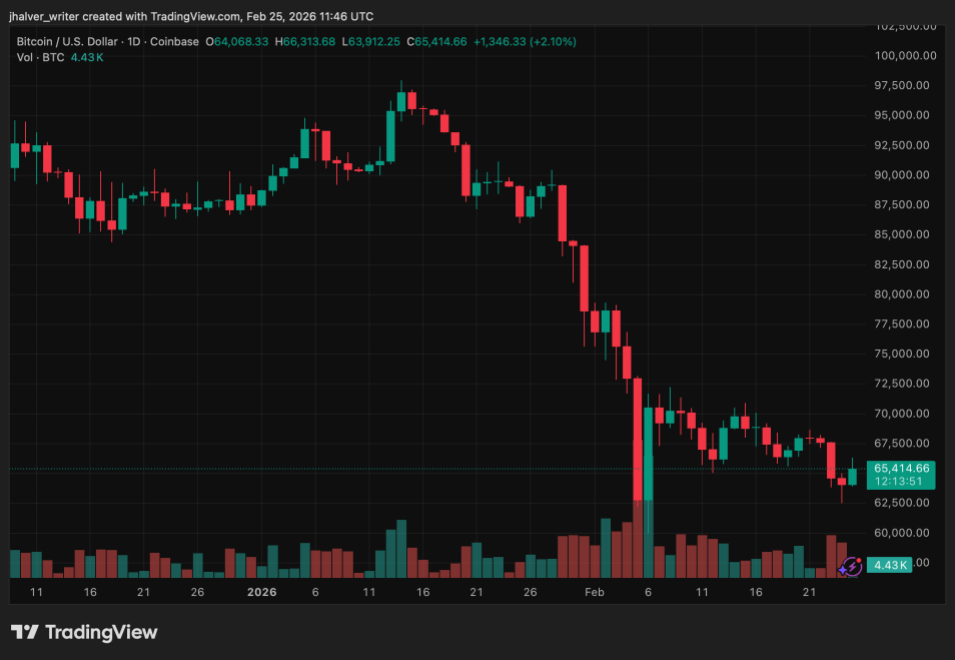
BTC's price trends to the downside on the daily chart. Source: BTCUSD on Tradingview

Market Rebound Signals Bearish Exhaustion

The total cryptocurrency market capitalization has added tens of billions of dollars over the past 24 hours, climbing back toward the $2.3 trillion region after earlier losses. Analysts point to signs of bearish exhaustion, with stabilizing price action suggesting that sellers may be losing control in the short term.

Bitcoin reclaimed the $65,000 level and continues to trade within a multi-week consolidation range between roughly $65,000 and $70,000. This rangebound structure reflects a balance between buyers and sellers, but the latest rebound indicates improving risk appetite.

Ethereum also advanced, holding near the $1,900 zone, while large-cap assets posted moderate gains of over 3%. Meanwhile, leveraged markets contributed to the rally, as widespread short liquidations forced automated buybacks that accelerated upward price movement.

Altcoins mirrored the broader trend, with tokens such as UNUS SED LEO (LEO) posting double-digit gains amid steady capital inflows. Smaller-cap assets recorded sharper percentage moves, although volatility remains elevated across that segment of the market.

U.S. Economic Data and Liquidity Expectations Drive Momentum

A major catalyst behind today’s crypto surge is anticipation surrounding upcoming U.S. initial jobless claims data. Historically, weaker labor market readings have strengthened expectations of Federal Reserve rate cuts, which tend to support risk assets like cryptocurrencies by improving liquidity conditions.

Recent market behavior suggests traders are positioning ahead of the data release. Bitcoin has repeatedly reacted positively to jobless claims reports this month, reinforcing the connection between macroeconomic indicators and crypto price action.

Similarly, improving sentiment in global equity markets, particularly technology stocks, has added support. Crypto assets often move alongside risk assets, and gains in equities have encouraged investors to re-enter digital markets following the recent dip.

Key Levels to Watch as Breakout Pressure Builds

Despite the recovery, the market remains at a critical technical juncture. For the broader crypto market, a decisive move above the $2.30 trillion capitalization level could confirm stronger bullish momentum. Failure to hold current support, however, may reopen downside risks.

Bitcoin faces a similar test, with resistance near the $67,000–$70,000 range acting as the next major hurdle. A confirmed breakout above this zone would strengthen the bullish outlook, while a drop below recent support levels could revive volatility.

Even as the Fear and Greed Index remains in extreme fear territory, improving price stability and macro catalysts suggest traders are preparing for a potential breakout, one that may ultimately depend on the direction set by upcoming U.S. economic data.

Cover image from ChatGPT, BTCUSD chart on Tradingview

Related Questions

QWhat are the main factors contributing to the crypto market's surge according to the article?

AThe main factors are technical recovery, macroeconomic expectations (particularly around U.S. economic data), market structure dynamics, bearish exhaustion, and leveraged market short liquidations triggering automated buybacks.

QWhat key U.S. economic data are traders anticipating that is influencing crypto prices?

ATraders are anticipating the upcoming U.S. initial jobless claims data, as weaker labor market readings can strengthen expectations of Federal Reserve rate cuts, which improve liquidity conditions and support risk assets like cryptocurrencies.

QWhat is the critical total market capitalization level that could confirm stronger bullish momentum for the crypto market?

AA decisive move above the $2.30 trillion total market capitalization level could confirm stronger bullish momentum for the broader crypto market.

QWhat is the significant price range that Bitcoin is currently trading within and what is the next major resistance hurdle?

ABitcoin is trading within a multi-week consolidation range between roughly $65,000 and $70,000. The next major resistance hurdle is near the $67,000–$70,000 range.

QHow did leveraged markets contribute to the price rally mentioned in the article?

ALeveraged markets contributed to the rally through widespread short liquidations, which forced automated buybacks that accelerated the upward price movement.

Related Reads

380,000 Apps Exposed, 2,000+ Apps Leaked Secrets: AI Programming Turns 'Intranet' into Public Internet

Israeli cybersecurity firm RedAccess uncovered a severe data exposure trend linked to "vibe coding" or AI-powered software development tools. Their research found approximately 38,000 publicly accessible web applications built with platforms like Lovable, Base44, Netlify, and Replit. Of these, an estimated 2,000 apps exposed sensitive corporate and personal data, including medical records, financial information, internal strategic documents, and customer chat logs. In some cases, access even granted administrative privileges. The core issue stems from default privacy settings that make applications public by default, combined with a lack of built-in security controls (like authentication) in the AI-generated code. This allows employees without security expertise—"citizen developers"—to easily create and deploy applications that bypass standard corporate security reviews. The exposed apps, often indexed by search engines, are trivially discoverable. While some platform providers (Replit, Lovable, Wix/Base44) argue that security configuration is the user's responsibility and question the validity of some findings, security researchers confirm the widespread reality of such exposures. This pattern, also noted in prior studies, highlights a critical security gap as AI democratizes app creation, potentially leading to massive, unintentional data leaks.

marsbit26m ago

380,000 Apps Exposed, 2,000+ Apps Leaked Secrets: AI Programming Turns 'Intranet' into Public Internet

marsbit26m ago

Attracting Global Capital, Asia's New 'Super Cycle' Is Unfolding

Investors are turning to Asia as the next frontier for global equity growth, with a new "super cycle" unfolding across the region. Driven by the AI revolution, Asian markets, particularly South Korea, have seen significant rallies. According to Morgan Stanley analysis, the underlying drivers of Asia's industrial cycle are shifting from traditional sectors like real estate and manufacturing to massive investments in AI infrastructure, energy security and transition, and supply chain resilience. Fixed asset investment in Asia is projected to grow from around $11 trillion in 2025 to $16 trillion by 2030, with a 7% annual growth rate from 2026-2030. The AI wave is a primary catalyst, driving immense capital expenditure for chips, servers, data centers, and power systems. Asia is central to this hardware supply chain. In China, AI investment is focused on building a full-system domestic capability, with the local AI chip market potentially reaching $86 billion by 2030. Beyond AI, China's export story is expanding from EVs and batteries to robotics. The country already captures about half of new global industrial robot demand and over 90% of humanoid robot shipments. This growth phase mirrors the early stages of China's EV export boom. Simultaneously, energy security investments, spurred by AI's massive power needs, are rising, with China benefiting from its leadership in solar, batteries, and EVs. Regional defense spending is also increasing structurally, supporting demand for advanced manufacturing. The main beneficiaries are China, South Korea, and Japan, positioned in core supply chain areas. However, risks remain, including potential overcapacity, profit margin pressures from competition, persistent technological restrictions, geopolitical friction, and workforce displacement due to AI-driven automation. Market volatility is also expected to increase as investor expectations diverge on the realization of these capital investment and export themes.

marsbit27m ago

Attracting Global Capital, Asia's New 'Super Cycle' Is Unfolding

marsbit27m ago

Funding Weekly Report | 14 Public Funding Events, Kalshi Completes $10B New Funding Round at $220B Valuation Led by Coatue Management

Weekly Funding Roundup: 14 Deals and $10.49B+ in Total Funding, Led by Kalshi's $1B Round Last week (5.4-5.10) saw 14 notable funding events in the global blockchain ecosystem, raising over $10.49 billion in total. Key highlights include Kalshi, a prediction market platform, securing a $1 billion round led by Coatue Management, reaching a $22 billion valuation. The platform now boasts ~2 million MAUs and $178B in annualized trading volume. In DeFi, regulated on-chain reinsurer OnRe raised $5 million in Series A funding, and Bitcoin-backed credit protocol Saturn Credit completed a $2 million seed round. For Infrastructure & Tools, OpenTrade raised $17 million to expand its stablecoin yield infrastructure, and RWA platform Balcony secured $12.7 million to deploy its property settlement service in the US. Centralized Finance saw one deal: AI-driven trading platform Stockcoin.ai completed a seed round led by Amber Group. In the prediction market sector alongside Kalshi, AI-powered platform Elastics raised $2 million. Other notable deals include SC Ventures' strategic investment in crypto market maker GSR and Centrifuge securing a "seven-figure" investment from Coinbase to become a core RWA partner for Base. On the investor side, Haun Ventures raised a new $1 billion fund targeting crypto and AI, and Multi Investment raised ~$616 million to focus on blockchain and Web3 investments.

marsbit1h ago

Funding Weekly Report | 14 Public Funding Events, Kalshi Completes $10B New Funding Round at $220B Valuation Led by Coatue Management

marsbit1h ago

Trading

Spot
Futures
活动图片





