Why Bitcoin’s Current Market Behavior Doesn’t Resemble An Accumulation Phase Right Now

bitcoinistPublished on 2026-01-06Last updated on 2026-01-06

Abstract

Despite Bitcoin's recent price recovery toward $100,000, on-chain data suggests the market is not in an accumulation phase. According to analyst Joao Wedson, current activity resembles redistribution rather than accumulation, with large investors likely to sell heavily if BTC reaches the $95,000–$96,700 range. Additionally, realized losses of $511 million continue to dominate over profits of $312 million, indicating ongoing investor capitulation. This selling pressure, however, may help cleanse the market and potentially mark the end of a corrective phase.

Following the sudden recovery of the broader cryptocurrency market, the Bitcoin price is slowly heading back towards the $100,000 mark, showing that bulls are reentering the market. Despite bulls returning to the market, on-chain data suggests that the current state of BTC is not in an accumulation phase.

Bitcoin Is Not In An Accumulation Phase

Bitcoin’s price appears to have regained bullish traction once again, breaking past key resistance levels that previously halted upward attempts. However, the current market structure of BTC is triggering questions about whether the flagship asset is now in an accumulation phase.

Joao Wedson, a market expert and the founder of Alphactal on-chain platform, has offered insights into Bitcoin’s market dynamics, revealing what the current market structure actually looks like rather than accumulation. Although price action may appear stable on the surface, on-chain and flow statistics indicate that buyers are not yet intervening with the conviction usually observed during classic accumulation periods.

According to the market expert, BTC’s current market structure leans heavily towards a redistribution phase rather than an accumulation phase. This suggests that activity is more of a transitory scenario where distribution and cautious participation continue to prevail, as the market looks for a clearer direction.
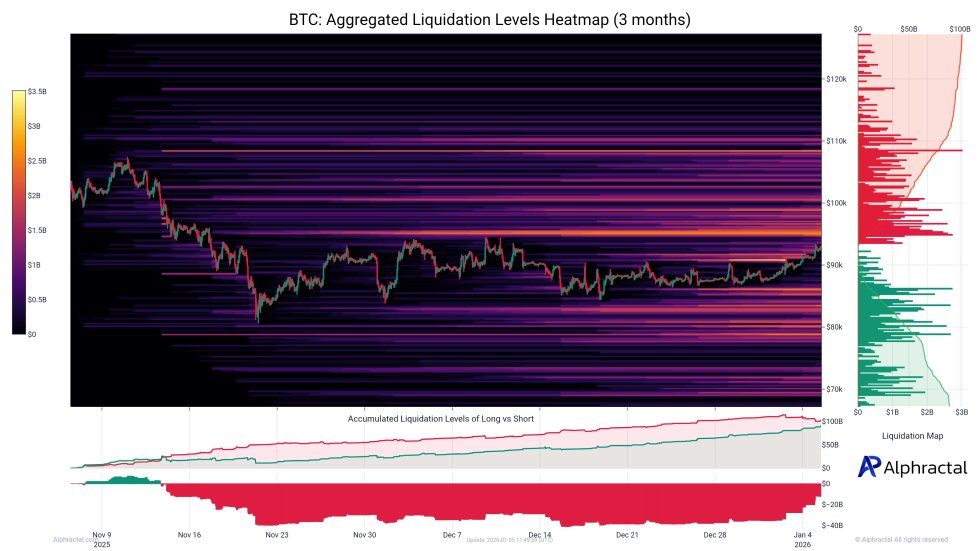
Source: Chart from Joao Wedson on X

If the price of BTC reaches the $95,000 to $96,700 range, Wedson claims that the market could witness strong selling interest from large investors or whales in the area, fueled by liquidity escape. Meanwhile, for those thinking about opening short positions, the expert has declared that this is the region where the decision makes the most sense.

Wedson’s bold statement is supported by the fact that the market usually deceives. However, before a real move is carried out in the current market state, even those who are positioned correctly typically need to be liquidated.

Realized Losses Are Still Dominant In The Market

Price action may have turned bullish, but on-chain activity has not completely moved into positive zones. Despite the current rebound in Bitcoin Darkfost, a CryptoQuant author and market expert has disclosed that realized losses continue to dominate the market.

Darkfost’s research is mainly centered on the Bitcoin weekly average of realized profits and losses. As observed on the chart, the realized profits of BTC are at $312 million, while realized losses are maintaining a value of $511 million.

This divergence shows that some investors are choosing to capitulate and exit the market by reducing their losses in spite of the ongoing recovery in BTC’s price. Furthermore, these phases of capitulation have frequently signaled the end of corrective phases.

The current capitulation has intensified over the past week. Data shows that it is approaching levels comparable to the previous bear market phase, which might have made it possible for the market to be sufficiently cleansed to begin on a healthier basis.

BTC trading at $93,284 on the 1D chart | Source: BTCUSDT on Tradingview.com

Trending Cryptos

Related Questions

QAccording to Joao Wedson, what phase does Bitcoin's current market structure resemble, and why?

AAccording to Joao Wedson, Bitcoin's current market structure resembles a redistribution phase rather than an accumulation phase. This is because on-chain data shows buyers are not intervening with the conviction seen in accumulation periods, and activity is more transitory with distribution and cautious participation.

QWhat is the significance of the $95,000 to $96,700 price range for Bitcoin, as mentioned in the analysis?

AThe $95,000 to $96,700 price range is significant because it is where the market could witness strong selling interest from large investors (whales), driven by liquidity escape. It is also the region where opening a short position is considered to make the most sense.

QWhat does the data on realized profits and losses indicate about current investor behavior?

AThe data indicates that realized losses ($511 million) are significantly higher than realized profits ($312 million), showing that many investors are choosing to capitulate and exit the market by selling at a loss, despite the ongoing price recovery.

QHow does the current level of capitulation compare to previous market phases, and what might it signal?

AThe current capitulation is intensifying and approaching levels comparable to the previous bear market phase. This often signals the end of a corrective phase and could mean the market is being sufficiently cleansed to begin a new, healthier upward trend.

QWhat is the overall contradiction between Bitcoin's price action and its on-chain activity, as presented in the article?

AThe contradiction is that while Bitcoin's price action has turned bullish and is recovering, the on-chain activity (such as the dominance of realized losses and lack of strong buyer conviction) has not moved into positive zones, suggesting the market structure is not yet fundamentally strong.

Related Reads

Agent Race Ends, Super Workbench Takes Over

The era of fragmented AI agents is ending. Over the past month, China's tech giants—Tencent, Alibaba, and ByteDance—have simultaneously shifted strategy: instead of launching new, standalone AI agents, they are consolidating their various agent projects into unified "super workbenches." Tencent integrated its QClaw teams into WorkBuddy, a strategic product hailed as a potential third flagship after QQ and WeChat. Alibaba is merging its QoderWork, Wukong, and MuleRun agents into a new "Qianwen Office" platform under DingTalk's leadership. ByteDance rebranded its TRAE SOLO coding agent to TRAE Work, signaling a broader focus on workflow collaboration. This convergence marks a pivotal industry consensus. The initial exploration phase, where companies rapidly built numerous overlapping agents for different scenarios, proved costly and inefficient. With open-source tools eroding technical barriers, competition has shifted from agent creation to resource consolidation and cost control. Historically, platform wars are won not by creating more products, but by simplifying them—as seen with browsers unifying web access and super-apps consolidating services. Now, the "super workbench" aims to become the unified AI entry point for work. This reflects a deeper market realization: the primary audience for AI is no longer just programmers (a market in the tens of millions) but all knowledge workers (a market of billions). The real opportunity lies in augmenting everyday tasks—managing emails, documents, data, and meetings—across the entire workday. The core battleground is becoming control over the primary AI entry point that employees use daily. Tencent's WorkBuddy leverages WeChat and Tencent Docs; Alibaba's Qianwen Office taps into DingTalk's organizational data; ByteDance's TRAE Work integrates with Feishu's workflows. Whoever owns this "super workbench" gains strategic control over orchestrating enterprise data and APIs. This shift is redefining enterprise software. Traditional SaaS applications, valued for their user interfaces, will recede into the background. Their core functionalities will be exposed as standardized "Skills" or APIs for the super workbench's agents to invoke. Software value will shift from selling user seats to charging based on API calls and outcomes delivered. The evolution of agents is moving through clear stages: first as novel standalone products, then as consolidated primary work entry points, and finally as pervasive, invisible capabilities embedded into the digital fabric. The recent moves by major tech firms signal the transition from the first stage into the second, accelerating toward the third. In the end, the most successful agent technology may become invisible—like electricity or the HTTP protocol—a fundamental, unnamed infrastructure powering work itself.

marsbit5m ago

Agent Race Ends, Super Workbench Takes Over

marsbit5m ago

Michael Saylor: 110 Reasons to Oppose BIP-110

Michael Saylor presents 110 arguments against Bitcoin Improvement Proposal (BIP) 110, a soft fork aimed at restricting certain non-monetary data storage uses (like inscriptions) on the Bitcoin blockchain. He acknowledges the proponents' valid concerns—such as node costs, fee pressure, and preserving Bitcoin's monetary focus—but fundamentally disagrees with the proposed solution. Saylor argues that BIP 110 represents a dangerous precedent of using consensus rules to enforce value judgments on transaction validity, moving away from Bitcoin's core principles of neutrality and permissionless innovation. His key objections are organized into eleven categories: 1) It violates neutrality and hard consensus by banning currently valid transactions. 2) It fails to meet the high burden of proof required for a consensus change, lacking concrete data on the alleged crisis. 3) Its seven bundled technical restrictions are overly broad, targeting generic script functionalities and blocking future upgrade paths. 4) It sacrifices compatibility and future optionality by closing off designed upgrade hooks. 5) Its temporary rules add significant complexity (grandfathering, expiry states) without sufficient justification. 6) The economic and security impacts, particularly on miner revenue and fee markets, are uncertain and unmodeled. 7) Superior, market-based tools (fee markets, relay/mining policies) already exist to manage blockchain load. 8) It stifles innovation by creating a chilling effect for developers. 9) Its modified activation mechanism (55% threshold, forced signaling) is aggressive and risks network splits. 10) The precedent it sets—using consensus to suppress disliked but legal uses—is more dangerous than the problem it aims to solve. 11) A better path exists: improving measurements, refining resource-based policies, and allowing market forces to work. Saylor concludes that Bitcoin's strength lies in its neutral rules, open markets, and hard consensus. Changing these foundational elements to target specific use cases is an unnecessary and risky "iatrogenic" intervention. He advocates for guarding Bitcoin's neutrality rather than acting as its redeemer.

marsbit20m ago

Michael Saylor: 110 Reasons to Oppose BIP-110

marsbit20m ago

Trading

Spot

Hot Articles

What is $BITCOIN

DIGITAL GOLD ($BITCOIN): A Comprehensive Analysis Introduction to DIGITAL GOLD ($BITCOIN) DIGITAL GOLD ($BITCOIN) is a blockchain-based project operating on the Solana network, which aims to combine the characteristics of traditional precious metals with the innovation of decentralized technologies. While it shares a name with Bitcoin, often referred to as “digital gold” due to its perception as a store of value, DIGITAL GOLD is a separate token designed to create a unique ecosystem within the Web3 landscape. Its goal is to position itself as a viable alternative digital asset, although specifics regarding its applications and functionalities are still developing. What is DIGITAL GOLD ($BITCOIN)? DIGITAL GOLD ($BITCOIN) is a cryptocurrency token explicitly designed for use on the Solana blockchain. In contrast to Bitcoin, which provides a widely recognized value storage role, this token appears to focus on broader applications and characteristics. Notable aspects include: Blockchain Infrastructure: The token is built on the Solana blockchain, known for its capacity to handle high-speed and low-cost transactions. Supply Dynamics: DIGITAL GOLD has a maximum supply capped at 100 quadrillion tokens (100P $BITCOIN), although details regarding its circulating supply are currently undisclosed. Utility: While precise functionalities are not explicitly outlined, there are indications that the token could be utilized for various applications, potentially involving decentralized applications (dApps) or asset tokenization strategies. Who is the Creator of DIGITAL GOLD ($BITCOIN)? At present, the identity of the creators and development team behind DIGITAL GOLD ($BITCOIN) remains unknown. This situation is typical among many innovative projects within the blockchain space, particularly those aligning with decentralized finance and meme coin phenomena. While such anonymity may foster a community-driven culture, it intensifies concerns about governance and accountability. Who are the Investors of DIGITAL GOLD ($BITCOIN)? The available information indicates that DIGITAL GOLD ($BITCOIN) does not have any known institutional backers or prominent venture capital investments. The project seems to operate on a peer-to-peer model focused on community support and adoption rather than traditional funding routes. Its activity and liquidity are primarily situated on decentralized exchanges (DEXs), such as PumpSwap, rather than established centralized trading platforms, further highlighting its grassroots approach. How DIGITAL GOLD ($BITCOIN) Works The operational mechanics of DIGITAL GOLD ($BITCOIN) can be elaborated on based on its blockchain design and network attributes: Consensus Mechanism: By leveraging Solana’s unique proof-of-history (PoH) combined with a proof-of-stake (PoS) model, the project ensures efficient transaction validation contributing to the network's high performance. Tokenomics: While specific deflationary mechanisms have not been extensively detailed, the vast maximum token supply implies that it may cater to microtransactions or niche use cases that are still to be defined. Interoperability: There exists the potential for integration with Solana’s broader ecosystem, including various decentralized finance (DeFi) platforms. However, the details regarding specific integrations remain unspecified. Timeline of Key Events Here is a timeline that highlights significant milestones concerning DIGITAL GOLD ($BITCOIN): 2023: The initial deployment of the token occurs on the Solana blockchain, marked by its contract address. 2024: DIGITAL GOLD gains visibility as it becomes available for trading on decentralized exchanges like PumpSwap, allowing users to trade it against SOL. 2025: The project witnesses sporadic trading activity and potential interest in community-led engagements, although no noteworthy partnerships or technical advancements have been documented as of yet. Critical Analysis Strengths Scalability: The underlying Solana infrastructure supports high transaction volumes, which could enhance the utility of $BITCOIN in various transaction scenarios. Accessibility: The potential low trading price per token could attract retail investors, facilitating wider participation due to fractional ownership opportunities. Risks Lack of Transparency: The absence of publicly known backers, developers, or an audit process may yield skepticism regarding the project's sustainability and trustworthiness. Market Volatility: The trading activity is heavily reliant on speculative behavior, which can result in significant price volatility and uncertainty for investors. Conclusion DIGITAL GOLD ($BITCOIN) emerges as an intriguing yet ambiguous project within the rapidly evolving Solana ecosystem. While it attempts to leverage the “digital gold” narrative, its departure from Bitcoin's established role as a store of value underscores the need for a clearer differentiation of its intended utility and governance structure. Future acceptance and adoption will likely depend on addressing the current opacity and defining its operational and economic strategies more explicitly. Note: This report encompasses synthesised information available as of October 2023, and developments may have transpired beyond the research period.

969 Total ViewsPublished 2025.05.13Updated 2025.05.13

What is $BITCOIN

Discussions

Welcome to the HTX Community. Here, you can stay informed about the latest platform developments and gain access to professional market insights. Users' opinions on the price of BTC (BTC) are presented below.

活动图片