Why Bitcoin Price Is Still Falling Despite Rising Strategy And ETF Demand: Researcher

bitcoinistPublished on 2026-03-28Last updated on 2026-03-28

Abstract

Despite significant Bitcoin purchases by institutional players like spot ETFs and Michael Saylor’s MicroStrategy (MSTR), the price of Bitcoin fell toward $65,000 on March 27. According to CryptoQuant’s Head of Research Julio Moreno, this decline is due to a contraction in overall spot BTC demand, as measured by the Demand Growth metric. While ETF inflows and MSTR’s acquisitions—now holding over 762,000 BTC—have increased, broader investor accumulation has slowed. Most corporate treasuries have reduced Bitcoin buying activity except for MicroStrategy. BTC was trading around $66,300, down over 4% in 24 hours.

On Friday, March 27th, the price of Bitcoin fell toward the $65,000 level, reflecting the growing uncertainty in the broader global financial markets. Interestingly, this decline in the flagship cryptocurrency’s value came despite the increasing market activity of select institutional investors. A prominent on-chain analytics expert has come forward with a plausible explanation for the fall in the Bitcoin price despite increasing institutional buying activity.

BTC Overall Demand Still On The Decline

In a new post on the social media platform X, CryptoQuant’s Head of Research, Julio Moreno, revealed why the price of Bitcoin is in steady decline despite significant purchases by exchange-traded funds (ETFs) and Michael Saylor-led Strategy (MSTR). According to the on-chain expert, this trend can be explained by the contracting overall spot demand for BTC.

Moreno drew this observation from the Demand Growth metric, which measures the rate of change in the accumulation of a specific cryptocurrency (Bitcoin, in this case) by investors. This apparent demand growth indicator assesses demand by comparing the freshly mined BTC to the amount of unmoved coin in over a year.

In his analysis, Moreno excluded the spot BTC ETFs and Strategy to show a divergence in their movement from the overall metric. As shown in the chart below, BTC demand from the exchange-traded funds and its largest corporate holder has been growing since the end of March, with the overall spot demand still contracting.
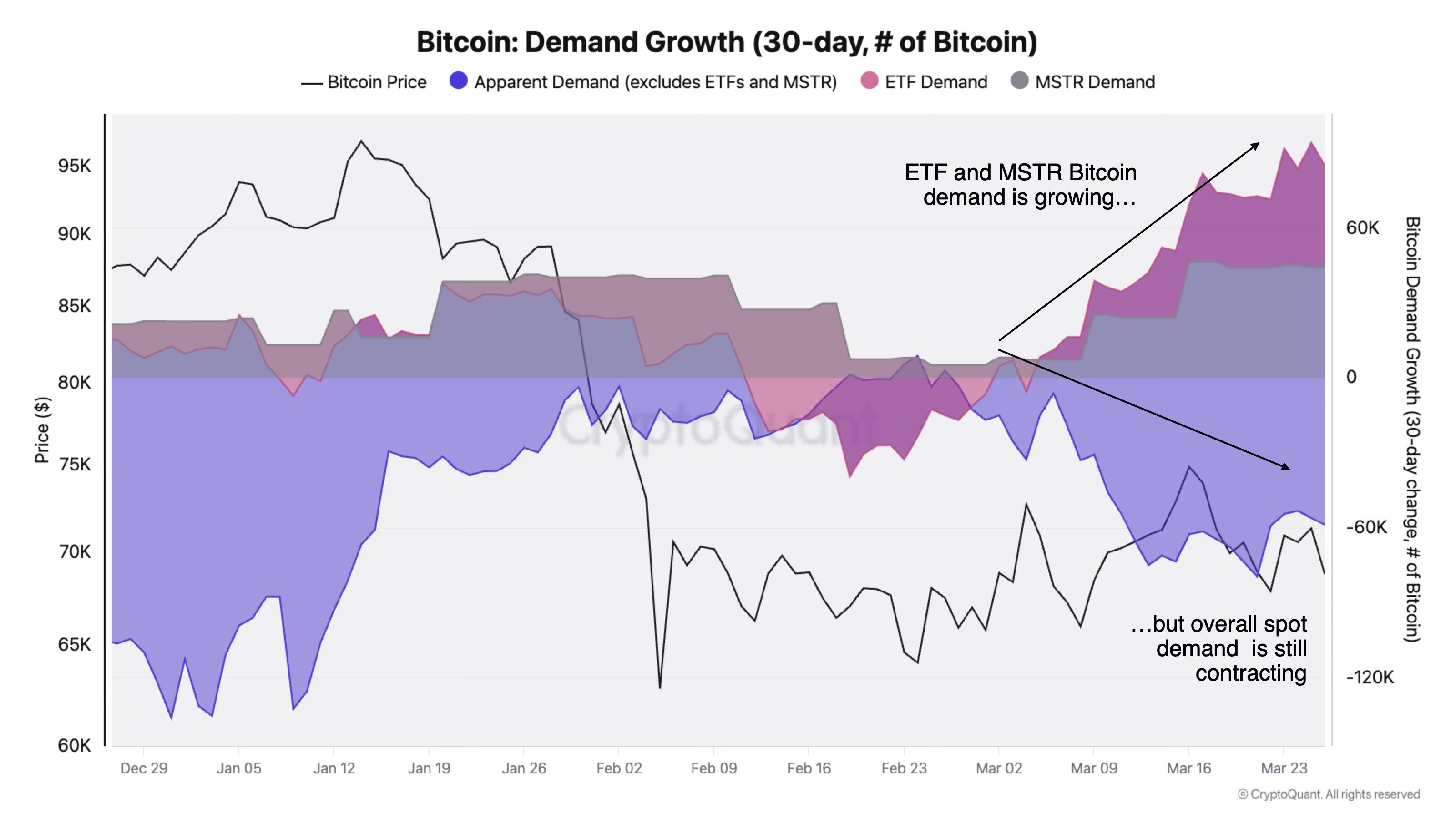
Source: @jjcmoreno on X

Typically, news of positive ETF inflows and fresh Strategy’s treasury acquisitions are welcomed with excitement, as they are believed to have some impact on the value of the premier cryptocurrency. According to the CryptoQuant Head of Research, it is not enough to look at the activities of the spot ETFs and Strategy when judging the current Bitcoin demand.

As CryptoQuant revealed in its latest research report, Strategy is the sole driver of the BTC treasury demand, which has dwindled from its euphoric 2025 high. While most BTC treasury companies have reduced their market activity, Strategy has continuously doubled down on its position with additional Bitcoin purchases.

As Bitcoinist reported, the Saylor-led firm recently added over 1,000 coins to its holdings, bringing its Bitcoin treasury to around 762,099 BTC (around of 3.81% of the entire circulating supply). Meanwhile, the US-based Bitcoin exchange-traded funds recorded four consecutive weeks of capital inflows, prior to this week’s negative performance.

Bitcoin Price At A Glance

After falling to around $65,500 on Friday, the market leader is now hovering around $66,300. According to data from CoinGecko, the BTC price is down by more than 4% in the past 24 hours.

The price of BTC on the daily timeframe | Source: BTCUSDT chart on TradingView


Related Questions

QWhy is the price of Bitcoin falling despite increased buying activity from ETFs and MicroStrategy?

AThe price is falling because the overall spot demand for Bitcoin is contracting, as indicated by the Demand Growth metric, which shows a decline in accumulation by investors despite the isolated buying from ETFs and MicroStrategy.

QWhat is the 'Demand Growth metric' mentioned in the article, and what does it measure?

AThe Demand Growth metric measures the rate of change in the accumulation of Bitcoin by investors. It assesses demand by comparing the amount of newly mined BTC to the amount of coins that haven't moved in over a year.

QHow has MicroStrategy's (MSTR) Bitcoin purchasing activity compared to other corporate treasuries?

AMicroStrategy is the sole driver of BTC treasury demand, as most other corporate treasuries have reduced their market activity. MicroStrategy has continuously increased its holdings, recently adding over 1,000 coins to its treasury.

QWhat was the performance of US-based Bitcoin ETFs prior to the week discussed in the article?

APrior to the week discussed, US-based Bitcoin exchange-traded funds had recorded four consecutive weeks of capital inflows.

QWhat was the price of Bitcoin and its 24-hour performance at the time the article was written?

AAt the time of writing, Bitcoin was hovering around $66,300, down by more than 4% in the past 24 hours after falling to around $65,500 earlier on Friday.

Related Reads

The Battle for the AI Payment Race: Traditional Card Networks Face Off Against Coinbase

With the rise of AI agents conducting transactions, a battle for the underlying payment infrastructure is underway. Two distinct and incompatible approaches have emerged for enabling autonomous AI payments. The first approach is championed by traditional card networks Visa and Mastercard. They leverage their existing tokenized card credential systems, extending them to allow verified AI agents to make purchases within user-defined limits. Services like Mastercard's Agent Pay and Visa's Intelligent Commerce integrate with major AI platforms (e.g., OpenAI, Anthropic) and keep transactions within the established, decades-old card payment model. This system offers advantages for consumer retail, including robust fraud protection, chargeback mechanisms, and extensive merchant networks. The second approach, led by Coinbase, utilizes stablecoins on open internet protocols. Its x402 protocol reactivates the HTTP 402 status code for machine-to-machine micropayments, using USDC for settlement directly on-chain. This method eliminates the need for accounts or card fees, making it highly efficient for high-frequency, low-value, cross-border transactions between AI agents—such as paying for API calls, data streams, or computational resources—where traditional card fees and settlement times are impractical. While card networks excel in consumer-facing scenarios requiring dispute resolution, stablecoin protocols are tailored for machine economies. A key challenge for both is agent identity verification and transaction authorization. Notably, Visa and Mastercard are hedging their bets by also investing in stablecoins. Visa has rapidly grown its stablecoin settlement volume and is collaborating with Coinbase to bridge its network with the x402 protocol. Mastercard plans to acquire stablecoin platform BVNK. Their strategy is to become the fee-collecting gateway for all payment flows, regardless of the channel. Current applications reflect this division: consumer AI shopping tools (e.g., ChatGPT's checkout, Amazon's "Shop for Me") predominantly use card networks, while machine-focused services (e.g., Amazon Bedrock's core payments) adopt stablecoins via the x402 protocol. In the short term, a coexistence model is expected, with cards dominating retail and stablecoins powering machine transactions. The long-term outcome depends on whether AI-driven commerce evolves to resemble traditional retail or becomes a vast network of machine micropayments. By investing in both tracks, the incumbent card networks are positioning themselves to capture transaction fees regardless of which future prevails.

marsbit13m ago

The Battle for the AI Payment Race: Traditional Card Networks Face Off Against Coinbase

marsbit13m ago

Farewell to Traditional Bulls and Bears: The Market Has Entered an Era of Rotating Bubbles

Farewell to traditional bull and bear markets; we have entered an era of rolling bubbles. This article uses a meteorological analogy to explain the modern market's shift from slow-moving, long-term trends to a chain of rapid, successive speculative frenzies. The old market resembled "stratiform" weather—slow, broad cycles lasting years. Today's market is like a "mesoscale convective system," where isolated storms (bubbles in sectors like AI, GLP-1 drugs, or crypto) form in sequence. Each is triggered by the outflow of capital and sentiment from the previous one, creating a self-perpetuating chain of booms and busts. This structural change is driven by eight permanent shifts: the democratization of speculation (zero-commission trading, retail options activity), perpetual buying from defined-contribution retirement plans, the dominance of passive investing (creating price-insensitive flows), the rise of multi-strategy funds and high-frequency trading (weakening price discovery), suppressed volatility that erupts violently, an index composition now dominated by long-duration, narrative-driven tech stocks, the elimination of information delays, and a permissive fiscal/monetary backdrop. These conditions ensure that rolling bubbles are the new normal. To navigate this environment, investors should either become deep-sector experts who understand the underlying technologies and business models or become adept observers of trends and capital flows. While chaotic from within each "storm," a higher-altitude view reveals a predictable pattern of serial booms. The key is to avoid being emotionally swept up in any single narrative and to recognize the market's new, permanent structure.

marsbit48m ago

Farewell to Traditional Bulls and Bears: The Market Has Entered an Era of Rotating Bubbles

marsbit48m ago

Trading

Spot
Futures

Hot Articles

What is $BITCOIN

DIGITAL GOLD ($BITCOIN): A Comprehensive Analysis Introduction to DIGITAL GOLD ($BITCOIN) DIGITAL GOLD ($BITCOIN) is a blockchain-based project operating on the Solana network, which aims to combine the characteristics of traditional precious metals with the innovation of decentralized technologies. While it shares a name with Bitcoin, often referred to as “digital gold” due to its perception as a store of value, DIGITAL GOLD is a separate token designed to create a unique ecosystem within the Web3 landscape. Its goal is to position itself as a viable alternative digital asset, although specifics regarding its applications and functionalities are still developing. What is DIGITAL GOLD ($BITCOIN)? DIGITAL GOLD ($BITCOIN) is a cryptocurrency token explicitly designed for use on the Solana blockchain. In contrast to Bitcoin, which provides a widely recognized value storage role, this token appears to focus on broader applications and characteristics. Notable aspects include: Blockchain Infrastructure: The token is built on the Solana blockchain, known for its capacity to handle high-speed and low-cost transactions. Supply Dynamics: DIGITAL GOLD has a maximum supply capped at 100 quadrillion tokens (100P $BITCOIN), although details regarding its circulating supply are currently undisclosed. Utility: While precise functionalities are not explicitly outlined, there are indications that the token could be utilized for various applications, potentially involving decentralized applications (dApps) or asset tokenization strategies. Who is the Creator of DIGITAL GOLD ($BITCOIN)? At present, the identity of the creators and development team behind DIGITAL GOLD ($BITCOIN) remains unknown. This situation is typical among many innovative projects within the blockchain space, particularly those aligning with decentralized finance and meme coin phenomena. While such anonymity may foster a community-driven culture, it intensifies concerns about governance and accountability. Who are the Investors of DIGITAL GOLD ($BITCOIN)? The available information indicates that DIGITAL GOLD ($BITCOIN) does not have any known institutional backers or prominent venture capital investments. The project seems to operate on a peer-to-peer model focused on community support and adoption rather than traditional funding routes. Its activity and liquidity are primarily situated on decentralized exchanges (DEXs), such as PumpSwap, rather than established centralized trading platforms, further highlighting its grassroots approach. How DIGITAL GOLD ($BITCOIN) Works The operational mechanics of DIGITAL GOLD ($BITCOIN) can be elaborated on based on its blockchain design and network attributes: Consensus Mechanism: By leveraging Solana’s unique proof-of-history (PoH) combined with a proof-of-stake (PoS) model, the project ensures efficient transaction validation contributing to the network's high performance. Tokenomics: While specific deflationary mechanisms have not been extensively detailed, the vast maximum token supply implies that it may cater to microtransactions or niche use cases that are still to be defined. Interoperability: There exists the potential for integration with Solana’s broader ecosystem, including various decentralized finance (DeFi) platforms. However, the details regarding specific integrations remain unspecified. Timeline of Key Events Here is a timeline that highlights significant milestones concerning DIGITAL GOLD ($BITCOIN): 2023: The initial deployment of the token occurs on the Solana blockchain, marked by its contract address. 2024: DIGITAL GOLD gains visibility as it becomes available for trading on decentralized exchanges like PumpSwap, allowing users to trade it against SOL. 2025: The project witnesses sporadic trading activity and potential interest in community-led engagements, although no noteworthy partnerships or technical advancements have been documented as of yet. Critical Analysis Strengths Scalability: The underlying Solana infrastructure supports high transaction volumes, which could enhance the utility of $BITCOIN in various transaction scenarios. Accessibility: The potential low trading price per token could attract retail investors, facilitating wider participation due to fractional ownership opportunities. Risks Lack of Transparency: The absence of publicly known backers, developers, or an audit process may yield skepticism regarding the project's sustainability and trustworthiness. Market Volatility: The trading activity is heavily reliant on speculative behavior, which can result in significant price volatility and uncertainty for investors. Conclusion DIGITAL GOLD ($BITCOIN) emerges as an intriguing yet ambiguous project within the rapidly evolving Solana ecosystem. While it attempts to leverage the “digital gold” narrative, its departure from Bitcoin's established role as a store of value underscores the need for a clearer differentiation of its intended utility and governance structure. Future acceptance and adoption will likely depend on addressing the current opacity and defining its operational and economic strategies more explicitly. Note: This report encompasses synthesised information available as of October 2023, and developments may have transpired beyond the research period.

363 Total ViewsPublished 2025.05.13Updated 2025.05.13

What is $BITCOIN

Discussions

Welcome to the HTX Community. Here, you can stay informed about the latest platform developments and gain access to professional market insights. Users' opinions on the price of BTC (BTC) are presented below.

活动图片














