Author:Nancy,PANews
While leading public chains like Solana and Base are fully engaged in competing for developers, traffic, and ecosystem expansion, the Ethereum Foundation (EF) has chosen to actively take a back seat.
Persistent loss of core talent, combined with multiple rounds of ETH selling pressure, has continuously fueled FUD sentiment surrounding the EF. This seemingly passive strategy is steadily eroding market trust in the EF.
On May 25, Vitalik Buterin published a lengthy response to recent controversies. He proposed that the EF is merely a special node with a specific mission, outlined the EF's future streamlining strategy and technical roadmap, and explicitly stated that maintaining the ETH price does not fall within the EF's responsibility.
After losing its 'leading big brother,' how will Ethereum continue forward in the post-foundation era?
From Executionism to Long-Termism: Diverging Styles of Public Chain Foundations
Recently, controversies over the loss of core foundation members, frequent ETH sales, and debates about ecosystem execution capability have been fermenting, intensifying external skepticism towards the EF, even sparking discussions about starting anew.
Meanwhile, Vitalik's latest disclosure reveals that the EF currently holds only about 0.16% of the total ETH supply, far lower than the common 10%—50% range for many public chain foundations.
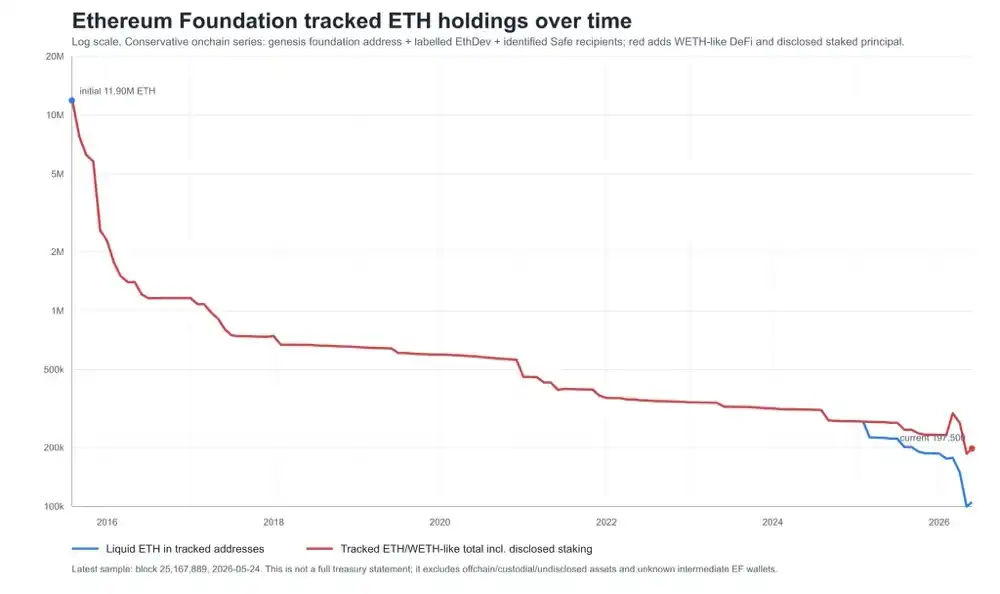
In other words, the EF's initial allocation of approximately 6 million ETH (8.3% of the initial total supply) has been largely depleted over the past decade, leaving around 100,000 ETH. Today, the EF can no longer sustain the role of supporting the vast ecosystem's high-speed operation, whether in terms of financial reserves, personnel scale, or organizational execution capability.
As one of the industry's most representative pure foundations, the EF has long focused on protocol research, public goods development, and open-source ecosystem support. Although the EF does not directly control the Ethereum network, its early accumulation of ETH reserves and the sustained influence of key developers like Vitalik have long positioned it as a crucial coordinating and driving force within the Ethereum ecosystem.
However, as the Ethereum ecosystem matures, the EF and Vitalik are intentionally diminishing their centralized influence, transitioning to a more low-key, backstage supporting role. This shift stems from adherence to neutrality and long-termism on one hand, and is constrained by practical pressures on the other.
As the EF's role within Ethereum diminishes, the singular growth path that ecosystem projects once relied on—heavily dependent on foundation resources and support—is gradually becoming obsolete. Ecosystem expansion is shifting towards community-driven innovation and diverse external collaboration.
Indeed, the foundation models of different public chains not only shape their respective governance cultures but also determine the ecosystem's maturity, degree of decentralization, and long-term evolutionary path.
In contrast, other emerging public chains are still in a phase of intense expansion, where foundations play a more aggressive and dominant role. For example, emerging chains like Solana, Aptos, and TON adopt more flexible foundation-driven models. By holding a high proportion of tokens early on, they implement high-intensity resource investment, continuous incentive programs, and support from DAT companies, sometimes with founding teams directly involved, to maintain high execution efficiency and growth speed.
Base represents another path. As a Coinbase-supported L2, it does not rely on a traditional independent foundation structure. Instead, it leverages parent company resources and commercial networks to drive ecosystem development, supplemented by ecosystem funds to promote developer and application integration. The advantage of this model lies in its high resource integration efficiency, enabling rapid user growth and product implementation.
Chains like Polygon and Avalanche employ a hybrid architecture with both a foundation and Labs. The foundation is responsible for governance transparency and community public affairs, while Labs focuses on product development and commercial execution. This avoids excessive centralization in a single entity while enhancing decision-making and implementation speed. The Hyperliquid Foundation follows a more financially-native governance path, deeply integrating governance rights, economic incentives, and ecosystem development funds through token mechanisms. It also allocates some resources for policy research and external communication, enhancing the ecosystem's self-sustainability and adaptability.
More importantly, as emerging public chains are still in fierce expansion and competition, they generally offer high cash salaries and substantial token incentives to aggressively attract developer resources, holding a clear advantage in the short-term talent war. In comparison, Ethereum is not competitive in terms of compensation. It relies more on developers' idealism, open-source culture identification, and the long-term ecosystem reputation to sustain contributions. Meanwhile, many core developers who entered the Ethereum ecosystem early have already gained considerable financial returns during the last bull market. Some members have gradually stepped back from frontline development and maintenance roles, leading to a noticeable shortage of sustained execution manpower within the ecosystem.
It can be said that the EF's transformation is both a result of Ethereum's developmental evolution and a long-term survival choice made under constraints of funding and execution capability.
Foundation to Reduce Token Sales; ETH Value Growth Needs More Major Holders
"The Ethereum Foundation has done a lot of technical work, but the market views it as a company, so this expectation gap leads to dissatisfaction. In other words, it's all about the price," the crypto KOL Lanhu Notes pinpointed the crux of the issue.
For the Ethereum community, almost all controversies eventually circle back to the issue of ETH's stagnant price.
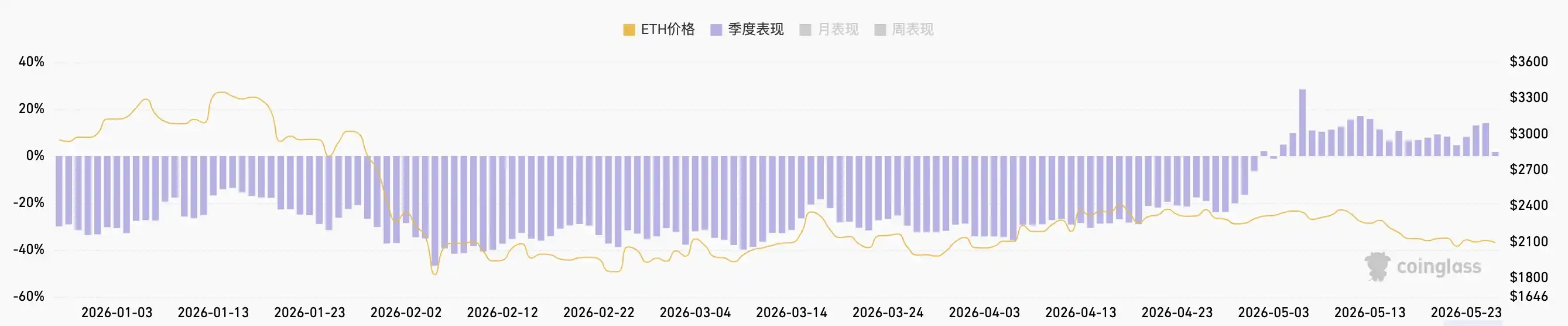
Crypto journalist Laura Shin pointed out that since the Dencun upgrade, Ethereum's series of roadmap choices have consistently lacked sufficient consideration for tokenomics, overly focusing on ideology while neglecting capital markets and price performance, leading to dissatisfaction within the community and among investors. Having external organizations participate can only aid business expansion, not fundamentally solve market issues at the asset level of ETH.
More importantly, the competition has just begun. Laura Shin believes we are currently at a critical stage for real-world adoption. However, compared to competitors actively capturing market share, attracting developers, and capital, the Ethereum Foundation seems increasingly reliant on past successes. Especially when the most competitive talents within the ecosystem continue to leave, this laissez-faire attitude may ultimately help competitors grow stronger and even give rise to new challengers.
Vitalik also responded to market skepticism in his long post. He emphasized that ETH is Ethereum's most valuable product, and the scale of ETH value currently carried and secured by the Ethereum network has reached approximately $250 billion. He disclosed that over 90% of his personal net worth is allocated to ETH, with the remainder primarily consisting of about $40 million in on-chain fiat assets, which he has fully invested in open-source biotech, software, and hardware projects.
However, Vitalik also stated that although the foundation will reduce ETH sales in the future, maintaining the ETH price is not within the EF's scope of responsibility. In his view, the Ethereum ecosystem already contains numerous individuals and institutions with financial resources far exceeding the EF. To truly drive ETH asset value growth, more ecosystem 'heroes' need to work together. The EF is also planning to establish connections with such organizations, providing them with necessary initial support.
Blockchain researcher William Mougayar expressed a similar view. He believes ETH is essentially an asset, Ethereum is a shared computing infrastructure, and the Ethereum Foundation is merely a non-profit organization responsible for promoting protocol development. One of its long-term goals is even to "gradually make the founders themselves less important."
As the EF actively recedes into the background, ETH is entering a new stage that relies more on ecosystem self-drive.
While the community is anxious about ETH's price, Ethereum's mainstream adoption is accelerating. Two Ethereum DAT companies, BitMine and Sharplink, are expected to be included in the US Russell Indexes on June 29 this year. Specifically, BMNR will be included in the Russell 1000 Index and Russell 3000 Index, while SBET will be included in the Russell 2000 Index and Russell 3000 Index.
According to BitMine Chairman Tom Lee, based on BitMine's current market capitalization of $107.5 billion, if successfully included, BitMine would attract at least $2.15 billion in buying funds.
Lanhu Notes further pointed out that global funds tracking the Russell 2000 and Russell 3000 indexes are in the trillions of dollars. Once officially included, relevant index funds are compelled to allocate the corresponding stocks. This opens the floodgates of passive funds for SBET and BMNR, allowing a large number of ordinary investors who previously had no exposure to the crypto market to automatically hold these stocks, pushing Ethereum into the mainstream channel of traditional finance. Passive fund buying creates real demand, often providing short-term support for stock prices around the inclusion date, and in the long term, increases stock liquidity and institutional holding ratios. It should be noted that while these funds are buying stocks, not ETH itself, it may indirectly strengthen market demand for ETH.
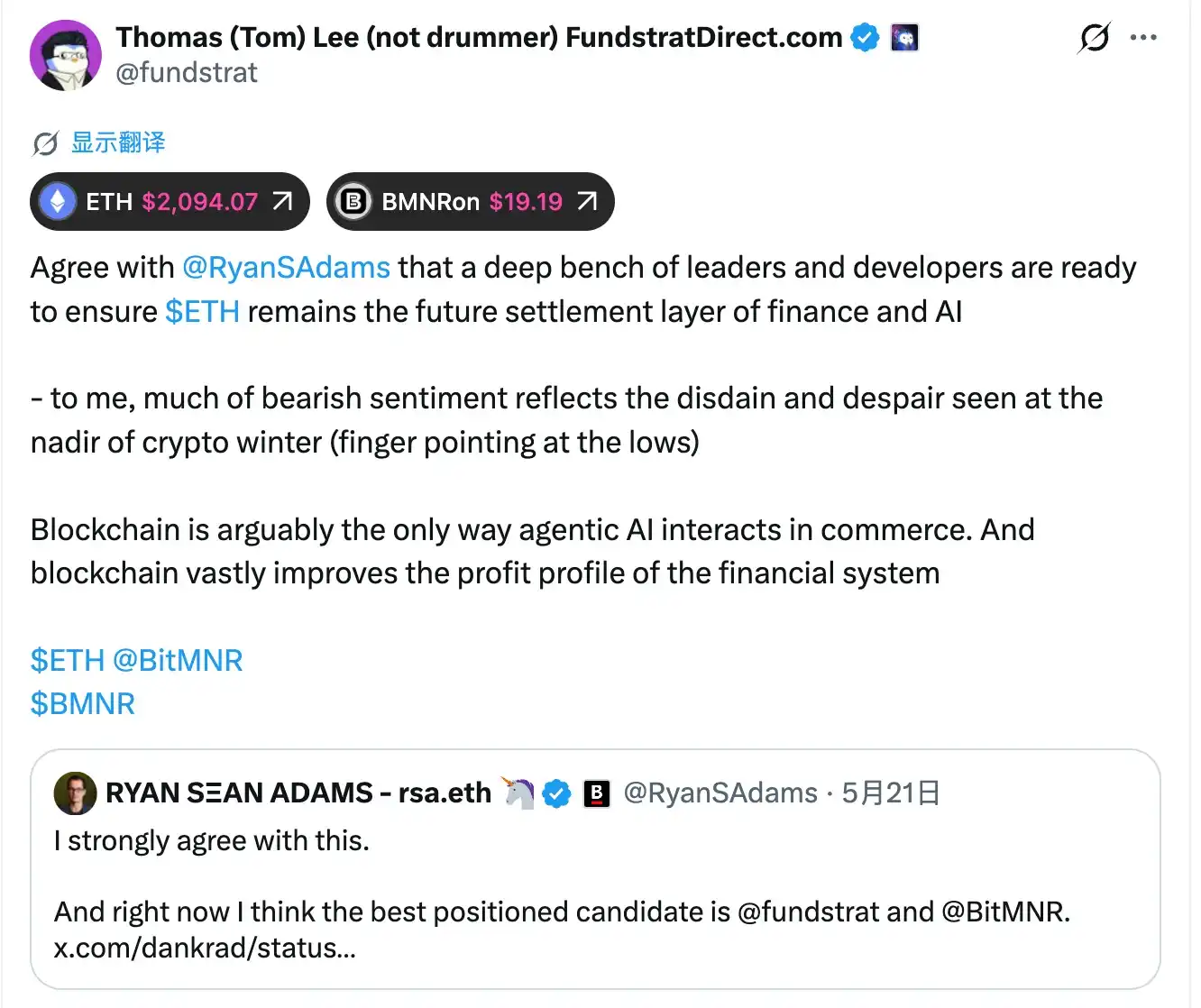
In the post-foundation era, who might be the next leader of the Ethereum community? Tom Lee has begun volunteering. His affiliated Fundstrat and BitMine are seen by the community as the best candidates. BitMine holds approximately 5.28 million ETH, accounting for 4.37% of the total supply, making it the largest ETH treasury globally.
Rejecting the Performance War, Adhering to CROPS Values
Beyond the new positioning of the Ethereum Foundation, Vitalik also shared his personal thoughts on Ethereum's future technical roadmap.
In Vitalik's view, Ethereum must build unique and hard-to-replicate competitiveness. With AI technology rapidly evolving and the entire tech industry experiencing explosive growth, if Ethereum merely clings to the existing EVM architecture and only meets short-term user demands through periodic hard forks, it will gradually lose its appeal.
He believes that simply chasing high-speed scaling, with only a slight advantage in decentralization over other chains, will ultimately relegate Ethereum to mediocrity. Ethereum needs to scale while also focusing on CROPS: the five dimensions of censorship resistance, liveness & protection against economic capture, open, privacy, and security.
Indeed, over the past few years, market attention on public chain competition has almost entirely focused on performance, cost, and user growth. Whether it's Solana, Sui, or various modular narratives, the competition essentially revolves around being "faster, cheaper, and easier to use."
However, Vitalik clearly does not want Ethereum to continue being drawn into this performance race. Because, looking at realistic outcomes, it's difficult for Ethereum to completely outperform the new generation of high-performance public chains in terms of performance. And if it continuously sacrifices its own characteristics for performance, it will gradually lose its core value foundation.
Vitalik specifically emphasized that for underlying infrastructure-level public chains like Ethereum and Bitcoin, even if 34% of nodes go offline, they absolutely cannot rely on social consensus or hard forks to 'bail out.' This might be acceptable for chains like Hyperledger, BNB, or Solana, but it is unacceptable for Ethereum, Bitcoin, Zcash, and others.
Simultaneously, state scaling is also a key research direction for Ethereum. And well-designed L2 networks can continue to provide value for the ecosystem. Especially in vertical scenarios like transactions and privacy, dedicated L2s still hold significant importance. Furthermore, with the advancement of erasure code P2P technology and other optimization solutions, Ethereum's future block intervals are also expected to be shortened further.
Compared to ecosystem prosperity, the current Vitalik seems more concerned with Ethereum maintaining its irreplaceability—a technical roadmap imbued with Vitalik's values.
In Vitalik's view, if a company appears too dogmatic in adhering to its principles, the worst outcome is merely a slowdown in its own development, while technological progress will continue to be driven by other companies. The best outcome, however, is that a company truly aligned with the community's values can gain spontaneous support, talent, and marketing resources from the community—support that is difficult to obtain through money alone. He believes that some AI companies have previously attempted to achieve similar effects through effective altruism, but due to the corruptibility of consequentialism, the results were limited.
In the post-foundation era, even as the EF gradually recedes from the center stage of Ethereum under the banner of neutrality and long-termism, whether it can truly quell negative market sentiment remains unknown. A more critical question is how Ethereum, caught in a downtrend cycle, can initiate an upward trajectory through roadmap reforms—a topic of greater concern to the market.




















