When Migration Becomes the Norm: Why 'Your Own EVM Chain' Is Becoming Standard

marsbitPublished on 2026-02-05Last updated on 2026-02-05

Abstract

In the past year, the industry's real "voting" has shifted from governance forums to deployment scripts, migration plans, and budgets. Projects are choosing ecosystems through action, not words—migrating mainnets, prioritizing tool stacks, and betting on networks with stronger market effects. A prime example is Noble, a leading stablecoin infrastructure in Cosmos, which moved to its own EVM L1, signaling that the main battleground for stablecoins and app distribution remains in EVM ecosystem due to its mature developer tools, wallet/dApp ecosystem, and concentrated liquidity. The trend toward "having your own EVM chain" is becoming standard. While EVM offers clear advantages in assets, integrations, and tools, generic chains come with constraints like fee volatility, congestion, and shared sequencing. Application chains/rollups allow teams to internalize these constraints—tailoring block times, execution models, and infrastructure to their business needs, and aligning transaction revenue with growth incentives. Rollup-as-a-Service (RaaS) platforms like Caldera are reducing the high costs and complexity of building and maintaining chains, turning "chain-as-a-product" into a replicable strategy. They focus not just on deployment but also on solving interoperability challenges—e.g., via Caldera's Metalayer, which standardizes cross-chain bridging and integration to reduce friction for users and developers. As migration to EVM continues, the focus shifts from "which chain to c...

Over the past year, the most genuine "voting" in the crypto industry has increasingly occurred not in governance forums, but in deployment scripts, migration plans, and budget sheets. Project teams no longer express their stance through slogans; instead, they choose ecosystems through actions: where to migrate their mainnet, which toolstack to prioritize for the next phase of product adaptation, and which network effect-stronger market to bet their liquidity and partnerships on.

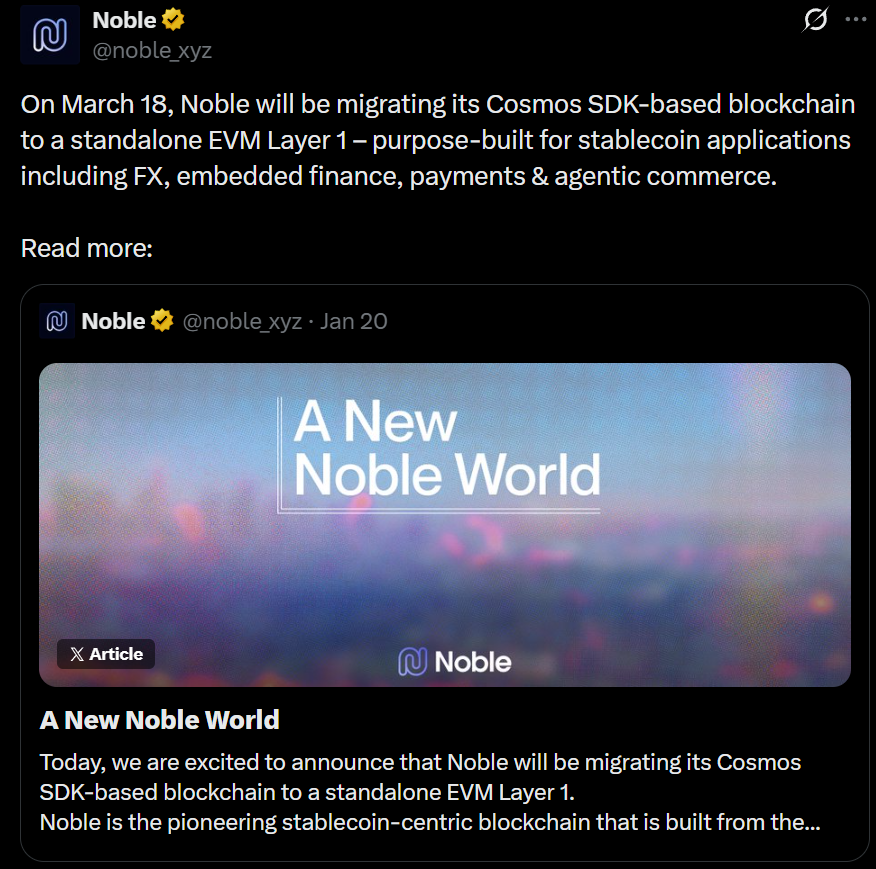
Noble's pivot is a typical case. As one of the most successful stablecoin infrastructures in the Cosmos ecosystem, it once handled the issuance and cross-chain distribution of native USDC and connected numerous chains and stablecoin settlement scenarios via IBC. But when it announced its migration to an independent EVM L1 and deeply tied its stablecoin products and network value capture mechanisms, the signal was clear enough: the main battlefield for stablecoins, settlement, and application distribution remains in EVM. Stablecoin market share is highly concentrated in EVM, and developer tools and wallet/dApp ecosystems are more mature. But this doesn't mean that "going EVM" equals "squeezing into some general-purpose chain" and everything is settled. On the contrary, while more and more teams are moving towards EVM, they are beginning to redefine a question: are we choosing a chain, or are we choosing a growth method?
Why Will 'Your Own EVM Chain' Become More Common?

First, the advantages of EVM remain clear: larger stablecoin and asset volume, more comprehensive integration targets, and more mature developer tools. This determines that many applications ultimately still want to complete their growth and distribution within EVM. But on the other hand, on general-purpose chains, applications often have to accept a series of exogenous constraints: fee volatility, congestion, shared sequencing environment, unified upgrade schedules, and the resulting uncontrollable user experience. The appeal of appchains/rollups lies in "internalizing" these constraints—teams can choose block times, execution models, RPC, and infrastructure configurations more suitable for their business characteristics, and more tightly bind transaction revenue and incentive design to their own network and product growth.

In other words, the industry is shifting from "choosing a chain and adapting to it" to "choosing an architecture and shaping it." When the cost of this path is significantly reduced, "having your own EVM chain" becomes more like a replicable product strategy rather than a high-stakes gamble.

Rollup as a Service Is Turning 'Building Your Own Chain' from a Heavy Asset into a Standard Move

What hinders the adoption of the appchain model is not "unclear value," but "construction and operation are too expensive." From chain setup, security, operation, monitoring, to cross-chain, bridging, message passing, and user onboarding paths, each item implies high human and time costs. For most teams, even if they recognize "chain as a product," they might be deterred by engineering complexity. This is also the background against which Rollup as a Service (RaaS) comes to the forefront: it productizes deployment, hosting, maintenance, and part of the security engineering, allowing teams to focus their energy back on the application itself—functionality, ecosystem partnerships, growth, and commercialization.

Taking Caldera as an example, its core narrative and roadmap are quite typical: early on, it lowered the barrier to rollup deployment to a more affordable level through its Rollup Engine; and after the number of rollups grew rapidly, it further focused on "how to smooth out fragmentation." Caldera calls this layer the Metalayer: hoping to equip new chains with more complete interconnection capabilities from the start, including fast bridging, aggregation, and developer SDKs, reducing the integration and time costs teams would otherwise spend separately connecting with multiple suppliers. Behind this is a very realistic judgment: the real bottleneck of the appchain model is not "whether a chain can be built," but "does having your own chain impact user experience?" If user onboarding, cross-chain, and interaction paths are smooth enough, the sovereignty and controllable experience of appchains/rollups become more attractive; conversely, interoperability and liquidity fragmentation will offset the benefits of "lower gas fees and higher performance."

After the Distribution Logic Changes, 'Interconnection' Becomes Growth Infrastructure

When the barrier to "building your own chain" is lowered by RaaS, a new problem becomes more prominent: chains can be created more easily, but users and funds may not come in more easily. For most applications, the real growth loss often occurs before use—how many steps for onboarding, how long to wait for cross-chain, whether fees are transparent, what to do if it fails. Funds are scattered across Ethereum mainnet, various L2s, exchanges, and other ecosystems; user entry points also come from wallets, aggregators, centralized channels, or dApp jumps. In this distribution landscape, cross-chain and onboarding paths are essentially part of the conversion funnel; the greater the friction, the more likely new users are consumed "before reaching the product."

Precisely because interconnection begins to affect conversion and retention, the competitive focus of RaaS is shifting from "can you launch a chain with one click" to "can you prevent the chain from becoming an island." Some infrastructure teams are also extending their focus from deployment capabilities to the productization of the interconnection layer: taking Caldera as an example, in addition to providing rollup deployment and operation capabilities, it has also made interconnection one of its core directions by launching Metalayer, hoping to preemptively and standardize the integration of cross-chain, bridging, and related toolchains as much as possible, so that new chains are equipped with smoother asset entry and cross-network flow paths from the start, rather than patching them up sporadically after launch. For project teams, this means fewer vendor assemblies, shorter integration cycles, and more controllable user experiences; for users, it means fewer "multiple-choice questions" and less operational friction. Only after interconnection friction decreases can the sovereignty and controllable experience of appchains/rollups not be offset by cross-chain complexity, making it easier to replicate success on a larger scale.

The Next Generation Standard Is Not 'Where to Migrate To,' but 'Taking Growth into Your Own Hands'

As more and more projects move closer to EVM, the industry's decision-making focus is also changing: from "which chain to choose to side with" to "choosing a more effective growth and delivery method." EVM's advantages as a distribution market still hold, but if a business remains on a general-purpose chain long-term, key experiences become more dependent on the external environment: fee volatility caused by congestion, queuing and failure rates due to shared execution, and upgrade and parameter constraints under unified schedules. In the early stages, these uncertainties are acceptable; once entering the scaling phase, they directly impact conversion and commercialization, making growth more like "depending on market conditions."

The reason why "your own EVM chain/rollup" is increasingly becoming a standard is not that all project teams want to do infrastructure, but because it makes growth variables more controllable: fees and performance are more stable, confirmation and execution environments are more tailored to the business, upgrade schedules can follow the product, and it's easier to form a closed loop between chain-layer revenue, incentives, resource investment, and product operation. More importantly, RaaS lowers the cost of building and operating chains, and interconnection layers like Metalayer reduce cross-chain and integration friction, making "having your own execution environment" no longer equal to "sacrificing distribution and liquidity." When these two types of costs decrease simultaneously, owning an EVM chain/rollup transforms from a customized option for a few leading projects into a replicable standard solution for more applications in the scaling phase.


Related Questions

QWhat is the main reason why projects are choosing to build their own EVM chains or rollups?

AThe main reason is to gain greater control over their growth and user experience. On a shared, general-purpose chain, projects are subject to external constraints like fee volatility, network congestion, and a shared upgrade schedule. By having their own EVM-compatible chain or rollup, they can tailor the execution environment to their specific business needs, stabilize fees and performance, and create a closed loop between chain-level revenue, incentives, and product growth.

QWhat role does Rollup as a Service (RaaS) play in the trend of 'owning your own EVM chain'?

ARollup as a Service (RaaS) is a key enabler by significantly lowering the barriers to entry. It productizes the complex processes of chain deployment, hosting, maintenance, and security engineering. This allows development teams to focus their resources on the application itself—such as functionality, ecosystem partnerships, and growth—rather than the heavy lifting of building and operating the underlying infrastructure, making 'owning your own chain' a more standard and accessible strategy.

QAccording to the article, what is the new bottleneck for application-specific chains/rollups after deployment becomes easier?

AThe new bottleneck is not the ability to create a chain, but ensuring it is not an isolated island. The major challenge is facilitating smooth user and capital inflow. Friction in processes like cross-chain bridging, asset onboarding, and user interaction paths can create a significant conversion funnel, potentially losing new users before they even reach the application. Therefore, seamless interoperability has become a critical growth infrastructure.

QHow does the article describe the shift in the industry's decision-making focus?

AThe industry's decision-making focus is shifting from 'choosing which chain to align with' to 'choosing a more effective method for growth and product delivery.' It's less about picking a side in an ecosystem and more about selecting an architectural strategy—like an app-specific rollup—that allows a project to shape its own environment and control the key variables that affect its growth and user experience.

QWhat is the purpose of an 'interoperability layer' or 'Metalayer' as mentioned in the context of RaaS providers like Caldera?

AThe purpose of an interoperability layer or 'Metalayer' is to reduce the friction of cross-chain interactions and integration from the very beginning. It provides standardized tools for bridging, aggregation, and developer SDKs, allowing a new chain to launch with pre-built, smooth pathways for assets to enter and flow across networks. This minimizes the need for projects to assemble solutions from multiple vendors post-launch, reduces integration time, and provides a more controlled and frictionless user experience.

Related Reads

From South Korea to the United States: Blue-Collar Jobs Are Becoming Increasingly Popular, Thanks to AI

AI is reshaping the labor market's value proposition. The traditional four-year college degree is losing its appeal as a guaranteed career path, while skilled blue-collar trades like electricians, welders, and plumbers are experiencing historic demand and wage premiums. This shift is driven by dual pressures: AI's displacement of certain white-collar roles and a booming need for physical infrastructure and data center construction. Data confirms the trend. In the U.S., vocational school revenue surged, and a significant portion of recent layoffs are AI-related. Surveys show a majority of Gen Z adults plan to pursue blue-collar work, citing better job security against AI automation. Vocational education interest has exploded recently. Experts cite a psychological shift as younger generations seek tangible, AI-resistant careers and avoid high student debt. In many cases, salaries for skilled trades now match or exceed those requiring a bachelor's degree. In South Korea, semiconductor vocational high schools boast near-total employment, with graduates securing high-paying roles at companies like Samsung. The shortage is structural, exacerbated by a retiring baby boomer workforce and massive infrastructure projects. Companies like JPMorgan Chase, Meta, and Lowe's are investing heavily in training programs. However, overcoming historical stigma and a "perception gap" around trade careers remains a key challenge to closing the talent gap.

marsbit34m ago

From South Korea to the United States: Blue-Collar Jobs Are Becoming Increasingly Popular, Thanks to AI

marsbit34m ago

Qualcomm: AI Hype Subsides, When Will Smartphones Emerge from the Gloom?

Qualcomm reported its Q3 FY2026 results (ending June 2026), with revenue of $9.95B, down 4% YoY but above expectations. Gross margin declined to 53.1%, pressured by rising costs across manufacturing and memory. Key business segments showed mixed performance: Handset revenue fell 19.6% YoY to $5.09B, dragged by an 11% decline in non-Apple Android shipments and weaker high-end mix. Conversely, Automotive revenue surged 61% to $1.59B, and IoT grew 9% to $1.83B. Core operating profit dropped 41% YoY due to margin compression and higher expenses. Management's Q4 FY2026 guidance projects revenue of $9.7B-$10.5B, in line with consensus, but Non-GAAP EPS guidance of $2.05-$2.25 fell short of expectations. Amidst persistent weakness in its core handset market, Qualcomm is pursuing growth in AI, focusing on Edge AI (smartphones, PCs, automotive) and Data Center AI. Its data center strategy includes four pillars: AI accelerators (e.g., AI200), commercial CPUs (Dragonfly C1000), custom silicon, and connectivity solutions. While these initiatives initially boosted its stock, concerns over AI capital expenditure sustainability have since erased those gains. The company targets $5B in data center revenue for FY2027 and $15B for FY2029. The report concludes that with the traditional handset business still under pressure, the data center opportunity is currently viewed as a longer-term option, and a more conservative valuation based on core operations may be warranted until AI contributions materialize.

marsbit38m ago

Qualcomm: AI Hype Subsides, When Will Smartphones Emerge from the Gloom?

marsbit38m ago

From TPU to Self-Evolving Agents: How Jeff Dean Predicts the Next Step in AI

At the 2026 YC Startup School, Jeff Dean outlined his vision for AI's next phase, shifting focus from simply scaling models to building intelligent, autonomous systems. He believes AI's progress is no longer just about creating smarter models, but about integrating them into systems capable of long-term, iterative work, automated experimentation, and continuous learning. This evolution moves the competition from "who has the bigger model" to "who can best organize intelligence." Dean suggests AI capabilities are now comparable to a junior engineer, enabling the automation of complex workflows. However, the true challenge and opportunity lie in managing these AI "workers" at scale. He emphasizes the importance of **context engineering**—structuring tools, memory, and feedback loops—over raw model power. For startups, this means building deep expertise in niche domains where general models currently fail (near 0-1% success rates), leveraging proprietary data, specialized tools, and domain-specific evaluators. A recurring theme is re-examining fundamental constraints. Dean's past work, like moving Google's search index to memory or creating the TPU, stemmed from questioning outdated assumptions about hardware and cost. He sees similar inflection points today, particularly in **specialized inference hardware** to drastically reduce latency and energy consumption for real-time Agent operation. Notably, he points out that in modern AI systems, the dominant cost is often not computation but **data movement**. Reliable, long-running Agents require robust system design, borrowing concepts from distributed computing like checkpointing, state management, and parallel exploration to handle failures and maintain progress over days or weeks. As AI automates execution, the scarcest human skills will shift to **defining clear specifications**, **judging what problems are worth solving** (taste), and designing effective feedback loops. Ultimately, Dean's framework prioritizes understanding the problem deeply, identifying the true bottlenecks, and systematically building closed-loop systems where AI can not only perform tasks but also improve AI itself.

marsbit38m ago

From TPU to Self-Evolving Agents: How Jeff Dean Predicts the Next Step in AI

marsbit38m ago

Trading

Spot
活动图片




