When Bitcoin Miners Take to Space

marsbitPublished on 2026-04-01Last updated on 2026-04-01

Abstract

SpaceX is reportedly preparing for a historic IPO with a target of $1.75 trillion, while simultaneously advancing plans to deploy AI data centers in orbit, leveraging space’s vacuum for cooling and solar energy for power. This has sparked interest in whether Bitcoin mining—also energy-intensive and dependent on computing hardware—could also move to space. The core idea involves placing mining ASICs on the back of solar panels in orbit, using abundant solar energy to power mining operations. Heat dissipation in vacuum, a key challenge, is manageable through thermal radiation, and communication with mining pools is feasible with low latency via low Earth orbit satellites. However, the economics remain prohibitive. Launch costs, currently around $2,720 per kilogram via Falcon 9, make mining payloads financially unviable. Estimates suggest that with current technology, the payback period would exceed 100 years. SpaceX’s Starship may eventually reduce launch costs below $200/kg, making space mining more feasible. Companies like Starcloud—backed by NVIDIA and top VCs—are already testing orbit-based computing, including AI and planned Bitcoin mining experiments. Others, like SpaceChain and Cryptosat, focus on secure blockchain nodes and cryptographic services in space rather than mining. While orbital mining is not yet economically competitive with terrestrial operations, it represents a long-term vision for radically reducing energy costs and expanding the infrastructure of dec...

According to multiple media reports, Musk's space exploration company SpaceX will soon submit an IPO prospectus to the U.S. Securities and Exchange Commission (SEC), targeting a valuation of $1.75 trillion and an expected financing scale exceeding $75 billion. If successful, this would be the largest IPO in human history, far surpassing the record of $29.4 billion set by Saudi Aramco in 2019, and it will also be the most watched IPO this year.

Interestingly, in February 2026, SpaceX suddenly acquired xAI, another AI company under Musk, and incorporated the "Orbital Data Center" into its core strategy: utilizing the vacuum of space for heat dissipation and continuous solar power supply to send AI computing power into low Earth orbit. Musk believes that, in the long run, space-based AI is the only way to achieve scalable development.

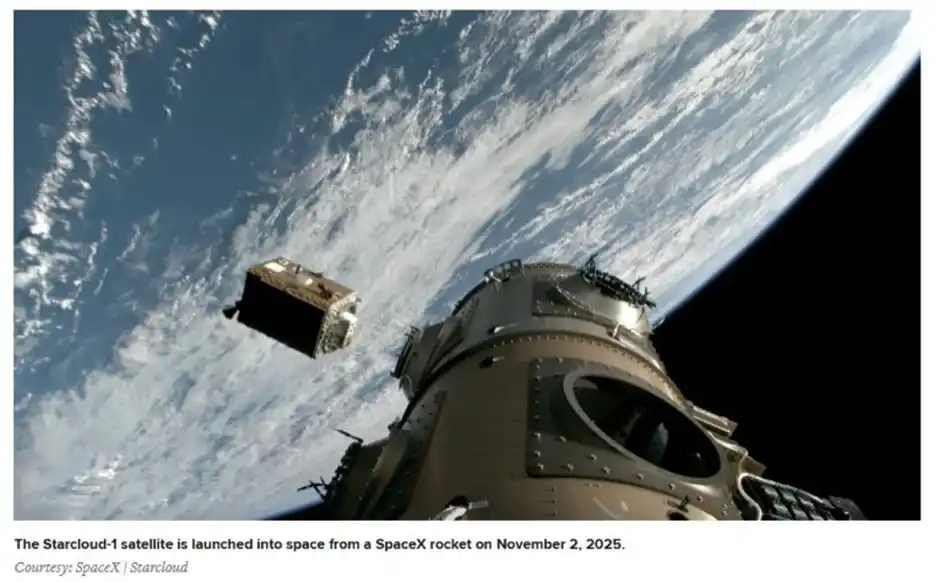
At the same time, NVIDIA is also actively exploring this direction. It has invested in the orbital data center startup Starcloud, which successfully sent an NVIDIA H100 GPU into orbit in November 2025, completing the first-ever training and inference of an AI large language model in space.
As SpaceX sends AI computing power into space, many are also beginning to wonder: since Bitcoin mining also relies on computing chips and can utilize solar power, could it also be moved to space? However, this issue is far more complex than most people imagine.

A Satellite, a Solar Panel, a Miner

Mining is a competitive mathematical calculation. Millions of miners worldwide operate simultaneously, competing to be the first to solve a specific hash value, with the successful one receiving the Bitcoin reward for the current block. This process is called Proof of Work, and its cost is a massive amount of electricity. The continuous power consumption of the global Bitcoin network is approximately 20 gigawatts, equivalent to the total industrial electricity consumption of a medium-sized country. Miners' profit margins are largely determined by electricity prices; once electricity prices rise, profit margins are compressed.

The endless sunlight in space directly addresses the core cost variable of Bitcoin mining: electricity.

In Earth's orbit, solar radiation intensity is about 1,380 watts per square meter, six times the average level on the ground, and is unaffected by clouds, day/night cycles, or seasons. In specific geosynchronous orbits, satellites can receive near-continuous sunlight and generate power persistently. Attaching a miner to the back of a solar panel and sending it into orbit to mine forever is the underlying logic of space mining.

Bitcoin core developer Peter Todd published a technical analysis in December 2024, pushing this idea from concept to an engineering blueprint. He proposed the concept of a "flat-panel miner": installing ASIC chips directly on the back of a solar panel, with the front facing the sun to generate power and the chips on the back consuming electricity to mine, with the entire structure radiating waste heat in both directions.
Space heat dissipation is a counterintuitive challenge. On Earth, chip heat can be carried away by air convection; but in the vacuum of space, with no air, heat can only be dissipated through radiation. Todd's calculations show that, without additional cooling devices, the thermal equilibrium temperature of this structure in orbit is about 59°C, well within the normal operating range of the chips. If the temperature is considered too high, simply tilting the entire panel slightly relative to the sun to reduce the illuminated area can further improve heat dissipation.

Communication is surprisingly simple as well. The communication between miners and mining pools essentially involves receiving new block headers and submitting computation results, generating about 10MB of data per day, less than the data consumed by streaming a single song. Communication latency in low Earth orbit (500 to 1,000 km above Earth) ranges from 4 to 30 milliseconds, resulting in a stale block rate (i.e., submitting outdated computation results) of less than 0.01%, on par with the vast majority of ground-based miners, with no substantial difference. In fact, Blockstream began using geosynchronous satellites to broadcast the entire Bitcoin blockchain globally as early as 2017, proving that the combination of satellites and blockchain has never been an unsolved problem.

So, if it's physically feasible and the engineering framework is viable, why isn't it widespread? The reason is the high cost of rocket transportation.

The Uneconomical Math

Using SpaceX's Falcon 9 rocket to send cargo to low Earth orbit currently costs about $2,720 per kilogram.

Peter Todd estimated that a complete 20-kilowatt space mining system, including solar panels, heat radiators, ASIC chip arrays, structural supports, and communication modules, weighs about 1,600 to 2,200 kilograms. At current prices, the launch cost alone would be as high as $4.3 million to $6 million.

How much computing power can this system contribute daily, and how many coins can it mine? Researcher Nick Moran provided the answer: daily revenue is about $92.7, equivalent to roughly $34,000 per year. The payback period exceeds 100 years.

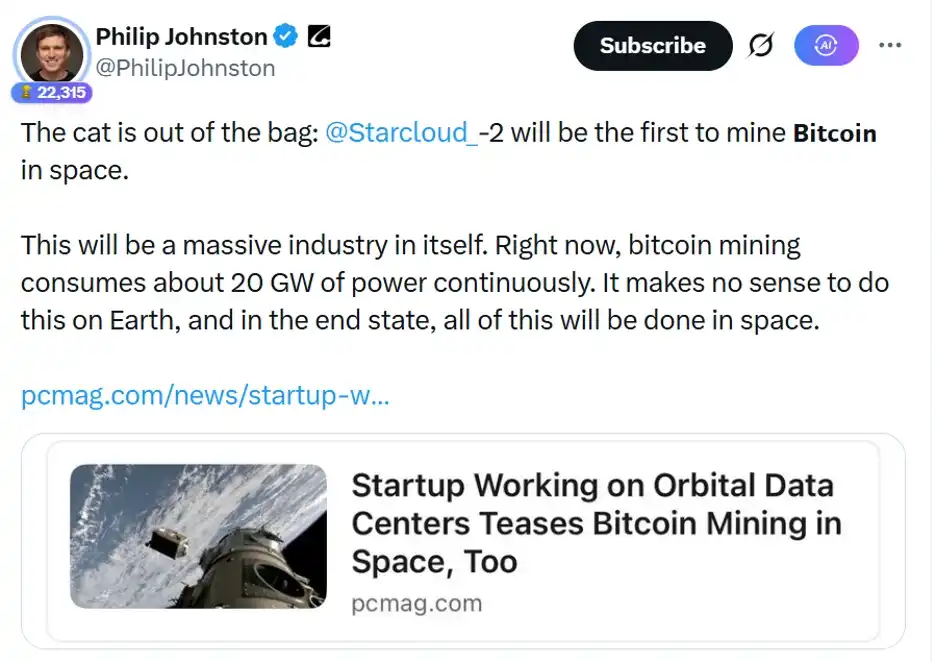
Starcloud's CEO Philip Johnston calculated that launch costs must drop below $200 per kilogram for space mining to have basic commercial logic. This means the cost needs to decrease by another 13.

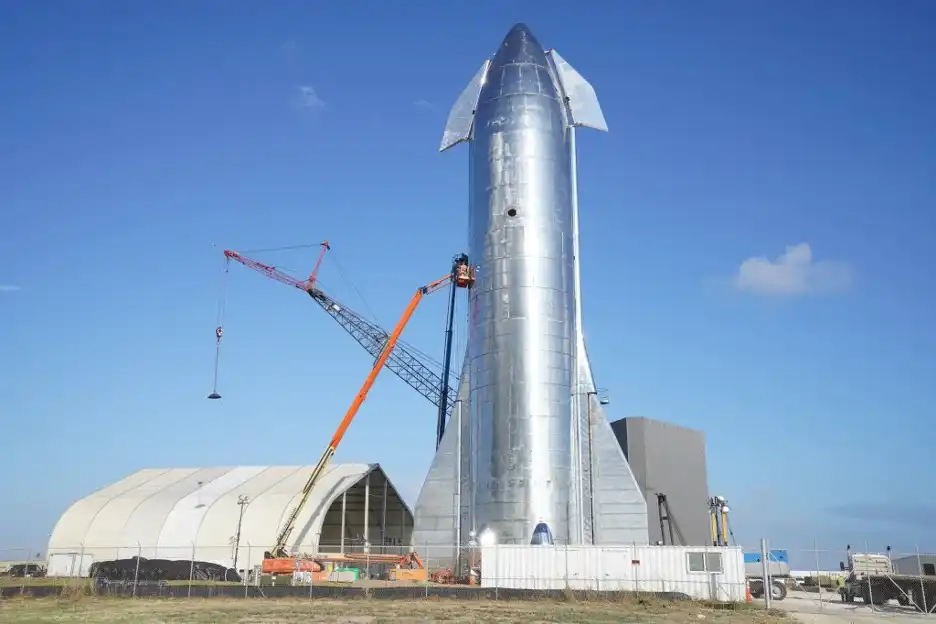
SpaceX's Starship is widely considered the key to achieving this leap. The fully reusable Starship could theoretically reduce the launch cost per kilogram to below $100 or even lower, which is one of the underlying assumptions for the viability of the orbital data center in SpaceX's current IPO vision. However, when this cost curve will materialize, and whether it will, remains an open variable.
Another challenge is the automatic adjustment of Bitcoin's network-wide mining difficulty. The Bitcoin protocol calculates the total network hash rate every two weeks and automatically adjusts the mining difficulty to maintain a block time of approximately 10 minutes. In other words, if a large number of space miners enter the market and the total network hash rate increases significantly, the mining difficulty will rise accordingly, synchronously compressing the profits of all miners, including those in orbit.

Some Are Always Busy Searching for Treasure

Despite this, a number of startups are actively pushing forward with this endeavor.

Starcloud, formerly Lumen Orbit, is currently the company closest to actual implementation and the most important case study in the entire field. Founded in 2024 and headquartered in Redmond, Washington, it is backed by NFX, Y Combinator, a16z's angel fund, Sequoia Capital's angel fund, and NVIDIA. Total funding is approximately $200 million. The company's CTO worked at Airbus Defense and Space for ten years, and the lead engineer previously worked on the Starlink project at SpaceX.

In November 2025, Starcloud successfully sent its first satellite, carrying an NVIDIA H100 GPU, into orbit, ran Google's Gemma language model in space, and sent the first-ever message generated by AI in orbit to Earth. In March 2026, Starcloud announced that its second satellite would carry both Bitcoin ASIC chips and NVIDIA's latest-generation Blackwell GPU, aiming to become the first organization to mine a Bitcoin in space. Additionally, the company has applied to the U.S. Federal Communications Commission (FCC) for a constellation plan deploying up to 88,000 satellites, with a long-term vision of building a total of 5 gigawatts of computing power infrastructure in orbit.
SpaceChain is an OG player in this field, co-founded by former Bitcoin core developer Jeff Garzik and Zheng Zhong. Since 2017, SpaceChain has launched at least seven blockchain payloads to satellites and the International Space Station. In June 2020, Garzik completed the first-ever Bitcoin transaction in space from an orbit 400 km above Earth, for an amount of 0.0099 BTC, using SpaceChain's multisignature wallet node installed on the space station. SpaceChain's core focus is on orbital secure nodes for blockchain transactions, not active mining: locking private keys in space where no hacker or government on Earth can physically access them.

Cryptosat, founded by two Stanford PhDs, currently operates three satellites in orbit, primarily providing tamper-resistant orbital cryptography services. In 2023, Cryptosat participated in the largest trusted setup ceremony in Ethereum's history (KZG Ceremony), generating partial random number parameters through orbital nodes, institutionally ensuring that these parameters could not be controlled by any single ground-based entity. It explores another possibility for space blockchain: not mining, but making the entire crypto-economic system more resistant to attack.

From Orbit to Market: What This Means for the Mining Industry

For currently operating Bitcoin mining companies, space mining does not pose an immediate competitive threat in the short term. However, the fact that numerous startups continue to attempt it indicates that the significant cost reduction potential it represents still holds great attraction and imaginative space for the industry. This also reflects, from a side perspective, the structural cost pressures facing the entire industry.

After the 2024 halving, the network-wide hash rate and difficulty continue to hit record highs, with energy costs accounting for 70% to 90% of total operating expenses. In this context, whoever can obtain clean electricity at the lowest cost and most stably has the deepest moat. Hydroelectric, wind, and associated natural gas resources in the United States, the Middle East, and Africa are becoming the core drivers of a new wave of mining mergers, acquisitions, and site selection.

The logic of space mining is an ultimate extrapolation of this trend: if cheap electricity on the ground will eventually narrow due to competitive demand, then go to where energy is most abundant—the cosmos.

Of course, if the Starcloud-2 satellite manages to mine the first Bitcoin in 2026, it would be equivalent to a grain of sand falling into the ocean compared to the global total hash rate of over 900 exahashes per second (EH/s). But symbolic significance itself has penetrating power. Just like that 0.0099 BTC space transaction in 2020, its value lies not in the amount but in proving that it can be done.

From SpaceX's IPO narrative to NVIDIA's orbital computing power布局, to Starcloud's ASIC satellite plan, an outline is emerging: the cosmos is becoming the competitive arena for the next generation of computing infrastructure. AI computing power led the way, and Bitcoin computing power is following closely behind.

On that day, the global digital network connecting every corner of the Earth, as described in Satoshi Nakamoto's whitepaper, could also break free from Earth and float in the universe, seeking new opportunities.


Related Questions

QWhat is the core concept behind space-based Bitcoin mining as described in the article?

AThe core concept is to place Bitcoin mining hardware, specifically ASIC chips, on solar panels in Earth's orbit. This setup uses the abundant and constant solar energy in space for power, while the vacuum environment aids in radiating heat away from the mining equipment.

QWhat is the single biggest economic challenge preventing the widespread adoption of space-based Bitcoin mining?

AThe single biggest economic challenge is the extremely high cost of rocket launches to transport the mining equipment into orbit, currently around $2,720 per kilogram using a Falcon 9 rocket, making the payback period over 100 years.

QWhich company, backed by NVIDIA, is a key player in testing both AI and Bitcoin mining operations in space?

AStarcloud (formerly Lumen Orbit) is the company backed by NVIDIA. It successfully sent an NVIDIA H100 GPU into orbit in 2025 and announced plans for a second satellite to carry both Bitcoin ASIC chips and a Blackwell GPU.

QHow does the Bitcoin network's difficulty adjustment mechanism impact the potential profitability of space-based miners?

AThe Bitcoin protocol automatically adjusts the mining difficulty every two weeks based on the total network hashrate. If many space-based miners come online and significantly increase the total hashrate, the difficulty will rise, compressing profit margins for all miners, including those in space.

QBesides mining, what other two applications of blockchain technology in space are mentioned in the article?

AThe two other applications are: 1) Operating secure, tamper-proof orbital nodes for transactions and wallet storage (e.g., SpaceChain's multi-signature wallet on the ISS). 2) Providing trusted setup ceremonies and cryptographic services to enhance the security of crypto-economic systems (e.g., Cryptosat's role in Ethereum's KZG Ceremony).

Related Reads

From MSTR to STRC+: Where Is the Limit of the Strategy Universe?

From MSTR to STRC+: The Evolution and Limits of the Strategy Universe This article examines the transformation of Strategy (formerly MicroStrategy) from a simple "Bitcoin treasury" company into a complex financial engineering firm building a BTC-backed credit system. **Core Thesis:** Strategy's true significance lies not just in its massive BTC holdings (~844k BTC), but in its attempt to transform this static reserve into a multi-layered credit curve within traditional capital markets and, subsequently, into on-chain yield infrastructure. **The MSTR Flywheel:** The initial model was a reflexive loop: BTC price rises → MSTR stock rises → company raises capital (debt/equity) at a premium → buys more BTC → increases per-share BTC exposure → MSTR premium grows. This "amplified Bitcoin" equity (MSTR) thrives on bullish momentum but is vulnerable to tightening premiums and rising funding costs. **Building the Credit Curve:** Strategy's innovation is slicing its single BTC balance sheet into different risk/return profiles via specialized securities: * **MSTR:** High-volatility equity layer absorbing full BTC upside/downside. * **STRC:** Key product. A perpetual preferred stock designed as "short duration high yield credit," offering ~11.5% floating monthly dividends. It attracts fixed-income investors seeking yield without direct BTC exposure, funding Strategy's operations. * **STRD/STRK/STRF:** Other preferred/share classes with varying durations, conversion rights, and fixed dividends. **Risks of the STRC Model:** STRC's high yield is not risk-free. Its stability depends on: 1) Sufficient BTC asset coverage, 2) Strategy's continued ability to pay dividends, and 3) Market faith in the MSTR/STRC funding flywheel. Stress points include deep BTC price declines eroding the asset buffer, rising dividend costs if STRC trades below par, and a broken flywheel if MSTR's premium (mNAV) falls persistently. **On-Chain Expansion: STRC+:** Projects like **Saturn** and **Apyx** aim to package STRC's (and other DAT preferred stock) cash flows into on-chain stablecoin yield (e.g., sUSDat, apyUSD). They offer DeFi a new yield source distinct from trading fees or incentives—cash dividends from traditional securities. However, this introduces compounded risks: off-chain custody, issuer credit risk, BTC volatility, and protocol execution risk. **Conclusion: The Ultimate Boundary** Strategy's endgame is not infinite BTC accumulation. It is the market's long-term acceptance of a new credit system where BTC serves as collateral for tradable securities whose cash flows can power on-chain financial applications. Its "universe" expands if this BTC-native credit curve gains legitimacy, but contracts if these instruments are repriced purely as high-risk, yield-bearing credit assets without stablecoin mythology.

marsbit16m ago

From MSTR to STRC+: Where Is the Limit of the Strategy Universe?

marsbit16m ago

Founder of Baixing.com: My Fourteen Claude Code Usage Experiences

Founder of Baixing.com Shares 14 Personal Tips for Using Claude Code The author outlines his personal, non-universal strategies for maximizing Claude Code. Key points include: focusing deeply on one primary tool (Claude Code) rather than constant comparison; mastering essential shortcuts for the editor and command line; utilizing voice input like HoldSpeak; starting projects with a structured PROJECT.md file; defaulting to Claude agents for most tasks; and leveraging integrations with GitHub and Cloudflare for build, deployment, and infrastructure. He emphasizes a clear separation between human and machine work: manually maintain a core CLAUDE.md file, and understand AI-generated content by asking the AI, not reading its raw code. Efficient communication involves dragging files (screenshots, audio, documents) directly into the interface. For knowledge management, he recommends a centralized, Git-synced memory system based on ~/.claude/CLAUDE.md to ensure permanence and avoid scattered project memories. Other practices include writing and continuously refining "Skills," using the expensive but reliable ultracode for complex dynamic workflows, and employing Git documentation as handoff points between agents. The overarching philosophy is to treat Claude Code like a horse (or a person) with its own pathfinding abilities—setting goals and boundaries rather than micromanaging every turn.

链捕手24m ago

Founder of Baixing.com: My Fourteen Claude Code Usage Experiences

链捕手24m ago

Gary Yang: Agent Economy and AI Submicroeconomics

**Title:** Agent Economy and AI Sub-Microeconomics - Gary Yang **Summary:** Following the AI singularity, the pace of evolution has accelerated rapidly, creating new generational disparities in technological advancement globally. While many regions are still grappling with single-agent bottlenecks, Silicon Valley has moved ahead into the next dimension: the Agent Economy and A2A ecosystems. The article outlines six key areas of this emerging paradigm: 1. **AI Payment Competition & H2A Bottlenecks:** A fierce battle for AI Agent payment protocol standards is underway (e.g., MPP, x402). However, most current efforts remain Human-to-Agent (H2A), essentially grafting AI onto traditional human-centric commerce, which creates a non-AI-native bottleneck. The true potential lies in Agent-to-Agent (A2A) autonomous economies. 2. **Agent Economy & the Inevitable A2A Trend:** The Agent Economy is defined by autonomous AI Agents creating, exchanging, and capitalizing value as independent economic actors. The A2A ecosystem describes their interactions. This represents the next major investment frontier, akin to the early days of e-commerce or DeFi, but with faster iteration and an AI-native, efficiency-first perspective that often diverges from human needs. 3. **AI Protocol vs. Crypto Protocol:** AI Protocols are the foundational rules for Agent interaction in an open network (communication, discovery, collaboration), akin to the governance and economic laws of the AI world. Currently, they focus on communication and weak boundaries, unlike Crypto Protocols which emphasize asset rights and clear ownership. While they appear different due to political-economic factors and legacy system constraints, their eventual convergence into a unified Digital Protocol system is seen as inevitable, driven by first principles. 4. **AI Agent Sub-Microeconomics & Biological Analogy:** AI Agent economics differ fundamentally from human economics: higher frequency/lower value transactions, energy/value direct correlation, efficiency-driven (not emotional) decisions, task-oriented (not consumption-oriented) behavior, and near-zero organizational/communication costs. A powerful analogy frames the Agent economy as a biological system: the LLM is the nucleus, the Agent harness is the cytoplasm, the Agent itself is a cell, its communication protocol is the cell membrane, and external tools (Skills, Prompts) are the extracellular environment. 5. **The Inevitability of AIFi & FinChip:** AIFi (AI Finance) represents the financial system where AI-native value within the Agent economy is tokenized and exchanged. Unlike TradFi/DeFi where value resides *in* finance, in AIFi, value originates *in* AI, and finance becomes its form. This shift is enabled by Agents taking over value discovery. FinChip (Financial Chip) is introduced as a key infrastructure—a fusion of AI autonomy and crypto smart contracts—forming intelligent financial assets to power the future A2A economy. 6. **AI-Native as a Paradigm Shift:** Adopting AI is not akin to "Internet+". It requires AI-Native thinking—designing systems based on first principles, the shortest energy-value path, and maximum efficiency. This abstract, counter-intuitive logic poses a significant, ongoing challenge for all practitioners, as effective, generalized upgrade methodologies will be slow to emerge in this rapidly evolving landscape.

链捕手1h ago

Gary Yang: Agent Economy and AI Submicroeconomics

链捕手1h ago

Trading

Spot
Futures

Hot Articles

What is $BITCOIN

DIGITAL GOLD ($BITCOIN): A Comprehensive Analysis Introduction to DIGITAL GOLD ($BITCOIN) DIGITAL GOLD ($BITCOIN) is a blockchain-based project operating on the Solana network, which aims to combine the characteristics of traditional precious metals with the innovation of decentralized technologies. While it shares a name with Bitcoin, often referred to as “digital gold” due to its perception as a store of value, DIGITAL GOLD is a separate token designed to create a unique ecosystem within the Web3 landscape. Its goal is to position itself as a viable alternative digital asset, although specifics regarding its applications and functionalities are still developing. What is DIGITAL GOLD ($BITCOIN)? DIGITAL GOLD ($BITCOIN) is a cryptocurrency token explicitly designed for use on the Solana blockchain. In contrast to Bitcoin, which provides a widely recognized value storage role, this token appears to focus on broader applications and characteristics. Notable aspects include: Blockchain Infrastructure: The token is built on the Solana blockchain, known for its capacity to handle high-speed and low-cost transactions. Supply Dynamics: DIGITAL GOLD has a maximum supply capped at 100 quadrillion tokens (100P $BITCOIN), although details regarding its circulating supply are currently undisclosed. Utility: While precise functionalities are not explicitly outlined, there are indications that the token could be utilized for various applications, potentially involving decentralized applications (dApps) or asset tokenization strategies. Who is the Creator of DIGITAL GOLD ($BITCOIN)? At present, the identity of the creators and development team behind DIGITAL GOLD ($BITCOIN) remains unknown. This situation is typical among many innovative projects within the blockchain space, particularly those aligning with decentralized finance and meme coin phenomena. While such anonymity may foster a community-driven culture, it intensifies concerns about governance and accountability. Who are the Investors of DIGITAL GOLD ($BITCOIN)? The available information indicates that DIGITAL GOLD ($BITCOIN) does not have any known institutional backers or prominent venture capital investments. The project seems to operate on a peer-to-peer model focused on community support and adoption rather than traditional funding routes. Its activity and liquidity are primarily situated on decentralized exchanges (DEXs), such as PumpSwap, rather than established centralized trading platforms, further highlighting its grassroots approach. How DIGITAL GOLD ($BITCOIN) Works The operational mechanics of DIGITAL GOLD ($BITCOIN) can be elaborated on based on its blockchain design and network attributes: Consensus Mechanism: By leveraging Solana’s unique proof-of-history (PoH) combined with a proof-of-stake (PoS) model, the project ensures efficient transaction validation contributing to the network's high performance. Tokenomics: While specific deflationary mechanisms have not been extensively detailed, the vast maximum token supply implies that it may cater to microtransactions or niche use cases that are still to be defined. Interoperability: There exists the potential for integration with Solana’s broader ecosystem, including various decentralized finance (DeFi) platforms. However, the details regarding specific integrations remain unspecified. Timeline of Key Events Here is a timeline that highlights significant milestones concerning DIGITAL GOLD ($BITCOIN): 2023: The initial deployment of the token occurs on the Solana blockchain, marked by its contract address. 2024: DIGITAL GOLD gains visibility as it becomes available for trading on decentralized exchanges like PumpSwap, allowing users to trade it against SOL. 2025: The project witnesses sporadic trading activity and potential interest in community-led engagements, although no noteworthy partnerships or technical advancements have been documented as of yet. Critical Analysis Strengths Scalability: The underlying Solana infrastructure supports high transaction volumes, which could enhance the utility of $BITCOIN in various transaction scenarios. Accessibility: The potential low trading price per token could attract retail investors, facilitating wider participation due to fractional ownership opportunities. Risks Lack of Transparency: The absence of publicly known backers, developers, or an audit process may yield skepticism regarding the project's sustainability and trustworthiness. Market Volatility: The trading activity is heavily reliant on speculative behavior, which can result in significant price volatility and uncertainty for investors. Conclusion DIGITAL GOLD ($BITCOIN) emerges as an intriguing yet ambiguous project within the rapidly evolving Solana ecosystem. While it attempts to leverage the “digital gold” narrative, its departure from Bitcoin's established role as a store of value underscores the need for a clearer differentiation of its intended utility and governance structure. Future acceptance and adoption will likely depend on addressing the current opacity and defining its operational and economic strategies more explicitly. Note: This report encompasses synthesised information available as of October 2023, and developments may have transpired beyond the research period.

363 Total ViewsPublished 2025.05.13Updated 2025.05.13

What is $BITCOIN

Discussions

Welcome to the HTX Community. Here, you can stay informed about the latest platform developments and gain access to professional market insights. Users' opinions on the price of BTC (BTC) are presented below.

活动图片