What The XRP Ledger Achieved In 2025 And What Must Improve In 2026

bitcoinistPublished on 2025-12-31Last updated on 2025-12-31

Abstract

The XRP Ledger (XRPL) made significant progress in 2025, particularly in the development of smart contracts, which reached an alpha test net stage, allowing developers to actively deploy and experiment. Interoperability advanced with the integration of Wormhole and Axelar, enabling bridged yield-bearing assets. Tokenization also saw strength with the launch of RLUSD and other stablecoins. However, DeFi activity declined after a strong start with meme coins, though baseline DEX activity remained higher than previous levels. The app layer improved but lacked a breakout application. For 2026, key improvements are needed. Builders emphasize the urgency of implementing batch transactions and sponsored fees to reduce user friction and enable mass onboarding. Enhancing DEX and AMM liquidity is critical, as is attracting more quality assets, especially real-world assets (RWAs) like yield-bearing stablecoins and tokenized stocks. There is a strong call for a serious incentive and grant program from the XRPL Foundation to fund developers, improve tools, and support consumer apps that can scale beyond the core community and attract millions of users.

The XRP Ledger (XRPL) closed 2025 with real progress on smart contracts, interoperability, and tokenization, but builders say 2026 needs to focus on removing user friction, improving DEX liquidity, and funding apps that can scale beyond the core community.

What The XRP Ledger Achieved In 2025

XRPL dUNL validator Vet said 2025 was “great” across several areas, led by smart contracts reaching an environment developers can actively test. “Smart Contracts, lots of development to get the alpha test net out — you can deploy and play around with it today,” Vet wrote. “A lot more community awareness.” The implication is straightforward: the work is no longer purely theoretical, and the ecosystem can start converting curiosity into actual deployments.

DeFi, however, did not maintain its earlier pace. Vet wrote that XRP DeFi “came strong out of 2024 with meme coins,” but “activity dried out over the year.” Even so, he argued the floor is higher than before: “DEX baseline activity is higher than before,” he wrote, describing 2026 as an opportunity to “build it out” into something more durable.

On interoperability, Vet highlighted a year of shipping. “Interoperability wise we got Wormhole going live, Axelar live + bridged yield bearing issued assets to the XRPL,” he wrote. He also pointed to a possible technical direction for the next phase: “ZKP looks like an enabler for trust minimized bridging,” suggesting zero-knowledge proofs could reduce reliance on trust-heavy bridge designs.

XRPL’s app layer improved, but without a breakout winner. “The existing projects and wallets on the XRPL doubled down a lot,” Vet wrote. “More polished, new features and integrations. No new app that took over the community though.” That matters because UX improvements help retention, but major growth typically follows a flagship product that creates its own gravity.

Tokenization was another bright spot, with Vet calling it “very strong with RLUSD,” alongside “smaller launches of other stables and tokenized funds.” Still, he flagged distribution as a bottleneck: “Distribution channels of those assets is still something we have to work on,” he wrote, tying it directly to the health of DeFi and applications. Issuance alone is not enough; assets need liquidity, integrations, and pathways into end-user products.

What Must Improve In 2026

Anodos Finance co-founder and CEO Panos Mekras used a post to lay out what he wants to see next year, arguing that XRPL has to prioritize both infrastructure and incentives.

“Seeing Batch transactions and sponsored fees/reserves live as soon as possible, which are crucial for removing friction and mass consumer onboarding,” Panos wrote. “More quality assets coming to XRPL, especially RWAs: yield-bearing stablecoins, tokenized stocks, commodities. A serious incentive and grant program finally happening, @XRPLF stepping up with real resources for builders, better dev tools, funding killer consumer apps and use cases that can bring millions to XRPL.”

Vet responded: “i agree with all 3 wishes.” Panos also called out DEX/AMM liquidity as “a serious issue,” framing it as a practical constraint on growth rather than an abstract metric.

At press time, XRP traded at $1.86.
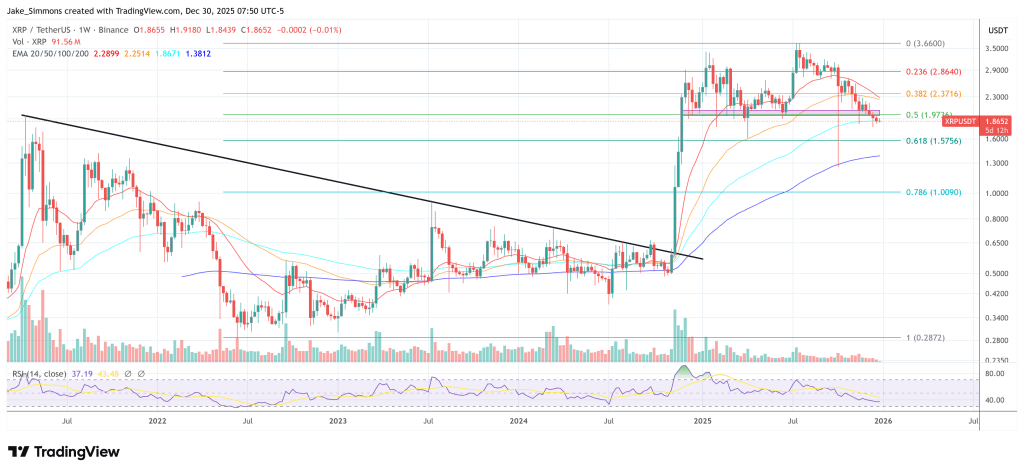
XRP remains below key support, 1-week chart | Source: XRPUSDT on TradingView.com

Related Questions

QWhat were the key areas of progress for the XRP Ledger in 2025 according to the article?

AThe key areas of progress for the XRP Ledger in 2025 were smart contracts reaching an active testing environment, interoperability with solutions like Wormhole and Axelar going live, and significant advancements in tokenization, particularly with RLUSD.

QWhat did Vet identify as a major technical direction for the next phase of interoperability?

AVet identified Zero-Knowledge Proofs (ZKP) as a potential enabler for trust-minimized bridging, suggesting it could reduce reliance on trust-heavy bridge designs.

QAccording to Panos Mekras, what are two specific technical features crucial for removing user friction and enabling mass consumer onboarding in 2026?

AAccording to Panos Mekras, Batch transactions and sponsored fees/reserves are two specific technical features crucial for removing user friction and enabling mass consumer onboarding.

QWhat was cited as a 'serious issue' that is a practical constraint on the growth of the XRPL ecosystem?

ADEX/AMM liquidity was cited as a 'serious issue' and a practical constraint on the growth of the XRPL ecosystem.

QDespite the progress in tokenization, what specific challenge or bottleneck was highlighted?

AThe specific challenge highlighted was the distribution channels for these new assets, which was identified as a bottleneck that needs to be improved to support the health of DeFi and applications.

Related Reads

U.S. Government Bans Foreign Nationals from Using Fable 5, Anthropic Issues Rebuttal

U.S. Government Bans Foreign Access to Fable 5, Anthropic Issues Rebuttal On June 12th, the U.S. government ordered AI company Anthropic to immediately suspend all foreign access—including foreign nationals within the U.S. and Anthropic's own foreign employees—to its newly released Fable 5 and Mythos 5 AI models, citing national security concerns. This forced Anthropic to temporarily disable access to both models for all users globally, as it cannot technically differentiate user nationality at scale. The models, released just three days prior, represent Anthropic's highest public capability tier. Fable 5 is the first publicly available model from the advanced "Mythos" family, while Mythos 5 is a less-restricted version for approved cybersecurity and critical infrastructure partners. The government's directive was reportedly triggered by claims from another company that it could "jailbreak" Mythos 5, raising alarm within the Trump administration. Anthropic, in a detailed public statement, strongly challenged this rationale. The company argues the demonstrated "jailbreak" is a narrow, non-generalized technique that merely involves identifying minor, known software vulnerabilities—a capability common to other publicly available models like OpenAI's GPT-5.5 and routinely used by cybersecurity defenders. Anthropic stated it has complied with the order but disagrees with the government's standard, warning that applying it industry-wide would halt all new frontier model deployments. The company criticized the lack of a transparent, fact-based legal process and expressed confidence the situation stems from a misunderstanding. It is working to restore access and will release more technical details within 24 hours. Other Anthropic models remain unaffected.

链捕手15m ago

U.S. Government Bans Foreign Nationals from Using Fable 5, Anthropic Issues Rebuttal

链捕手15m ago

The Revelation from the Raydium Theft Incident: New DeFi Vulnerabilities Lurking in Forgotten Old Contracts

**Raydium Exploit Reveals DeFi's Hidden Risk: Forgotten "Zombie" Contracts** A recent attack on Raydium's deprecated V3 AMM pools resulted in a loss of approximately $1.34 million. The hacker exploited pools that were no longer supported by Raydium's current UI or SDK but remained fully functional and accessible on-chain. This incident highlights a critical, often overlooked category of risk in DeFi: inactive or legacy smart contracts that projects fail to properly decommission. Since March 2025, there have been at least 8 publicly reported attacks targeting such abandoned contracts, with total losses around $10.8 million. Including older pools and deprecated features, the count rises to 10 incidents with roughly $22.5 million in losses. These "zombie contracts" represent a lifecycle management failure rather than a code vulnerability, yet they are typically misclassified under general "code bug" categories in security reports, masking the true scale of the problem. The root cause is that projects often merely document a contract as "deprecated" without taking essential technical steps to secure it: withdrawing remaining assets, disabling external call functions, and implementing ongoing monitoring. These forgotten, under-monitored components become prime targets for attackers. To address this, the industry needs to recognize "zombie contracts" as a distinct risk category and establish standardized decommissioning protocols. Essential steps should include: 1) a formal retirement announcement, 2) removal of all front-end integrations, 3) withdrawal of locked assets, 4) disabling key contract functions, 5) ongoing security monitoring, 6) clear user communication, and 7) a post-mortem analysis. The value of a DeFi project lies not only in its current TVL but also in the security of its historical codebase, which has now become a new attack surface.

Foresight News2h ago

The Revelation from the Raydium Theft Incident: New DeFi Vulnerabilities Lurking in Forgotten Old Contracts

Foresight News2h ago

Robots Begin to 'Consume Data': The Hidden Production Chain from Indian Data Factories to Billion-Dollar Humanoid Robots

Robots have started to 'consume data,' driving the formation of a new industrial supply chain focused on producing training data for embodied AI. Unlike large language models, which are trained on vast internet text corpora, embodied AI models face a 'data desert' in the physical world. This has created a massive demand for first-person perspective video data (Ego Data), captured by workers wearing cameras in places like Indian garment factories. Companies like Neocambrian AI are establishing 'data factories' where workers perform standardized tasks (e.g., sorting clothes, kitchen organization) to generate thousands of hours of video. Research, such as NVIDIA's EgoScale, demonstrates that scaling this human demonstration data predictably improves robot performance, particularly for dexterous manipulation. This has validated a training path combining large-scale human data for pre-training with smaller amounts of robot-specific data for fine-tuning. The value of different data types varies significantly, forming a 'data pyramid.' The base consists of low-cost, large-scale internet and Ego Data. Higher layers include more expensive motion-capture data (e.g., from data gloves), simulation/synthetic data, and the most costly and scarce layer: real robot teleoperation data. This demand has spawned a layered ecosystem of data suppliers: low-cost data factories, motion capture and alignment specialists, robot-native teleoperation service providers, simulation data companies, and platforms aiming for data standardization. Robot companies themselves are adopting a 'layered procurement' strategy: outsourcing generic Ego Data while building in-house capabilities for robot-specific adaptation data and the critical deployment/failure data generated in real-world applications. The industry is shifting focus from hardware and basic mobility to the data pipelines required for general-purpose capability. While parallels exist to data labeling companies like Scale AI in the LLM boom, the physical complexity of robot data—involving action success ambiguity and sim-to-real gaps—requires more integrated solutions for data collection, annotation, and a continuous feedback loop. The race is on to build the data engines that will teach robots to operate reliably in the unstructured real world.

marsbit4h ago

Robots Begin to 'Consume Data': The Hidden Production Chain from Indian Data Factories to Billion-Dollar Humanoid Robots

marsbit4h ago

Trading

Spot
Futures

Hot Articles

What is XRP 2.0

XRP 2.0: A New Frontier in the Cryptocurrency Landscape Introduction to XRP 2.0 In the ever-evolving realm of cryptocurrency, new projects continuously emerge, vying for attention and adoption. One such promising initiative is XRP 2.0, a novel cryptocurrency project designed to leverage advanced blockchain technology and robust encryption methodologies. While the name draws parallels with Ripple’s XRP, it’s crucial to note that XRP 2.0 operates independently, focusing on enhancing transaction security, privacy, and scalability. As the digital financial landscape increasingly embraces decentralized solutions, XRP 2.0 aims to contribute meaningfully to web3 and the overall expansion of crypto projects. What is XRP 2.0? At its core, XRP 2.0 is a cryptocurrency project that aims to create a secure and decentralized digital currency ecosystem. Its foundational technology integrates sophisticated blockchain principles with cutting-edge encryption techniques. The overarching goal of XRP 2.0 is to establish itself as a reliable and efficient platform enabling swift transaction execution while prioritizing enhanced privacy protections for its users. The project is promoted as a solution to many limitations faced by existing cryptocurrencies, proposing a system that can handle a higher volume of transactions with improved speed and privacy. This versatility positions XRP 2.0 as a significant contender in a marketplace riddled with various digital currencies. Who is the Creator of XRP 2.0? The identity of the creator behind XRP 2.0 has been flagged as ‘Wilbur.’ However, comprehensive details regarding Wilbur or their associated entity remain elusive. The anonymity of many cryptocurrency creators is not an uncommon phenomenon in the industry, often designed to maintain a degree of privacy and security. Who are the Investors of XRP 2.0? As of now, specific information related to the investment foundations or organizations supporting XRP 2.0 is not publicly available. In the cryptocurrency sector, the backing by reputed investors can significantly influence a project's credibility and success, yet the transparency regarding the financial supporters of XRP 2.0 has not been established. How Does XRP 2.0 Work? XRP 2.0 stands out by employing a combination of blockchain technology and advanced encryption algorithms that ensures secure and decentralized transactions. Its innovative structure includes unique features designed to foster user engagement and broaden functionalities beyond conventional cryptocurrency transactions. Among these features, XRP 2.0 incorporates AI-powered capabilities, such as text-to-image and text-to-speech functionalities. These additions are designed to enhance the interactive experience for users, promoting broader applicability across various sectors. By bridging technological advancements with user-centered design, XRP 2.0 aims to capture the attention of a diverse range of individuals and enterprises looking to integrate cryptocurrency solutions into their operational frameworks. Timeline of XRP 2.0 Understanding XRP 2.0 requires examining the milestones that have defined its journey thus far: July 23, 2023: XRP 2.0 is introduced as a novel cryptocurrency project, aiming to revolutionize secure and decentralized transaction capabilities in the blockchain domain. September 8, 2023: The launching of another project, XRP20, occurs, marking the emergence of an ERC-20 token on the Ethereum blockchain that remains unrelated to XRP 2.0. November 13, 2023: The XRP Ledger undergoes a significant update with the release of rippled server software version 2.0.0. It is essential to note that this development is disconnected from the XRP 2.0 cryptocurrency project. Key Points About XRP 2.0 To distill the essence of XRP 2.0, several critical factors emerge: Unique Features: The inclusion of features like AI-powered text-to-image and text-to-speech further diversifies the potential applications of XRP 2.0. Blockchain Technology: The framework utilizes advanced blockchain mechanisms and encryption protocols, ensuring a secure and decentralized environment for transactions. Scalability and Privacy: XRP 2.0 prioritizes enhanced privacy protections in transaction processes and the scalability necessary to accommodate a growing user base. No Affiliation with Ripple: Importantly, despite its name, XRP 2.0 does not have any allegiance or collaboration with Ripple’s XRP, distinguishing its operational framework and objectives within the cryptocurrency ecosystem. Conclusion XRP 2.0 represents an ambitious venture into the cryptocurrency sphere, aiming to offer a combination of security, privacy, and efficiency in digital transactions. By integrating sophisticated technologies and user-friendly features, the project sets out to broaden the horizons of what cryptocurrency can achieve in today's digital economy. While the anonymity of its creator and lack of disclosed investors might raise questions for some, XRP 2.0's focus on advanced functionalities and decentralisation enhances its appeal amidst an increasingly crowded crypto market. As the cryptocurrency landscape continues to evolve, XRP 2.0 may yet emerge as a pivotal player in the expansion of secure and scalable blockchain solutions.

942 Total ViewsPublished 2024.04.01Updated 2024.12.03

What is XRP 2.0

Discussions

Welcome to the HTX Community. Here, you can stay informed about the latest platform developments and gain access to professional market insights. Users' opinions on the price of XRP (XRP) are presented below.

活动图片















