What Kind of DeFi Does Wall Street Want?

marsbitPublished on 2026-04-02Last updated on 2026-04-02

Abstract

Wall Street's vision for DeFi has shifted from simple asset tokenization to building a programmable, restructurable fixed-income infrastructure that enables yield financialization. The key driver is no longer retail speculation but institutional capital and Real-World Assets (RWA), with DeFi TVL surging from ~$115B to over $237B in 2025, while active wallets declined—indicating large, infrequent institutional inflows. RWA, now valued at $27.5B (up 2.4x YoY), is used as collateral in protocols like Aave Horizon, Maple Finance, and Centrifuge, creating an on-chain repo and rehypothecation flywheel. These structures function like institutional money-market funds, offering 4–6% yields from tokenized treasuries and stablecoin pools. Crucially, institutions are moving beyond holding assets to actively managing yield and risk. Protocols like Pendle Finance allow yield tokenization—splitting assets into Principal Tokens (PT) and Yield Tokens (YT)—enabling fixed-rate exposure, speculation, and on-chain interest rate hedging using mechanisms like yield AMMs. However, major barriers remain: public blockchain transparency exposes positions and liquidation levels, creating adversarial risks, and compliance (KYC, sanctions screening, audit trails) must be natively embedded into protocols—not added externally. Zero-knowledge proofs could offer a solution by enabling regulatory verification without leaking sensitive data. In summary, Wall Street wants a DeFi that integrates with global c...

Author: Chloe, ChainCatcher

For years, tokenization has been positioned as the bridge for cryptocurrencies to reach Wall Street. The logic behind putting treasury bonds on-chain, issuing tokenized funds, and digitizing stocks has always pointed to one idea: once assets are on-chain, institutional capital will naturally follow.

But tokenization itself has never been the endgame. DWF Ventures believes that the real key to unlocking the institutional market is not digitizing assets, but financializing yield.

Since 2025, the Total Value Locked (TVL) in DeFi has climbed from approximately $115 billion to over $237 billion. The main driver behind this is no longer purely speculative retail investors, but real institutional capital and Real-World Assets (RWA). Institutions are no longer just watching; they are starting to see DeFi as infrastructure for deploying capital.

It can be said that the DeFi Wall Street truly wants to see has shifted from "putting assets on-chain" to a "programmable, recomposable, interest-rate-risk-hedgeable" fixed-income infrastructure. Today, we can glimpse this transformation through TVL and RWA data, institutional protocol examples, yield tokenization theory, and the implementation of privacy and compliance.

TVL and Institutional Data: Which Layer Are Institutions Filling?

In Q3 2025, DeFi's TVL climbed from about $115 billion at the start of the year to $237 billion. Meanwhile, the number of active wallets on-chain decreased by 22% in the same period. DappRadar data clearly shows that the push behind this rally is not from retail investors, but from "high-value, low-frequency" institutional capital.

In this structure, the most crucial part is RWA: As of the end of March 2026, the total value of RWA had reached $27.5 billion, a growth of over 2.4 times compared to $8 billion in March 2025. These assets are primarily used by institutions as collateral for stablecoin loans through protocols like Aave Horizon, Maple Finance, and Centrifuge, forming an "on-chain repo (repurchase agreement)" re-collateralization flywheel.
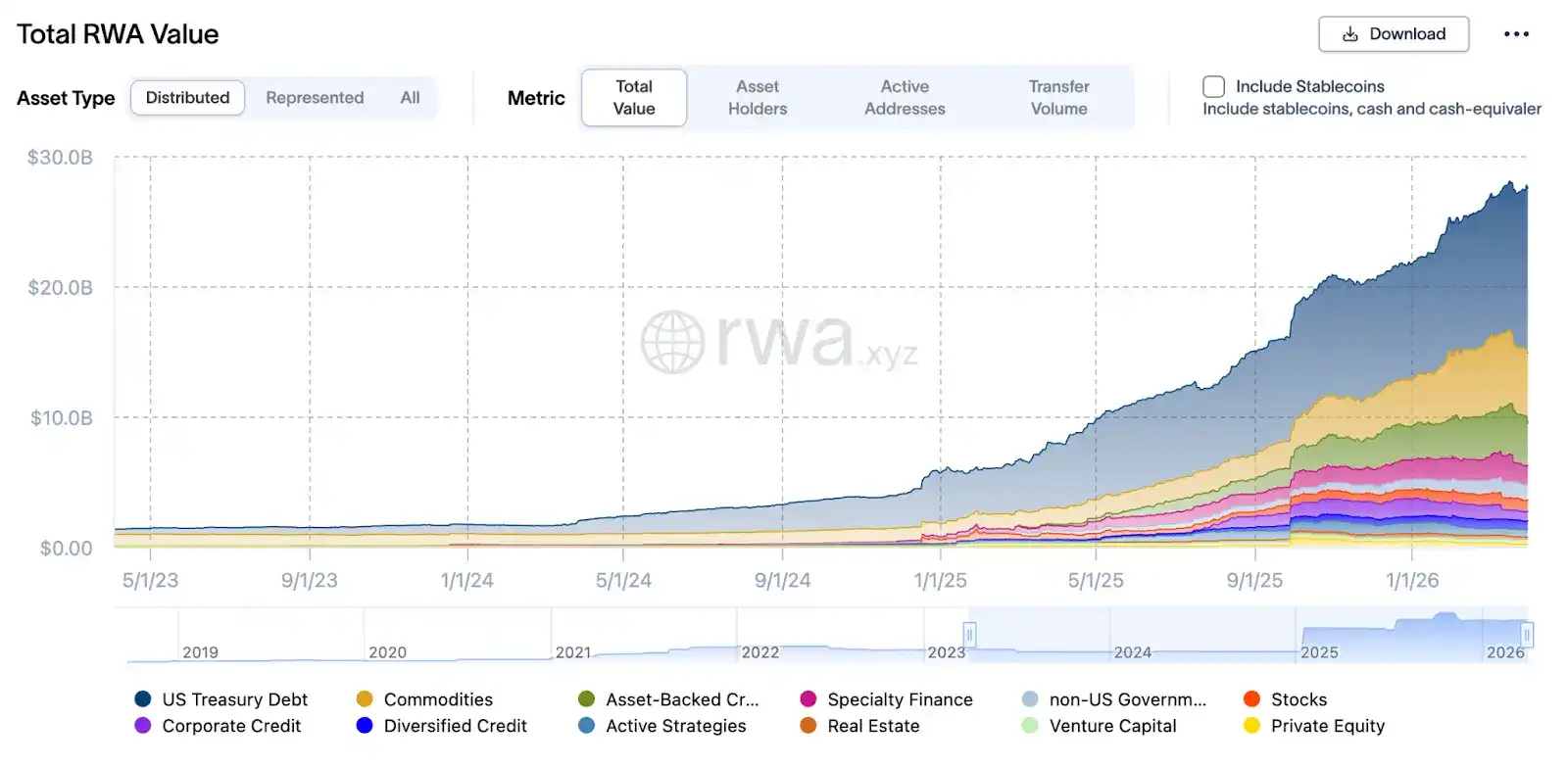
Taking Aave Horizon as an example, its RWA market had accumulated an asset size of about $540 million by the end of 2025. This includes stablecoins like Superstate's USCC, RLUSD, and Aave's GHO, as well as various US Treasury assets (like VBILL), with annualized yields ranging between 4-6%. This structure is essentially an "institutional version of a money market fund": the front end consists of tokenized treasury bonds and bills, the back end is a stablecoin liquidity pool, and smart contracts automatically handle interest payments, refinancing, and liquidation in the middle.

From "Holding" to "Operating": Are Institutions Playing On-Chain Repo or Fixed Income?

In the traditional fixed income market, bonds are not just tools for holding and collecting interest; they are used for repo (repurchase agreements), re-collateralization, splitting, and embedding into structured products, forming a flywheel of capital efficiency. By 2025, DeFi had begun replicating this logic.

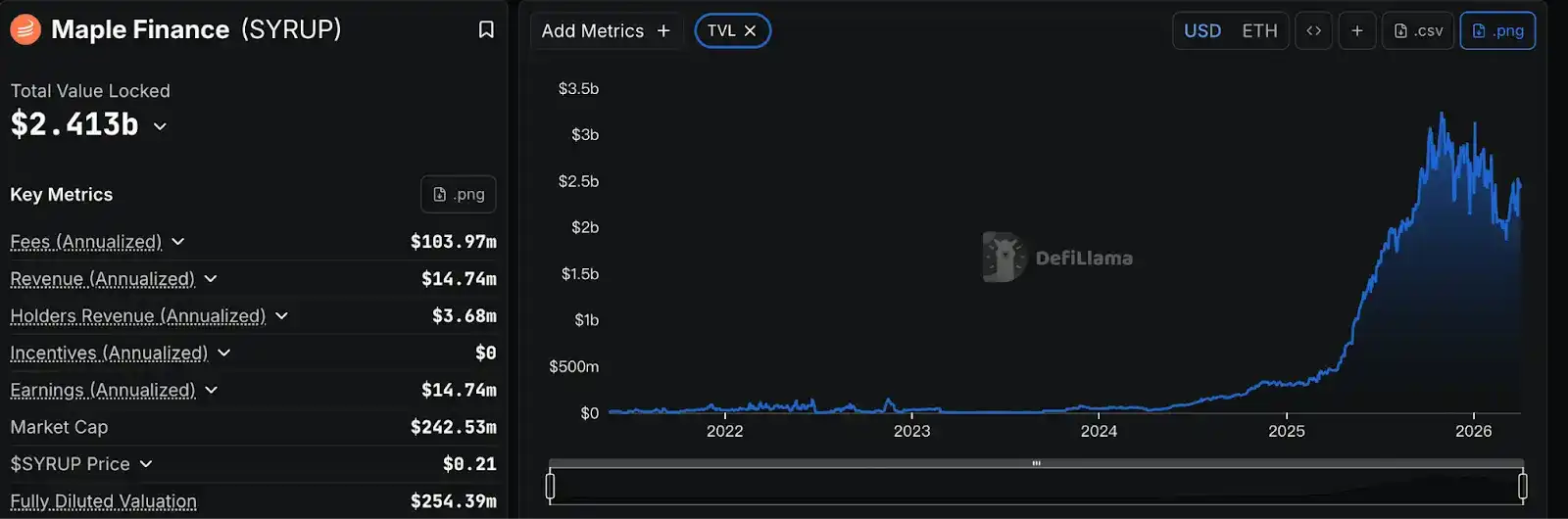
Maple Finance's TVL surged from $297 million in 2025 to over $3.1 billion, at times approaching $3.3 billion. The main driver was institutions entering the RWA lending market, tokenizing private loans and corporate loans for "over-the-counter" stablecoin lending and refinancing.
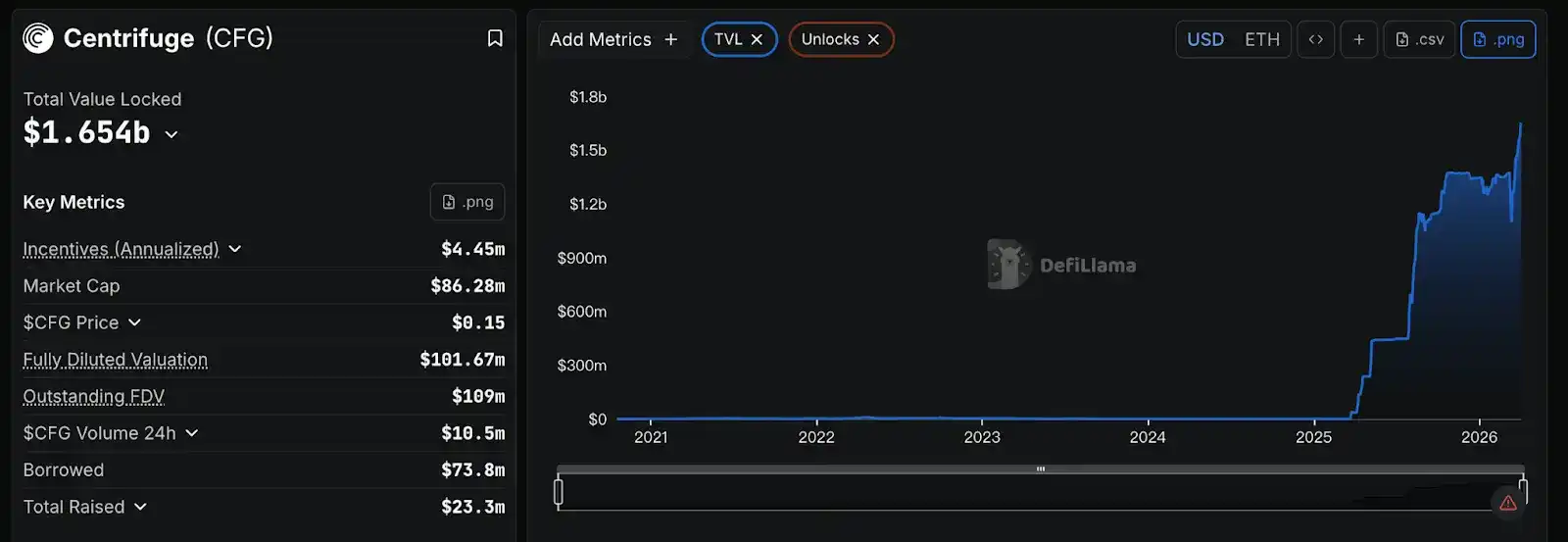
Centrifuge, on the other hand, focuses on converting Small and Medium Enterprise (SME) loans, trade finance, and accounts receivable into on-chain assets. To date, its ecosystem manages over $1 billion in TVL and has successfully developed multiple diversified asset pools, extending from private credit to highly liquid US Treasury bonds.

Simultaneously, Centrifuge has also integrated deeply with top DeFi protocols, such as Sky (formerly MakerDAO). Through its collaboration with Centrifuge, MakerDAO can invest its reserves in real-world enterprise loans, providing substantial yield support for the stablecoin DAI. There's also Aave; the two joined forces to create a dedicated RWA market, allowing KYCed institutional investors to use Centrifuge's asset tokens as collateral, achieving cross-protocol liquidity cycles.
Yield Tokenization and Yield Trading Markets: Can Interest Rate Risk Be Hedged?

If you were to map the structure of Wall Street's fixed income market, you would see several key modules: principal and interest can be separated (e.g., zero-coupon bonds, stripped coupons), interest rate risk can be independently traded and hedged, and liquidity and compliance can be separated but reconnected through middleware.

In May 2025, a paper titled "Split the Yield, Share the Risk: Pricing, Hedging and Fixed rates in DeFi" on arXiv first proposed a formal framework for "yield tokenization": splitting yield-bearing assets into "Principal Tokens (PT)" and "Yield Tokens (YT)", and using SDEs (Stochastic Differential Equations) and a no-arbitrage framework to price and hedge interest rate risk.

This design has already been implemented in some protocols. Take Pendle Finance as an example. Pendle uses a specially designed Yield AMM whose price curve adjusts over time (time decay factor), ensuring the PT price converges to its redemption value at maturity. These mechanisms allow market participants to allocate liquidity based on risk preferences (e.g., fixed-rate seekers buy PT, yield speculators buy YT).

For institutions, this means yield structures can be "modularized" and directly plugged into traditional asset allocation models (e.g., duration, DV01, interest rate risk contribution); interest rate risk no longer needs to be hedged solely with off-chain futures or IRS (Interest Rate Swaps). Instead, it can be adjusted directly on-chain by trading "yield tokens," enabling instant and transparent interest rate risk hedging and significantly improving capital efficiency.

Two Major Real-World Challenges: Privacy and Compliance

Even as DeFi's TVL breaks through tens of billions of dollars, the large-scale inflow of institutional capital is still hindered by two key challenges: privacy and compliance.

First Challenge: Public Chain Holdings Are Transparent, Liquidation Points Are Exposed

On mainstream public chains, every transaction and address's holdings are publicly visible, which poses an extremely high risk for institutions. Trading strategies, leverage levels, and liquidation points can be completely known by counterparties, potentially leading to targeted shorting and liquidation. Once a liquidity crunch or price volatility occurs, malicious actors can place orders targeting specific addresses, amplifying losses. This is one reason institutional capital is hesitant to fully commit to DeFi.

Here, zero-knowledge proofs (ZKPs) may become a key solution. They would allow institutions to prove their legitimacy to regulators without leaking information publicly. Specifically, regulators could verify that an institution complies with regulatory requirements, while other market participants cannot see the institution's complete holdings or liquidation points. This is the privacy layer Wall Street truly wants—not "complete anonymity," but "meeting compliance requirements without disclosing business secrets."

Second Challenge: KYC, Sanctions Screening, and Auditing Must Be Embedded in the Protocol Itself

Another red line for institutions is: compliance is not an afterthought patch, but natively built-in. In traditional finance, KYC, sanctions screening, and audit requirements are already embedded in settlement systems and trading processes. But in many DeFi protocols, these checks still remain at the "front-end gateway" or rely on "intermediary institutions," rather than being written directly into the protocol logic.

What institutions expect is: KYC and sanctions screening are no longer just about "users uploading ID documents, followed by pure trust," but rather a module or middleware that can verify identity and sanctions lists on-chain without exposing complete data; and audit and regulatory requirements can also be directly written as "verifiable rules," e.g., a transaction must execute only under certain compliance conditions, or an address's exposure must not exceed a certain limit.

The IOSCO, in its November 2025 report "Tokenization of Financial Assets," explicitly emphasized the need to establish "verifiable compliance rules" and "transparent but controlled audit trails" on DLT (Distributed Ledger Technology). Some institutional DeFi platforms have begun experimenting with "compliance modules," embedding KYC, AML, sanctions screening, and regulatory reporting directly into the protocol layer, rather than relying on external tools or post-hoc patches.

Conclusion: What Kind of DeFi Does Wall Street Want?

Returning to the initial question, what kind of DeFi does Wall Street want? First, a more advanced asset clearing and servicing system that can seamlessly integrate with global compliance infrastructure, building an institutional-grade moat. Second, in terms of yield structure, the ability to precisely replicate the traditional fixed income market's logic of yield decomposition and hedging, achieving risk modularization. Third, in terms of compliance and security, using zero-knowledge proofs to embed "verifiable compliance" and "programmatic risk control" into the protocol's foundation, achieving a balance between privacy and regulation.

Replacing traditional finance has never been an option for Wall Street. Instead, it's about having an additional parallel world where capital, risk, and returns can be reassembled more flexibly in a programmable way.


Related Questions

QWhat is the key factor that DWF Ventures believes is crucial for unlocking the institutional market in DeFi, according to the article?

ADWF Ventures believes the key to unlocking the institutional market is not the digitization of assets, but the financialization of yield.

QWhat does the data from DappRadar indicate about the recent surge in DeFi's Total Value Locked (TVL)?

ADappRadar data shows that the recent surge in DeFi TVL, which rose from about $115 billion to over $237 billion, was driven by 'high-value, low-frequency' institutional capital, not retail speculators, as the number of active wallets decreased by 22% in the same period.

QHow does the article describe the role of protocols like Pendle Finance in addressing institutional needs?

AProtocols like Pendle Finance implement a 'yield tokenization' framework, splitting yield assets into Principal Tokens (PT) and Yield Tokens (YT). This allows for the modularization of yield structures, enabling institutions to directly hedge interest rate risk on-chain by trading these tokens, which improves capital efficiency and fits into traditional asset allocation models.

QWhat are the two main obstacles preventing large-scale institutional inflow into DeFi, as outlined in the article?

AThe two main obstacles are privacy and compliance. Specifically: 1) The transparency of public blockchains exposes institutional trading strategies and liquidation points. 2) The need for KYC, sanctions screening, and auditing to be natively embedded into the protocol logic itself, not just handled at the front-end or by intermediaries.

QAccording to the article's conclusion, what does Wall Street ultimately want from DeFi?

AWall Street wants a DeFi that is a more advanced asset clearing and servicing system that can seamlessly integrate with global compliance infrastructure. It also seeks a yield architecture that can replicate the interest rate decomposition and hedging logic of traditional fixed-income markets for modular risk, and it requires embedded 'verifiable compliance' and 'programmatic risk control' at the protocol level using technologies like zero-knowledge proofs to balance privacy and regulation.

Related Reads

AI Agent Completely Transforms Web3 Gaming: From the Rugpull Bakery Bot Controversy to the New 2026 Agent Paradigm

This article explores how the AI Agent paradigm is fundamentally transforming Web3 gaming, moving from a disruptive force to a core, legitimized element. It begins with the controversy in the competitive baking game Rugpull Bakery, where automated scripts caused fairness issues. Instead of banning them, the developers integrated AI Agents into the official gameplay by providing technical documentation (skill.md, agent.json), marking a shift towards "Agentic Gaming." The piece outlines three primary implementation models for AI Agents in Web3 games by 2026: 1. **Autonomous Competitors & Economic Entities:** AI Agents act as independent players with unique strategies. Examples include TEN Protocol's poker agents, AI Arena's trainable NFT fighters, and Satoshi Strike Force's "Digital Athletes" trained on player data. The Somnia blockchain is highlighted as a dedicated "Agentic L1" infrastructure supporting this model at scale. 2. **Modular Infrastructure & Programmable Environments:** This model, exemplified by EVE Frontier, allows AI Agents to program game world logic itself. Using "Smart Assemblies" (e.g., Smart Turrets, Smart Gates), Agents can modify shared economic and physical rules on-chain, creating dynamic, player/AI-built worlds. The ERC-8183 standard further enables these automated entities to hire other AI services for complex tasks. 3. **Hybrid Companions & Dynamic Adaptation:** Here, AI serves as a collaborative partner. In Parallel Colony, highly autonomous AI Avatars work alongside human players who provide high-level guidance. Illuvium plans to use AI to make NPCs dynamic and responsive, creating personalized, emergent narratives for each player. The conclusion posits that Web3 gaming has reached a "post-human" inflection point. Blockchains' transparency and programmability, combined with new standards and infrastructure like Somnia, make integrating and governing AI Agents not just viable but essential. The future lies in a symbiotic digital order where players transition from manual laborers to commanders and partners of algorithmic intelligence.

marsbit50m ago

AI Agent Completely Transforms Web3 Gaming: From the Rugpull Bakery Bot Controversy to the New 2026 Agent Paradigm

marsbit50m ago

Saylor's Purchase of 1550 Bitcoin Is a Bad Trade

**Title: Saylor's Purchase of 1,550 Bitcoins Was a Bad Trade** The article critically analyzes Strategy's recent move of selling 32 bitcoins followed by a much larger purchase of 1,550 bitcoins. While appearing bullish, the author argues this trade is detrimental to MSTR shareholders. The core argument revolves around the concept of "breakeven modified Net Asset Value (mNAV)," a key metric for Strategy. To increase Bitcoin per share (BPS) for MSTR holders, Strategy must issue new shares at a premium high enough that the funds raised can buy more bitcoin than the bitcoin backing each existing share. Currently, this breakeven mNAV is estimated at 1.30. The recent trade failed on two counts: 1. The shares for the $181 million raise were issued at an mNAV *below* the 1.30 breakeven point. Selling "cheap" shares to buy bitcoin actually *reduces* BPS. 2. Only $101.3 million of the raised funds were used to buy bitcoin; the rest went to boost the company's dollar reserves. The breakeven mNAV calculation assumes *100%* of proceeds are used for bitcoin purchases. Diverting funds, even if mNAV were high, dilutes BPS. The result is an estimated 0.19% decrease in Bitcoin per share for MSTR holders. In exchange, Strategy merely extended its operational runway for its dollar reserves from ~6.3 months to 7 months. The author interprets this as Strategy prioritizing the survival and development of its STRC business over its stated core goal of increasing MSTR's BPS. This constitutes a gamble: if sacrificing MSTR value leads to improved market sentiment and a recovery in STRC's price (and thus mNAV), the whole system could work. If not, Strategy may be forced into a cycle of further diluting MSTR to stay afloat, potentially leading to deferred STRC dividends or corporate decline. The article concludes with a hope for price recovery for Bitcoin, MSTR, and STRC.

Foresight News1h ago

Saylor's Purchase of 1550 Bitcoin Is a Bad Trade

Foresight News1h ago

The AI Bear Market Lasting Two Days Is Over; Why Did Funds Buy Back Storage Stocks First?

After a severe two-day selloff in early June that erased over $1 trillion from U.S. chip stock market value, capital is flowing back first to the memory sector. The correction was not driven by a collapse in AI demand but rather a market reassessment of high expectations. Stocks like Broadcom faced selling pressure despite strong AI revenue guidance, signaling a shift in focus from who has an "AI story" to who can most rapidly translate AI demand into verifiable profits and earnings per share (EPS). Memory companies, such as Micron and SK Hynix, are leading the recovery because their EPS growth is more immediately verifiable. The AI server boom directly increases demand for high-bandwidth memory (HBM) and high-capacity server DRAM, tightening supply and driving up contract prices for conventional DRAM and NAND Flash. This price increase, coupled with a shift to higher-margin products, flows directly into near-term revenue and profitability, as evidenced in recent earnings reports. In contrast, other AI semiconductor segments like GPUs, ASICs, and optical modules, while central to the long-term AI infrastructure story, face longer and less certain paths to EPS validation. Their growth depends more on future product cycles, customer adoption timelines, and capital expenditure plans. The rebound in memory stocks highlights a market preference for assets with shorter, more transparent EPS conversion cycles following the recent de-risking phase. However, this does not negate the potential of other AI hardware segments should they provide clearer near-term order visibility. The episode has raised the validation bar for all AI-related investments.

marsbit1h ago

The AI Bear Market Lasting Two Days Is Over; Why Did Funds Buy Back Storage Stocks First?

marsbit1h ago

Trading

Spot
Futures
活动图片




