What Does The SpaceX IPO Have To Do With The Dogecoin Price?

bitcoinistPublished on 2026-03-30Last updated on 2026-03-30

Abstract

SpaceX's potential IPO has drawn significant attention to Dogecoin (DOGE) due to Elon Musk's well-known affinity for the meme cryptocurrency. Speculation around the public listing, which could be the largest IPO ever at an $80 billion raise and a $1.75 trillion valuation, briefly pushed DOGE near the $0.10 mark. The connection stems from Musk’s influence and ongoing projects like the DOGE-1 lunar mission, as well as potential integration of DOGE payments into the X platform (formerly Twitter) under Musk’s ownership. Crypto analyst Javon Marks suggests DOGE has one of the strongest market setups and could reach $7 in the next bull run (2027–2028), significantly exceeding its current all-time high. At the time of writing, DOGE is trading around $0.0927, up 2% in 24 hours.

The imminent SpaceX IPO has drawn attention to DOGE, with eyes on how the Dogecoin price could react to the public listing of Elon Musk’s company. This is because of the affinity that the world’s richest man has for the foremost meme coin, which has brought about a connection between DOGE and developments around him.

Dogecoin Price Briefly Rises On SpaceX IPO Speculations

The Dogecoin price notably rose close to the psychological $0.10 level following reports that Elon Musk’s SpaceX could file for an IPO soon. According to a Reuters report, the space company is reportedly looking to raise up to $80 billion at a $1.75 trillion valuation. This could make the IPO the largest ever, topping Saudi Aramco’s 2019 IPO.

The Dogecoin price reacts to developments surrounding a potential SpaceX IPO, given Elon Musk’s relationship with DOGE. As such, the meme coin has been known to react to developments around the world’s richest man. It is also worth noting that DOGE has a direct connection to SpaceX through the long-planned DOGE-1 lunar mission, which aims to send a physical Dogecoin to the moon.

Elon Musk recently revived talks about the mission, stating that it could maybe happen next year. As such, the SpaceX IPO represents a huge positive for the Dogecoin price. DOGE also has a connection with SpaceX through the X social media platform, which is now part of SpaceX following its acquisition of xAI.

X is planning to roll out its payment services, with speculations that the social media platform could integrate DOGE payments. The Dogecoin price rose when Musk announced that X Money will launch to the public next month. A potential integration could serve as the catalyst to send the Doge price higher.

DOGE Has One Of The Best Setups Right Now

Ahead of the SpaceX IPO, crypto analyst Javon Marks said in an X post that the Dogecoin price has one of the best setups in the market right now. His accompanying chart showed that DOGE could soon bottom and rally to as high as $7 in the next bull run, marking a new all-time high (ATH) for the meme coin, surpassing its current ATH of $0.73.

This Dogecoin price rally to $7 is expected to happen between 2027 and 2028, which could mark the start of the next bull run. Marks made this prediction based on DOGE’s historical performance in past bull runs. The foremost meme coin notably saw gains of over 8,000% and 30,000% in the 2017 and 2021 bull runs, respectively.
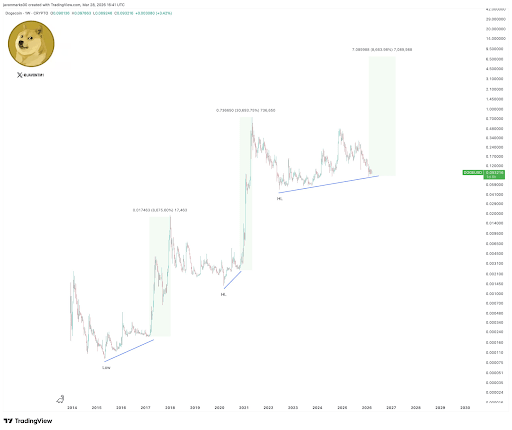
Source: Chart from Javon Marks on X

At the time of writing, the Dogecoin price is trading at around $0.09270, up almost 2% in the last 24 hours, according to data from CoinMarketCap.

DOGE trading at $0.09 on the 1D chart | Source: DOGEUSDT on Tradingview.com

Related Questions

QWhat is the connection between the SpaceX IPO and the Dogecoin price?

AThe connection exists because of Elon Musk's well-known affinity for Dogecoin. The Dogecoin price has historically reacted to developments around him, and the SpaceX IPO is a major event for his company. Additionally, there is a direct link through the planned DOGE-1 lunar mission and the potential integration of DOGE payments on the X platform, which is now part of SpaceX.

QHow did the Dogecoin price react to the SpaceX IPO speculation?

AThe Dogecoin price notably rose, approaching the psychological $0.10 level, following reports that SpaceX could file for an IPO soon.

QWhat is the DOGE-1 lunar mission and its significance to Dogecoin?

AThe DOGE-1 lunar mission is a long-planned project that aims to send a physical Dogecoin to the moon. Elon Musk recently revived talks about the mission, suggesting it could happen next year, which creates a positive connection between SpaceX and the Dogecoin price.

QAccording to analyst Javon Marks, what is the potential price target for Dogecoin in the next bull run?

ACrypto analyst Javon Marks predicted that the Dogecoin price could rally to as high as $7 in the next bull run, which would be a new all-time high, surpassing its current ATH of $0.73. This is expected to happen between 2027 and 2028.

QWhat is the potential role of the X platform (formerly Twitter) in the future of Dogecoin?

AThe X platform, now part of SpaceX, is planning to roll out payment services. There is speculation that it could integrate DOGE payments, which could act as a catalyst to send the Dogecoin price higher.

Related Reads

A 'Overlooked' Market Event: Joint US-Japan-South Korea Intervention, Rare US Treasury Involvement, and Bessent's Quiet 'Market Rescue'?

Summary: The United States, Japan, and South Korea executed their largest coordinated foreign exchange intervention in nearly 30 years. The action targeted depreciation pressure on the Japanese yen and South Korean won. This move is seen as a significant effort by the US to stabilize the financial markets of its key allies and prevent the spillover of risks. Key details: * Japan reportedly intervened on July 30 using approximately 8.45 trillion yen (about $52.8 billion). South Korean authorities also intervened that day, selling dollars to support the won. * Notably, the US Treasury Department intervened directly in yen markets for the first time in roughly 30 years. The New York Fed, reportedly acting on behalf of the Treasury, sold euros to buy yen via Goldman Sachs and Morgan Stanley on July 31. Analysts view the use of the euro-yen pair as a way to alleviate yen pressure without adding selling pressure to the US dollar. * Prior to the action, the New York Fed conducted "rate checks" on both USD/JPY and EUR/JPY, a newer signaling tool that falls between verbal and physical intervention. The intervention is interpreted as going beyond traditional currency stabilization. Analysts, such as Michael Hartnett of Bank of America, suggest it resembles a "Price Keeping Operation" for the AI era. The core US objectives are perceived to be: 1. Preventing rapid yen depreciation from triggering a sharp rise in Japanese government bond yields. 2. Containing financial stress from spreading across Asian markets like South Korea and Japan. 3. Reducing the risk of disorderly capital flows impacting the US bond market. This coordinated action underscores the importance of Japan and South Korea as critical partners in the US semiconductor and AI supply chain. Stabilizing their financial markets is seen as vital to mitigating risks to the broader tech industry and the US market itself. The intervention coincides with market pressures, including the KOSDAQ index hitting a low since October 2022. While seen as a move to control volatility, some analysts caution it may not fundamentally reverse existing market trends.

marsbit4m ago

A 'Overlooked' Market Event: Joint US-Japan-South Korea Intervention, Rare US Treasury Involvement, and Bessent's Quiet 'Market Rescue'?

marsbit4m ago

Will the Federal Reserve Definitely Raise Interest Rates in September? How Will Cryptocurrencies and US Stocks Bear the Pressure?

In early August 2024, market expectations for a September Federal Reserve rate hike surged dramatically, from below 50% to over 80%, driven by renewed inflation concerns. This shift followed a contentious July FOMC meeting where a 9-3 vote to hold rates revealed a growing hawkish faction advocating for an immediate hike, citing prolonged above-target inflation. The key catalyst is escalating conflict near the Strait of Hormuz, which has pushed oil prices up approximately 20% in July, threatening to reignite inflation. The next critical data point is the July CPI report on August 12th; a hot reading could solidify hike expectations. For crypto assets, particularly Bitcoin, this represents near-term pressure. Bitcoin continues to exhibit high-beta, risk-on characteristics, making it sensitive to tightening liquidity and higher opportunity costs. However, historical precedent suggests that if a hike is perceived as the cycle's end rather than its start, the negative impact may be brief, with markets quickly pivoting to anticipate future rate cuts. U.S. stocks, especially crypto-linked equities like Coinbase and high-valuation tech stocks, face amplified volatility. Higher rates increase discount rates in valuation models, pressuring growth stocks. This coincides with a pivotal tech earnings season where investor focus has shifted from massive AI capital expenditures to demonstrable revenue and cash flow generation. Companies with negative cash flows and weak growth narratives could see severe pressure if a September hike materializes, as financing costs would rise. Key indicators to watch include oil prices, upcoming inflation data, and Fed commentary at events like the Jackson Hole symposium.

Odaily星球日报4m ago

Will the Federal Reserve Definitely Raise Interest Rates in September? How Will Cryptocurrencies and US Stocks Bear the Pressure?

Odaily星球日报4m ago

From South Korea to the United States: Blue-Collar Jobs Are Becoming Increasingly Popular, Thanks to AI

AI is reshaping the labor market's value proposition. The traditional four-year college degree is losing its appeal as a guaranteed career path, while skilled blue-collar trades like electricians, welders, and plumbers are experiencing historic demand and wage premiums. This shift is driven by dual pressures: AI's displacement of certain white-collar roles and a booming need for physical infrastructure and data center construction. Data confirms the trend. In the U.S., vocational school revenue surged, and a significant portion of recent layoffs are AI-related. Surveys show a majority of Gen Z adults plan to pursue blue-collar work, citing better job security against AI automation. Vocational education interest has exploded recently. Experts cite a psychological shift as younger generations seek tangible, AI-resistant careers and avoid high student debt. In many cases, salaries for skilled trades now match or exceed those requiring a bachelor's degree. In South Korea, semiconductor vocational high schools boast near-total employment, with graduates securing high-paying roles at companies like Samsung. The shortage is structural, exacerbated by a retiring baby boomer workforce and massive infrastructure projects. Companies like JPMorgan Chase, Meta, and Lowe's are investing heavily in training programs. However, overcoming historical stigma and a "perception gap" around trade careers remains a key challenge to closing the talent gap.

marsbit1h ago

From South Korea to the United States: Blue-Collar Jobs Are Becoming Increasingly Popular, Thanks to AI

marsbit1h ago

Trading

Spot
活动图片