Vitalik Buterin Says Ethereum Solved The Blockchain Trilemma

bitcoinistPublished on 2026-01-05Last updated on 2026-01-05

Abstract

Vitalik Buterin claims Ethereum has effectively solved the blockchain trilemma—decentralization, consensus, and high bandwidth—through two key technical developments now in production. PeerDAS, which enables decentralized data availability sampling, is live on the mainnet. ZK-EVMs, though still in an alpha stage, offer production-level performance with safety improvements underway. Buterin argues these innovations shift Ethereum into a new category of decentralized network, combining robust consensus with high throughput. He outlines a multi-year rollout, expecting significant scalability improvements by 2026–2030, with ZK-EVMs eventually becoming the primary validation method. Distributed block building is noted as a longer-term goal to enhance fairness and reduce centralization risks.

Ethereum co-founder Vitalik Buterin said the network has effectively “solved” the blockchain trilemma: decentralization, consensus, and high bandwidth, arguing that the missing ingredients are now live on mainnet or within reach as zero-knowledge Ethereum virtual machines (ZK-EVMs) move toward production use.

In a Jan. 3 post on X, Buterin framed the moment around two technical developments: PeerDAS, which he said is now live on Ethereum mainnet, and ZK-EVMs, which he described as being at an “alpha stage” with “production-quality performance” while “remaining work is safety.”

“These are not minor improvements; they are shifting Ethereum into being a fundamentally new and more powerful kind of decentralized network,” Buterin wrote. “To see why, let’s look at the two major types of p2p network so far.”

Buterin drew a contrast between early peer-to-peer systems that could scale throughput but lacked agreement on shared state, and blockchains that achieved robust consensus but paid for it with constrained bandwidth. He pointed to BitTorrent as a model of decentralized distribution without consensus, and to Bitcoin as a model of decentralization and consensus that keeps bandwidth low because “it’s not ‘distributed’ in the sense of work being split up, it’s replicated.”

Ethereum Will Solve The Blockchain Trilemma

The claim, in Buterin’s telling, is that Ethereum is entering a third category. “Now, Ethereum with PeerDAS (2025) and ZK-EVMs (expect small portions of the network using it in 2026), we get: decentralized, consensus and high bandwidth,” he said. “The trilemma has been solved — not on paper, but with live running code, of which one half (data availability sampling) is on mainnet today, and the other half (ZK-EVMs) is production-quality on performance today — safety is what remains.”

Buterin cast this as the culmination of a multi-year roadmap rather than a sudden breakthrough. He described it as a “10-year journey,” pointing back to early data availability sampling research and noting that ZK-EVM efforts began around 2020. The arc of his argument is that data availability sampling changes what a decentralized network can safely publish and verify at scale, while ZK-EVMs change how nodes can validate execution, shifting validation toward proof-based verification as the technology matures.

Looking ahead, Buterin laid out an approximate timeline for how he expects the vision to roll out over the next four years. In 2026, he expects “large non-ZKEVM-dependent gas limit increases” tied to BALs and ePBS, alongside what he described as the first opportunities to run a ZK-EVM node.

From 2026 through 2028, he anticipates a sequence of changes, gas repricings, adjustments to state structure, moving execution payloads into blobs, and other steps, aimed at making higher gas limits safe. Between 2027 and 2030, he expects “large further gas limit increases,” with ZK-EVMs becoming “the primary way to validate blocks on the network.”

He also flagged what he called a “third piece” of the puzzle: distributed block building. The long-term goal, he wrote, is a world where “the full block is never constituted in one single place,” though he stressed it “will not be necessary for a long time.” The nearer-term focus is distributing “meaningful authority in block building,” either through in-protocol mechanisms—he floated expanding FOCIL as a primary transaction channel—or through out-of-protocol systems such as distributed builder marketplaces.

For Buterin, distributing block building is not just an engineering preference but a risk and fairness question: he argued it would reduce the chance of “centralized interference with real-time transaction inclusion,” while creating “a better environment for geographical fairness.”

At press time, ETH traded at $3,164.
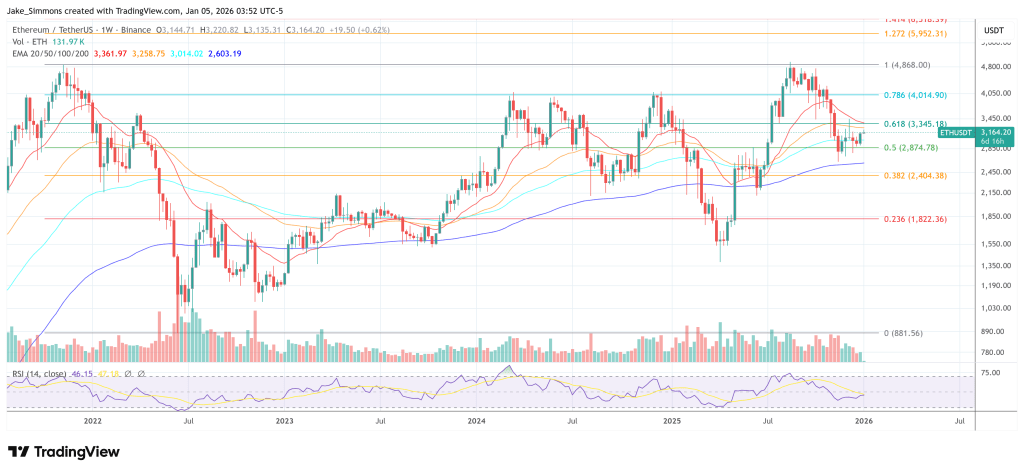
ETH faces the 50-week EMA, 1-week chart | Source: ETHUSDT on TradingView.com

Trending Cryptos

Related Questions

QWhat are the two key technical developments that Vitalik Buterin claims have solved the blockchain trilemma for Ethereum?

AThe two key technical developments are PeerDAS, which is now live on the Ethereum mainnet, and ZK-EVMs, which are at an 'alpha stage' with production-quality performance.

QAccording to Buterin, what are the three components of the blockchain trilemma that Ethereum has now addressed?

AThe three components of the blockchain trilemma are decentralization, consensus, and high bandwidth.

QWhat is the long-term goal for distributed block building that Buterin describes?

AThe long-term goal is a world where 'the full block is never constituted in one single place' to reduce the risk of centralized interference and improve geographical fairness.

QWhat approximate timeline did Buterin provide for when ZK-EVMs are expected to become the primary way to validate blocks on the Ethereum network?

AButerin expects ZK-EVMs to become the primary way to validate blocks between 2027 and 2030.

QHow did Buterin contrast early peer-to-peer systems like BitTorrent with blockchains like Bitcoin?

AHe contrasted them by stating that early P2P systems like BitTorrent could scale throughput but lacked agreement on a shared state, while blockchains like Bitcoin achieved robust consensus but paid for it with constrained bandwidth, as the work is replicated rather than distributed.

Related Reads

In Jinjiang, Fujian, a Storage Super Unicorn Lies Quiet

In Fujian's Jinjiang, a city known for sportswear, lies a quiet semiconductor giant: Fujian Jinhua Integrated Circuit Co. (JHICC). Once a promising domestic DRAM manufacturer alongside Yangtze Memory and ChangXin Memory Technologies (CXMT), its journey was derailed in 2018 when the U.S. placed it on an Entity List and filed criminal charges for alleged trade secret theft. This halted production for years. A turning point came in February 2024 when a U.S. federal court found JHICC not guilty. However, it had lost crucial time. While CXMT soared to become a top-valued A-share company in 2024, JHICC, with an estimated valuation of 80 billion RMB, was just restarting. Its current output is primarily customized DDR4 chips, not the advanced DDR5/HBM demanded for AI, but it still benefits from the broader memory chip upcycle. JHICC's story is tied to Chen Zhengkun, a veteran engineer who left Micron to lead the venture. Founded in 2016 with state-backed funding, JHICC partnered with Taiwan's UMC to develop DRAM technology. Rapid progress was cut short by the U.S. actions, which Micron initiated, partly due to its heavy reliance on the Chinese market. Post-sanctions, Chen's team worked to rebuild the production line with reduced reliance on U.S. technology. According to its records, JHICC achieved small-scale production and revenue growth under immense pressure. It now focuses on the stable "niche" DRAM market (e.g., TVs, routers) with a monthly capacity of ~40,000 wafers, aiming for 60,000 by 2026. It holds over 1,000 patents but remains on the Entity List. For Jinjiang, investing in JHICC was a bold industrial leap. The local government provided unwavering financial and logistical support during the crisis, helping the company survive. JHICC has become the anchor for a growing local semiconductor cluster. Though its scale lags behind domestic peers, JHICC's persistence symbolizes a hard-won foothold in a global market long dominated by Samsung, SK Hynix, and Micron. Having missed one boom, it seeks a place in the new AI-driven memory supercycle.

marsbit4m ago

In Jinjiang, Fujian, a Storage Super Unicorn Lies Quiet

marsbit4m ago

Must-Watch Events Next Week|CLARITY Act Could Face Senate Vote; SpaceX, Circle to Report Earnings (8.3-8.9)

**Summary: Key Events and Developments to Watch (August 3-9)** The upcoming week is marked by significant financial disclosures, key legislative deadlines, and notable product updates. **Major Financial Events:** Several companies are scheduled to release their Q2 2026 earnings. American Bitcoin (ABTC) will report on August 3, followed by SpaceX and Hut 8 Mining Corp. on August 4, and Circle on August 5. Notably, a significant portion of SpaceX shares (up to 12% of total shares) will be unlocked on August 6 following their earnings release. **Key Legislative Deadline:** The U.S. Senate faces an August 7 deadline to secure 60 votes for the CLARITY Act, a bipartisan bill aiming to establish a federal regulatory framework for cryptocurrencies. The Senate may hold a full vote on the bill during the week. **Economic Data:** The U.S. July Non-Farm Payrolls report will be released on August 7, providing crucial labor market data. **Technology & Product Updates:** * **Shutdowns:** DeFi portfolio tracker Zapper and wallet app Ctrl Wallet will cease operations on August 3. * **Upgrades:** LayerZero will deprecate its v1 relayers on August 3. XRP Ledger's new version 3.3.0, featuring five new functions, is expected next week. * **AI:** Elon Musk announced that the advanced Grok 4.6 AI model is set for release around August 7. * **Bitcoin:** The BIP-110 forced signaling for a potential Bitcoin network change is scheduled to begin around August 8. **Other Notable Events:** Chinese robotics firm Unitree Tech has set its preliminary price inquiry for its IPO for August 5. South Korean exchange Upbit will delist AQT and AERGO tokens on August 3.

marsbit2h ago

Must-Watch Events Next Week|CLARITY Act Could Face Senate Vote; SpaceX, Circle to Report Earnings (8.3-8.9)

marsbit2h ago

Trading

Spot

Hot Articles

Discussions

Welcome to the HTX Community. Here, you can stay informed about the latest platform developments and gain access to professional market insights. Users' opinions on the price of ETH (ETH) are presented below.

活动图片















