Vitalik Buterin says Ethereum can handle temporary loss of finality

cointelegraphPublished on 2025-12-10Last updated on 2025-12-10

Abstract

Vitalik Buterin, co-founder of Ethereum, stated that the network can tolerate temporary losses of finality without serious risk, even after a recent client bug nearly disrupted its confirmation mechanism. Buterin emphasized that while finalization indicates a block is irreversible, occasional delays of several hours due to bugs are acceptable. The critical issue to avoid is finalizing incorrect blocks. Experts, including Fabrizio Romano Genovese, supported this view, noting that during such events, Ethereum operates similarly to Bitcoin, which relies on probabilistic finality. In Ethereum, finality is achieved when a block receives over 66% of validator votes and remains unchallenged for over two epochs (64 blocks). While this mechanism ensures deterministic finality, its temporary loss reverts the network to probabilistic guarantees, as seen in a May 2023 incident. The loss of finality may impact infrastructure like bridges and layer-2 solutions, potentially delaying deposits or cross-chain transactions. However, users would not face transaction rollbacks or invalidations. Polygon confirmed that operations would continue normally, though transfers from Ethereum might be delayed until finality is restored. Genovese noted that developers choosing not to implement fallback mechanisms for finality loss bear responsibility for such delays.

Ethereum can afford to lose finality from time to time without putting the network at serious risk, according to co-founder Vitalik Buterin, even after a recent client bug came close to disrupting the blockchain’s confirmation mechanism.

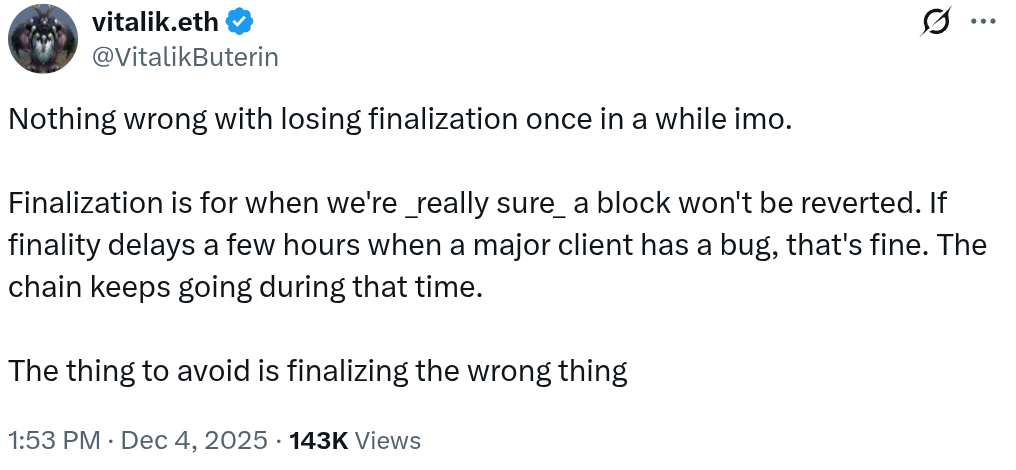
Following a recent bug in the Prysm Ethereum client, Buterin said in an X post that there is “nothing wrong with losing finalization once in a while.” He added that finalization indicates the network is “really sure” a block will not be reverted.

Buterin argued that if finality is occasionally delayed for hours due to a major bug, “that’s fine,” and the blockchain keeps working while that happens. The real issue would be something else, he said: “The thing to avoid is finalizing the wrong thing.”
Source: Vitalik Buterin

Related: Ethereum’s first ZK-rollup, ZKsync Lite, to be retired in 2026

Experts weigh in on finalization loss

Fabrizio Romano Genovese, PhD in computer science at the University of Oxford, England, partner at the blockchain research company 20squares, and Ethereum protocol expert, agreed with Buterin.

He said that when finality is lost, Ethereum becomes more like Bitcoin (BTC), and pointed out that Bitcoin has had “no finality since 2009 and no one complains.”

A proof-of-work blockchain, such as Bitcoin’s, can branch into multiple chains, with the one that receives the most work (usually the longest) considered valid. Still, if a secondary branch grows enough to overtake the main branch, it invalidates the main branch and the transactions it contained — this is called a reorganization.

This is how Bitcoin operates: its finality is probabilistic, not deterministic, because — while it is almost impossible after enough blocks are added to the main branch — a reorganization can still theoretically occur. Genovese explained how Ethereum is different, with rules setting blocks as “final.”

Ethereum has a finalization mechanism: when a block receives more than 66% of the validator votes, it becomes ‘justified.’ At this point, if more than two epochs (64 blocks) pass, the block is finalized.

This is not just theoretical; it happened in May 2023 due to an incident very similar to the recent one with the Prysm client. Genovese said that these incidents do not make the chain insecure; instead, “it just means that our guarantees around reorg have temporarily reverted to be probabilistic and not deterministic.”

Related: Vitalik Buterin floats gas futures on Ethereum to hedge fee spikes

Consequences for L2s and bridges

Still, Genovese noted that a lack of finality would affect infrastructure that relies on it, including some inter-blockchain or layer-2 (L2) bridges. A representative from the Ethereum sidechain Polygon told Cointelegraph that Polygon would continue with normal operations, but transfers from Ethereum to the sidechain “may be delayed while waiting for finality.”

Furthermore, the Polygon spokesperson said that the crosschain settlement layer AggLayer would delay transactions from Ethereum to L2 until finality is reached again. Still, they said that “there is no scenario in which users experience a rollback or message invalidation” due to a loss of finality:

“The practical impact of a delayed finality event is simply that deposits may take longer to appear. Users are not exposed to reorg-driven reversions beyond this delay.”

Genovese shifted the blame for such delays to developers who require finality. “If a bridge builder decides not to implement any fallback mechanism in case of loss of finality, that’s their choice,” he concluded.

Magazine: When privacy and AML laws conflict: Crypto projects’ impossible choice

Trending Cryptos

Related Questions

QWhat is Vitalik Buterin's view on Ethereum occasionally losing finality?

AVitalik Buterin believes that Ethereum can afford to lose finality from time to time without putting the network at serious risk, stating that it's acceptable if finality is occasionally delayed for hours due to a major bug, as the blockchain continues to function.

QHow does Fabrizio Romano Genovese compare Ethereum's loss of finality to Bitcoin?

AFabrizio Romano Genovese compares Ethereum's loss of finality to Bitcoin by noting that when finality is lost, Ethereum becomes more like Bitcoin, which has had no finality since 2009 and operates with probabilistic finality rather than deterministic finality.

QWhat is the key difference between Ethereum's finality mechanism and Bitcoin's?

AEthereum has a deterministic finality mechanism where blocks become 'justified' after receiving more than 66% of validator votes and are finalized after more than two epochs (64 blocks) pass. Bitcoin, on the other hand, has probabilistic finality, where the chain with the most work is considered valid but can theoretically be reorganized.

QHow does a loss of finality on Ethereum affect layer-2 solutions and bridges?

AA loss of finality on Ethereum can delay infrastructure that relies on it, such as inter-blockchain or layer-2 bridges. For example, transfers from Ethereum to sidechains like Polygon may be delayed, and cross-chain settlement layers like AggLayer would postpone transactions until finality is restored, though users are not exposed to reorg-driven reversions beyond the delay.

QWhat was the cause of the recent incident that nearly disrupted Ethereum's finalization mechanism?

AThe recent incident that nearly disrupted Ethereum's finalization mechanism was caused by a bug in the Prysm Ethereum client, which is similar to an incident that occurred in May 2023.

Related Reads

US CFTC Launches Broad Investigation into Polymarket, Is the Prediction Market Party Coming to an End?

The U.S. Commodity Futures Trading Commission (CFTC) is conducting a broad investigation into the prediction market platform Polymarket, focusing on its business practices including social media promotions. This follows a bipartisan letter from U.S. senators urging the CFTC to probe alleged fraudulent marketing tactics used to promote gambling-like products. The action coincides with a period of explosive growth for the prediction market sector, driven by events like the World Cup, with platforms like Kalshi and Robinhood reporting record trading volumes and revenue. The investigation signals a potential end to the sector's unregulated expansion and may lead to clearer federal oversight, particularly regarding investor protection and distinguishing prediction markets from traditional sports betting. The CFTC's move has also intensified a jurisdictional conflict with multiple U.S. states (including Kentucky and New York), which have sued platforms like Polymarket and Kalshi, accusing them of operating illegal sports betting and threatening state gambling tax revenues. Furthermore, the CME Group has sued the CFTC, challenging its approval of certain prediction market products. The report also highlights the political and capital interests intertwined with the industry. Donald Trump Jr. holds advisory and investment roles in both Kalshi and Polymarket, and the Trump administration has previously emphasized federal regulatory authority over these markets. The CFTC's investigation into Polymarket is framed as a step towards formalizing the industry's regulatory landscape, moving it from a phase of "wild growth" towards a more structured future.

marsbit1h ago

US CFTC Launches Broad Investigation into Polymarket, Is the Prediction Market Party Coming to an End?

marsbit1h ago

U.S. CFTC Launches Extensive Investigation into Polymarket, Is the Prediction Market Frenzy Season Cooling Down?

The U.S. Commodity Futures Trading Commission (CFTC) has launched a broad investigation into the prediction market platform Polymarket, focusing on its business practices including social media activities. This follows a bipartisan letter from U.S. senators urging the CFTC to probe allegations of paid influencer false marketing and fraudulent promotion of gambling-like products to American users. The investigation comes as the prediction market sector experiences explosive growth, largely driven by the World Cup. Weekly trading volumes have hit record highs, exceeding $14.4 billion, with platforms like Kalshi and Robinhood's new venture seeing significant activity. Major firms like Meta are also showing interest in the space. This regulatory scrutiny signals a potential end to the sector's "wild growth" phase. The CFTC's move also highlights an escalating jurisdictional conflict between federal regulators and state authorities. Over a dozen states, including Kentucky and New York, have sued platforms like Polymarket and Kalshi, accusing them of operating illegal sports betting, which threatens state gambling tax revenues. The CFTC is countersuing to assert its exclusive federal jurisdiction over these "event contracts" as derivatives. Furthermore, the CFTC's approval of Kalshi's Bitcoin perpetual futures contract has sparked a lawsuit from traditional exchange CME, alleging regulatory overreach. The political and capital landscape is intricate, with Donald Trump Jr. holding advisory roles and investments in both Kalshi and Polymarket. This connects capital, political influence, and regulatory bodies, suggesting the current investigation may be a step toward formalizing the industry's rules rather than halting its progress.

Odaily星球日报1h ago

U.S. CFTC Launches Extensive Investigation into Polymarket, Is the Prediction Market Frenzy Season Cooling Down?

Odaily星球日报1h ago

Trading

Spot

Hot Articles

Discussions

Welcome to the HTX Community. Here, you can stay informed about the latest platform developments and gain access to professional market insights. Users' opinions on the price of ETH (ETH) are presented below.

活动图片