Venezuela, Sanctioned and Kicked Out of the Dollar System by the U.S., Turns to USDT

marsbitPublished on 2026-02-22Last updated on 2026-02-22

Abstract

Venezuela, heavily sanctioned by the US and cut off from the dollar system, has turned to USDT (Tether) to manage a significant portion of its national revenue, particularly from oil sales. An estimated 80% of the country's oil transactions are now conducted using the stablecoin. This shift was not a voluntary adoption of cryptocurrency but a necessity due to the inability to legally transact in USD. The Venezuelan government, which once banned stablecoins, now facilitates their use for both corporate and retail payments, including salaries and groceries. However, the use of cryptocurrencies like USDT remains limited in large-scale illicit activities, such as drug trafficking, where traditional cash-based and trade-based money laundering methods still dominate. US authorities have not emphasized crypto in recent indictments, suggesting that digital assets may not yet be practical for moving very large sums illicitly. Nonetheless, Venezuela’s embrace of a digital dollar sets a precedent for other nations under sanctions and may paradoxically reinforce the global dominance of the dollar.

Author: Blockworks

Compiled by: Deep Tide TechFlow

Deep Tide Introduction: Venezuela's case is the most powerful real-world footnote for stablecoins—not because they chose crypto, but because they had no other choice. This article demonstrates the complete path of a sovereign nation forced to adopt USDT under sanction pressure, while also revealing the real limitations of stablecoins in large-scale money laundering scenarios.
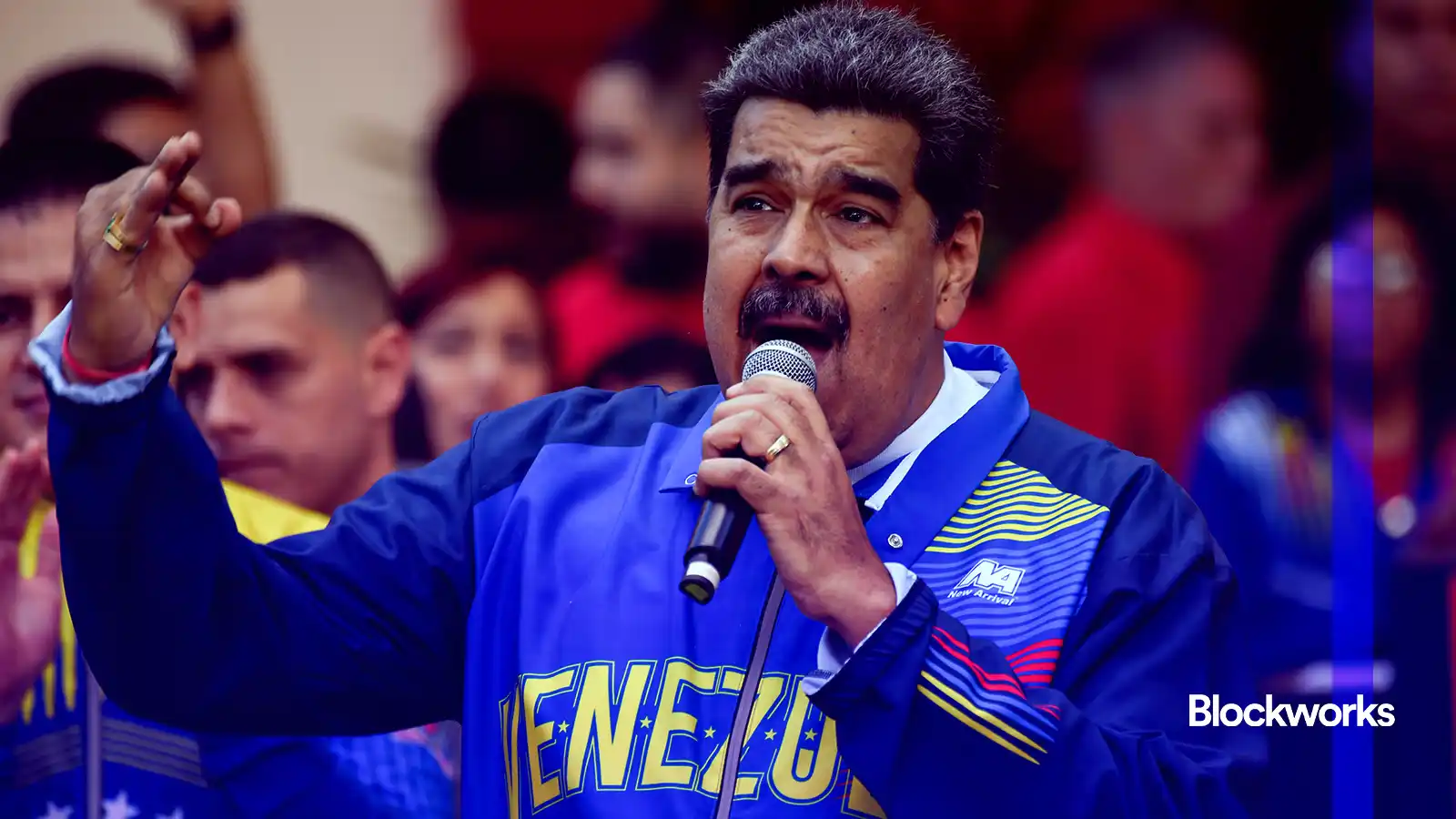
"I don't think it's a bad thing, this so-called 'dollarization' process... Thank God it exists."

— Nicolás Maduro

A recent report by The New York Times stated that Venezuela has become "the first country to manage a large portion of its fiscal revenue using cryptocurrency."

But this was not an active choice.

Approximately half of Venezuela's revenue comes from oil sales denominated in U.S. dollars. As a sanctioned country, Venezuela cannot legally send or receive dollars.

Previously, sanctioned governments typically exchanged oil for dollars—or bartered oil for goods or infrastructure investments—through a network of shell companies and offshore banks.

Now, they have a simpler option: accept stablecoins as payment. Economist Asdrúbal Oliveros estimates that Tether's USDT is the medium of exchange for about 80% of Venezuela's oil sales.

The Venezuelan government once banned the use of stablecoins for transactions, viewing them as a threat to the bolívar. But the devastating impact of U.S. sanctions left it with almost no choice, ultimately forcing it to embrace stablecoins.

Venezuela's current interim president, Delcy Rodriguez, acknowledged the inevitability of crypto-driven dollarization as early as August last year. She told business leaders at the time that "non-traditional management mechanisms" were being implemented to better manage the bolívar exchange rate.

Reuters reported shortly thereafter: "The Venezuelan government has allowed greater use of USDT since June." With state approval, banks now sell USDT obtained from oil sales to local businesses, which use these stablecoins to pay domestic and international suppliers.

They also hope stablecoins will circulate at the retail level: the head of Venezuela's National Supermarket Association recently stated on national television that grocery stores are advancing system upgrades to accept USDT payments.

In other words, the Venezuelan government is encouraging the use of dollars issued by Tether to replace its own currency, the bolívar.

As a result, USDT—which many Venezuelans call "Binance dollars"—is now used in various scenarios, "from buying groceries and paying apartment management fees to issuing salaries and paying suppliers."

So, for a stablecoin enthusiast like me, it was quite disappointing to see that the U.S. government's indictment against Nicolás Maduro didn't even mention cryptocurrency or stablecoins.

The indictment describes illegal fund flows using the old ways: planes returning from Mexico "loaded with drug proceeds"; weapons like grenades bartered for cocaine; protection fees paid by sharing shipments of cocaine; and a $2.5 million cash bribe.

Why no mention of cryptocurrency?

There are two possibilities: 1) The U.S. government has stopped publicly criticizing crypto, and prosecutors know when to skip it; or 2) Crypto and stablecoins are still inadequate for the scale of funding required by Maduro and his associates. The former is more interesting, but the latter is more likely the truth.

"It is difficult for the state to quickly liquidate these [crypto] assets," explained Asdrúbal Oliveros, "because transferring crypto funds requires going through various controls that are currently not being met."

A report by TRM Labs reached a similar conclusion: "Large-scale drug trafficking organizations still heavily rely on physical cash, trade-based money laundering, and the protection of state or quasi-state institutions when moving core proceeds. Cryptocurrency typically plays a secondary or complementary role rather than replacing these mechanisms."

Analysts from the national security think tank Lawfare also agree: "Cryptocurrency-based sanctions evasion remains a drop in the bucket compared to traditional illicit finance channels."

Some are more optimistic about the practicality of stablecoins and crypto in the field of "international payments."

For example, InSight Crime reported that Mexican drug cartels are sustained by an "industrial-scale crypto money laundering pipeline" that funnels black money through digital networks to Chinese chemical suppliers.

They detailed a niche market where stablecoins have found a fit: acting as intermediaries connecting Chinese money brokers who need dollars to sell to clients circumventing China's capital controls, and Mexican drug cartels who need to buy fentanyl precursor chemicals from China.

This isn't the product-market fit crypto enthusiasts hoped for, but in terms of actual behavior, the fit is quite strong. For instance, the DEA stated that its seizures of illicit cash have significantly decreased because criminal groups are "placing cryptocurrency above traditional cash laundering schemes."

Correspondingly, seizures of "virtual currency" have risen significantly: between 2020 and 2024, the DEA seized $2.5 billion in cryptocurrency, compared to only $2.2 billion in cash.

This might explain why Maduro and his associates stick to more traditional payment methods—traceable cryptocurrency and freezable stablecoins are not yet ready for the largest-scale money laundering needs.

Nonetheless, Venezuela's embrace of the digital dollar is setting a precedent. Lawfare concluded: "U.S. adversaries have established a working proof-of-concept, and emerging financial technologies may further consolidate it."

If that's the case, the U.S. dollar itself might be further consolidated as a result.

Being prohibited from using dollars did not push Venezuela to adopt the yuan for oil settlements—instead, it led the government to switch to the digital dollar.

Related Questions

QWhy has Venezuela turned to using USDT for its oil sales according to the article?

ADue to U.S. sanctions, Venezuela cannot legally send or receive U.S. dollars. Approximately 80% of its oil sales are now conducted using Tether's USDT as a transaction medium, as it provides a simpler alternative to traditional workarounds involving shell companies and offshore banks.

QWhat was the Venezuelan government's initial stance on stablecoins like USDT, and why did it change?

AThe Venezuelan government initially banned stablecoin transactions, viewing them as a threat to the Bolivar. However, the devastating impact of U.S. sanctions left them with almost no choice, forcing them to embrace stablecoins to manage revenue and economic activities.

QHow is USDT being used within Venezuela beyond oil sales, as mentioned in the article?

AUSDT is used for various daily transactions, including buying groceries, paying apartment management fees, disbursing salaries, and settling payments with suppliers. The government is encouraging its use at the retail level, with supermarkets adapting systems to accept USDT payments.

QWhy does the article suggest that cryptocurrencies and stablecoins were not mentioned in the U.S. government's indictment against Nicolás Maduro?

AThe article presents two possibilities: 1) The U.S. government has shifted away from publicly criticizing crypto, and prosecutors omitted it strategically, or 2) Cryptocurrencies and stablecoins are still inadequate for the scale of money laundering required by Maduro and his associates, with traditional methods like cash and trade-based laundering remaining dominant.

QWhat broader implication does the article highlight regarding the use of digital dollars like USDT in sanctioned economies?

AThe article suggests that Venezuela's adoption of USDT sets a precedent, creating a 'working proof-of-concept' for other U.S. adversaries. This could further entrench the use of digital dollars, ironically strengthening the U.S. dollar's role even in economies sanctioned by the U.S., rather than prompting a shift to alternatives like the Chinese yuan.

Related Reads

South Korean Exchanges 'Battle' Regulators, Challenging the Boundaries of Enforcement and Legislation

South Korea's cryptocurrency industry is engaged in a rare, direct confrontation with regulators. The Financial Intelligence Unit (FIU), the primary anti-money laundering (AML) watchdog, has recently imposed heavy penalties on major exchanges like Upbit and Bithumb for alleged violations involving unregistered overseas VASPs and AML procedures. However, exchanges are now actively challenging these actions in court and through industry associations. In a significant shift, the Seoul Administrative Court ruled in favor of Upbit's operator, Dunamu, overturning part of an FIU-ordered business suspension. The court found the FIU's penalty criteria and justification insufficiently clear. Similarly, the court suspended the enforcement of a six-month business suspension against Bithumb pending a final ruling, citing potential irreversible harm to the exchange. Beyond legal battles, the industry is contesting proposed legislative amendments. The Digital Asset eXchange Alliance (DAXA) strongly opposes a draft rule that would mandate Suspicious Transaction Reports (STRs) for all crypto transfers over 10 million KRW (~$6,800). DAXA argues this "poison pill" clause violates legal principles and would overwhelm the STR system, increasing reports from 63,000 to an estimated 5.45 million annually for major exchanges, thereby crippling effective AML monitoring. This conflict highlights a structural tension in South Korea's crypto governance: comprehensive digital asset laws are still developing, while regulators rely heavily on AML enforcement. The industry's move from passive compliance to active legal and legislative challenges signifies a new phase, pressing for clearer rules and more proportionate enforcement. While short-term disputes may intensify, this clash could ultimately lead to a more mature and sustainable regulatory framework for South Korea's vibrant crypto market.

marsbit41m ago

South Korean Exchanges 'Battle' Regulators, Challenging the Boundaries of Enforcement and Legislation

marsbit41m ago

After 50x Storage Surge, Justin Sun Always Looks to the Next Decade

Sun Yuchen, known for his controversial stunts like a $30 million lunch with Warren Buffett (canceled due to a kidney stone) and eating a $6.2 million duct-taped banana, is often overshadowed by a significant fact: his decade-long track record of spotting major investment trends. In 2016, he famously advised young people to invest in Bitcoin, Nvidia, Tesla, and Tencent instead of buying property. A hypothetical $20,000 investment in Nvidia and Tesla from that list would now be worth over 50 million RMB. His latest major call was on November 6, 2025, predicting a "50x storage opportunity" tied to the AI boom, which materialized with Sandisk's stock surging nearly 50-fold by 2026. Looking ahead, Sun now focuses on the next frontier: Physical AI. He identifies four key areas: 1. **Embodied AI/Robotics**: He sees this reaching its "iPhone moment," with companies like UBTech and Galaxy General leading in commercialization. 2. **Drones**: Viewed as the first commercially viable form of Physical AI, revolutionizing sectors from warfare (e.g., AeroVironment's Switchblade) to logistics. 3. **Spatial Computing**: Beyond VR, it's about AI understanding physical space, a foundational technology for robotics and autonomous systems, exemplified by Apple's Vision Pro. 4. **Space Exploration**: After a 2025 suborbital flight with Blue Origin, Sun advocates for space as the ultimate frontier, discussing blockchain's potential role in space asset management and data transactions. His investment philosophy involves betting on entire, inevitable trends rather than single companies. For robotics, he sees Tesla (the body/manufacturer) and Nvidia (the brain/AI platform) as complementary plays. In defense drones, he highlights companies making tanks obsolete (AeroVironment) and those augmenting fighter jets (Kratos). For space, he participated in Blue Origin's flight and anticipates SpaceX's potential IPO to redefine the sector's valuation. Sun Yuchen's vision frames the next two decades not as a revolution in information flow (like the internet), but in the fundamental operation of the physical world through AI-powered robots, autonomous systems, and spatial intelligence, ultimately extending human and AI activity into space. While many still focus on conventional assets, he continues to look toward the next technological horizon.

marsbit1h ago

After 50x Storage Surge, Justin Sun Always Looks to the Next Decade

marsbit1h ago

The Billionaires Behind the Most Expensive Midterm Election in History

"The Most Expensive Midterm Elections and Their Billionaire Backers" This analysis details the unprecedented scale of spending in the 2026 midterm elections, highlighting the key billionaire donors shaping the political landscape. Jeff Yass, founder of Susquehanna International Group, has contributed over $81 million, ranking third among individual donors behind George Soros ($102.6M) and Elon Musk ($84.8M). Yass is a major donor to Trump's MAGA Inc. and supports school choice and various candidates. Overall, federal committees have raised over $4.7 billion this cycle, with political ad spending projected to reach $10.8 billion. Republican-aligned groups are significantly out-raising their Democratic counterparts. "Dark money" from undisclosed sources continues to grow. The core stakes involve control of Congress and policy direction for Trump's final term. Donors are also motivated by specific issues: Sergey Brin and Chris Larsen are funding opposition to a proposed California wealth tax and supporting crypto-friendly policies. Other top donors include OpenAI's Greg Brockman and his wife Anna ($50M total to MAGA Inc. and an AI-focused PAC), Richard Uihlein ($45.3M to conservative causes), venture capitalists Marc Andreessen and Ben Horowitz (each over $44M to crypto/AI PACs and MAGA Inc.), Miriam Adelson ($42.6M to GOP leadership PACs), Paul Singer ($33.9M), and Diane Hendricks ($25.8M to MAGA Inc.). The article notes that the peak fundraising period is still ahead, with major primaries approaching.

marsbit1h ago

The Billionaires Behind the Most Expensive Midterm Election in History

marsbit1h ago

The Largest IPO in History Is Approaching, Surpassing SpaceX, 28 Years of AI Self-Iteration, Countdown to Intelligence Explosion

"Anthropic Nears Trillion-Dollar IPO, Fueled by Explosive Growth and 2028 'Intelligence Explosion' Warning Anthropic is considering a deal valuing the AI company near $1 trillion, potentially leading to one of the largest IPOs ever and surpassing SpaceX. Its revenue has skyrocketed, with Annual Recurring Revenue (ARR) reaching $45 billion in May 2026—a 500% increase in just five months. This vertical growth curve is attributed to its key products, Claude Code and Cowork, dominating AI coding and enterprise collaboration. Beyond commercial success, co-founder Jack Clark issued a pivotal warning in an interview: there is a greater than 50% chance that by the end of 2028, AI systems will achieve recursive self-improvement—the ability to autonomously build a 'better version' of themselves, initiating an 'intelligence explosion.' This prophecy underpins the company's astronomical valuation, as the market prices in the potential for transformative and disruptive AI. Further signaling its ambition, Anthropic formed a $1.5 billion joint venture with Goldman Sachs and Blackstone, aiming to disrupt traditional consulting firms like McKinsey by deploying Claude AI for complex strategic work. This move tests AI's capacity to replace high-level cognitive labor, a precursor to its predicted autonomous evolution. The narrative presents a dual future: unprecedented economic opportunity alongside significant risks like economic restructuring and security threats. Anthropic's meteoric rise and Clark's 2028 prediction frame the coming years as a countdown to a potential technological singularity."

marsbit1h ago

The Largest IPO in History Is Approaching, Surpassing SpaceX, 28 Years of AI Self-Iteration, Countdown to Intelligence Explosion

marsbit1h ago

Trading

Spot
Futures
活动图片

