USDC flows surge on Ethereum: Inside the ‘strategic’ shift driving ETH’s 20% move

ambcryptoPublished on 2026-03-18Last updated on 2026-03-18

Abstract

Recent on-chain data indicates a significant strategic shift in Ethereum's liquidity, marked by a surge in USDC flows. Over the past month, USDC supply on Ethereum expanded by 10.13%, while USDT saw only a 1.46% increase. This nearly tenfold growth gap suggests a deliberate rotation of capital toward USDC, supported by concentrated holdings among major wallets. The top 100 USDC wallets now hold $32.71 billion, with the top six controlling over 25% of the supply. This shift aligns with Ethereum's 20% price appreciation and is reinforced by key fundamentals: Total Value Staked (TVS) reached an all-time high of 38 million ETH, and Real-World Asset (RWA) value grew 6%. The trend appears driven by Tether's strategic pivot toward Bitcoin infrastructure and Circle's strong market performance, with its market cap surpassing $80 billion and its stock rising 120%. The data suggests Ethereum's 2025 upgrades are now materializing in heightened on-chain activity, making USDC flows a critical indicator for ETH's ongoing repricing.

HODLer patience from the 2025 bear cycle finally seems to be paying off.

At the time, altcoins ended the cycle deep in double-digit losses, even though fundamentals stayed strong. Take the Fusaka upgrade. It was mainly focused on boosting Ethereum’s throughput.

The impact? Network transaction volume climbed 36% by year-end, even as ETH closed the year down 29%.

From a technical lens, that kind of volume expansion usually lines up with improving on-chain liquidity, as higher activity leads to better capital flow and stronger network usage.

In that context, Ethereum’s [ETH] 20% move over the past month looks less like a random spike and more like a strategic shift starting to play out.
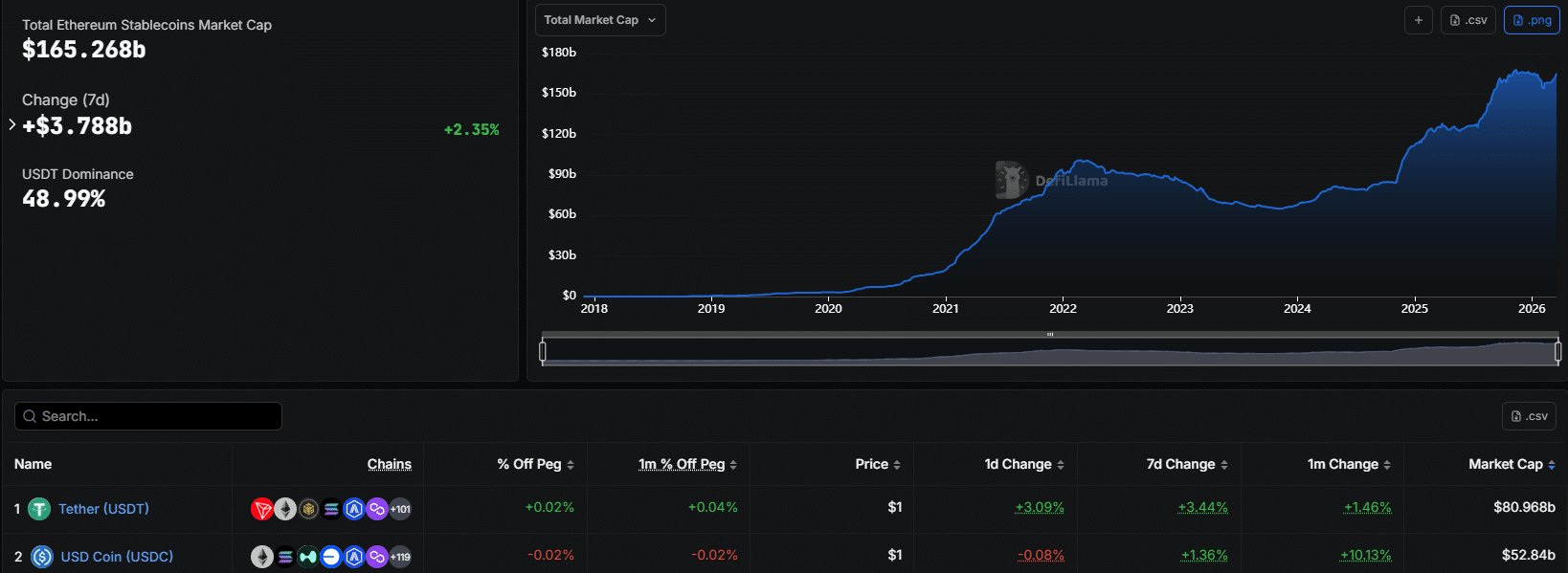
Source: DeFiLlama

As the chart above shows, Ethereum’s stablecoin flows are clearly rotating. Over the past month, USDT on-chain flow edged up just 1.46%, while USDC supply expanded by a much stronger 10.13%. That is almost a tenfold gap, suggesting liquidity is starting to favor USDC over USDT.

Backing this up, Santiment data shows the top 100 USDC wallets on Ethereum now hold $32.71 billion worth of USDC. Even more notable, the top six alone control just over 25.6% of the total supply, pointing to a high level of concentration among major holders.

Taken together, this signals a clear shift in liquidity positioning, as larger players steadily accumulate USDC and reshape how they deploy capital across the Ethereum network.

Naturally, this raises the question: Is this just a short-term rotation or a “strategic” shift that could set the stage for an ETH repricing?

USDC gains momentum as USDT shifts focus to Bitcoin

USDC flows on Ethereum have pushed its market share above 32%, while USDT has dropped below 50%.

However, this shift appears to be more than a short-term rotation. Over the past 30 days, Tether has deployed roughly $20 million into Bitcoin [BTC] Layer 1 infrastructure, reflecting a deliberate strategy to strengthen BTC’s role as a settlement layer.

Against this backdrop, the growing USDT flow on Ethereum does not look random.

Instead, this context is reinforced by the underlying data. USDC’s market cap has jumped roughly 30%, surpassing $80 billion to reach an all-time high since Circle’s IPO in late Q2 2025.

Moreover, Circle’s stock [CRCL] has surged 120% over the past 30 days, highlighting solid technical and market performance that backs the on-chain trends.
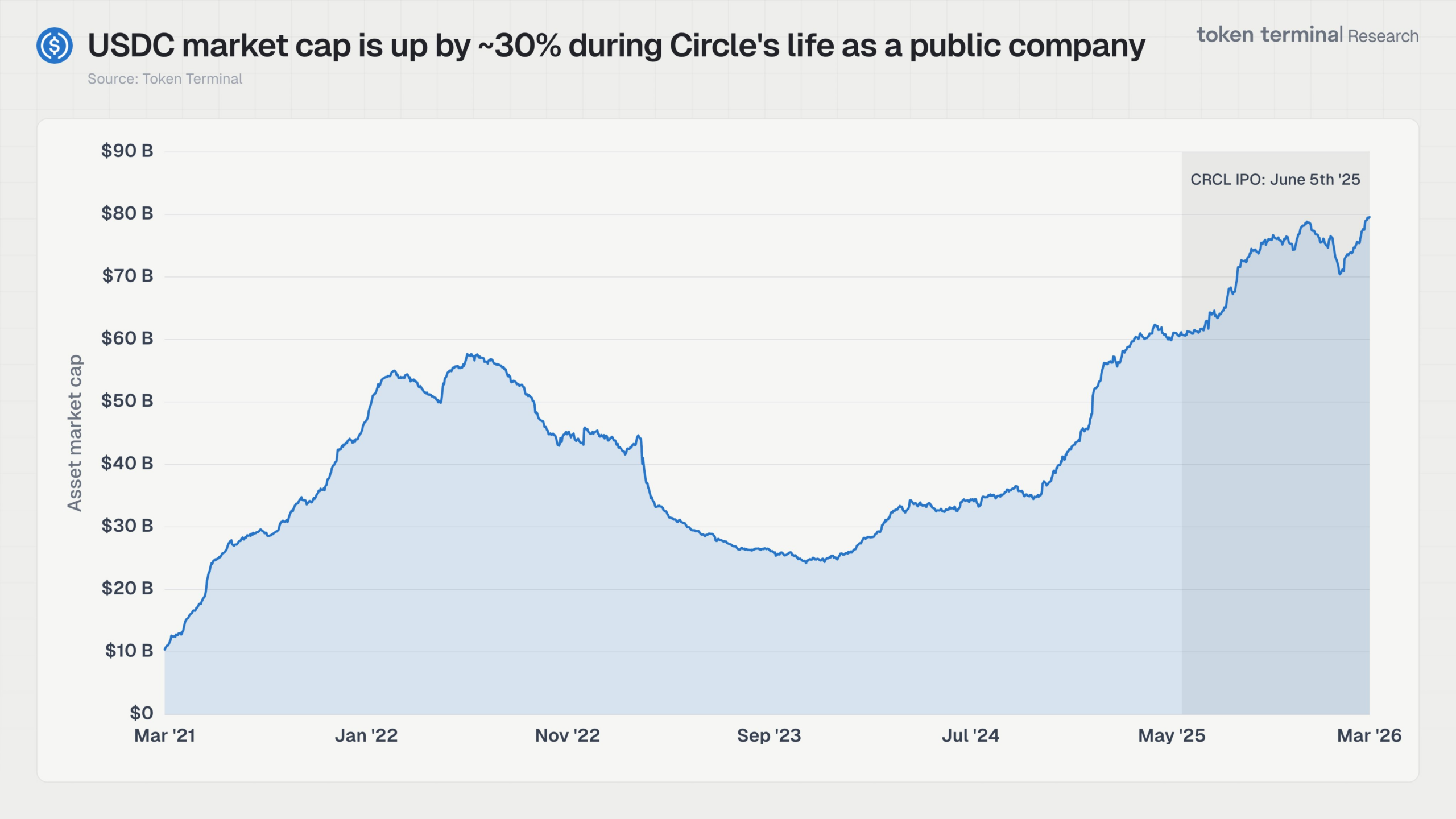
Source: Token Terminal

Taken together, Tether’s rotation toward Bitcoin, combined with Circle’s growing market share, shows that large players are strategically shifting how they deploy stablecoins on Ethereum.

The result is clear: USDC’s roughly 10% gain over the past month aligns closely with ETH’s 20% price increase.

Notably, on-chain data reinforces this trend. CryptoQuant shows that ETH’s Total Value Staked (TVS) has climbed nearly 3% to an all-time high of 38 million ETH, while the total value of Real-World Assets (RWA) has risen about 6% over the same period.

In essence, the effects of Ethereum’s 2025 upgrades are showing up in its stablecoin activity, with USDC flows now feeding directly into on-chain activity. In this context, Ethereum’s market repricing is becoming increasingly tied to USDC flows, making it a key trend to watch.


Final Summary

  • USDC supply has surged over 10% on Ethereum in the past month, supported by large holders and on-chain activity, signaling strategic rotation rather than a short-term move.
  • ETH’s 20% price gain aligns with rising USDC flows, increased staking, and RWA growth, showing that Ethereum’s 2025 upgrades are driving stablecoin activity and influencing market repricing.


Related Reads

South Korean Stocks Plunge, Global Funds Liquidate: Has the Semiconductor Fundamentals Really Changed?

South Korean stocks experienced their sharpest decline of the year, with the KOSPI index plunging nearly 9% on Monday, triggering a market circuit breaker. Leading semiconductor firms Samsung Electronics and SK Hynix were heavily sold off, raising questions about whether the AI-driven bull market has reached an inflection point. This sell-off was largely triggered by a significant drop in the U.S. semiconductor sector late last week. Concurrently, NVIDIA CEO Jensen Huang visited Seoul over the weekend, meeting with top executives from SK Group, Samsung, LG, and NAVER. He announced a new multi-year partnership with SK Hynix to co-develop next-generation memory products for AI data centers. Huang emphasized that AI infrastructure build-out remains in its early stages, creating a stark contrast between market panic and ongoing, strengthened industry collaboration. The article argues that South Korea has become one of the most sensitive markets for global AI-related capital flows, functioning like a large AI memory ETF due to the heavy weighting of its chipmakers. The current market turmoil reflects a shift in investor focus: from simply betting on overall AI growth to scrutinizing which companies will actually capture the profits from that growth. This "profit pool reassessment" phase is causing high volatility based on supply chain news and earnings guidance. Ultimately, the direction of the Korean market will be determined by external factors—NVIDIA's orders, HBM supply-demand dynamics, and capital expenditures from cloud service providers—rather than domestic conditions. The disconnect between sharp price corrections and continued strong signals from the industry core leaves the market at a crossroads, awaiting clearer data on the durability of AI infrastructure demand.

marsbit27m ago

South Korean Stocks Plunge, Global Funds Liquidate: Has the Semiconductor Fundamentals Really Changed?

marsbit27m ago

Trump in Talks with AI Companies Over Profit Sharing, A Narrative Pressure of Industrial Revolution Scale Begins

In recent AI market discussions, a new dimension beyond growth and profits has emerged: the question of how the immense wealth potentially generated by AI should be shared with the wider public. Triggered by reports of White House officials discussing "voluntary equity transfers" with top AI firms, similar to models like Alaska's Permanent Fund, the conversation focuses on public wealth funds. OpenAI's own whitepaper proposes such funds, allowing households without direct tech stock ownership to benefit from AI gains. More radical proposals, like Bernie Sanders' call for high public equity stakes and board seats, represent an extreme end of the spectrum. Currently, these are early-stage policy probes, not enacted laws. OpenAI's initiative is seen as an attempt to secure "social license" for its future expansion, mitigating risks of public backlash, stricter regulation, or anti-trust actions as AI's economic impact grows. The core market implication is the introduction of a "policy discount" to AI valuations, particularly for private model companies like OpenAI, Anthropic, and xAI. Investors must now consider not just future earnings but also what portion might be allocated to public mechanisms. The impact varies greatly based on the mechanism. A small, voluntary transfer of non-voting economic rights (e.g., 5%) acts as a quantifiable long-term cost. Government acquisition of economic rights via warrants tied to support differs from direct equity with governance power. The most disruptive scenario would be forced high-percentage public ownership affecting control and innovation incentives. Key signals to watch include whether other AI companies follow suit, if the White House formalizes proposals, related disclosures in future IPO documents, and any market price reactions. For now, this represents a shift from pricing pure AI growth to pricing its potential distribution. A manageable, voluntary economic share is akin to an insurance cost for societal acceptance, while a forced shift toward control and governance would fundamentally alter valuation logic.

marsbit31m ago

Trump in Talks with AI Companies Over Profit Sharing, A Narrative Pressure of Industrial Revolution Scale Begins

marsbit31m ago

From Record Highs to a Two-Week Low: Why Did AI Concept Stocks Suddenly Pull Back?

From Record Highs to Two-Week Lows: Why Did AI Stocks Suddenly Pull Back? U.S. stock indices, led by the tech-heavy Nasdaq 100, fell sharply to two-week lows. This marked a reversal from earlier in the week when AI infrastructure and semiconductor stocks had propelled major indices to record highs. Investors are rotating out of these previously high-flying tech sectors into other areas. The sell-off was driven by profit-taking and concerns that the AI rally had become overextended, exacerbated by chipmaker Broadcom's sales outlook falling short of lofty market expectations. The decline accelerated following a stronger-than-expected U.S. May nonfarm payrolls report, which showed 172,000 jobs added versus an estimated 88,000. This data sparked a jump in bond yields, with the 10-year Treasury yield rising to 4.553%, as it reinforced market speculation that the Federal Reserve's next move could be a rate hike rather than a cut. Globally, equities also declined, with European and Asian markets falling. Within the U.S. market, chip and AI-related stocks like Super Micro Computer and Arm Holdings led the losses, dropping over 7%. Cryptocurrency-linked stocks and mining shares also fell sharply amid drops in Bitcoin and commodity prices. While the overall Q1 earnings season remained solid, with 83% of S&P 500 companies beating estimates, the weakness was concentrated in tech. Excluding the tech sector, Q1 earnings growth was around 3%, the weakest in two years.

marsbit32m ago

From Record Highs to a Two-Week Low: Why Did AI Concept Stocks Suddenly Pull Back?

marsbit32m ago

JP Morgan Mid-Year Research Report Analysis: The AI Supercycle is Not Over, Reduce Cash Holdings + Allocate to Real Assets

JP Morgan's 2026 Mid-Year Outlook argues the AI supercycle is far from over, despite market pessimism. The report advises clients to reduce cash holdings, increase allocations to real assets as an inflation hedge, and focus on emerging markets. Key conclusions include: 1. **AI Supercycle Intact**: Hyperscalers' 2026 capex forecasts exceed $650B, with AI contributing to GDP growth. However, their financial profile is shifting toward heavy investment, compressing free cash flow. 2. **SaaS Disruption**: Traditional software companies are being negatively impacted by AI, with significant stock declines and pressure in credit markets. 3. **Persistent Inflation**: Core inflation is structurally higher post-pandemic. Holding excess cash and bonds leads to real wealth erosion. Recommendations include commodities, infrastructure, real estate, and gold. 4. **Geopolitical Shocks & Opportunities**: The Hormuz Strait blockade caused a major oil shock, but JP Morgan views the subsequent equity market pullback as a buying opportunity. "Fragmentation" is creating pockets of value, notably in resource-rich Latin America, AI-supply-chain-linked East Asia, and deeply discounted Chinese equities, where a policy shift could trigger a re-rating. 5. **Regional Views**: The firm is cautious on Europe due to high energy costs and lower innovation investment, preferring US and select EM exposures. In short, JP Morgan sees market volatility as an entry point but recommends a portfolio pivot: favor AI infrastructure, real assets, and EM, while avoiding excess cash, vulnerable software firms, and traditional 60/40 stock-bond allocations.

marsbit57m ago

JP Morgan Mid-Year Research Report Analysis: The AI Supercycle is Not Over, Reduce Cash Holdings + Allocate to Real Assets

marsbit57m ago

Trading

Spot
Futures

Hot Articles

Discussions

Welcome to the HTX Community. Here, you can stay informed about the latest platform developments and gain access to professional market insights. Users' opinions on the price of ETH (ETH) are presented below.

活动图片















