US Treasury Secretary Urges Congress To Pass Crypto Market Structure Bill This Spring

bitcoinistPublished on 2026-02-14Last updated on 2026-02-14

Abstract

US Treasury Secretary Scott Bessent has urged Congress to pass the stalled crypto market structure bill, the CLARITY Act, this spring to provide market reassurance amid recent volatility. He noted that some industry opposition has contributed to instability and emphasized the importance of bipartisan cooperation to advance the legislation. Bessent warned that the opportunity could diminish if Democrats gain control of the House in November. Patrick Witt of the Crypto Council also discussed the bill's progress, highlighting that the Senate Agriculture Committee portion has passed, but the Banking Committee's section remains pending. He called for compromise to address issues like stablecoin regulations without derailing the broader bill, which includes key measures on regulatory clarity and developer protections.

The US Secretary of the Treasury has called for the passage of the long-awaited crypto market structure bill this spring to provide reassurance to the industry amid recent market volatility.

Bessent Calls For Crypto Market Structure Bill

On Friday, Treasury Secretary Scott Bessent urged the US lawmakers to pass the stalled crypto market structure bill soon, highlighting the importance of getting the legislation on President Donald Trump’s desk before the end of the spring legislative window.

In a CNBC interview, Bessent affirmed that part of the recent market volatility was “self-induced” due to the reaction of some industry participants to the bill. He affirmed that some digital assets firms have been blocking it, which hasn’t been “good for the overall crypto community.”

Notably, the long-awaited CLARITY Act has been stalled for nearly a month after the Senate Banking Committee published its bill draft. The legislation was heavily criticized by crypto industry leaders, who slammed multiple of its policies, including key restrictions for stablecoin issuers.

The Treasury Secretary considers that passing the bill would “give great comfort” to the market at a time of significant volatility. Moreover, he pointed out that there’s a bipartisan working group trying to advance the legislation, with democrats “that want to work with republicans on getting a market structure bill.”

However, Bessent noted that the chances of getting a deal done could fall apart if Democrats take control of the House of Representatives in November, highlighting the Biden administration’s crackdown on the industry.

“There’s a lot of innovation that goes on adjacent to crypto, the blockchain, and DeFi. So, I think it’s important to get this clarity bill done as soon as possible and on the president’s desk this spring,” he concluded.

‘More Work To Be Done’

Similarly, Patrick Witt, executive director of the US President’s Council of Advisors for Digital Assets, discussed the progress on the crypto market structure bill on Friday.

Speaking with Yahoo Finance, Witt stated, “We are working hard to address the issues that were raised that led to the postponement of that markup and hopefully get that back on the book soon.”

He highlighted that lawmakers were able to pass the Senate Agriculture Committee’s half of the CLARITY Act, which handles the Commodity Futures Trading Commission (CFTC)’s portion of the bill.

The Crypto Council’s executive director outlined that once the Senate Banking Committee’s portion of the bill is passed, the two pieces of legislation will need to be reconciled before a final vote on the Senate floor. “So, more work to be done, but we are a step closer with the passage of the Ag portion of this a couple of weeks ago,” he said.

Discussing who must bend to advance the bill, Witt affirmed that both sides would have to compromise. “It’s unfortunate that this has become such a big issue, because ultimately, this is not the stablecoin bill that was the GENIUS Act,” he said.

“What we’ve encouraged both sides to do is find a middle ground. Let’s use a scalpel heel here to address this narrow issue of idle yield (...). But let’s not take a chainsaw out of this; let’s not let this derail the bill. There is so much goodness in this bill, no matter what your perspective is,” Witt continued.

He listed some of the “excellent measures” proposed in the bill, including the clear line between the SEC and the CFTC, regulatory jurisdiction, and developer protections, which he considers to be “critical to future-proof this industry from a future Gary Gensler or, God forbid, a Secretary of the Treasury Elizabeth Warren.”

Lastly, he shared that the White House might host another meeting between the banking and crypto industry to discuss the payment of stablecoin rewards.
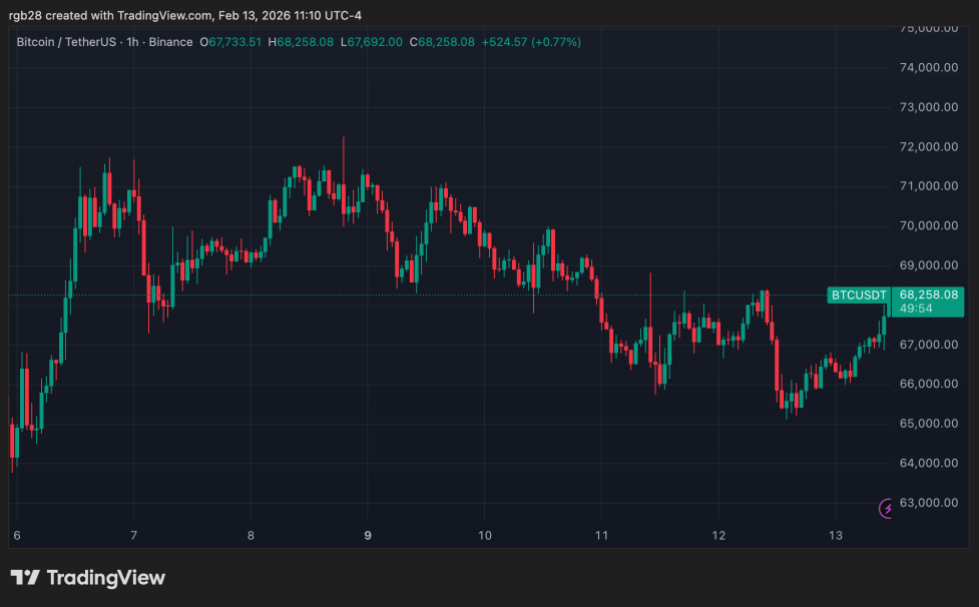
Bitcoin (BTC) trades at $68,258 in the one-week chart. Source: BTCUSDT on TradingView


Related Questions

QWho is urging Congress to pass the crypto market structure bill and when?

AUS Treasury Secretary Scott Bessent is urging Congress to pass the crypto market structure bill this spring.

QWhat is the name of the specific bill that has been stalled in the Senate?

AThe specific bill is called the CLARITY Act.

QAccording to the Treasury Secretary, why is it important to pass the bill quickly?

AHe believes passing the bill would 'give great comfort' to the market during a time of significant volatility and provide regulatory clarity for the industry.

QWhat potential political event could cause the chances of a deal to 'fall apart'?

AThe chances of a deal could fall apart if Democrats take control of the House of Representatives in November.

QWhich two committees' bills need to be reconciled before a final Senate vote?

AThe bills from the Senate Banking Committee and the Senate Agriculture Committee need to be reconciled.

Related Reads

CPU Makes a Comeback to the Table, A $170 Billion "Power Seizure" Drama Begins

A new era is dawning for the server CPU (Central Processing Unit), driven by the shift from AI model training to large-scale reasoning and the rise of Agentic AI. This article explores how the CPU is reclaiming a central role in the AI data center. For years, the focus has been on the GPU (Graphics Processing Unit) for AI training. However, as AI moves to the inference and Agent phase—where tasks involve complex, multi-step reasoning, tool calls, and data management—the workload balance is flipping. Studies show CPUs now handle over 70% of the workload in Agentic AI, up from 10-30% in training. This is because Agent tasks generate massive intermediate data (KV Cache) that exceeds GPU memory, forcing it to be offloaded to the CPU's larger, more scalable memory pools. This increased importance is translating into market changes. Major players are taking note: NVIDIA launched its first standalone CPU line, Vera, based on ARM architecture and optimized for Agent performance. AMD doubled its server CPU market forecast to over $1200 billion by 2030. Analyst reports project the total server CPU market could reach $1700 billion by 2030, with AI-driven demand being a primary driver. Furthermore, the classic ratio of CPUs to GPUs in AI servers is rapidly changing, converging from 1:8 toward 1:1 for Agent deployments. This surge in demand has led to a rare industry-wide price increase of 10-15% for server CPUs from Intel and AMD, breaking a decade-long trend of "more performance for the same price." Demand is bifurcating into high-core-count CPUs for in-rack GPU support and moderate-core CPUs for standalone Agent task orchestration. In China, this global trend presents an opportunity for domestic CPU manufacturers like Hygon (海光信息) and Huawei Kunpeng, who are bolstered by both growing AI infrastructure needs and national policies promoting technological self-reliance ("xin chuang"). The maturity of their software ecosystems is also accelerating, evidenced by faster adaptation to new AI models. In conclusion, the narrative is shifting from a GPU-centric view to one where CPU-GPU synergy is critical. The CPU is no longer a peripheral component but a performance-defining bottleneck and a key growth driver in the AI hardware stack, opening a massive new market estimated in the hundreds of billions of dollars.

marsbit10h ago

CPU Makes a Comeback to the Table, A $170 Billion "Power Seizure" Drama Begins

marsbit10h ago

TechFlow Intelligence: AMD AI Director Publicly Criticizes Claude Code for "Becoming Dumber and Lazier", Trump Claims Full Ceasefire in Hormuz But Strait Still Has 80 Unexploded Mines

TechFlow Intelligence Report: This daily digest covers key developments in AI, crypto, hardware, and geopolitics. In AI, SK Telecom faces US export control scrutiny over its partnership with Anthropic, while a Gemini user reports being misled in a scam scenario, sparking safety debates. China's Z.AI launches the GLM-5.2 model, rivaling Claude Opus without NVIDIA chips. In crypto, Bithumb lists ReProtocol, and Upbit delists KernelDAO. On the hardware front, MIT researchers build a custom OS to study chips, ASML denies US claims its advanced lithography machines are in China, and Amazon considers selling its in-house AI chips. Apple's future A21 Pro chip may use TSMC's latest N2P process. Major tech issues include 10,000 GitHub repositories distributing malware and Apple patching a critical eavesdropping flaw in Beats earbuds. US stocks rise, led by semiconductors, with Intel surging 10.6%, while SpaceX falls 3.5%. Geopolitically, despite a US-Iran deal, the Strait of Hormuz remains risky with ~80 uncleared mines, stalling 80M barrels of oil on standby tankers. Iran postpones Switzerland talks, and Trump calls the agreement an "unconditional surrender." The report highlights a contrast: temporary geopolitical calm versus the ongoing, fundamental restructuring of tech supply chains and chip independence.

marsbit10h ago

TechFlow Intelligence: AMD AI Director Publicly Criticizes Claude Code for "Becoming Dumber and Lazier", Trump Claims Full Ceasefire in Hormuz But Strait Still Has 80 Unexploded Mines

marsbit10h ago

Trading

Spot
Futures
活动图片