US Military Confirms Running Bitcoin Node, Four-Star General Calls It a 'Power Projection Tool'

marsbitPublished on 2026-04-23Last updated on 2026-04-23

Abstract

U.S. Indo-Pacific Command (INDOPACOM) Commander Admiral Samuel Paparo has confirmed that the military command is operating a Bitcoin network node and conducting cybersecurity tests using the protocol. In testimonies before the Senate and House Armed Services Committees, Paparo characterized Bitcoin not as a financial asset but as a "computer science tool" and a "tool of national power." He emphasized its value in cybersecurity, particularly the proof-of-work mechanism, which imposes physical costs on attackers and can be applied in both offensive and defensive cyber operations. This marks a significant shift in the Pentagon’s narrative, moving from targeting illicit finance to recognizing Bitcoin as a technology with national security implications. INDOPACOM is not mining Bitcoin but is using the node for monitoring and operational testing. The move signals the U.S. military’s direct participation in the Bitcoin network and reflects growing geopolitical interest in the protocol’s strategic potential.

Author: Thursday, Deep Tide TechFlow

Deep Tide Introduction: Admiral Paparo, Commander of the U.S. Indo-Pacific Command, testified before the Senate and House Armed Services Committees this week, confirming that the command is operating a Bitcoin network node and conducting "live-fire tests" in cybersecurity.

He characterized Bitcoin as a "computer science tool" and a "means of power projection," rather than a financial asset. This is the first public confirmation by a U.S. combatant command of direct participation in the Bitcoin peer-to-peer network, signaling a shift in the Pentagon's narrative on Bitcoin from "combating illicit finance" to a "defense-level technological asset."
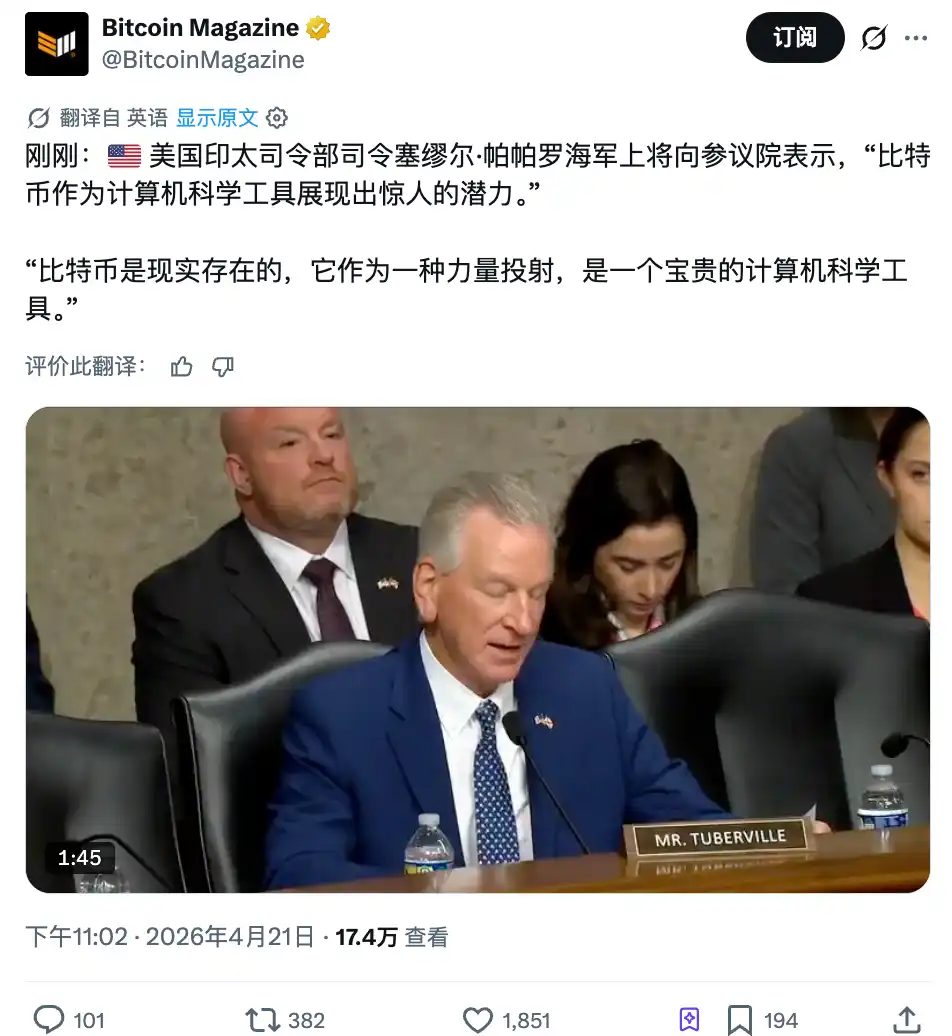
The U.S. military's characterization of Bitcoin is undergoing a fundamental shift.

According to a Bitcoin Magazine report on April 22, Admiral Samuel Paparo, Commander of the U.S. Indo-Pacific Command (INDOPACOM), testified consecutively before the Senate and House Armed Services Committees this week, confirming that the command is currently operating a full Bitcoin network node and conducting a series of military cybersecurity tests based on the Bitcoin protocol. Paparo is the highest-ranking commander of the largest of the U.S. six unified combatant commands, overseeing approximately 380,000 military personnel and responsible for the Indo-Pacific theater covering half the Earth's surface.

In his testimony, Paparo explicitly defined Bitcoin as a "computer science tool" and a "means of power projection," not a speculative financial asset. This is the first time a senior U.S. military general has characterized Bitcoin as such in a public congressional setting, and the first known confirmation of a U.S. combatant command directly participating in the Bitcoin peer-to-peer network.

Senate Testimony: Bitcoin is a "Tool of National Power"

On April 21, at the Senate Armed Services Committee hearing for the FY2027 Defense Authorization review, Paparo responded to a question from Senator Tommy Tuberville (R-AL) regarding Bitcoin's strategic value.

Tuberville directly asked: Does U.S. leadership in the Bitcoin space enhance deterrence against China? Paparo did not回避, telling the committee that INDOPACOM's research focuses on the underlying computer science architecture of Bitcoin, including the integration of its three core technological components: cryptography, blockchain, and proof-of-work.

Paparo stated: "Bitcoin is a reality. It is a peer-to-peer, zero-trust value transfer system. Anything that underpins the full suite of national power tools for the United States of America is beneficial." He added, "Beyond its economic attributes, Bitcoin has very important computer science applications in the cybersecurity domain."

Paparo further elaborated on the military potential of the proof-of-work protocol. He pointed out that Bitcoin's proof-of-work mechanism "imposes costs far beyond simple algorithmic network protection," and its applications can extend to both offensive and defensive cyber operations.

In other words, the Pentagon is interested not in Bitcoin's price movements, but in its architecture as a computer security system that "imposes physical costs on attacks."

House Hearing Confirmation: "We Have a Node on the Bitcoin Network"

On April 22, Paparo faced further questioning from Representative Lance Gooden (R-TX) in the House Armed Services Committee, disclosing more details.

According to the press release from Gooden's office and the hearing transcript published that day, Paparo clearly stated: "Currently we are in an experimental phase. We currently have a node on the Bitcoin network. We are not mining. We use it for monitoring and to conduct a series of operational tests, utilizing the Bitcoin protocol to protect cybersecurity."

During the hearing, Gooden also cited data from the Bitcoin Policy Institute, pointing out that China currently holds approximately 194,000 bitcoins, while the U.S. holds about 328,000. He pressed Paparo:

In the era of digital competition, should the United States maintain its lead in Bitcoin holdings just as it does with strategic resources like gold and oil?

In response, Paparo stated that people are currently using Bitcoin to protect their digital property, which is precisely the function enabled by the combination of the proof-of-work protocol, blockchain, and cryptography. He also expressed support for the positive role of the GENIUS Act (a stablecoin legislative framework) in maintaining the global dominance of the U.S. dollar but did not comment publicly on a "strategic Bitcoin reserve," indicating a preference for deeper discussion in a classified setting.

Pentagon Narrative Shift

A notable feature of Paparo's testimony is what he "did not say." He did not describe Bitcoin as a reserve asset, payment system, or speculative tool, but consistently positioned it as a computer science system with direct military relevance.

According to Bitcoin Magazine, previous public statements by the U.S. military on cryptocurrency were almost entirely focused on combating illicit finance and sanctions enforcement. Paparo's testimony marks a significant shift in this narrative framework, with Bitcoin's protocol-layer architecture being characterized for the first time by an active-duty combatant commander as a technology with national security value.

Sam Lyman, Director of Research at the Bitcoin Policy Institute, stated in a declaration that Paparo's testimony confirms Bitcoin is "already an undeniable asset of geopolitical importance."

As of early 2026, there are approximately 15,000 to 20,000 publicly reachable full nodes on the Bitcoin network, with the actual number likely higher as many nodes operate behind firewalls. The addition of INDOPACOM's node means the U.S. military is no longer just an observer of the Bitcoin network, but a direct participant.


Related Questions

QWhat did Admiral Samuel Paparo confirm about the U.S. Indo-Pacific Command's involvement with Bitcoin?

AAdmiral Samuel Paparo confirmed that the U.S. Indo-Pacific Command is running a Bitcoin network full node and conducting a series of military cybersecurity tests based on the Bitcoin protocol.

QHow did Admiral Paparo characterize Bitcoin during his congressional testimony?

AHe characterized Bitcoin as a 'computer science tool' and a 'means of power projection,' rather than a speculative financial asset.

QWhich U.S. legislative bodies did Admiral Paparo testify before regarding Bitcoin's strategic value?

AHe testified before both the Senate Armed Services Committee and the House Armed Services Committee.

QWhat specific Bitcoin mechanism did Paparo highlight for its military potential?

AHe highlighted the Proof-of-Work protocol for its ability to 'impose costs that go far beyond simple algorithmic network protection' and its applications in offensive and defensive cyber operations.

QWhat does the article suggest is the shift in the Pentagon's narrative on Bitcoin?

AThe narrative is shifting from focusing on 'combating illicit finance' to recognizing Bitcoin as a 'defense-level technological asset' with national security value due to its protocol-layer architecture.

Related Reads

TechFlow Intelligence Bureau: Chip Stocks Lose Trillions in a Single Day, Bitcoin Falls Below $60,000, US-Iran Conflict Escalates

**Daily Tech & Markets Roundup: AI Advances, Market Turmoil, and Geopolitical Tensions** **AI / LLMs**: Anthropic's internal report on AI self-improvement sparked serious discussions about Recursive Self-Improvement (RSI). Meanwhile, debate continues on AI coding tools after Claude was accused of introducing bugs into the rsync codebase. In positive news, DeepSeek V4 Flash impressed in local deployment tests, and GitHub Copilot now supports custom endpoints for local models. A surprising research turn suggests removing chain-of-thought prompting can sometimes improve LLM performance. **Crypto / Web3**: Bitcoin plunged below $60,000, with its RSI hitting levels last seen during the COVID-19 crash, driven by strong U.S. jobs data reviving interest rate hike fears. Discussions highlight Ethereum DeFi's continued lack of a smooth consumer payment layer. **Chips / Hardware**: Chip stocks suffered a massive sell-off, with the Philadelphia Semiconductor Index posting its worst single-day drop in six years, erasing over a trillion dollars in value. Marvell, Micron, AMD, and Intel were among the biggest losers. **Tech Companies**: A leaked Microsoft document revealing goals to make Copilot "addictive" drew criticism. LinkedIn founder Reid Hoffman left Microsoft's board to focus full-time on his AI agent startup, Manus. Google was revealed to be paying SpaceX $920 million monthly for AI training compute. **Markets & Macro**: A blowout U.S. jobs report (172k vs. 80k expected) crushed hopes for near-term rate cuts, sending Treasury yields soaring and triggering a broad market sell-off. CEOs from Kraft, McDonald's, and Whirlpool simultaneously warned U.S. consumers are exhausting their savings. **Geopolitics**: U.S.-Iran tensions escalated with missile/drone interceptions and U.S. strikes on Iranian radar sites, keeping the critical Strait of Hormuz largely closed since late February and posing ongoing oil supply risks. **The Bottom Line**: The strong jobs data acted as a single trigger for correlated sell-offs across equities, crypto, and chips. Underlying the volatility is a stark contradiction between robust employment data and warnings of consumer weakness, alongside geopolitical risks that could reignite inflation, leaving markets to price in a fraught macro outlook with no clear "soft landing" path.

marsbit2h ago

TechFlow Intelligence Bureau: Chip Stocks Lose Trillions in a Single Day, Bitcoin Falls Below $60,000, US-Iran Conflict Escalates

marsbit2h ago

It Took Me a Year to See the Bitter Truth About Agent Payments

After a year building infrastructure for the Agent economy, engaging with major players like Stripe, Visa, and Coinbase, the author shares a sobering analysis of the current state of Agent payments. The core finding is a stark lack of genuine, immediate demand across most envisioned use cases. The article breaks down four key market segments: 1. **Agent-to-Merchant (Consumer Shopping):** For most product categories (e.g., clothing, electronics), conversational AI shopping is a step backwards from visual e-commerce interfaces. While agents excel at understanding needs, they can't replace side-by-side product comparison. Real merchant interest is defensive "Agent Engine Optimization," not driven by current customer demand. Potential exists for high-frequency, low-decision purchases (like food delivery) or navigating complex store UIs, but these require massive B2C distribution channels dominated by giants like Amazon. 2. **Agent-to-API (Developer Services):** Developers already have subscriptions and billing relationships for APIs (compute, data). Prepaid balances solve micro-payment issues for low transaction volumes. A deeper structural problem is that major SaaS vendors' business models rely on enterprise contracts, resisting granular pay-per-call pricing. While protocols like MPP and x402 serve the long tail of niche services, this market is small and developers are historically low-willingness-to-pay. 3. **Agent-to-Agent:** This remains largely theoretical with minimal transaction volume. While it represents a long-term bet on a fundamentally new transaction infrastructure (sub-second, micro-penny to million-dollar, multi-party settlements), it does not constitute a present market. 4. **Agent-to-Finance:** This is the only category with existing, paying demand. Integrating AI into financial workflows (trading, portfolio management) is a natural evolution and enables new capabilities like autonomous rebalancing. However, competition favors established, regulated institutions. The "real problem" is not moving money between agents, but the broader challenge of **coordination**—orchestrating work between agents and humans, verifying outcomes, and settling results. Payment is just one component of settlement, which is itself part of coordination. Companies that solve the coordination layer will subsume payment, not the other way around. While well-funded incumbents build defensively for a long-term future, startups must find where the market is today—which, for the author's team, lies outside these four categories in an area of real, growing, and underserved activity.

marsbit2h ago

It Took Me a Year to See the Bitter Truth About Agent Payments

marsbit2h ago

It Took Me a Year to See the Hard Truth About Agent Payments

**Title: It Took Me a Year to See the Hard Truth About Agent Payments** Over the past year, I've worked on infrastructure for the Agent economy, engaging with major players like Stripe, Visa, Coinbase, and numerous startups. The findings reveal a stark reality: genuine, widespread demand for Agent-based payments does not yet exist. **Key Observations:** * **Agent-to-Merchant (Shopping):** The user experience for AI shopping often falls short, especially for visual product discovery. While AI excels at understanding needs, conversational interfaces can't yet replace browsing and comparing multiple products visually. Current merchant interest is largely defensive ("Agent Engine Optimization") for a future that hasn't arrived. High-frequency, low-friction purchases (like food delivery) are potential fits, but lack open APIs and face high AI inference costs. Simpler, more affordable, or cross-language interactions for complex UIs are a niche opportunity but require massive consumer distribution to scale. * **Agent-to-API (Developer Tools):** Developer payment needs for APIs (computing, data, models) are already met through subscriptions and prepaid credits. The core challenge is not payment friction but supplier economics: most large SaaS providers prefer enterprise contracts over micropayments for API calls. Protocols like MPP and x402 suit the long-tail of smaller services but cater to a developer market historically reluctant to pay for these tools. Major infrastructure needs at the top of the stack are already being addressed. * **Agent-to-Agent (Machine Commerce):** This is a long-term vision with almost no current transaction volume. While a future with high-speed, high-frequency, multi-party machine-to-machine transactions would require novel infrastructure, it remains theoretical. The market is not here yet. * **Agent-to-Finance:** This is the only category with clear, present demand. Financial professionals and DeFi users already pay for tools, and AI augmentation is a natural evolution. Autonomous AI agents can enable entirely new financial strategies. However, competition is fierce from established, regulated incumbents who can more easily layer AI onto their existing products. **The Core Insight:** Companies, especially giants with long time horizons, are building defensively for a potential future of mass machine commerce. For them, early investment is a low-cost hedge. For startups, the current market reality is different. The primary challenge isn't just moving money between agents (payments). The larger, unsolved problem is **orchestration** – coordinating work between agents and humans, verifying outcomes, and then settling. Payment is just a part of settlement, which is just a part of orchestration. Companies that solve the orchestration problem will subsume payments, not the other way around. After a year of building, we see the real, growing, and underserved market opportunity lies in this broader domain of orchestration.

链捕手3h ago

It Took Me a Year to See the Hard Truth About Agent Payments

链捕手3h ago

Trading

Spot
Futures

Hot Articles

What is $BITCOIN

DIGITAL GOLD ($BITCOIN): A Comprehensive Analysis Introduction to DIGITAL GOLD ($BITCOIN) DIGITAL GOLD ($BITCOIN) is a blockchain-based project operating on the Solana network, which aims to combine the characteristics of traditional precious metals with the innovation of decentralized technologies. While it shares a name with Bitcoin, often referred to as “digital gold” due to its perception as a store of value, DIGITAL GOLD is a separate token designed to create a unique ecosystem within the Web3 landscape. Its goal is to position itself as a viable alternative digital asset, although specifics regarding its applications and functionalities are still developing. What is DIGITAL GOLD ($BITCOIN)? DIGITAL GOLD ($BITCOIN) is a cryptocurrency token explicitly designed for use on the Solana blockchain. In contrast to Bitcoin, which provides a widely recognized value storage role, this token appears to focus on broader applications and characteristics. Notable aspects include: Blockchain Infrastructure: The token is built on the Solana blockchain, known for its capacity to handle high-speed and low-cost transactions. Supply Dynamics: DIGITAL GOLD has a maximum supply capped at 100 quadrillion tokens (100P $BITCOIN), although details regarding its circulating supply are currently undisclosed. Utility: While precise functionalities are not explicitly outlined, there are indications that the token could be utilized for various applications, potentially involving decentralized applications (dApps) or asset tokenization strategies. Who is the Creator of DIGITAL GOLD ($BITCOIN)? At present, the identity of the creators and development team behind DIGITAL GOLD ($BITCOIN) remains unknown. This situation is typical among many innovative projects within the blockchain space, particularly those aligning with decentralized finance and meme coin phenomena. While such anonymity may foster a community-driven culture, it intensifies concerns about governance and accountability. Who are the Investors of DIGITAL GOLD ($BITCOIN)? The available information indicates that DIGITAL GOLD ($BITCOIN) does not have any known institutional backers or prominent venture capital investments. The project seems to operate on a peer-to-peer model focused on community support and adoption rather than traditional funding routes. Its activity and liquidity are primarily situated on decentralized exchanges (DEXs), such as PumpSwap, rather than established centralized trading platforms, further highlighting its grassroots approach. How DIGITAL GOLD ($BITCOIN) Works The operational mechanics of DIGITAL GOLD ($BITCOIN) can be elaborated on based on its blockchain design and network attributes: Consensus Mechanism: By leveraging Solana’s unique proof-of-history (PoH) combined with a proof-of-stake (PoS) model, the project ensures efficient transaction validation contributing to the network's high performance. Tokenomics: While specific deflationary mechanisms have not been extensively detailed, the vast maximum token supply implies that it may cater to microtransactions or niche use cases that are still to be defined. Interoperability: There exists the potential for integration with Solana’s broader ecosystem, including various decentralized finance (DeFi) platforms. However, the details regarding specific integrations remain unspecified. Timeline of Key Events Here is a timeline that highlights significant milestones concerning DIGITAL GOLD ($BITCOIN): 2023: The initial deployment of the token occurs on the Solana blockchain, marked by its contract address. 2024: DIGITAL GOLD gains visibility as it becomes available for trading on decentralized exchanges like PumpSwap, allowing users to trade it against SOL. 2025: The project witnesses sporadic trading activity and potential interest in community-led engagements, although no noteworthy partnerships or technical advancements have been documented as of yet. Critical Analysis Strengths Scalability: The underlying Solana infrastructure supports high transaction volumes, which could enhance the utility of $BITCOIN in various transaction scenarios. Accessibility: The potential low trading price per token could attract retail investors, facilitating wider participation due to fractional ownership opportunities. Risks Lack of Transparency: The absence of publicly known backers, developers, or an audit process may yield skepticism regarding the project's sustainability and trustworthiness. Market Volatility: The trading activity is heavily reliant on speculative behavior, which can result in significant price volatility and uncertainty for investors. Conclusion DIGITAL GOLD ($BITCOIN) emerges as an intriguing yet ambiguous project within the rapidly evolving Solana ecosystem. While it attempts to leverage the “digital gold” narrative, its departure from Bitcoin's established role as a store of value underscores the need for a clearer differentiation of its intended utility and governance structure. Future acceptance and adoption will likely depend on addressing the current opacity and defining its operational and economic strategies more explicitly. Note: This report encompasses synthesised information available as of October 2023, and developments may have transpired beyond the research period.

363 Total ViewsPublished 2025.05.13Updated 2025.05.13

What is $BITCOIN

Discussions

Welcome to the HTX Community. Here, you can stay informed about the latest platform developments and gain access to professional market insights. Users' opinions on the price of BTC (BTC) are presented below.

活动图片














