US lawmakers propose tax break for small stablecoin payments, staking rewards

cointelegraphPublished on 2025-12-21Last updated on 2025-12-21

Abstract

US lawmakers have introduced a discussion draft proposing tax exemptions for small stablecoin payments and deferral options for staking and mining rewards. The bill, introduced by Representatives Max Miller and Steven Horsford, aims to amend the Internal Revenue Code to accommodate the growing use of digital assets in everyday transactions. It would exempt gains or losses on stablecoin transactions under $200, provided the stablecoin is dollar-pegged and issued under the GENIUS Act. Additionally, taxpayers could defer income recognition from staking and mining rewards for up to five years, addressing concerns around "phantom income." The draft also includes anti-abuse measures and extends certain securities rules to digital assets. Meanwhile, crypto industry groups are urging the Senate to reconsider proposed restrictions on stablecoin rewards.

US lawmakers have introduced a discussion draft that would ease the tax burden on everyday crypto users by exempting small stablecoin transactions from capital gains taxes and offering a new deferral option for staking and mining rewards.

The proposal, introduced by Representatives Max Miller of Ohio and Steven Horsford of Nevada, seeks to amend the Internal Revenue Code to reflect the growing use of digital assets in payments. The draft is set “to eliminate low-value gain recognition arising from routine consumer payment use of regulated payment stablecoins,” per the draft.

Under the draft, users would not be required to recognize gains or losses on stablecoin transactions of up to $200, provided the asset is issued by a permitted issuer under the GENIUS Act, pegged to the US dollar and maintains a tight trading range around $1.

The bill includes safeguards to prevent abuse. The exemption would not apply if a stablecoin trades outside a narrow price band, and brokers or dealers would be excluded from the benefit. Treasury would also retain authority to issue anti-abuse rules and reporting requirements.
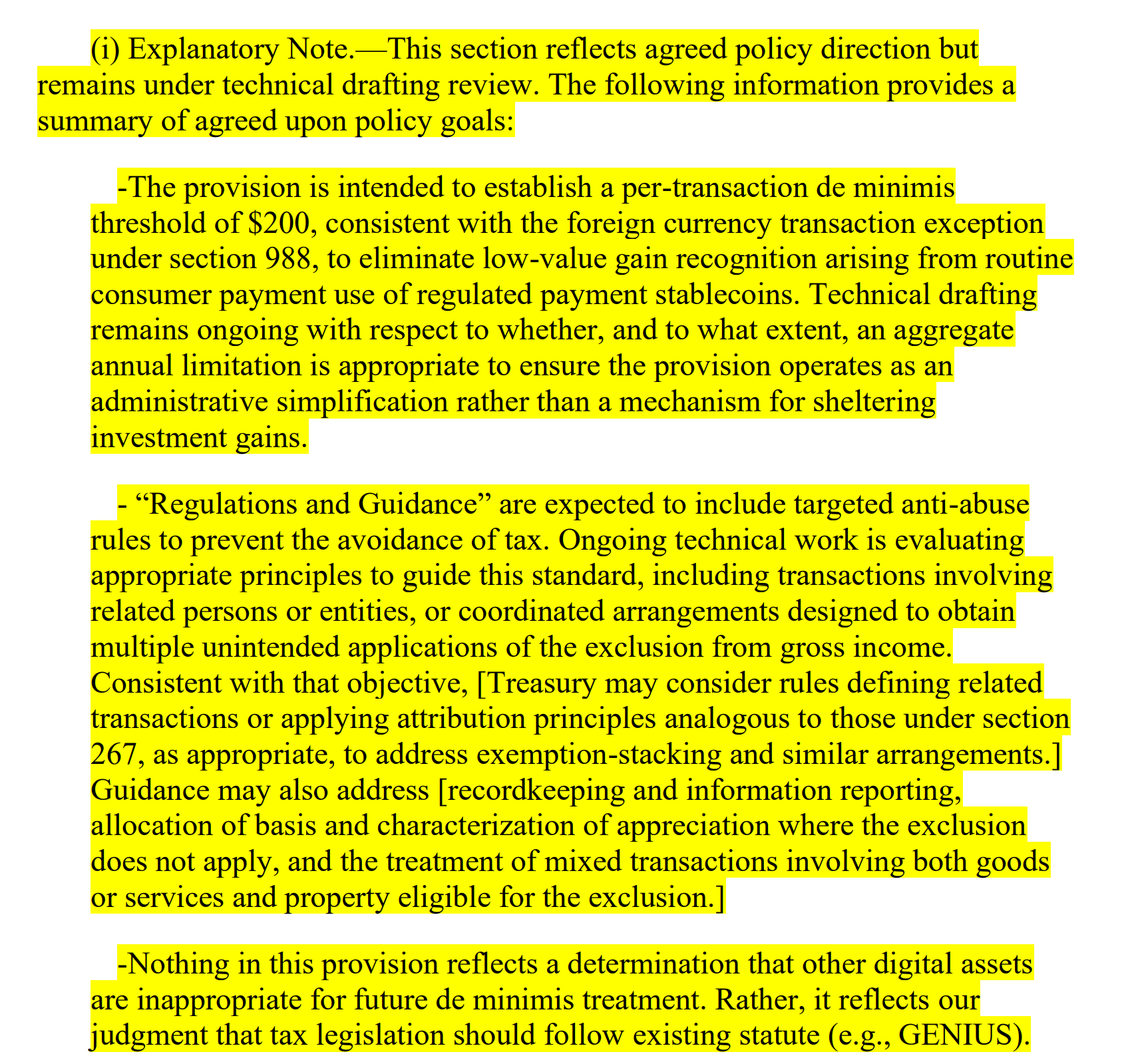
Draft bill explains the reasoning behind tax breaks. Source: House

Related: Crypto Biz: Bank stablecoins get a rulebook; Bitcoin gets a land grab

US bill defers taxes on crypto staking rewards

Beyond payments, the proposal addresses long-standing concerns around “phantom income” from staking and mining. Taxpayers would be allowed to elect to defer income recognition on staking or mining rewards for up to five years, rather than being taxed immediately upon receipt.

“This provision is intended to reflect a necessary compromise between immediate taxation upon dominion & control and full deferral until disposition,” the draft said.

The draft also extends existing securities lending tax treatment to certain digital asset lending arrangements, applies wash sale rules to actively traded crypto assets, and allows traders and dealers to elect mark-to-market accounting for digital assets.

Related: Galaxy predicts stablecoins will overtake ACH transaction volume in 2026

Crypto groups urge Senate to rethink stablecoin rewards ban

Last week, the Blockchain Association sent a letter to the US Senate Banking Committee, signed by more than 125 crypto companies and industry groups, opposing efforts to extend restrictions on stablecoin rewards to third-party platforms.

The group argued that expanding the GENIUS Act’s limits beyond stablecoin issuers would curb innovation and increase market concentration in favor of large incumbents. The letter compared crypto rewards to incentives commonly offered by banks and credit card companies, warning that banning similar features for stablecoins would undermine fair competition.

Magazine: 2026 is the year of pragmatic privacy in crypto — Canton, Zcash and more

Related Questions

QWhat is the main purpose of the tax proposal introduced by US lawmakers regarding stablecoins?

AThe proposal aims to ease the tax burden on everyday crypto users by exempting small stablecoin transactions (up to $200) from capital gains taxes and offering a deferral option for staking and mining rewards.

QWhich US representatives introduced the discussion draft to amend the Internal Revenue Code for digital assets?

ARepresentatives Max Miller of Ohio and Steven Horsford of Nevada introduced the discussion draft.

QWhat are the conditions under which a stablecoin transaction would be exempt from capital gains taxes under the draft bill?

AThe exemption applies to stablecoin transactions of up to $200, provided the asset is issued by a permitted issuer under the GENIUS Act, pegged to the US dollar, and maintains a tight trading range around $1.

QHow does the proposal address the issue of 'phantom income' from staking and mining rewards?

ATaxpayers would be allowed to elect to defer income recognition on staking or mining rewards for up to five years, instead of being taxed immediately upon receipt.

QWhy did the Blockchain Association and over 125 crypto companies oppose extending restrictions on stablecoin rewards to third-party platforms?

AThey argued that expanding the GENIUS Act’s limits beyond stablecoin issuers would curb innovation, increase market concentration in favor of large incumbents, and undermine fair competition by banning features similar to incentives offered by banks and credit card companies.

Related Reads

Goldman Sachs Bows Down, Bitcoin Finally Breaks Through the Gates of Wall Street

Wall Street giants, including Goldman Sachs, Morgan Stanley, Charles Schwab, and the New York Stock Exchange, have reversed their long-standing opposition to Bitcoin and are now actively embracing it. After years of dismissing Bitcoin as a scam, a bubble, or a tool for illicit activities, these institutions are launching Bitcoin ETFs, enabling spot trading, and building dedicated crypto infrastructure. Goldman Sachs, which once called Bitcoin a "fraud tool," is now offering Bitcoin ETFs. Morgan Stanley, which internally banned the term "cryptocurrency," has launched its largest-ever ETF backed by Bitcoin. Charles Schwab has opened spot crypto trading for its retail clients, integrating Bitcoin alongside traditional assets. The NYSE is building robust infrastructure to support digital assets, signaling a long-term commitment. This dramatic shift is driven not by a change in ideology but by economic necessity. As Bitcoin repeatedly survived market crashes and grew into a multi-trillion-dollar asset class, ignoring it became too costly. Wall Street’s business model relies on capturing fees, and Bitcoin’s rise represented a massive wealth transfer occurring outside their ecosystem. The fear of missing out (FOMO) and client demand forced these institutions to capitulate. The article frames this as a historic surrender to Bitcoin’s mathematical inevitability. Unlike the trust-based traditional financial system, Bitcoin operates on decentralized, transparent, and unchangeable rules. Its scarcity and resilience make it a hedge against fiat currency devaluation and systemic risk. The narrative has flipped: not holding Bitcoin is now seen as the greater risk. The author concludes that Bitcoin has not been co-opted by Wall Street; instead, it has co-opted Wall Street, marking a fundamental shift in the global financial architecture.

marsbit55m ago

Goldman Sachs Bows Down, Bitcoin Finally Breaks Through the Gates of Wall Street

marsbit55m ago

Trading

Spot
Futures

Hot Articles

How to Buy US

Welcome to HTX.com! We've made purchasing Talus Network (US) simple and convenient. Follow our step-by-step guide to embark on your crypto journey.Step 1: Create Your HTX AccountUse your email or phone number to sign up for a free account on HTX. Experience a hassle-free registration journey and unlock all features.Get My AccountStep 2: Go to Buy Crypto and Choose Your Payment MethodCredit/Debit Card: Use your Visa or Mastercard to buy Talus Network (US) instantly.Balance: Use funds from your HTX account balance to trade seamlessly.Third Parties: We've added popular payment methods such as Google Pay and Apple Pay to enhance convenience.P2P: Trade directly with other users on HTX.Over-the-Counter (OTC): We offer tailor-made services and competitive exchange rates for traders.Step 3: Store Your Talus Network (US)After purchasing your Talus Network (US), store it in your HTX account. Alternatively, you can send it elsewhere via blockchain transfer or use it to trade other cryptocurrencies.Step 4: Trade Talus Network (US)Easily trade Talus Network (US) on HTX's spot market. Simply access your account, select your trading pair, execute your trades, and monitor in real-time. We offer a user-friendly experience for both beginners and seasoned traders.

4.4k Total ViewsPublished 2025.12.11Updated 2025.12.11

How to Buy US

Discussions

Welcome to the HTX Community. Here, you can stay informed about the latest platform developments and gain access to professional market insights. Users' opinions on the price of US (US) are presented below.

活动图片