US financial markets ‘poised to move on-chain,’ amid DTCC tokenization greenlight

cointelegraphPublished on 2025-12-12Last updated on 2025-12-12

Abstract

U.S. financial markets are advancing toward on-chain tokenization following the SEC's approval of a DTCC pilot program for tokenizing assets like the Russell 1000 index, ETFs, and U.S. Treasuries. SEC Chair Paul Atkins emphasized that this shift will enhance market predictability, transparency, and efficiency. The SEC issued a no-action letter allowing the DTCC to proceed without enforcement risk and is considering an "innovation exemption" to ease regulatory burdens for builders. This move accelerates the adoption of blockchain for settlements, enabling 24/7 trading and reducing intermediaries. Analysts note rapid progress in financial tokenization, with continued funding and regulatory support fueling infrastructure development.

Traditional financial markets are moving rapidly onchain as the US Securities and Exchange Commission chair doubles down on the idea of an “innovation exemption” to accelerate tokenization.

“U.S. financial markets are poised to move on-chain,” wrote Paul Atkins, the chair of the SEC, in a Friday X post, adding that the agency is “embracing new technologies to enable this onchain future.”

His comments come shortly after the SEC issued a “no action” letter to a subsidiary of the Depository Trust and Clearing Corporation (DTCC), enabling it to offer a new securities market tokenization service.

The DTCC plans to tokenize assets including the Russell 1000 index, exchange-traded funds tracking major indexes, and US Treasury bills and bonds, which Atkins called an “important step towards onchain capital markets.”

“On-chain markets will bring greater predictability, transparency, and efficiency for investors,” he said.

However, the green light for the DTCC’s pilot is only the beginning, as the SEC will consider an innovation exemption to enable builders to start “transitioning our markets onchain,” without being burdened by “cumbersome regulatory requirements,” added Atkins.
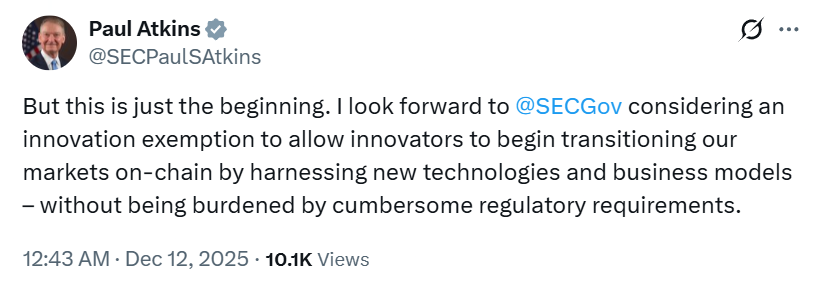
Source: Paul Atkins

Atkins pledged to encourage innovation as the industry moves toward onchain settlement, which would settle transactions on a blockchain ledger, removing intermediaries, enabling 24/7 trading and faster transaction finality.

Related: Crypto nears its ‘Netscape moment’ as industry approaches inflection point

Cointelegraph has contacted the SEC for comment on the details and timeline of an innovation exemption for tokenization.

Atkins first proposed an innovation exemption for tokenization during his remarks at the Crypto Task Force Roundtable on DeFi on June 9.

The SEC’s no-action letter means that the agency won’t take enforcement action if the DTCC’s product operates as described. The DTCC provides clearing, settlements and trading services as one of the most important infrastructure providers for US securities.

Asset tokenization involves minting tangible assets on the blockchain ledger, offering more investor access through fractionalized shares and 24/7 trading opportunities.

Related: Bitcoin treasuries stall in Q4, but largest holders keep stacking sats

DTCC pilot and RWA builders push more TradFi onchain

Crypto analysts have praised the SEC’s move to allow the DTCC’s new market tokenization service, which will award tokenized assets the same entitlements and investor protection mechanisms as traditional assets.

“Not sure people fully appreciate how quickly financial markets are heading towards full tokenization... Moving even faster than I expected,” wrote ETF analyst Nate Geraci, in a Friday X post.

Over the past few months, the SEC issued two no-action letters: one for a Solana-based decentralized physical infrastructure network (DePIN) project, and a second no-action letter in September that allowed investment advisers to use state trust companies as crypto custodians.

Meanwhile, crypto projects continue to raise funds to build the infrastructure necessary for tokenized onchain markets.

On Tuesday, asset tokenization network Real Finance closed a $29 million private funding round to build an infrastructure layer for real-world assets (RWAs) that can boost institutional participation.

Magazine: SEC’s U-turn on crypto leaves key questions unanswered

Related Reads

Gensyn AI: Don't Let AI Repeat the Mistakes of the Internet

In recent months, the rapid growth of the AI industry has attracted significant talent from the crypto sector. A persistent question among researchers intersecting both fields is whether blockchain can become a foundational part of AI infrastructure. While many previous AI and Crypto projects focused on application layers (like AI Agents, on-chain reasoning, data markets, and compute rentals), few achieved viable commercial models. Gensyn differentiates itself by targeting the most critical and expensive layer of AI: model training. Gensyn aims to organize globally distributed GPU resources into an open AI training network. Developers can submit training tasks, nodes provide computational power, and the network verifies results while distributing incentives. The core issue addressed is not decentralization for its own sake, but the increasing centralization of compute power among tech giants. In the era of large models, access to GPUs (like the H100) has become a decisive bottleneck, dictating the pace of AI development. Major AI companies are heavily dependent on large cloud providers for compute resources. Gensyn's approach is significant for several reasons: 1) It operates at the core infrastructure layer (model training), the most resource-intensive and technically demanding part of the AI value chain. 2) It proposes a more open, collaborative model for compute, potentially increasing resource utilization by dynamically pooling idle GPUs, similar to early cloud computing logic. 3) Its technical moat lies in solving complex challenges like verifying training results, ensuring node honesty, and maintaining reliability in a distributed environment—making it more of a deep-tech infrastructure company. 4) It targets a validated, high-growth market with genuine demand, rather than pursuing blockchain integration without purpose. Ultimately, the boundaries between Crypto and AI are blurring. AI requires global resource coordination, incentive mechanisms, and collaborative systems—areas where crypto-native solutions excel. Gensyn represents a step toward making advanced training capabilities more accessible and collaborative, moving beyond a niche controlled by a few giants. If successful, it could evolve into a fundamental piece of AI infrastructure, where the most enduring value in the AI era is often created.

marsbit10h ago

Gensyn AI: Don't Let AI Repeat the Mistakes of the Internet

marsbit10h ago

Why is China's AI Developing So Fast? The Answer Lies Inside the Labs

A US researcher's visit to China's top AI labs reveals distinct cultural and organizational factors driving China's rapid AI development. While talent, data, and compute are similar to the West, Chinese labs excel through a pragmatic, execution-focused culture: less emphasis on individual stardom and conceptual debate, and more on teamwork, engineering optimization, and mastering the full tech stack. A key advantage is the integration of young students and researchers who approach model-building with fresh perspectives and low ego, prioritizing collective progress over personal credit. This contrasts with the US culture of self-promotion and "star scientist" narratives. Chinese labs also exhibit a strong "build, don't buy" mentality, preferring to develop core capabilities—like data pipelines and environments—in-house rather than relying on external services. The ecosystem feels more collaborative than tribal, with mutual respect among labs. While government support exists, its scale is unclear, and technical decisions appear driven by labs, not state mandates. Chinese companies across sectors, from platforms to consumer tech, are building their own foundational models to control their tech destiny, reflecting a broader cultural drive for technological sovereignty. Demand for AI is emerging, with spending patterns potentially mirroring cloud infrastructure more than traditional SaaS. Despite challenges like a less mature data industry and GPU shortages, Chinese labs are propelled by vast talent, rapid iteration, and deep integration with the open-source community. The competition is evolving beyond a pure model race into a contest of organizational execution, developer ecosystems, and industrial pragmatism.

marsbit12h ago

Why is China's AI Developing So Fast? The Answer Lies Inside the Labs

marsbit12h ago

3 Years, 5 Times: The Rebirth of a Century-Old Glass Factory

Corning, a 175-year-old glass company, is experiencing a dramatic revival as a key player in AI infrastructure, driven by surging demand for high-performance optical fiber in data centers. AI data centers require vastly more fiber than traditional ones—5 to 10 times as much per rack—to handle high-speed data transmission between GPUs. This structural demand shift, coupled with supply constraints from the lengthy expansion cycle for fiber preforms, has created a significant supply-demand gap. Nvidia has invested in Corning, along with Lumentum and Coherent, in a $4.5 billion total commitment to secure the optical supply chain for AI. Corning's competitive edge lies in its expertise in producing ultra-low-loss, high-density, and bend-resistant specialty fiber, which is critical for 800G+ and future 1.6T data rates. Its deep involvement in co-packaged optics (CPO) with partners like Nvidia further solidifies its position. While not the largest fiber manufacturer globally, Corning's revenue from enterprise/data center clients now exceeds 40% of its optical communications sales, and it has secured multi-year supply agreements with major hyperscalers including Meta and Nvidia. Financially, Corning's optical communications revenue has surged, doubling from $1.3 billion in 2023 to over $3 billion in 2025. Its stock price has risen nearly 6-fold since late 2023. Key future catalysts include the rollout of Nvidia's CPO products and the scale of undisclosed customer agreements. However, risks include high current valuations and potential disruption from next-generation technologies like hollow-core fiber. The company's long-term bet on light over electricity, maintained even through the telecom bubble crash, is now being validated by the AI boom.

marsbit12h ago

3 Years, 5 Times: The Rebirth of a Century-Old Glass Factory

marsbit12h ago

Trading

Spot
Futures

Hot Articles

How to Buy US

Welcome to HTX.com! We've made purchasing Talus Network (US) simple and convenient. Follow our step-by-step guide to embark on your crypto journey.Step 1: Create Your HTX AccountUse your email or phone number to sign up for a free account on HTX. Experience a hassle-free registration journey and unlock all features.Get My AccountStep 2: Go to Buy Crypto and Choose Your Payment MethodCredit/Debit Card: Use your Visa or Mastercard to buy Talus Network (US) instantly.Balance: Use funds from your HTX account balance to trade seamlessly.Third Parties: We've added popular payment methods such as Google Pay and Apple Pay to enhance convenience.P2P: Trade directly with other users on HTX.Over-the-Counter (OTC): We offer tailor-made services and competitive exchange rates for traders.Step 3: Store Your Talus Network (US)After purchasing your Talus Network (US), store it in your HTX account. Alternatively, you can send it elsewhere via blockchain transfer or use it to trade other cryptocurrencies.Step 4: Trade Talus Network (US)Easily trade Talus Network (US) on HTX's spot market. Simply access your account, select your trading pair, execute your trades, and monitor in real-time. We offer a user-friendly experience for both beginners and seasoned traders.

4.5k Total ViewsPublished 2025.12.11Updated 2025.12.11

How to Buy US

Discussions

Welcome to the HTX Community. Here, you can stay informed about the latest platform developments and gain access to professional market insights. Users' opinions on the price of US (US) are presented below.

活动图片