US Crypto Policy Debate Intensifies as CLARITY Act Support Fractures

bitcoinistPublished on 2026-01-16Last updated on 2026-01-16

Abstract

Washington's efforts to regulate the crypto market face new uncertainty as the CLARITY Act, a key legislative proposal, encounters significant setbacks. Coinbase withdrew its support, citing concerns over restrictions on tokenized equities, crypto rewards, and expanded government data access. This prompted a pause in the Senate Banking Committee's progress on the bill, though the White House reaffirmed its backing. The debate centers on whether the SEC or CFTC should have primary oversight, with exchanges favoring the CFTC's commodity-based approach. Industry leaders are divided, with some supporting the bill as a necessary step forward despite its flaws, while others warn it could stifle innovation. Stablecoin regulation and consumer protection remain contentious issues.

Washington’s long-running effort to bring regulatory clarity to the U.S. crypto market has entered a more uncertain phase. The Digital Asset Market Clarity Act, known as the CLARITY Act, was expected to move closer to a Senate vote this week.

Instead, a sudden withdrawal of support from Coinbase and a last-minute pause by Senate leadership have exposed deep divisions within the industry and among lawmakers. While the White House insists the bill is still on track, the debate over how digital assets should be regulated is becoming more fragmented.
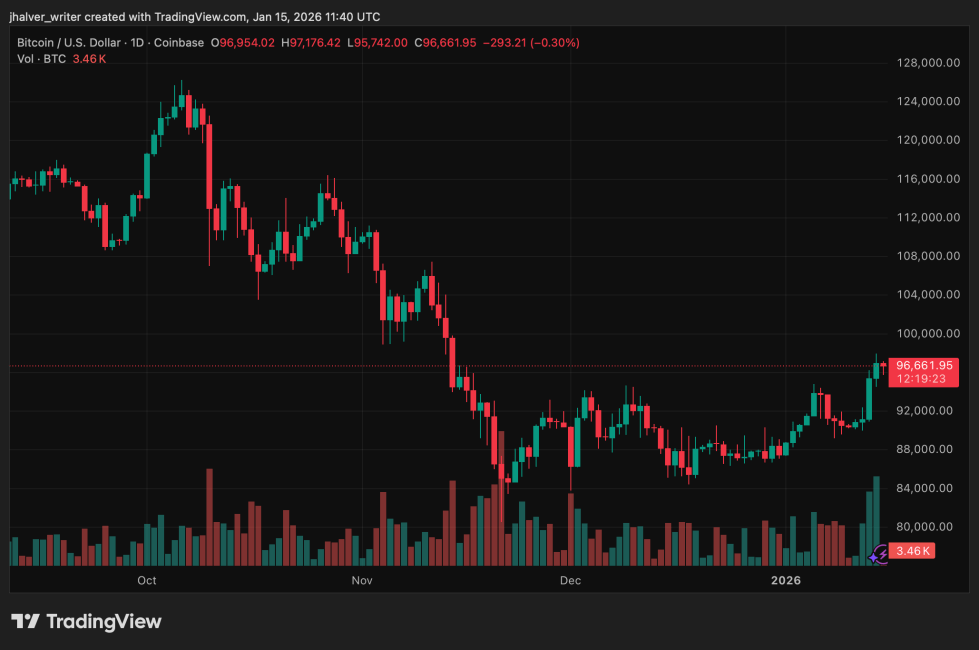
BTC's price records some gains on the daily chart. Source: BTCUSD on Tradingview

Coinbase Withdrawal Triggers Legislative Pause

The immediate turning point came when Coinbase CEO Brian Armstrong announced that the company could no longer support the current draft of the CLARITY Act.

Armstrong argued that the bill would be worse than the existing regulatory uncertainty, citing concerns over limits on tokenized equities, restrictions on crypto rewards, and expanded government access to financial data.

Shortly after, Senate Banking Committee Chair Tim Scott introduced a brief pause in the bill’s progress, cancelling a scheduled markup.

Scott described the delay as procedural rather than political, stating that negotiations were ongoing and bipartisan talks continued. A new markup date has been set for January 27, once updated bill language is released.

Despite the setback, White House AI and crypto czar David Sacks reiterated that the administration still backs the legislation. He said the pause should be used to resolve remaining issues and push forward a framework that allows innovation while strengthening oversight.

Industry Split Over SEC and CFTC Roles

At the core of the dispute is the division of regulatory authority between the Securities and Exchange Commission (SEC) and the Commodity Futures Trading Commission (CFTC) as outlined in the CLARITY Act.

Crypto exchanges generally favor the CFTC’s approach, which treats many digital assets as commodities. The SEC, by contrast, applies securities laws that impose stricter compliance requirements.

Critics argue the bill shifts too much power to the SEC, particularly over tokenized equities and certain crypto products. Coinbase has warned that the proposed rules could effectively block the development of on-chain stock trading and limit user reward programs.

Other industry leaders, including executives from Ripple, a16z, and Kraken, have taken a more cautious stance. While acknowledging flaws in the draft, they argue that passing some form of market structure legislation is better than leaving the sector in regulatory limbo.

Banks, Stablecoins, and the Broader Stakes

Another contentious issue is stablecoin regulation. The CLARITY Act would make it difficult for crypto platforms to offer yield or interest-like rewards on stablecoin holdings. Banks support these restrictions, saying they protect financial stability.

Lawmakers also point to past failures, such as the FTX collapse, as evidence that clearer rules are needed to protect consumers and national security. However, frustration is growing behind the scenes.

Senate sources indicate that some committee members were dissatisfied with Coinbase’s timing, perceiving the withdrawal as disruptive to months of negotiations.

Cover image from ChatGPT, BTCUSD chart from Tradingview

Related Questions

QWhat was the immediate trigger that caused a pause in the progress of the CLARITY Act?

AThe immediate trigger was Coinbase CEO Brian Armstrong's announcement that the company could no longer support the current draft of the bill.

QAccording to Coinbase, what are some specific concerns they have with the proposed CLARITY Act?

ACoinbase cited concerns over limits on tokenized equities, restrictions on crypto rewards, and expanded government access to financial data.

QWhich two U.S. regulatory agencies are at the core of the dispute over the CLARITY Act?

AThe Securities and Exchange Commission (SEC) and the Commodity Futures Trading Commission (CFTC) are at the core of the dispute.

QWhat is the new date set for the markup of the CLARITY Act after the pause?

AA new markup date has been set for January 27, once updated bill language is released.

QBesides Coinbase, which other industry leaders were mentioned as taking a more cautious stance on the bill?

AExecutives from Ripple, a16z, and Kraken were mentioned as taking a more cautious stance, arguing that passing some form of legislation is better than regulatory limbo.

Related Reads

Weekly Editor's Picks (0725-0731)

Weekly Editor's Picks (0725-0731) provides a curated selection of deep analysis, filtering out market noise. Key themes from this week include: **Macro & Policy:** The Federal Reserve's upcoming meeting is marked by high uncertainty, balancing cooling inflation data against persistent price pressures. Meanwhile, the U.S. crypto regulatory Clarity Act faces critical political hurdles, with its 2026 passage probability seen as low. **Investing & Crypto:** Analysis suggests long-term crypto success depends on conviction through volatile cycles, focusing on assets like Bitcoin and core smart contract platforms. A trend noted is the increasing similarity between global equity markets (especially tech) and crypto, driven by narrative and leverage. Several major crypto protocols show strong revenue growth, but this isn't always translating to token price appreciation due to sell pressure and structural factors. **AI & Semiconductors:** Nvidia's rising credit default swap rates signal market concern over AI infrastructure financing risks. The storage sector experienced volatility as markets began pricing in potential 2027 oversupply. Despite a record profitable quarter, SK Hynix's results were deemed "below expectations," reflecting heightened investor demands for future growth visibility. **Markets & DeFi:** TradeXYZ demonstrated remarkable accuracy in pre-market pricing for a major A股 listing. The token ONDO saw gains, linked to its growing role in the on-chain tokenized stock ecosystem. **Ethereum:** Post-Pectra upgrade, a major structural shift is underway as Lido begins migrating millions of ETH to new validator architectures designed for capital efficiency. **Also Highlighted:** Butian's bullish stock market move; OpenAI's Altman promising major advances; Samsung and SK Hynix securing large AI chip deals; Apple reaching a $5T market cap; and ongoing discussions around exchange security following Poolin's bankruptcy case.

marsbit35m ago

Weekly Editor's Picks (0725-0731)

marsbit35m ago

Low Investment Isn't Apple's Immunity Pass

While Meta and Google face investor scrutiny over ballooning AI capital expenditures, Apple's minimal AI investment has paradoxically become a strength. Its market cap recently reclaimed the global top spot, surpassing $5 trillion. The irony is deep: Apple's own AI efforts have lagged, with "Apple Intelligence" delayed and core talent lost, forcing reliance on partners like Google Gemini and Alibaba's Qianwen. Its Q3 FY2026 (Q2 CY) earnings initially seemed stellar. Revenue hit $109.4B (up 16% YoY), with iPhone and Mac sales, growing 22% and 29% respectively, driving most of the growth. However, the stock fell over 8% post-earnings. The primary concern was a weaker Q4 revenue growth forecast of 9-11%, below expectations, due to looming supply chain constraints. Apple is feeling the indirect cost of the AI boom. Soaring memory and chip prices, fueled by massive data center investments from Microsoft, Amazon, and others, are forcing Apple to raise Mac and iPad prices significantly. The upcoming iPhone launch is also expected to see substantial price hikes. Despite avoiding heavy AI infrastructure spending—its capital expenditures are actually down 28%—Apple cannot escape the industry-wide supply and cost pressures. While Apple's operating cash flow remains robust, its substantial R&D spending (up 32% YoY) has yet to yield major AI breakthroughs. As Tim Cook prepares to step down as CEO, Apple faces a challenging transition: balancing its premium hardware success against the strategic and cost pressures of the AI era it has so far cautiously navigated.

marsbit1h ago

Low Investment Isn't Apple's Immunity Pass

marsbit1h ago

PA Graphics Explanation | One Chart to Understand the Major Web3 Events in August 2026

**PANews Crypto Calendar: Key Web3 Events in August 2026** PANews introduces its revamped crypto calendar, featuring comprehensive coverage, flexible filtering, and easy export options. The market in August will be shaped by multiple key events across macroeconomics, regulation, tokenomics, and project developments: * **Macro & Policy:** Key US economic data releases (July Non-Farm Payrolls, CPI), the Federal Reserve meeting minutes, and the Jackson Hole Economic Symposium will be in focus. On the regulatory front, the US Senate plans to release a new draft of the *CLARITY Act*, while the EU's expanded crypto ban against Belarus comes into effect. * **Token Unlocks:** Significant token unlocks are scheduled for assets including ENA, AVAX, CONX, ZRO, and KAITO, which may influence market volatility. * **Project Updates & Shutdowns:** Several services, including Exchange Art, Ctrl Wallet, Zapper, NFTfi, and Summer.fi, are set to cease operations or undergo major adjustments. Users are advised to manage their assets accordingly. * **Corporate Activity:** Q2 earnings reports from companies like SpaceX, Circle, and Nvidia are due. Unitree Robotics will initiate its IPO subscription on the STAR Market, and Moonshot AI plans to begin a Pre-IPO financing round. * **Industry Events:** Major conferences such as Bitcoin Asia 2026 and the 2026 Digital Expo will take place. The overarching market narrative for August will revolve around macroeconomic expectations, regulatory developments, token unlock schedules, and ongoing industry consolidation.

marsbit1h ago

PA Graphics Explanation | One Chart to Understand the Major Web3 Events in August 2026

marsbit1h ago

Wall Street's Most Famous 'Cassandra' Now Has His Sights Set on Nvidia

Michael Burry, the famed "Big Short" investor, has once again captured Wall Street's attention with a series of short positions against major tech and semiconductor stocks, most notably Nvidia. In late June and July, through his "Cassandra Unchained" newsletter, Burry disclosed short bets against Nvidia, Tesla, Applied Materials, Caterpillar, the SOXX semiconductor ETF, and later, Micron Technology. His core thesis revolves around potential distortions in the AI infrastructure boom, specifically questioning whether extended depreciation schedules (e.g., 6 years vs. a realistic 2-3 years for AI chips) by cloud giants like Microsoft and Google artificially inflate profits. He also raises concerns about possible "off-balance-sheet circular financing," where chip demand might be propped up by vendor-backed funding to clients. Nvidia's stock experienced volatility following these disclosures, briefly dipping but largely holding near Burry's reported entry points, leaving his positions roughly flat or slightly underwater as of late July. This move is part of a pattern for Burry, whose track record since his legendary 2008 bet is mixed. He has faced notable losses, such as on Tesla in 2021, while scoring on broader market turns like the 2020 pandemic crash. His methodology focuses intensely on free cash flow and scrutinizing original financial documents to spot overvaluation and structural risks, but it often struggles with timing the market. The article contrasts Burry's stance with other prominent investors. Steve Eisman, another "Big Short" figure, is not shorting Nvidia, citing strong fundamentals but expressing nervousness about sustainability. Jim Chanos agrees with the broad "accounting mismatch" concern—comparing it to the dot-com bubble—but targets financial leverage in private equity firms rather than the chip stocks themselves. While Nvidia's short interest remains relatively low at 1.3-1.4% of float, the massive stock size means absolute short losses have been significant, exceeding $5 billion earlier this year. The piece concludes that for ordinary investors, the key takeaway is not replicating specific short bets but learning from the critical frameworks these investors use: questioning rosy accounting, identifying structural vulnerabilities, and maintaining skepticism during market euphoria, even if pinpointing the exact catalyst for a downturn remains elusive.

marsbit2h ago

Wall Street's Most Famous 'Cassandra' Now Has His Sights Set on Nvidia

marsbit2h ago

Trading

Spot
活动图片





