Upbit Lists Bittensor (TAO) with KRW, BTC, and USDT Trading Pairs

TheNewsCryptoPublished on 2026-02-16Last updated on 2026-02-16

Abstract

South Korea's largest cryptocurrency exchange, Upbit, listed Bittensor (TAO) on February 16, 2026, offering trading pairs with KRW, BTC, and USDT. This allows South Korean traders direct access to the token of the decentralized AI network. Initial trading restrictions were in place, including limited buy orders and a 10% floor on sell orders. Following the announcement, TAO's price saw a strong upward movement, reaching $189.23, driven by local demand and increased liquidity. The listing aligns with the growing narrative of integrating AI with blockchain rewards, and community sentiment remains positive. Despite recent market volatility, retail adoption in South Korea continues to be strong.

South Korea’s biggest cryptocurrency exchange Upbit has finally listed the native token of Bittensor (TAO) on its spot market on February 16, 2026. The exchange has included multiple trading pairs for the Korean won (KRW), Bitcoin (BTC), and Tether (USDT). The listing of TAO on Upbit will enable South Korean traders to trade the native token of the decentralized AI network directly. Bittensor is a peer-to-peer network that pays for AI contributions based on utility.

The buy orders were limited for the initial minutes after the start. Upbit prevented sell orders if they were more than 10% below the initial closing prices. Only limit orders were permitted in the first two hours. The system limited the transfer of assets to the Bittensor Network initially. The users were encouraged to refrain from using alternative networks such as EVM.

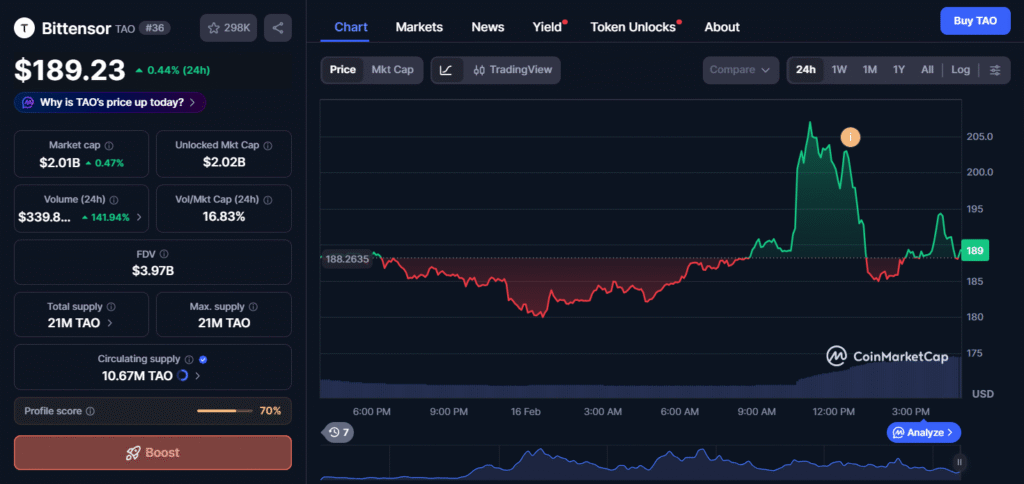
The early trading activities after the listing caused significant price movements for TAO. Currently, Tao is priced at $189.23. The token of Bittensor saw a strong rise in price after the announcement by Upbit as the local demand entered the market. The strong rise in price persisted in the following trading sessions as the liquidity expanded across the exchanges.

Retail adoption in South Korea has historically been strong, even with the recent reduction in trading volumes. The Korean won pairs are often indicative of domestic interest and inflows, especially when trading on major exchanges. Market context indicates volatility, with the overall crypto markets fluctuating. The price boost came about despite the larger markets being under pressure downwards recently. The market still limits Bittensor’s circulating supply relative to its maximum potential.

Decentralized AI Narrative and Market Outlook

The listing of Bittensor’s token is in line with the overall narrative of integrating artificial intelligence networks with blockchain rewards. The TAO tokens have various uses, such as rewards, staking, and transactions in the decentralized network.

The overall community sentiment for TAO was positive as the demand for crypto-AI infrastructure continues to increase. Market participants are exploring how decentralized machine intelligence can grow without relying on centralization. The addition of new trading pairs by Upbit is part of the overall strategy of the exchange.

Highlighted Crypto News:

IMF Warns Dollar-Linked Stablecoins Could Undermine Central Bank Control

TagsBittensorBTCCrypto ExchangeCryptocurrencyexchangeSouth KoreaSouth korean exchangesTAOUpbit

Trending Cryptos

Related Questions

QWhat is the significance of Upbit listing Bittensor (TAO) with multiple trading pairs?

AThe listing enables South Korean traders to directly trade TAO, the native token of the decentralized AI network Bittensor, using Korean won (KRW), Bitcoin (BTC), and Tether (USDT) pairs, which is significant as KRW pairs often indicate strong domestic interest and inflows.

QHow did Upbit manage the trading of TAO immediately after listing to ensure market stability?

AUpbit implemented several protective measures: buy orders were limited initially, sell orders more than 10% below the initial closing prices were prevented, only limit orders were permitted for the first two hours, and the transfer of assets to the Bittensor Network was initially limited to discourage the use of alternative networks like EVM.

QWhat was the market reaction to the TAO listing on Upbit?

AThe listing caused significant price surge for TAO, with the token's price rising strongly due to local demand entering the market. This positive price movement persisted in subsequent trading sessions as liquidity expanded across exchanges, despite downward pressure in the larger crypto markets.

QWhat is the core function of the Bittensor network as mentioned in the article?

ABittensor is a peer-to-peer network that incentivizes and pays for artificial intelligence (AI) contributions based on their utility, integrating AI with blockchain rewards.

QWhat broader narrative does the listing of Bittensor's token align with according to the article?

AThe listing aligns with the broader narrative of integrating artificial intelligence networks with blockchain rewards, as demand for crypto-AI infrastructure grows and market participants explore decentralized machine intelligence that operates without centralization.

Related Reads

Dan Koe: The Counterintuitive Truth—You Don't Need to Remember Everything You Read

Dan Koe: The Counterintuitive Truth — You Don't Need to Remember Everything You Read The central idea is that deliberately trying to remember information is often misguided. True learning isn't about memorizing facts but about having important knowledge surface naturally when needed through use. Most forgetting is normal, not a failure. The article reframes learning using a control theory framework—a four-step feedback loop: having a clear Goal, accurately Sensing your current state, Comparing the gap, and Acting to close it. Most learning stalls because people only do step 2 (blind input) without a goal to create the necessary "error signal" for focused action. The most effective method is to start with output, not input. Begin a meaningful personal project first, and learn only what's necessary to complete it. This project-driven, "just-in-time" learning ensures knowledge is contextual and retained. The concept of a "Second Brain" often fails because it becomes a digital graveyard—over-collected and under-utilized. The goal should be building a "Second Subconscious"—a dynamic system that proactively surfaces relevant ideas during creation, not a static storage vault. Tools like Obsidian+Claude or Eden can help by automating organization and enabling semantic search, but their value depends on linking knowledge to active projects. Ultimately, what matters is not what you store, but what you filter and internalize. Focus on ideas that shape your worldview, use projects as filters, and transform collected material through writing and sharing. AI should be used to reduce friction in research and editing, not to formulate your core views. In conclusion, remembering is a byproduct, not the goal. Knowledge that sticks comes from pursuing personal goals, applying it in real projects, and digesting it through creation. The tools are merely aids; the crucial step is to start doing meaningful work and let the necessary knowledge find you.

marsbit11m ago

Dan Koe: The Counterintuitive Truth—You Don't Need to Remember Everything You Read

marsbit11m ago

A New Era: The Fundamental Transformation of China's Entrepreneurs

A profound generational shift is underway among Chinese entrepreneurs. The wealth and influence once dominated by real estate and internet giants is now being claimed by a new wave of founders driving breakthroughs in AI, semiconductors, and robotics. This change is vividly reflected in 2026's wealth rankings. Figures like Zhang Yiming (ByteDance), Liang Wenfeng (DeepSeek), Chen Tianshi (Cambricon), and Wang Xingxing (Unitree Robotics) are ascending. Their wealth stems not from traditional business models but from market expectations for future technological competitiveness, with AI, chips, and smart hardware becoming the primary engines of wealth creation. Their common trait is a foundational focus on technology, often starting from the laboratory rather than a business plan. Examples include Chen Tianshi's decade-long push in AI chips, Liang Wenfeng's core algorithmic innovations at DeepSeek with a compact team, and Zhu Yiming's "no salary until profitable" 9-year journey to build Changxin Memory into a global DRAM player. This transition marks a fundamental shift in China's economic imperative: from commercial expansion and learning to indigenous innovation and deep industrial capability. While the previous generation built the foundational market and infrastructure, this new cohort is tasked with achieving global leadership in core technologies, moving China from "keeping pace" to pioneering original, breakthrough innovations that are industrialized at scale. The baton is being passed to those competing on the world stage through technological originality.

marsbit12m ago

A New Era: The Fundamental Transformation of China's Entrepreneurs

marsbit12m ago

Once-Popular Web3 Enters Wave of Layoffs

The once-hot Web3 industry is experiencing a severe wave of layoffs. While many companies attribute job cuts to AI-driven restructuring, the primary reason is often financial pressure. The Web3 sector, at the intersection of tech and finance, has been hit particularly hard. Employees at major cryptocurrency exchanges report sudden, impersonal layoffs—often with system access revoked overnight—and minimal or no severance. Common tactics include setting impossible performance targets or terminating employees for minor policy violations. The working atmosphere has become toxic, marked by intense monitoring, excessive meetings, and management obsessed with control and internal politics rather than product innovation. The industry's core business model is collapsing. Exchange revenue from trading fees and listing charges has plummeted due to a decline in quality projects and retail investor exodus. Events like the massive forced liquidation on October 10th further shattered confidence. Competition from on-chain derivatives platforms and prediction markets is intensifying the downturn. As layoffs continue, displaced workers struggle to find new opportunities. Many transition to the AI sector, but face significant bias from traditional finance and even some AI firms, which view crypto industry experience with suspicion. The current downturn appears more structural than cyclical, driven by unsustainable practices, internal strife, and a failure to innovate, raising questions about the industry's future trajectory.

marsbit1h ago

Once-Popular Web3 Enters Wave of Layoffs

marsbit1h ago

Trading

Spot

Hot Articles

What is $BITCOIN

DIGITAL GOLD ($BITCOIN): A Comprehensive Analysis Introduction to DIGITAL GOLD ($BITCOIN) DIGITAL GOLD ($BITCOIN) is a blockchain-based project operating on the Solana network, which aims to combine the characteristics of traditional precious metals with the innovation of decentralized technologies. While it shares a name with Bitcoin, often referred to as “digital gold” due to its perception as a store of value, DIGITAL GOLD is a separate token designed to create a unique ecosystem within the Web3 landscape. Its goal is to position itself as a viable alternative digital asset, although specifics regarding its applications and functionalities are still developing. What is DIGITAL GOLD ($BITCOIN)? DIGITAL GOLD ($BITCOIN) is a cryptocurrency token explicitly designed for use on the Solana blockchain. In contrast to Bitcoin, which provides a widely recognized value storage role, this token appears to focus on broader applications and characteristics. Notable aspects include: Blockchain Infrastructure: The token is built on the Solana blockchain, known for its capacity to handle high-speed and low-cost transactions. Supply Dynamics: DIGITAL GOLD has a maximum supply capped at 100 quadrillion tokens (100P $BITCOIN), although details regarding its circulating supply are currently undisclosed. Utility: While precise functionalities are not explicitly outlined, there are indications that the token could be utilized for various applications, potentially involving decentralized applications (dApps) or asset tokenization strategies. Who is the Creator of DIGITAL GOLD ($BITCOIN)? At present, the identity of the creators and development team behind DIGITAL GOLD ($BITCOIN) remains unknown. This situation is typical among many innovative projects within the blockchain space, particularly those aligning with decentralized finance and meme coin phenomena. While such anonymity may foster a community-driven culture, it intensifies concerns about governance and accountability. Who are the Investors of DIGITAL GOLD ($BITCOIN)? The available information indicates that DIGITAL GOLD ($BITCOIN) does not have any known institutional backers or prominent venture capital investments. The project seems to operate on a peer-to-peer model focused on community support and adoption rather than traditional funding routes. Its activity and liquidity are primarily situated on decentralized exchanges (DEXs), such as PumpSwap, rather than established centralized trading platforms, further highlighting its grassroots approach. How DIGITAL GOLD ($BITCOIN) Works The operational mechanics of DIGITAL GOLD ($BITCOIN) can be elaborated on based on its blockchain design and network attributes: Consensus Mechanism: By leveraging Solana’s unique proof-of-history (PoH) combined with a proof-of-stake (PoS) model, the project ensures efficient transaction validation contributing to the network's high performance. Tokenomics: While specific deflationary mechanisms have not been extensively detailed, the vast maximum token supply implies that it may cater to microtransactions or niche use cases that are still to be defined. Interoperability: There exists the potential for integration with Solana’s broader ecosystem, including various decentralized finance (DeFi) platforms. However, the details regarding specific integrations remain unspecified. Timeline of Key Events Here is a timeline that highlights significant milestones concerning DIGITAL GOLD ($BITCOIN): 2023: The initial deployment of the token occurs on the Solana blockchain, marked by its contract address. 2024: DIGITAL GOLD gains visibility as it becomes available for trading on decentralized exchanges like PumpSwap, allowing users to trade it against SOL. 2025: The project witnesses sporadic trading activity and potential interest in community-led engagements, although no noteworthy partnerships or technical advancements have been documented as of yet. Critical Analysis Strengths Scalability: The underlying Solana infrastructure supports high transaction volumes, which could enhance the utility of $BITCOIN in various transaction scenarios. Accessibility: The potential low trading price per token could attract retail investors, facilitating wider participation due to fractional ownership opportunities. Risks Lack of Transparency: The absence of publicly known backers, developers, or an audit process may yield skepticism regarding the project's sustainability and trustworthiness. Market Volatility: The trading activity is heavily reliant on speculative behavior, which can result in significant price volatility and uncertainty for investors. Conclusion DIGITAL GOLD ($BITCOIN) emerges as an intriguing yet ambiguous project within the rapidly evolving Solana ecosystem. While it attempts to leverage the “digital gold” narrative, its departure from Bitcoin's established role as a store of value underscores the need for a clearer differentiation of its intended utility and governance structure. Future acceptance and adoption will likely depend on addressing the current opacity and defining its operational and economic strategies more explicitly. Note: This report encompasses synthesised information available as of October 2023, and developments may have transpired beyond the research period.

1.4k Total ViewsPublished 2025.05.13Updated 2025.05.13
What is $BITCOIN

Discussions

Welcome to the HTX Community. Here, you can stay informed about the latest platform developments and gain access to professional market insights. Users' opinions on the price of BTC (BTC) are presented below.

活动图片