Up Over 130% in a Month, Steadily Among Top Ethereum Blob Consumers—How Real is World Chain's Growth?

marsbitPublished on 2026-06-22Last updated on 2026-06-22

Abstract

World Chain, the Layer-2 blockchain developed by the Worldcoin project, has demonstrated significant recent growth despite a generally competitive and challenging L2 landscape. Its native token, WLD, surged over 130% in a month, driven by institutional holdings (notably from Eightco Holdings), increased trading activity from promotional campaigns, and a key upcoming reduction in daily token unlocks starting July 2026. Concurrently, World Chain's on-chain activity soared, with active addresses growing nearly 650% in 30 days and its Total Value Secured (TVS) surpassing $610 million, primarily from bridge inflows. However, its decentralized finance (DeFi) ecosystem remains nascent, with a total value locked (TVL) of only ~$40 million largely concentrated in a single protocol. A standout metric is World Chain's high data usage: it has become the second-largest consumer of Ethereum Blobs (data storage units), trailing only Base. This indicates substantial real-user transaction demand, likely fueled by Worldcoin's identity verification and reward distribution activities on its dedicated chain. While its current growth is fueled by token momentum and bridge capital, World Chain's long-term success depends on converting this activity into a sustainable, diverse on-chain economy.

Author: Nancy, PANews

Since Vitalik reframed the Layer2 roadmap this year, the survival competition in the L2 track has become increasingly brutal. Star L2s like Base, Arbitrum, and OP Mainnet continue to vie for market attention and liquidity, while numerous mid-to-long-tail and emerging L2s have become "ghost towns," with many projects even forced to make drastic cuts to survive.

Amid this growing L2 fragmentation, World Chain has carved out a relatively independent growth trajectory. Although its on-chain ecosystem applications remain sparse, real user activity drives high-frequency interaction demand. Concurrently, riding the AI wave, WLD has recently experienced a relatively independent upward trend.

Behind the 130%+ Monthly Surge: Why is WLD on an Independent Run?

As the investment fervor in the AI sector continues to heat up, Worldcoin has become a target for market capital. CoinGecko data shows that WLD has surged 136.1% over the past 30 days, significantly outperforming most mainstream crypto assets.
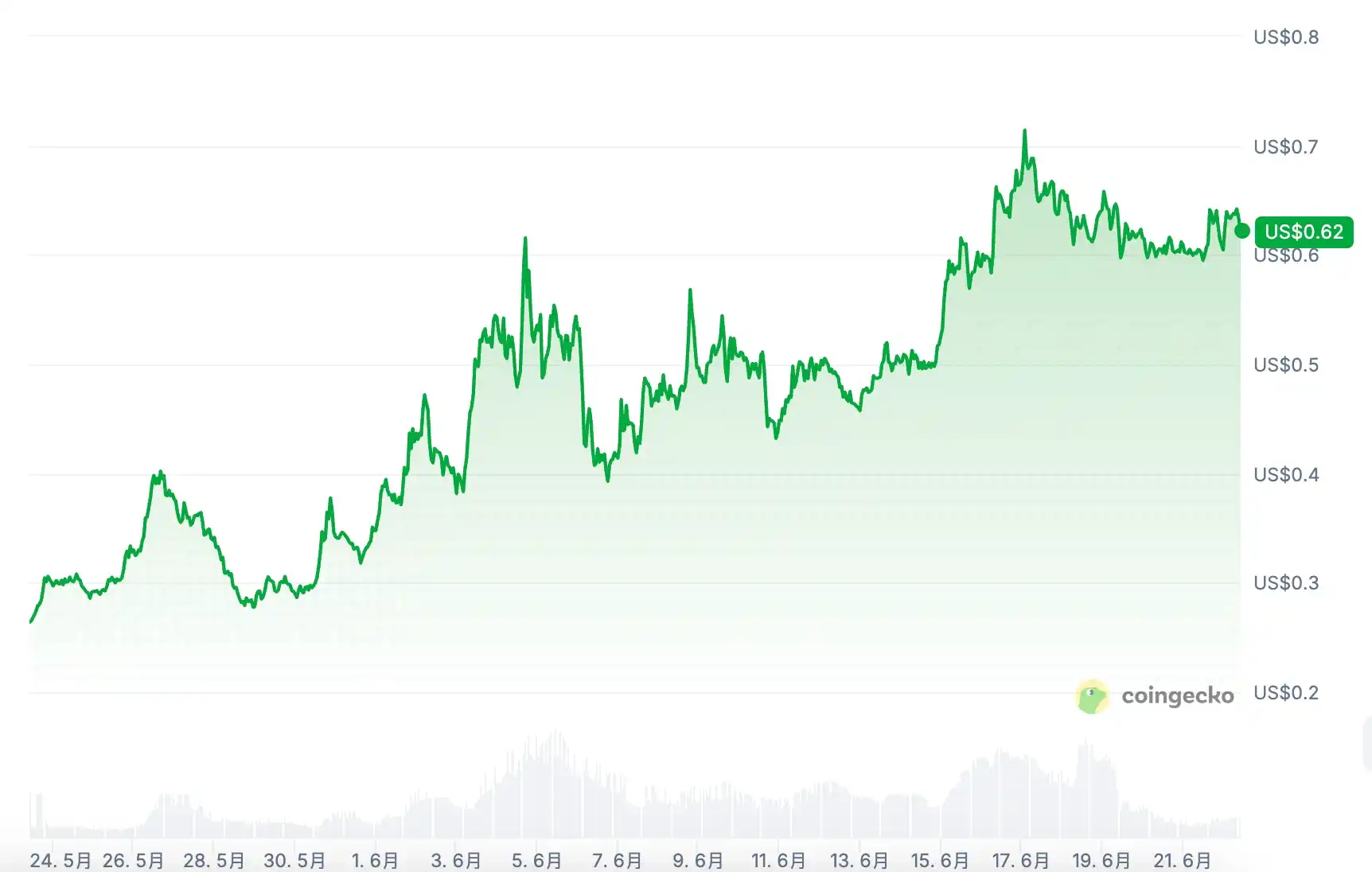
This rally is primarily driven by a confluence of multiple expectations and capital inflows.

On one hand, substantial institutional holdings have boosted market confidence. Nasdaq-listed company Eightco Holdings publicly holds approximately 283 million WLD (about 8.4% of the circulating supply), incorporating it into its treasury asset allocation. Additionally, as the company holds indirect equity in OpenAI (an investment of around $90 million), it has amplified the market's imagination regarding the value of its token holdings.

On the other hand, incentive activities have stimulated WLD's trading activity. At the end of last month, Oku Trade integrated into the World App and launched a WLD trading competition, directly incentivizing user participation. Dune data shows that WLD's daily trading volume on DEXs once exceeded $11 million, compared to a long-term average of several hundred thousand dollars, representing a multiplier increase in volume.

A more critical driving factor comes from expectations of improvements in tokenomics. According to the latest adjustment plan, starting July 24, 2026, the daily WLD unlock volume will decrease from approximately 5.1 million to about 2.9 million tokens, a reduction of about 43%. Community unlocks will drop from 3.2 million to 1.6 million (50% decrease), while team and investor unlocks will decrease from 1.9 million to 1.3 million tokens per day (32% decrease). This adjustment is widely interpreted by the market as a significant alleviation of medium-to-long-term supply pressure, helping to dampen expectations of continuous sell-side pressure.

Furthermore, as expectations for the listing of AI giant OpenAI continue to heat up, the market fervor for the AI narrative has spilled over. As a crypto project co-founded by its figurehead Sam Altman, market attention on Worldcoin has intensified, further driving speculative capital inflows.

Soaring On-Chain Activity, Growth Dependent on Bridge Inflows

Alongside the rising token price, on-chain activity on World Chain is also surging.

In terms of capital inflows, this growth phase is primarily fueled by bridged TVL. According to L2BEAT data, World Chain's Total Value Secured (TVS) now exceeds $610 million, representing an increase of about 122.6% over the past 30 days. Standard bridge asset inflows dominate this, amounting to approximately $557 million, a 118.4% month-on-month increase, constituting the main source of recent capital expansion.
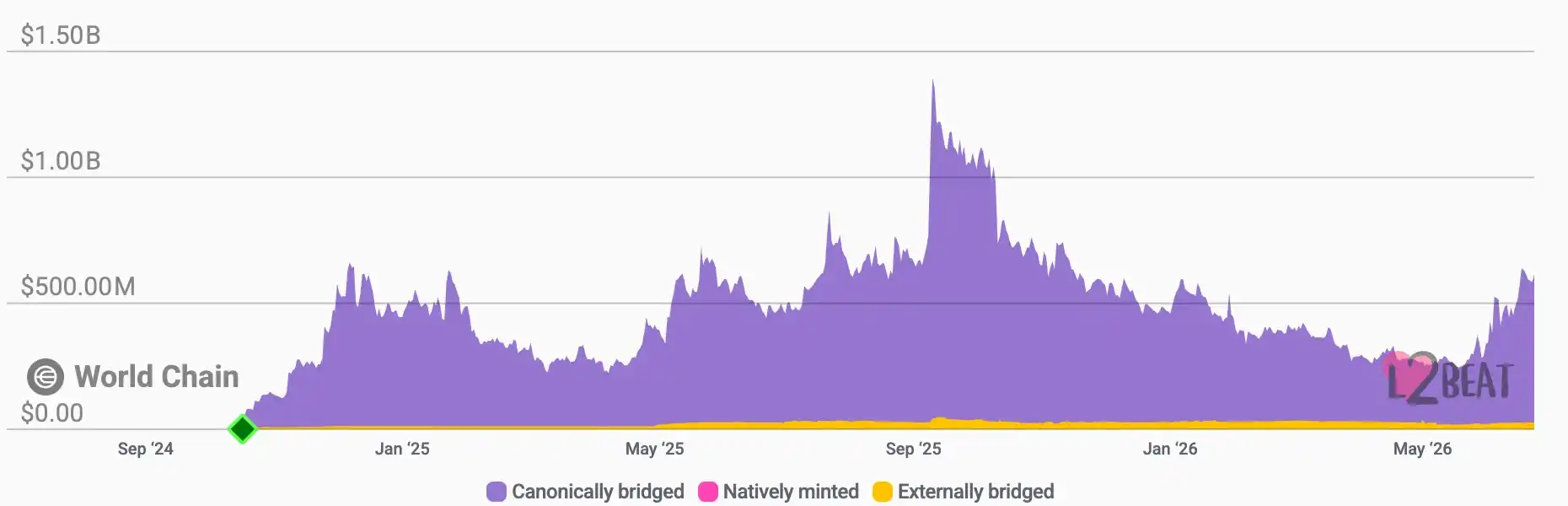
Growing alongside the capital flow is its on-chain activity. GrowThePie data shows that over the past 30 days, World Chain's daily active addresses have skyrocketed by 649%. In comparison, Polygon, Base, Arbitrum One, Celo, and others saw limited growth during the same period, with some even experiencing negative growth.
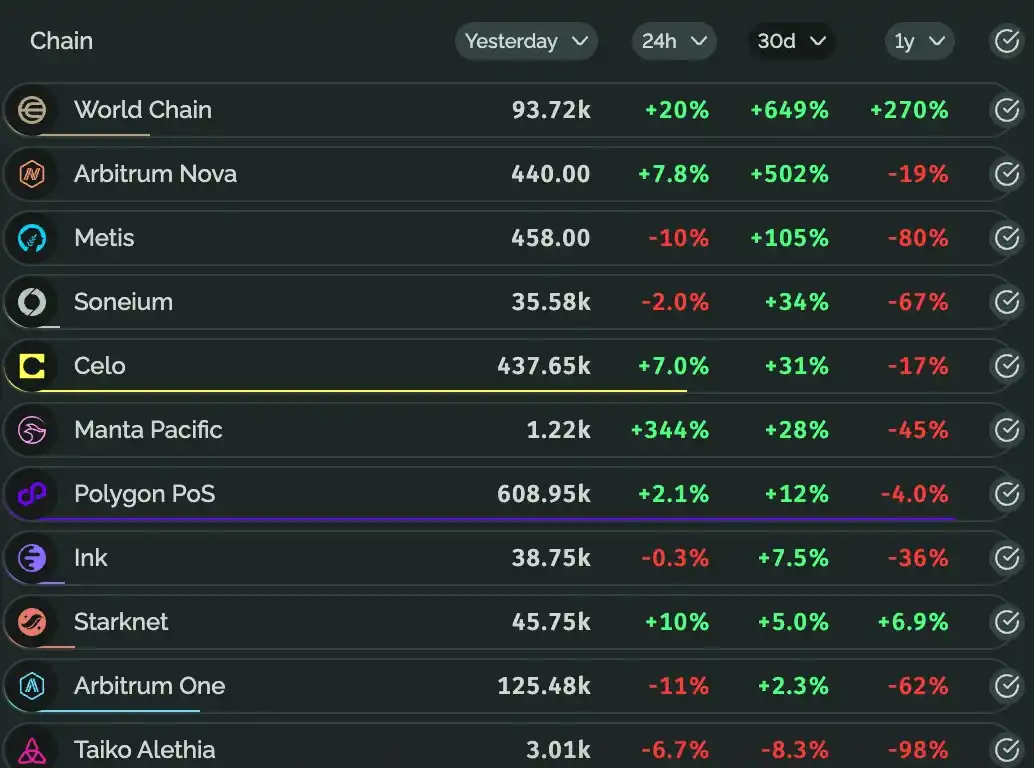
However, World Chain's on-chain ecosystem has not seen large-scale expansion. Compared to Base, which leverages Coinbase's traffic, or Arbitrum, which boasts a mature DeFi ecosystem, World Chain remains in the early stages of ecosystem development, lacking native protocols with network effects and high-frequency use cases.

DeFiLlama data shows that as of June 22, World Chain's TVL is only about $40.42 million, a scale incomparable to other leading L2s. Although it has nearly doubled over the past 30 days, the incremental liquidity is mainly concentrated in Morpho Blue-related vaults, with this protocol accounting for about 93% of World Chain's TVL.

In other words, a significant portion of the bridged capital remains in the form of idle assets, not effectively converted into DeFi lending, DEX trading, or complex application interactions. The depth of on-chain capital utilization and the efficiency of retention and conversion remain limited.

Second Only to Base, World Chain Becomes a Major Blob Consumer

Despite the lack of external applications, its unique positioning as Worldcoin's dedicated L2 and tens of millions of real user activities mean large-scale internal transactions are continuously driving up World Chain's Blob consumption, making it a high-frequency L2.

Blobs are primarily used by Layer 2 Rollups to publish transaction data to the mainnet at extremely low cost, achieving data availability. Since the Dencun upgrade in March 2024, the Ethereum mainnet has cumulatively submitted over 19.53 million Blobs. Among numerous Layer 2s, World Chain has grown into the second-largest Blob consumer, its strong performance even surpassing established L2s like Arbitrum.
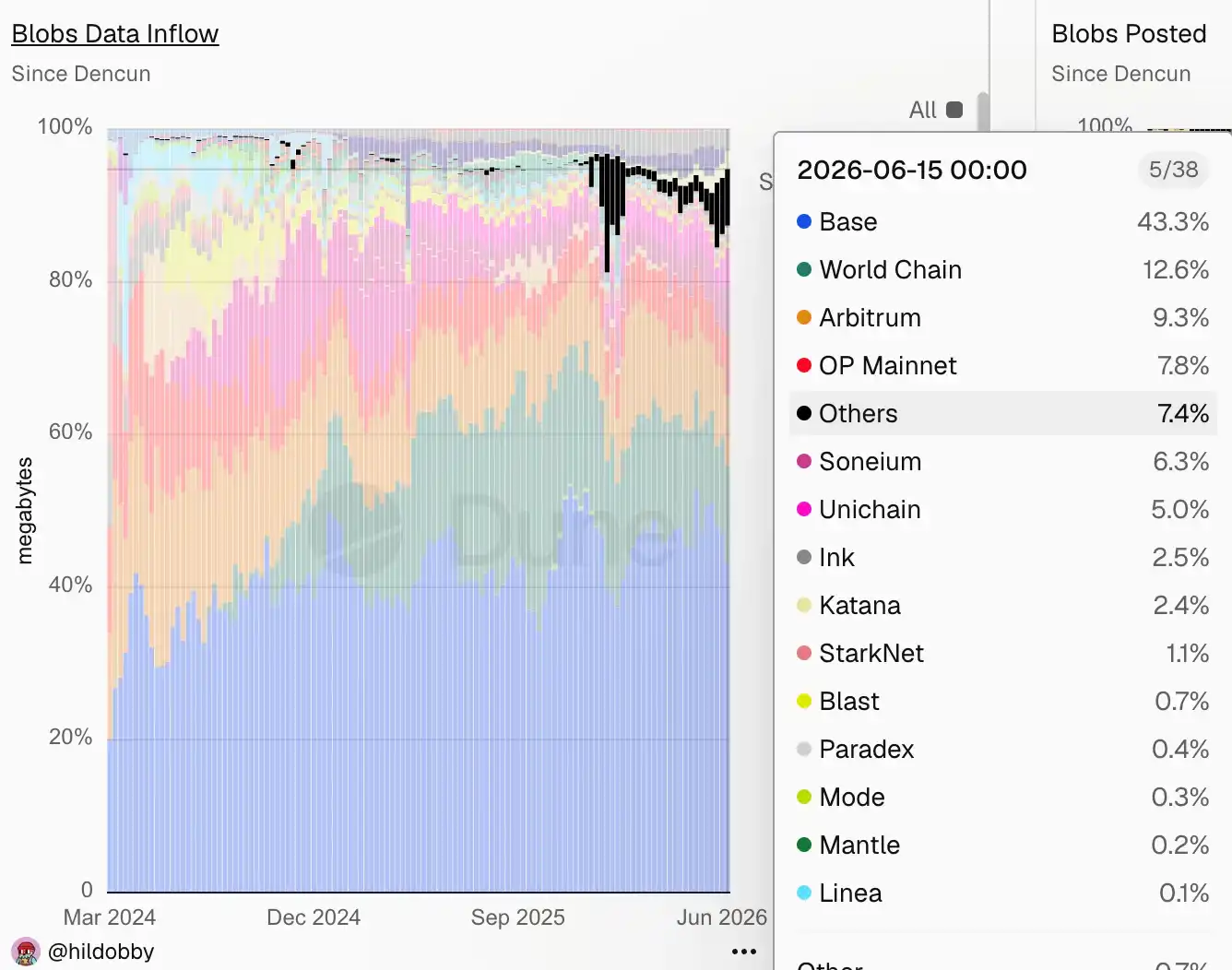
According to the latest Dune Analytics statistics, since its launch in June 2025, World Chain has cumulatively submitted over 2.63 million Blobs to Ethereum, firmly placing it among the top networks, second only to the leading Base. In the past 24 hours, it has averaged 106 Blob submissions per hour, equivalent to writing about 13.3MB of data to Ethereum per hour, with a Blob fill rate as high as 99%, leading most L2s in data packaging efficiency.

In terms of cost and operational efficiency, World Chain also demonstrates strong competitiveness. Over the past 3 days, its data availability (DA) fees amounted to about $304, with cumulative historical fees exceeding $2 million, proving more efficient compared to established L2s like Base (cumulative ~$6.45 million) and Arbitrum (cumulative ~$3.51 million). Simultaneously, it submits batches to Ethereum on average every 3 minutes and 45 seconds, with each submission transaction averaging 3 Blobs, indicating a high frequency of on-chain interactions.

Judging by the scale of data inflow, World Chain quickly ascended to the top tier shortly after launch and has maintained a leading position. As of June 15, its Blob data inflow accounted for 12.6% of the total network volume, second only to Base's 43.3%, solidifying its second-place standing. Mainstream L2s like Arbitrum One, Soneium, OP Mainnet, and Unichain all rank behind it.

While most L2s grapple with growth anxiety, World Chain's rise to the forefront of Blob consumption is not only due to the cost and throughput advantages afforded by its underlying OP Stack architecture, enabling it to handle on-chain activities more efficiently. More importantly, the migration of tens of millions of real World ID users to its dedicated chain, driven by scenarios like identity verification, subsidized Gas, and reward claims, generates sustained high-frequency transaction demand. This allows it to maintain vigorous data demand and Blob consumption even in the absence of a mature ecosystem.

Looking at a longer cycle, what truly determines the long-term development of an L2 is not short-term capital and trading hype. World Chain must effectively convert externally流入的资产 into on-chain liquidity and sustainable economic activities to evolve from a frequently used L2 into a mature network with a self-sustaining ecosystem.


Trending Cryptos

Related Questions

QWhat are the main factors driving WLD's significant price increase of over 130% in the past month?

AThe price surge is driven by multiple factors: institutional holdings (like Eightco Holdings holding ~284M WLD), incentive activities (e.g., Oku Trade integration boosting DEX volume), an expected improvement in tokenomics (a ~43% reduction in daily unlocks starting July 24, 2026), and heightened market interest in AI narratives linked to Sam Altman and OpenAI.

QHow has the on-chain activity of World Chain changed recently, and what is the primary source of its TVL growth?

AWorld Chain's on-chain activity has surged significantly, with active daily addresses increasing by 649% in the past 30 days. Its Total Value Secured (TVS) grew by about 122.6% to over $610 million, primarily driven by standard bridge inflows, which account for approximately $557 million of the TVL.

QWhat is the current state of World Chain's DeFi ecosystem compared to other major L2s?

AWorld Chain's DeFi ecosystem remains underdeveloped compared to L2s like Base or Arbitrum. Its total TVL is only about $40.42 million, with ~93% concentrated in Morpho Blue vaults. Most bridged assets are idle and have not been effectively converted into active DeFi usage such as lending or DEX trading.

QWhat is Blob consumption, and why is World Chain considered a major consumer on Ethereum?

ABlobs are used by Layer 2 Rollups to post transaction data to the Ethereum mainnet for data availability at low cost. World Chain is the second-largest Blob consumer on Ethereum, just after Base. Since its launch, it has submitted over 2.63 million Blobs, accounting for 12.6% of the network's total Blob data inflow, due to high-frequency transactions from millions of World ID users.

QWhat challenges does World Chain face for its long-term development despite its current high usage?

AThe key long-term challenge for World Chain is transforming externally bridged assets and high transaction frequency into a sustainable on-chain economy with deeper liquidity and diverse economic activities. It needs to move beyond being just a high-usage L2 driven by internal user actions (like identity verification and rewards) and build a robust, self-sustaining ecosystem with more native applications.

Related Reads

Blood Loss of $55 Million Selling 3,588 BTC, Strategy Becomes a Literal Scumbag

On July 6th, Strategy (formerly MicroStrategy) disclosed in an SEC filing that it sold 3,588 Bitcoin (BTC) between June 29th and July 5th for approximately $216 million, at an average price of ~$60,200. This marked the company's largest net sale since initiating its Bitcoin strategy in 2020 and its first institutionalized reduction of its core holding. The sale resulted in a realized loss of about $54.8 million, as the selling price was below its average cost basis of ~$75,476 per BTC. The proceeds were used to pay preferred stock dividends and replenish USD reserves. This move follows a new "Digital Credit Capital Framework" approved on June 29th, authorizing the sale of up to $1.25 billion in Bitcoin. The sale consumes roughly 17% of this authorized amount in its first week. Strategy's foundational narrative, built by founder Michael Saylor, was a commitment to "never sell" Bitcoin. The recent institutionalized selling framework and these substantial sales represent a significant shift from that original promise. While the amount sold is only 0.4% of Strategy's total holdings of 843,775 BTC, the action challenges the premium at which its stock (MSTR) trades relative to its Bitcoin holdings. Investors had priced in the "never sell" narrative. The company now faces a contradiction: it sells Bitcoin at a loss to pay dividends on the preferred stock it issued to fund Bitcoin purchases. Saylor has framed selling as a tool for future strategic purchases, but each sale erodes the credibility of the original commitment, potentially threatening the premium valuation of MSTR shares.

Foresight News56m ago

Blood Loss of $55 Million Selling 3,588 BTC, Strategy Becomes a Literal Scumbag

Foresight News56m ago

Dialogue with Yihui Capital, SoundAI Technology, Ling Universe, and Zhongbo Jili: Opportunities and Challenges in the AI Smart Hardware Track

On June 28, 2026, an event titled "New Opportunities in AI Hardware: The Battle for Interactive Entry Points Begins" was held in Beijing. It featured a report from ITJuzi and discussions with experts from SoundAI, Ling Universe, One Reed Capital, and Zhongbo Juli on the opportunities and challenges in China's AI hardware sector. Key report findings highlight the sector's intense activity: 327 out of 431 startups founded post-2023 have secured funding, with 179 investments in H1 2026 alone. The landscape is dominated by embodied intelligent robots, while wearable tech like smart rings and AI glasses shows rapid growth. Geographically, Shenzhen leads, leveraging its superior hardware supply chain, followed by Beijing and Shanghai. The overarching trend is for companies to focus on micro-innovations within specific scenarios rather than reinventing foundational technology. Industry leaders shared several critical insights: 1. **Balancing Innovation & Market Readiness**: Entrepreneurs face the "hammer looking for a nail" dilemma. Success requires balancing technical capability with user acceptance, cost control, and incremental design improvements rather than chasing disruptive innovation. 2. **Competitive Landscape**: The future interactive entry point may not be a single super-device but a mix of universal terminals and specialized, scenario-specific hardware. While large companies have ecosystem advantages, startups can win by deeply targeting vertical markets and specific user groups. 3. **Core Challenges & Business Models**: Key hurdles include deep understanding of AI models and navigating non-transparent hardware supply chains. Viable business models may involve selling hardware at cost and generating revenue through software subscriptions, but this requires tight control over both hardware BOM and model inference costs. 4. **The Road to Commercialization**: The ultimate test is market validation—achieving sales growth and sustainable cash flow. Companies must find the right application scenario, use edge computing effectively, and close the loop from technology to commercial success. 5. **The Future of Interaction**: Proactive, context-aware interaction is the next frontier, though it's currently limited by issues like model hallucinations and environmental perception. The near-term focus should be on identifying target users and creating a coherent experience in specific domains, such as health wearables. In summary, to succeed in the competitive AI hardware arena, companies must strategically choose their niche, build a team with the right geographical advantages (e.g., leveraging Shenzhen's supply chain), and most importantly, execute a flawless commercialization strategy that translates technology into market-accepted products and sustainable business growth.

marsbit1h ago

Dialogue with Yihui Capital, SoundAI Technology, Ling Universe, and Zhongbo Jili: Opportunities and Challenges in the AI Smart Hardware Track

marsbit1h ago

Trading

Spot

Hot Articles

Discussions

Welcome to the HTX Community. Here, you can stay informed about the latest platform developments and gain access to professional market insights. Users' opinions on the price of ETH (ETH) are presented below.

活动图片