Unveiling the 'White-Haired Stock God' Serenity: The Mental Elixir for Anxious Retail Investors

marsbitPublished on 2026-06-11Last updated on 2026-06-11

Abstract

The anonymous stock influencer known as "White-Haired Stock God" Serenity has ignited a frenzy in the A-share market. From June 5-9, Serenity's posts on platform X mentioning A-shares like LeaderDrive, Easun, and Innolight triggered sharp price surges, with some stocks hitting 20% daily limits. Serenity, who claims a 3612% personal return this year, gained fame internationally using a "chokepoint investment" strategy focused on small, monopolistic AI supply chain companies. With over 810k X followers, his influence rivals top analysts. His recent foray into Chinese stocks, which he claims is "for fun" to offer a "foreign perspective," has drawn scrutiny. While Serenity denies holding positions in these A-shares and states his posts are not recommendations, his actions have caused significant market volatility. He monetizes through a $1/month subscription, earning an estimated $54k monthly. Facing accusations of market manipulation, he maintains he promotes "information democracy." Community analysis suggests Serenity is likely an English-speaking Chinese national living in Japan, based on his posting patterns and shared personal details. He maintains anonymity due to past harassment. Ultimately, Serenity is seen by many as a manifestation of the current AI bull market's euphoria—a mysterious, seemingly successful figure who fulfills the market's desire for a "stock god," though such personas often face intense scrutiny when market sentiment shifts.

Author | Golem (@web 3_golem)

In the A-share market, the "White-Haired Stock God" Serenity has completely gone viral.

From June 5th to June 9th, Serenity successively "shilled" three A-shares on platform X. They were the embodiment intelligence robotics concept stock LeaderDrive, the digital intelligence new energy concept stock Yashi, and the leading optical module stock Innolight. The stock prices of the first two were vertically pulled to a 20cm limit-up on the same day, and LeaderDrive has already risen over 30% in June.

The reason Serenity possesses such strong "pumping power" is because before entering the view of domestic A-share investors, he had already gained extremely high popularity in international retail investor communities.

Serenity's investment characteristic is using the "Chokepoint Investment Method" to screen out small monopolistic companies in the AI industry chain that are not fully priced in. Because the over 16 stocks he has shilled this year have all achieved investment returns exceeding 100%, and his personal year-to-date investment return exceeds 3612%, coupled with his professional background as a former AI research scientist and his rigorous analysis of the AI industry and favored companies each time, Serenity has accumulated a large number of loyal retail followers in Europe, America, Japan, and South Korea. His X account subscribers exceed those of Musk, ranking first on the platform. Therefore, his influence on a single stock's price fluctuation surpasses that of ordinary stock analysts.

For example, on May 27th, Serenity posted on platform X announcing he had completed building a position in the European stock XFAB at a market cap of $1.28 billion. XFAB's stock price was subsequently pushed up continuously, with a single-day intraday maximum increase of 77%, and the stock price rose to a high of 13.13 euros. Since then, XFAB's stock price began a continuous decline and is currently trading around 8.8 euros, having returned to pre-shill levels.

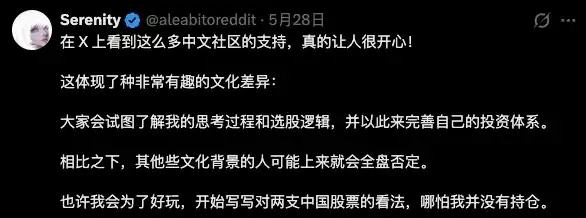
Just the day after causing significant volatility in XFAB's stock price, Serenity posted in Chinese on platform X, saying, "Because I see so much support from the Chinese community... I might, just for fun, start writing about my views on a couple of Chinese stocks."

A storm of blood and rain sweeping the A-share market thus began.
Disrupting the A-Share Market Without Holding Positions, Just for Fun?

In hindsight, these two stocks Serenity mentioned were LeaderDrive and Yashi.

On June 5th, Serenity posted in Chinese, specifically emphasizing "written specifically for my Chinese readers," stating that LeaderDrive (688017, 57.73 billion RMB) was his most favored Chinese listed target when positioning in the humanoid robotics sector. The main reason is its absolute dominance in certain robot component supply chains, with over 60% domestic market share and more than 1,800 global customers.
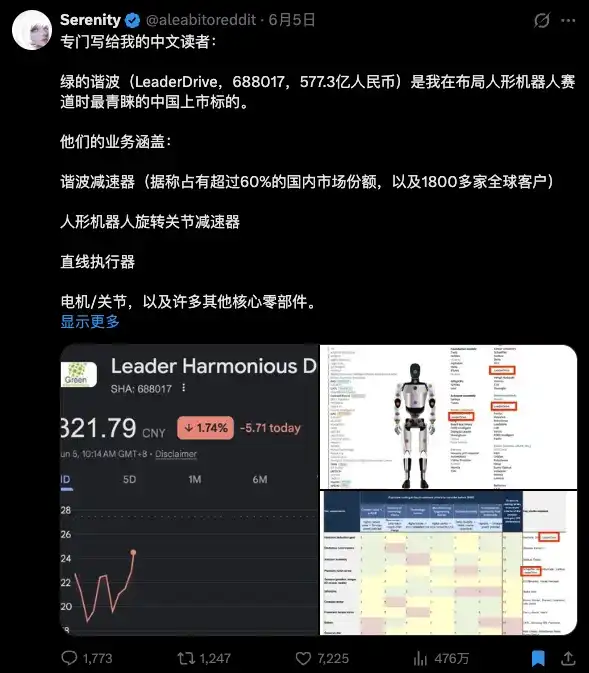
As of now, this post has been viewed over 4 million times and has been disseminated to multiple domestic social media platforms. LeaderDrive's stock price triggered a 20% limit-up on June 5th. By June 10th, in just 4 trading days, the stock price had risen over 30%.

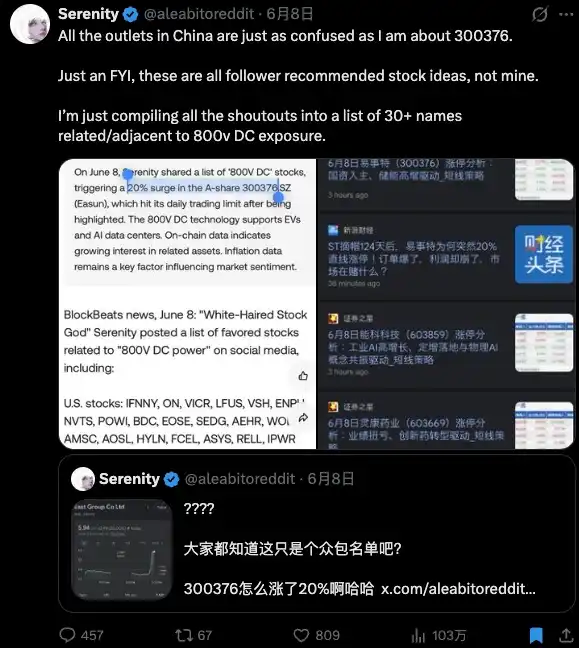
On June 8th, the same market script played out again. Serenity posted a crowdsourced list of over 30 companies in the "800V DC" concept on platform X, which included the A-share company Yashi. The news quickly fermented domestically, with Yashi's stock price happily receiving a 20CM limit-up within an hour, and by June 10th, its increase also exceeded 30%.

Serenity himself even seemed surprised, posting, 'Does everyone know this is just a crowdsourced list? How did 300376 (Yashi) go up 20%?'

Immediately after, he posted again saying, 'These are stocks recommended by fans, not my personal recommendations,' attempting to distance himself from it.
Besides these two stocks, Serenity also mentioned a third A-share, Innolight, on June 9th, stating it was the only Chinese listed company he invested in last year. However, because some AI mistranslated "Innolight" as another A-share listed company, Inno Laser, this caused Inno Laser to be violently pumped nearly 10% within 10 minutes. This "misunderstanding incident" also reveals the retail investors' FOMO towards Serenity himself—"blindly, just asking what to buy, afraid of missing out on the hot stuff."

Serenity's actions quickly drew the attention of domestic financial media and securities analysts, who began speculating about his purpose for "cross-border stock promotion." On June 9th, Cailian Press published a lengthy article warning domestic investors to be wary of overseas information flowing back in. If Serenity's sharing involved profit-sharing, the behavior would be classic "export-for-domestic-sale style cross-border pumping," requiring legal accountability. Some domestic securities analysts even openly vented on social media, "These clowns will be finished sooner or later, thinking they can act lawlessly just because they ran abroad."

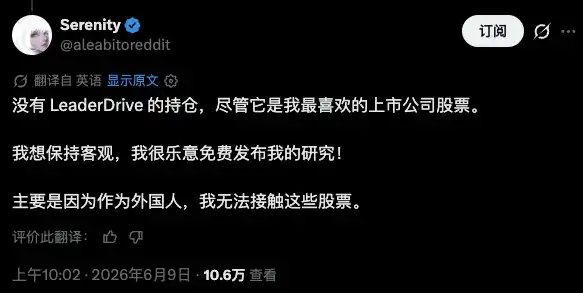
Facing domestic media's questioning about him "harvesting retail investors," Serenity responded that shilling A-shares was just because he thought "foreigners could bring a different perspective to A-shares." He also stated, "Although I really like LeaderDrive, I do not hold its stock." Perhaps, as he initially said, the original intention behind all this was just for fun.
Serenity appears almost like a "philanthropist." He emphasizes he does not do any paid promotions or marketing. The only paid thing is a $1 monthly subscription service. He is not a member of any institution or the Illuminati. The reason for his continuous free sharing is his belief that the stock market is a positive-sum game. He hopes retail investors can buy quality stocks without joining any expensive paid communities, even before institutions enter. He claims he is promoting information democratization.

In the investment field, don't overly deify anyone. Serenity may not seek profit, but he certainly seeks fame. Since starting to shill A-shares on June 5th, Serenity's follower count has surged again by over 200,000. As of June 11th, his X platform followers exceed 8.1 million, and account subscribers have grown to 54,000, surpassing Musk (46,000). With such a massive number of subscribers, even at $1, Serenity's fixed monthly income reaches $54,000, easily earning over a million RMB annually.

Serenity's pinned posts celebrate his account subscriber count surpassing Musk, calling it his goal. The fact that an anonymous account can have such high influence and attention makes investors even more curious about his real identity. Behind this account, is it a person, a team, or even just an AI?

Most Likely a Chinese National Living in Japan?

Serenity explains that his reason for remaining anonymous is to be able to freely express ideas online. He stated that when he first published negative views about IREN (a Nasdaq-listed stock), he received threats and harassment from dozens of accounts in real life, which is why he continues to remain anonymous.

Nevertheless, the community has gradually pieced together an image of Serenity from various collected fragments of information. It is highly likely he is a Chinese national living in Japan.

At the end of May, Serenity revealed some personal information. He said he is quite international, currently studying Japanese in Japan. Because he once lived in mainland China for a period and often traveled to Taiwan, he knows a bit of Chinese. Additionally, he played football in Mexico for two or three years, went to South Korea specifically to play League of Legends... his life seems quite comfortable.
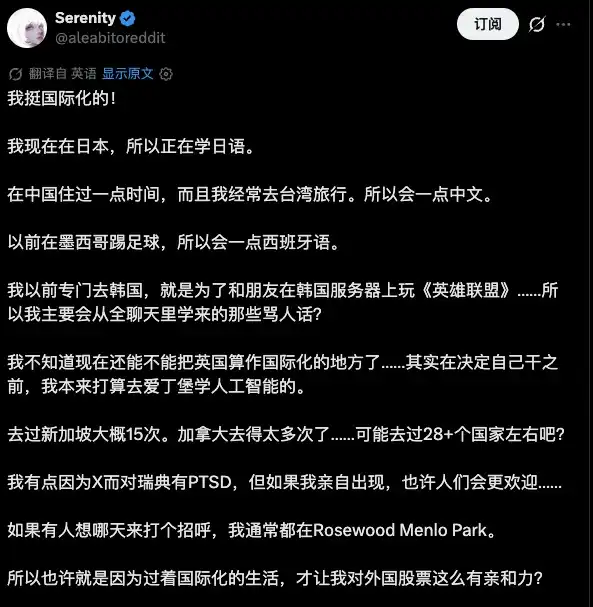
Serenity has lived in Japan for at least half a year. At the end of 2025, he often posted photos of his life in Japan on platform X, but since becoming popular, he rarely mentions personal life.
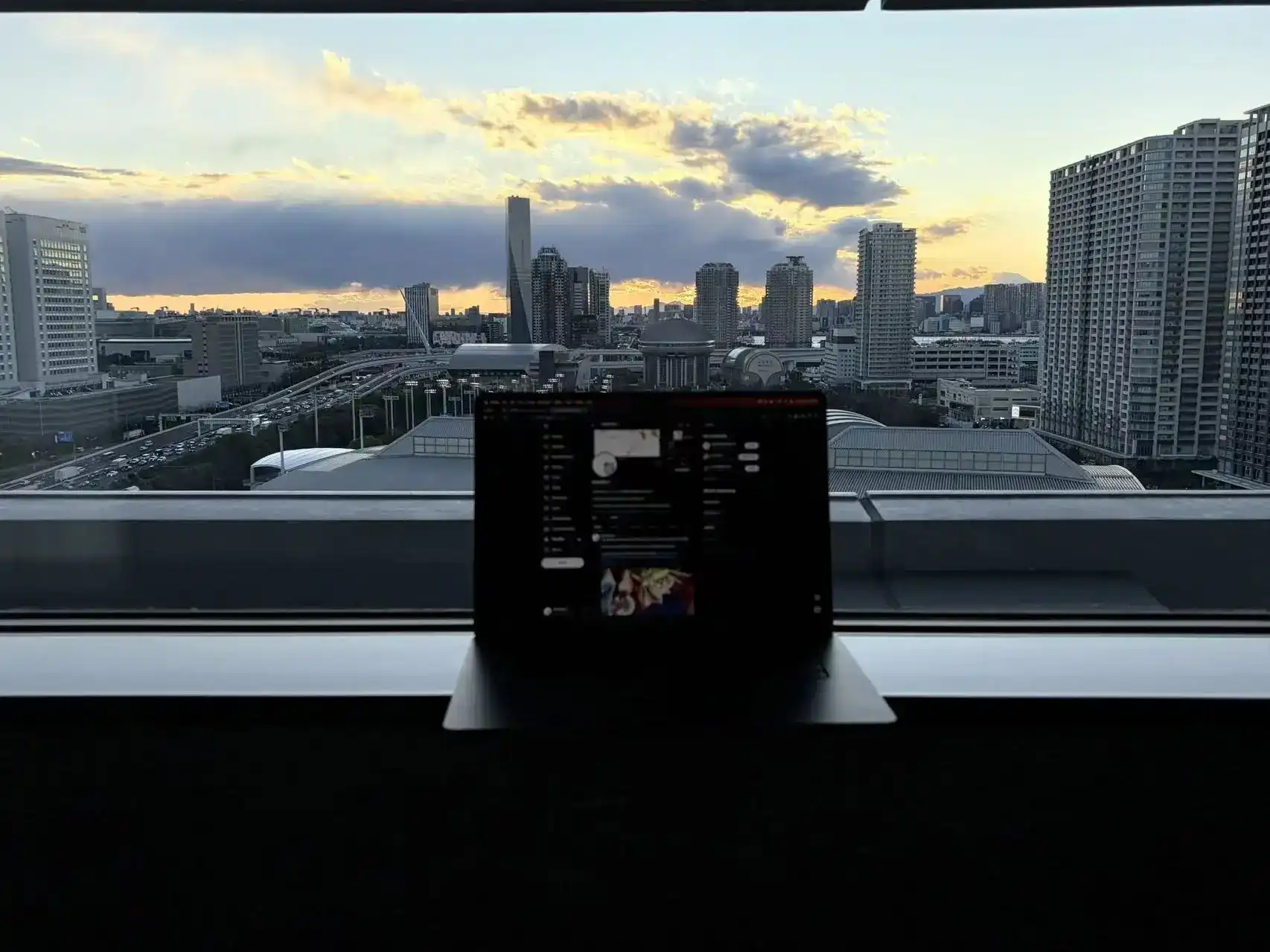
Serenity in Japan

Serenity is a high-frequency poster, averaging 9~10 posts per day, peaking at over 20. Looking at his daily posting frequency using AI statistics, he has about 5 hours of absolute account silence each day. This silence period is likely when Serenity is resting or sleeping. This timeframe corresponds roughly to the early morning hours (3:00 to 8:00) in some Asian time zones (UTC+8, UTC+9). Combined with the previous information, this basically locks Serenity's location to Japan.

The community leans towards thinking Serenity is a Chinese national, but Serenity emphasizes English is his native language. Most of his posts are still in English. Occasional posts in Chinese seem only to cater to Chinese fans. Moreover, if you count posts in different languages, his Japanese post count is higher than his Chinese.

Combining this with Serenity's early experiences—active on Reddit WSB (Odaily Note: Wall Street Bets is the largest US retail trading community) before moving to X, rejected an offer from Nvidia's AI team in 2018, and was reported by overseas renowned media like Bloomberg and Reuters—it is therefore possible to basically rule out Serenity being a Chinese citizen.

Serenity's anonymous identity, non-transparent investment returns, and excessive craving for influence are all increasing market controversy around him. But interestingly, everyone who questions him is also constantly refreshing his homepage.

Stock investment has always seen different idols in different eras: Warren Buffett, Cathie Wood, Roaring Kitty. Each era has its own spiritual totem. Bull markets magnify returns and also magnify faith. When more and more people start making money, we always want to find someone who can "scientifically explain the bubble." Serenity might just be the outward projection of this round of AI bull market sentiment—mysterious, professional, successful, fitting all the public imagination of a "stock god."

But next to the altar is the guillotine, because when the market turns, it will want to find someone to blame for the losses, and Serenity might then be the most suitable candidate. History repeats, the market moves forever forward, people enjoy creating idols and are also adept at "destroying idols." As for who Serenity really is, it probably isn't that important anymore.

Related Questions

QWho is Serenity, and what recent impact has he had on the A-share market?

ASerenity, known as the 'White-Haired Stock God,' is an anonymous influential figure in international retail investment communities. Recently, he 'called' three A-share stocks—LeaderDrive (绿的谐波), EAST (易事特), and Innolight (中际旭创)—on platform X, causing significant price surges, with the first two hitting 20cm daily limit-ups. His posts led to increased volatility and widespread attention in the A-share market.

QWhat is Serenity's claimed investment strategy, and what is his reported performance?

ASerenity employs a 'Chokepoint Investment Method,' focusing on small monopoly companies in the AI industry chain that are undervalued. He claims that over 16 stocks he recommended this year have yielded returns exceeding 100%, and his personal investment return for the year-to-date is over 3612%.

QHow does Serenity respond to accusations of market manipulation or 'pump-and-dump' schemes in China?

ASerenity denies any manipulative intent, stating that his discussions about A-shares aim to offer a 'different perspective from foreigners.' He emphasizes that he does not hold positions in stocks like LeaderDrive and claims his actions are 'just for fun.' He also distances himself from recommendations in crowdsourced lists, attributing them to fans.

QWhat is known about Serenity's background and identity based on community investigations?

ACommunity analysis suggests Serenity is likely a Chinese-speaking individual living in Japan. He has shared details about studying Japanese, traveling in Taiwan, and past stays in Mexico and South Korea. His posting patterns indicate he operates in Asian time zones (UTC+8/9). While he claims English as his native language, his ability to use Chinese and Japanese, along with his lifestyle posts from Japan, supports this profile.

QWhat are the potential motivations and risks associated with Serenity's activities according to the article?

AThe article suggests Serenity may seek fame and influence, as seen in his celebration of surpassing Elon Musk in X subscriptions. Financially, his subscription service could generate substantial income. However, his anonymity, opaque investment disclosures, and market impact raise concerns about accountability. The article warns that during market downturns, such figures often become scapegoats for losses, highlighting the cyclical nature of 'creating' and 'destroying' market idols.

Related Reads

Do Robots Also Need Encrypted Wallets? Stablecoin Giant Tether Bets on German Company NEURA Robotics

Do Robots Need Crypto Wallets? Stablecoin Giant Tether Bets on German Firm NEURA Robotics German robotics company NEURA Robotics has secured up to $1.4 billion in what is claimed to be the largest-ever funding round in the full-stack robotics industry, valuing the company at $7 billion. The Series C round attracted major investors like Tether, Qualcomm, Amazon, NVIDIA, Bosch, and the European Investment Bank. NEURA, founded in 2019, initially focused on AI-powered collaborative robots (cobots) for industrial automation, later expanding to autonomous mobile robots, service robots, and humanoid robots. Its core strategy is evolving from a hardware manufacturer to the operator of "Neuraverse," a platform designed to enable different robots to share learned experiences and data, creating network effects. A key, crypto-focused aspect of this investment is Tether's involvement. Tether plans to integrate its open-source Wallet Development Kit (WDK) into NEURA's robot platforms. This would embed self-custody wallet functionality, allowing robots to autonomously handle payments and settlements for tasks under pre-set rules—envisioning use cases in logistics or Robotics-as-a-Service (RaaS) models. This move could position stablecoins and crypto wallets as potential "machine payment infrastructure." Additionally, the partnership will see Tether's QVAC (QuantumVerse Automatic Computer) edge-AI framework tested and deployed within Neuraverse. This aims to enable low-latency, offline-capable AI decision-making directly on robots, reducing reliance on cloud computing for critical, time-sensitive operations. The investment underscores Tether's broader ambition to expand beyond being just a stablecoin issuer into AI, energy, and digital infrastructure, with NEURA's robotics network serving as a testbed for merging crypto-based financial layers with edge-based intelligence for the future of automation.

marsbit15m ago

Do Robots Also Need Encrypted Wallets? Stablecoin Giant Tether Bets on German Company NEURA Robotics

marsbit15m ago

AMD Launches Compact AI Host, Directly Challenging NVIDIA DGX Spark

In June 2026, AMD announced the Ryzen AI Halo, a compact AI developer desktop to rival NVIDIA's DGX Spark. Both feature 128GB unified memory for running 200B+ parameter models locally. Priced from $2,949 to $3,999, AMD undercuts NVIDIA's $3,999+ DGX Spark. The core divergence lies in architecture and philosophy. Ryzen AI Halo uses an x86-based Ryzen AI Max+ 395 APU (CPU+GPU+NPU), runs standard Windows/Linux, and emphasizes general-purpose PC flexibility. DGX Spark uses an ARM-based Grace Blackwell Superchip, runs a custom DGX OS, and includes a high-speed ConnectX-7 NIC for cluster prototyping, anchoring it to NVIDIA's full-stack CUDA ecosystem. AMD's ROCm software has improved, with simpler installation and support for major frameworks, but still lags behind CUDA's 17-year maturity in community support and cutting-edge library availability. AMD's broader strategy focuses on becoming a viable second-source supplier. Key moves include acquiring design capabilities via ZT Systems (while outsourcing manufacturing) and securing two major 6GW GPU supply deals with OpenAI and Meta in late 2025/early 2026. These contracts validate AMD's role in diversifying the AI supply chain, rather than outright beating NVIDIA. NVIDIA counters with a tightly integrated stack from desktop (DGX Spark) to data center, emphasizing seamless scalability and enterprise software subscriptions (AI Enterprise). In summary, Ryzen AI Halo represents AMD's pragmatic path: offering a cost-effective, open-ecosystem alternative for developers wary of vendor lock-in, while its large data center contracts aim to capture share from customers seeking a second GPU supplier. The choice boils down to a familiar, flexible PC environment with potential software gaps (AMD) versus a premium, optimized, but locked-in ecosystem (NVIDIA).

marsbit15m ago

AMD Launches Compact AI Host, Directly Challenging NVIDIA DGX Spark

marsbit15m ago

Sharplink CEO: One Million Ethereum Developers, Who Can Compete?

Etherean Ecosystem: One Million Developers and a Formidable Moat The Ethereum network has surpassed a significant milestone: over one million unique lifetime developers, with approximately 232,000 active in the past year. This vast and growing talent pool is Ethereum's core advantage, far more critical than transient metrics like speed or transaction fees. The central question is not which blockchain is fastest, but where the best builders choose to build long-term. Ethereum's answer lies in a decade-long accumulation of infrastructure, standards, tools, liquidity, and collaborative culture that is exceptionally difficult to replicate. It has become the default operating system for programmable finance. This massive developer base is actively working on complex, high-risk challenges that deepen Ethereum's strategic moat: * **Glamsterdam Upgrade (2026):** Focused on core protocol scalability (ePBS, parallel execution) while preserving core values like credible neutrality. * **Synchronous Composability:** Aims to make numerous Rollups interoperate like a single chain, directly addressing fragmentation concerns. * **Quantum Resistance:** Ethereum leads mainstream ecosystems in coordinated preparation for post-quantum cryptography, with a targeted migration plan around 2029. This developer advantage is self-reinforcing, fueled by: * **Deep Composability:** Applications interact like interoperable financial Lego bricks via shared standards (e.g., EVM, Solidity). * **Credible Neutrality:** Secured by over 900,000 validators, making it trusted by major institutions. * **Modularity:** Rollups (Base, Arbitrium, etc.) expand, rather than fracture, the ecosystem into a tightly connected modular internet economy. * **Culture:** Attracts top-tier researchers and standard-setters who guide the entire industry. In essence, while other chains generate activity, Ethereum is consolidating as the trusted, long-term coordination layer for internet-native finance. Its future is being built now by the architects of the next-generation financial infrastructure.

Odaily星球日报1h ago

Sharplink CEO: One Million Ethereum Developers, Who Can Compete?

Odaily星球日报1h ago

Ethereum Reaches the Milestone of One Million Developers, Sharplink CEO Delves Deep into Ethereum's Future Possibilities

Ethereum Surpasses One Million Developers Milestone: A Look at Its Unshakeable Dominance and Future Joseph Chalom, CEO of Sharplink, reflects on his recent Asia trip where he engaged deeply with Ethereum developers and ecosystem leaders. The most striking takeaway was not just the industry's vibrancy, but the rigorous, long-term vision of local builders. This context brings to life a pivotal statistic: Ethereum has now surpassed one million cumulative developers (1,012,824), with approximately 232,000 remaining active in the past year—a talent pool unmatched by any other crypto ecosystem. The critical question isn't which blockchain is fastest, but where top developers choose to build long-term. Ethereum's answer is unequivocal. Its decade-long lead stems from a unique convergence of technology, institutional culture, economic systems, and composability, cementing its role as the foundational operating system for programmable finance. This massive developer base is tackling the industry's hardest problems, continuously strengthening Ethereum's moat. Key initiatives include: * **The Glamsterdam Upgrade (planned 2026):** Introducing ePBS and Block-level Access Lists for parallel execution and higher throughput while preserving core values like credible neutrality and fair MEV distribution. * **Synchronous Composability:** Projects are working to enable atomic transactions across dozens of Rollups, making them function as one unified chain and eliminating ecosystem fragmentation. * **Post-Quantum Security:** Ethereum is far ahead in preparing for quantum computing threats, with a dedicated foundation working group and testnets targeting a full migration by ~2029—a crucial factor for institutional adoption. Beyond developers, Ethereum's core network effects are its unparalleled composability and unified standards (like EVM and Solidity), which create a powerful flywheel: more developers → better tools → greater liquidity → more institutional participation. Its other decisive advantages include credible neutrality (over 900k validators), a secure modular architecture with interconnected Rollups, and a deeply entrenched culture shaped by top-tier researchers. Ultimately, there's a vast difference between generating short-term activity and becoming the trusted, long-term coordination layer for global native finance. Major institutions prioritize security, trust, and liquidity—areas where Ethereum holds dominant mindshare. The industry's trajectory shows resources consolidating around unified standards, deep liquidity, and developer consensus. After meeting the builders in Seoul and Hong Kong, Chalom is more convinced than ever: Ethereum's unshakeable future is being built right now.

Foresight News1h ago

Ethereum Reaches the Milestone of One Million Developers, Sharplink CEO Delves Deep into Ethereum's Future Possibilities

Foresight News1h ago

Saylor's Latest Long Read: Bitcoin is Not Money, It's Digital Capital, and Money is Built Upon It

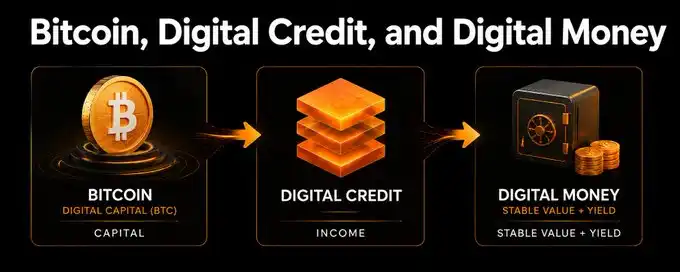
Michael Saylor presents his "Digital Asset Stack" theory, positioning Bitcoin as the foundational layer of digital capital. He argues Bitcoin itself should remain unchanged—no staking, inflation, or protocol alterations. Instead, a five-layer financial architecture should be built atop it: Digital Capital (BTC), Digital Credit (e.g., yield instruments like STRC), Digital Currency (stable, yield-bearing instruments pegged to fiat), Digital Yield (leveraged/structured products), and Digital Equity (e.g., MSTR stock, absorbing residual volatility). Saylor asserts this stack transforms Bitcoin's high-volatility, high-energy capital into tailored products: stable currencies for payments/savings, yield instruments for income seekers, and equity for growth investors. This approach meets diverse needs—corporate treasuries, banks, retirees, emerging market users—without compromising Bitcoin's core properties (scarcity, decentralization). The "killer use case" is rebuilding global money, credit, and capital markets on Bitcoin, bridging the fiat world with a superior digital asset foundation. The system leverages traditional finance principles (risk layering, structured products) while using Bitcoin as the ultimate collateral. This expands Bitcoin's utility, drives adoption, and offers a better monetary experience: digital, yield-bearing, stable-value tools for everyday use.

marsbit1h ago

Saylor's Latest Long Read: Bitcoin is Not Money, It's Digital Capital, and Money is Built Upon It

marsbit1h ago

Trading

Spot
Futures
活动图片