AMD Launches Compact AI Host, Directly Challenging NVIDIA DGX Spark

marsbitPublished on 2026-06-16Last updated on 2026-06-16

Abstract

In June 2026, AMD announced the Ryzen AI Halo, a compact AI developer desktop to rival NVIDIA's DGX Spark. Both feature 128GB unified memory for running 200B+ parameter models locally. Priced from $2,949 to $3,999, AMD undercuts NVIDIA's $3,999+ DGX Spark. The core divergence lies in architecture and philosophy. Ryzen AI Halo uses an x86-based Ryzen AI Max+ 395 APU (CPU+GPU+NPU), runs standard Windows/Linux, and emphasizes general-purpose PC flexibility. DGX Spark uses an ARM-based Grace Blackwell Superchip, runs a custom DGX OS, and includes a high-speed ConnectX-7 NIC for cluster prototyping, anchoring it to NVIDIA's full-stack CUDA ecosystem. AMD's ROCm software has improved, with simpler installation and support for major frameworks, but still lags behind CUDA's 17-year maturity in community support and cutting-edge library availability. AMD's broader strategy focuses on becoming a viable second-source supplier. Key moves include acquiring design capabilities via ZT Systems (while outsourcing manufacturing) and securing two major 6GW GPU supply deals with OpenAI and Meta in late 2025/early 2026. These contracts validate AMD's role in diversifying the AI supply chain, rather than outright beating NVIDIA. NVIDIA counters with a tightly integrated stack from desktop (DGX Spark) to data center, emphasizing seamless scalability and enterprise software subscriptions (AI Enterprise). In summary, Ryzen AI Halo represents AMD's pragmatic path: offering a cost-effective, open-...

In June 2026, AMD confirmed shipping plans for a new device at the San Francisco AI DevDay. This machine, about the size of an Apple Mac mini and equipped with 128GB of unified memory, is officially positioned as a local AI development platform. Just a few months earlier, NVIDIA's DGX Spark had already appeared on developers' desktops – also a palm-sized metal box, also with 128GB of unified memory, also claiming it could run 200-billion-parameter large models locally.
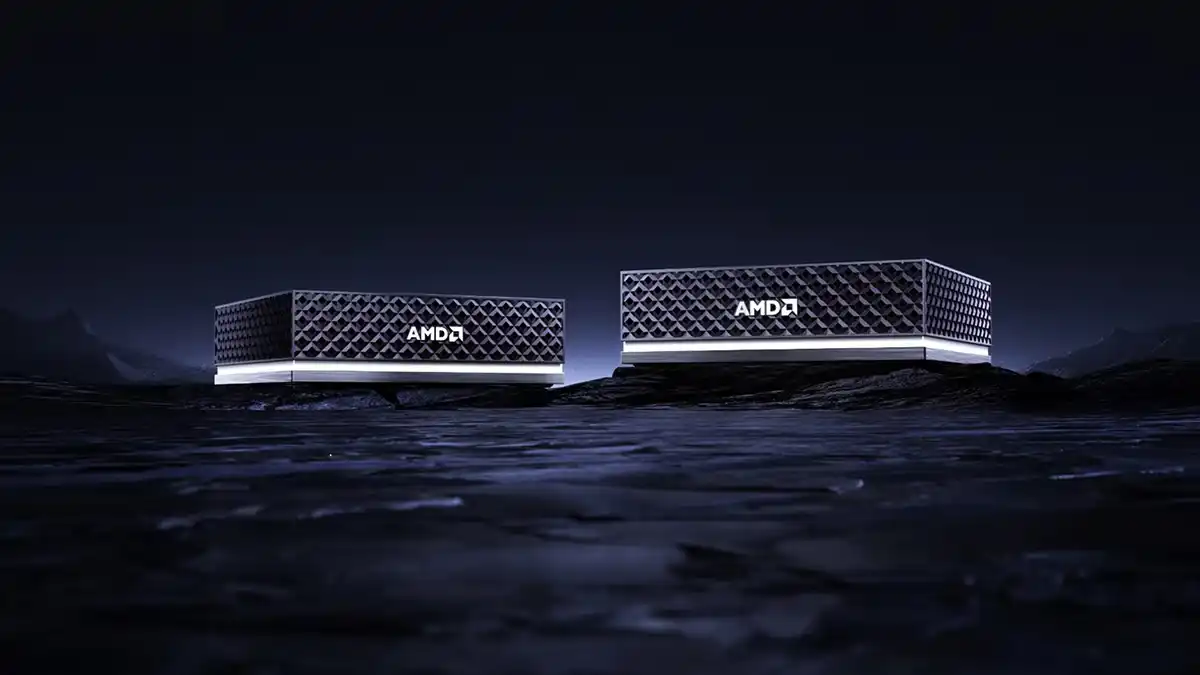
AMD Ryzen AI Halo Developer Platform, featuring the Ryzen AI Max+ 395 Processor

Benchmark reports by Tom's Hardware, based on the HP Z2 Mini G1a, provide a reference price for the AMD camp: $2,949 to $3,999. NVIDIA's official website lists the DGX Spark starting at $3,999, with some OEM versions reportedly discussed for a price increase to $4,679 in February 2026. On price, AMD has a slight edge, but that's only surface-level accounting.

The Same 128GB, Two Different Paths

The heart of the AMD Ryzen AI Halo is a Ryzen AI Max+ 395 processor: 16 Zen 5 cores, 40 RDNA 3.5 architecture GPU compute units, paired with a 50 TOPS XDNA 2 NPU. NVIDIA's official hardware documentation describes the DGX Spark with a different logic: a GB10 Grace Blackwell Superchip, a 20-core ARM CPU paired with a Blackwell architecture GPU, no NPU, but packing a ConnectX-7 200Gbps network card. The AMD device offers a 2.5GbE port and WiFi 7; NVIDIA offers 10GbE plus WiFi 7, plus that valuable high-speed network card.

Memory specs appear similar on the surface. Both use 128GB LPDDR5x. AMD's product page lists memory bandwidth at 256 GB/s, while NVIDIA's official figure is 273 GB/s. A gap of less than 7%, barely perceptible in most inference tasks.

Operating system choices reveal a more fundamental divergence between the two companies. The AMD Ryzen AI Halo comes pre-installed with Windows 11 Pro, with Ubuntu 24.04 as an option. It boots into a standard PC desktop, has Thunderbolt ports, and full support for universal peripherals. The DGX Spark runs DGX OS, a customized Ubuntu, and the first task after booting is configuring the CUDA environment and NVIDIA container toolchain.

A detailed hands-on comparison by The Register in December 2025 concluded: For single-batch large language model inference, the token generation speed of the two machines was very close. However, in the prompt processing stage, the DGX Spark was 2 to 3 times faster. This gap comes from the Blackwell architecture's support for lower-precision computing and NVIDIA's years of optimized code paths for inference pipelines. ServeTheHome's review pointed out another dimension: The ConnectX-7 network card in the DGX Spark retails for over $900 alone, and its potential value in multi-machine cluster scenarios far exceeds that of single-machine inference.

According to Tom's Hardware and other media benchmarks, the Ryzen AI Halo measures 85mm high, 168mm wide, 200mm deep, weighing 2.3 kg, closer to a traditional mini workstation in stature. NVIDIA official documentation shows the DGX Spark is 150mm square, 50.5mm thick, weighing 1.2 kg. One resembles a stacked hard drive enclosure, the other a router.

ROCm's Progress Bar, No Longer Just "Good Enough"

AMD's official release notes show ROCm 7.2 went live in January 2026, with the subsequent 7.2.4 version specifically optimizing the stability and performance of AI inference workloads. Phoronix provided detailed coverage on release day.

For developers in Linux environments, ROCm's installation process has simplified significantly compared to two years ago. In March 2026, technical blogger Kunal Ganglani wrote in a detailed ROCm usage guide that it took him about 30 minutes to go from system configuration to running a PyTorch model on an RX 7900 XTX, "while in 2024, doing the same thing would take half a day." His blog confirms ROCm now supports the four major deep learning frameworks – PyTorch, TensorFlow, JAX, DGL – and inference engines like vLLM, Ollama, and llama.cpp have ROCm backends available.

But this progress can't overcome CUDA's inertia. NVIDIA's software stack has accumulated over 17 years; the number of CUDA-related Q&A posts on Stack Overflow is dozens of times that for ROCm. New versions of cutting-edge libraries like FlashAttention and xFormers typically release CUDA versions first, with ROCm ports following weeks to months later. Any custom CUDA kernel that goes beyond the standard PyTorch API requires manual adaptation on the AMD platform. AMD's official compatibility matrix lists validated framework and GPU combinations, but "validated" and "having enough community discussion posts to search when problems arise" are two different things.

On Reddit's r/LocalLLaMA subreddit, discussion threads about which device to choose haven't stopped since late 2025. A frequently quoted summary comes from the end of Ganglani's blog: "If you need everything to work perfectly on day one, buy NVIDIA. If you're willing to spend an afternoon troubleshooting to save $800, ROCm is ready."

AMD seems well aware of this. Over the past year, the company's moves haven't been about directly replicating NVIDIA's moat but building a separate path outside it.

In August 2024, AMD announced the acquisition of ZT Systems for $4.9 billion. The Wall Street Journal confirmed the transaction's completion in March 2025. ZT Systems' business involves designing and assembling entire rack-scale AI server systems for hyperscale data center customers, including giants like Microsoft and Meta that purchase tens of thousands of GPUs annually. AMD gained system design capabilities from a single GPU to an entire rack.

But AMD soon made a seemingly contradictory decision. According to a Sanmina official announcement in May 2025, AMD spun off ZT Systems' data center manufacturing business to this electronic manufacturing services company, retaining only the design team. The logic is clear: AMD doesn't want to become a competitor to its own OEM customers. If AMD produced AI servers itself, server vendors selling AMD GPUs would immediately become wary. Keeping design capabilities and outsourcing manufacturing balanced capability acquisition with ecosystem relationships.

Two more critical events occurred in the following six months.

In October 2025, an AMD official press release announced a strategic partnership with OpenAI to deploy 6 GW of AMD Instinct GPUs. The first 1 GW was scheduled for shipment in the second half of 2026. A clause was hidden in this agreement: OpenAI had the option to purchase up to a 10% stake in AMD. Reuters and CNBC both highlighted this detail in their coverage that day. The GPUs supplied to OpenAI would be the next-generation Instinct GPUs, with specific models not disclosed by AMD.

In February 2026, AMD issued another official press release announcing an expanded partnership with Meta, also for deploying 6 GW of GPUs. This time the chips were custom MI450 variants for Meta, with shipments planned to begin in the second half of 2026. CNBC's report that day pointed out a detail: Just days before this collaboration was made public, Meta also announced an expanded AI chip procurement agreement with NVIDIA.

The fact that Meta signed long-term orders with both companies simultaneously is more telling than any technical comparison. For companies investing tens of billions of dollars annually in AI infrastructure, putting all their eggs in one basket is an unacceptable risk. AMD doesn't need to surpass NVIDIA in all aspects of performance; it just needs to provide a viable alternative outside of NVIDIA to secure orders under the "dual-supplier" logic. The scale of the two 6 GW contracts suggests that at least OpenAI and Meta have included AMD on their list.

NVIDIA's Concurrent Response Was a Combination of Moves

During the same period, NVIDIA played a combination of moves in the enterprise market. The DGX Spark is positioned as a developer desktop device, but its ConnectX-7 network card dictates it's not an isolated workstation. ServeTheHome's review analyzed the value of this network card in prototyping and distributed training debugging, concluding that while much slower than data center-grade NVLink, it's sufficient for small-scale cluster scenarios. This design anchors the DGX Spark within NVIDIA's larger enterprise product line: developers prototype on Spark, then migrate code to a DGX Station or cloud DGX instance, and finally deploy to server clusters equipped with H200 or B200 GPUs. A toolchain from desktop to data center, with consistent hardware and software, is welded onto CUDA.

NVIDIA also concurrently launched the AI Enterprise software subscription suite, bundling tools like TensorRT, RAPIDS, and the Triton Inference Server, charging per node. NVIDIA's official product page lists the complete tool inventory included in AI Enterprise. This isn't selling hardware; it's turning enterprise deployment and operations into a recurring revenue stream after developers are accustomed to CUDA.

Comparing the two paths, the divergence is clear enough.

NVIDIA has built a full-stack closed loop from chips to systems to software to cloud services. Developers can use optimized tools from their first day in this loop, at the cost of being locked into a single vendor's ecosystem. AMD is taking an open alternative route: using industry-standard x86 architecture, supporting both Windows and Linux, making ROCm an open-source stack compatible with mainstream frameworks, and using lower prices to attract cost-sensitive customers or those who have decided to diversify supplier risk.

The Ryzen AI Halo product itself is the most concise hardware expression of this route. It has no custom network card, no dedicated OS, no low-precision training acceleration units. It's a general-purpose PC that happens to pack unified memory capable of running 200B parameter models and a decent GPU. You can use it for large model inference, or close the terminal and open Photoshop. The $2,949 price for the HP Z2 Mini G1a referenced in Tom's Hardware's report is significantly lower than the DGX Spark's $3,999 starting price; with other OEM versions, the price difference could exceed $1,000.

But the flip side of this flexibility is compromise. The Register's benchmark data already shows that once you move away from single-batch inference into scenarios requiring massive parallel computing, Blackwell's low-precision advantages and years of optimized software stack quickly widen the gap. If you need a desktop box that can run Stable Diffusion for image generation, NVIDIA's CUDA ecosystem has a whole set of ready-to-install tools. AMD's RDNA 3.5 architecture doesn't support FP4 and FP8 low-precision formats, putting it at a performance disadvantage in workloads like image generation – a limitation determined by the RDNA architecture design, not something driver updates can solve.

The Box's Destiny Lies Outside the Box

Bringing the timeline back, AMD's actions over the past year form a fairly clear path.

At the hardware level: Instinct MI300 and MI325X in mass production, MI350 and MI450 progressing according to roadmap, Ryzen AI Max+ 395 evolving from a notebook chip to a desktop APU packed into a development platform. At the system level: Acquiring rack-level design capability through ZT Systems, then spinning off manufacturing while retaining R&D. At the customer level: Securing two 6 GW-level long-term contracts with the world's two largest AI compute consumers, bringing OpenAI onto the shareholder list. At the software level: ROCm iterating at roughly a version per quarter, catching up with mainstream framework support, though porting cutting-edge libraries and building community resources still need time.

Each step isn't isolated. Acquiring ZT Systems was to gain the ability to design the kind of hyperscale AI clusters OpenAI and Meta need, not just sell GPUs to server vendors. ROCm's rapid iteration is to ensure that customers signing 6 GW contracts have a usable software stack upon deployment, not just bare metal delivery. Launching the Ryzen AI Halo is to extend the same ROCm ecosystem to the desktop, allowing developers to use a $3,000 machine for local debugging before deploying models to a cloud-based MI450 cluster.

But this doesn't mean AMD has caught up with NVIDIA. The two 6 GW contracts are future deployment commitments; the energy capacity measured in gigawatts reflects infrastructure planning scale, not chips already shipped. The specific specifications of the MI450 remain undisclosed; the chip's actual performance, yield, and stability after large-scale deployment are unknowns. ROCm is "usable" on mainstream frameworks, but the state of "the community can help you when problems arise" requires more time to accumulate. And 17 years of CUDA accumulation can't be erased by a few quarters of rapid iteration.

NVIDIA's moat isn't just in software either. The ConnectX-7 network card in the DGX Spark hints at another dimension of competition: While AMD competes for developers with cost-effectiveness and openness, NVIDIA locks in teams needing distributed training and large inference pipelines with cluster expansion capabilities. Buying one DGX Spark costs $3,999; buying two plus a network cable lets you run distributed prototypes. In this scenario, ROCm's parity in single-machine inference is neutralized.

When the divergence between the two companies in AI finally lands on this palm-sized box, it becomes a concrete choice. You open AMD's box, get a familiar PC environment, install PyTorch with almost the same commands, load a model, start inference – the process is smooth until you need to use a library that only has a CUDA backend. You open NVIDIA's box, get a dedicated environment optimized from hardware to drivers to container toolchains, where everything works as expected upon startup, just with an extra thousand dollars on the bill, and the migration cost of switching suppliers in the future is already pre-locked.

AMD isn't directly challenging NVIDIA's full-stack empire. It chose a more pragmatic path: being a good-enough alternative when NVIDIA's pricing and supply chain delivery capacity can't meet all customer demand. The two 6 GW contracts are the strongest evidence of this strategy so far. The Ryzen AI Halo is an extension of this strategy to the desktop – not following the trend of making small AI boxes, but taking a step forward along the line of "using an open ecosystem and cost advantage to attract developers who don't want to be locked in."


Related Questions

QWhat is the key difference in the underlying approach between AMD's Ryzen AI Halo and NVIDIA's DGX Spark, despite their similar size and memory capacity?

AWhile both are small AI boxes with 128GB unified memory, they follow fundamentally different paths. Ryzen AI Halo is built on a general-purpose x86 platform with a CPU+GPU+NPU APU, pre-installs Windows 11 Pro/Ubuntu, and is designed as a versatile PC for AI and other tasks. DGX Spark uses NVIDIA's custom ARM Grace Blackwell Superchip, runs a specialized DGX OS, and is optimized from the ground up for AI, featuring a high-speed ConnectX-7 network card for cluster integration.

QAccording to article's analysis, what is AMD's primary strategic goal in the AI market, as evidenced by its recent high-value deals?

AAMD's primary goal is not to directly surpass NVIDIA's performance, but to become a viable 'second source' or alternative supplier for major AI customers. This strategy is evidenced by securing 6GW deployment deals with both OpenAI and Meta. These clients, investing billions, seek to avoid vendor lock-in and supply chain risks, allowing AMD to secure significant orders by being a 'good enough' and lower-cost option in a dual-supplier strategy.

QHow does the performance of the AMD Ryzen AI Halo and NVIDIA DGX Spark compare in real-world AI workloads, as per the benchmarks cited in the article?

ABenchmarks from The Register indicate that for single-batch LLM inference, the token generation speed of both machines is very close. However, DGX Spark is 2 to 3 times faster during the prompt processing phase. This advantage comes from Blackwell architecture's support for low-precision computations (FP4/FP8) and years of NVIDIA's software pipeline optimization. In multi-machine or distributed scenarios, DGX Spark's ConnectX-7 network card provides significant additional value.

QWhat significant step did AMD take in 2024/2025 to enhance its system-level capabilities for AI infrastructure, and what was the subsequent strategic move?

AIn 2024, AMD announced (completed in 2025) the acquisition of ZT Systems for approximately $4.9 billion. ZT Systems designs and assembles complete rack-scale AI server systems for hyperscalers like Microsoft and Meta. This gave AMD crucial system-level design expertise. Subsequently, in mid-2025, AMD strategically sold ZT Systems' manufacturing operations to Sanmina, retaining only the design team to avoid competing with its own OEM server partners and maintain healthy ecosystem relationships.

QWhat are the main trade-offs for a developer choosing between the AMD Ryzen AI Halo and the NVIDIA DGX Spark, based on the article's conclusion?

AChoosing AMD Ryzen AI Halo offers a familiar PC environment, lower cost (potentially over $1000 less), more hardware flexibility (e.g., Thunderbolt), and avoids deep vendor lock-in. The trade-off is potential compatibility issues with CUDA-only libraries, slower adoption of cutting-edge optimizations, and less mature community support (ROCm vs. CUDA). Choosing NVIDIA DGX Spark guarantees a polished, optimized AI stack from day one, superior performance in certain workloads (low-precision, prompt processing), and seamless integration into NVIDIA's larger cluster ecosystem, but at a higher price and with long-term vendor dependency.

Related Reads

Wall Street's Most Famous 'Cassandra' Now Has His Sights Set on Nvidia

Michael Burry, the famed "Big Short" investor, has once again captured Wall Street's attention with a series of short positions against major tech and semiconductor stocks, most notably Nvidia. In late June and July, through his "Cassandra Unchained" newsletter, Burry disclosed short bets against Nvidia, Tesla, Applied Materials, Caterpillar, the SOXX semiconductor ETF, and later, Micron Technology. His core thesis revolves around potential distortions in the AI infrastructure boom, specifically questioning whether extended depreciation schedules (e.g., 6 years vs. a realistic 2-3 years for AI chips) by cloud giants like Microsoft and Google artificially inflate profits. He also raises concerns about possible "off-balance-sheet circular financing," where chip demand might be propped up by vendor-backed funding to clients. Nvidia's stock experienced volatility following these disclosures, briefly dipping but largely holding near Burry's reported entry points, leaving his positions roughly flat or slightly underwater as of late July. This move is part of a pattern for Burry, whose track record since his legendary 2008 bet is mixed. He has faced notable losses, such as on Tesla in 2021, while scoring on broader market turns like the 2020 pandemic crash. His methodology focuses intensely on free cash flow and scrutinizing original financial documents to spot overvaluation and structural risks, but it often struggles with timing the market. The article contrasts Burry's stance with other prominent investors. Steve Eisman, another "Big Short" figure, is not shorting Nvidia, citing strong fundamentals but expressing nervousness about sustainability. Jim Chanos agrees with the broad "accounting mismatch" concern—comparing it to the dot-com bubble—but targets financial leverage in private equity firms rather than the chip stocks themselves. While Nvidia's short interest remains relatively low at 1.3-1.4% of float, the massive stock size means absolute short losses have been significant, exceeding $5 billion earlier this year. The piece concludes that for ordinary investors, the key takeaway is not replicating specific short bets but learning from the critical frameworks these investors use: questioning rosy accounting, identifying structural vulnerabilities, and maintaining skepticism during market euphoria, even if pinpointing the exact catalyst for a downturn remains elusive.

marsbit6m ago

Wall Street's Most Famous 'Cassandra' Now Has His Sights Set on Nvidia

marsbit6m ago

Weekly Selection丨Epic Stock Market Volatility, Changxin Tech's IPO Reshapes Storage Landscape, Saylor Aims to Re-Anchor STRC Around September 8th

PANews Weekly Digest: Market Turmoil, Tech Breakthroughs, and Crypto Developments. The week saw significant volatility across global markets. South Korea's KOSPI index experienced extreme turbulence, including multiple trading halts, largely driven by sharp declines in AI hardware stocks like SK Hynix. In contrast, China's Changxin Xinqiao (CXC) achieved a landmark IPO with a market cap surpassing 4 trillion yuan, marking a major success for the domestic DRAM industry after a decade of losses. In the crypto and Web3 space, several key narratives emerged. AI is driving demand for new infrastructure, with projects like AI agent wallets and programmable payments gaining traction, attracting interest from firms like Coinbase. The Bitcoin mining sector is pivoting, with companies like MARA focusing on energy management as electricity becomes a core AI-era asset. Meanwhile, the RWA (Real World Assets) sector faces a "utilization puzzle," with hundreds of billions in on-chain assets remaining dormant. Notable market movements included a historic single-day surge of over 17% for the KOSPI index and a significant migration of $16.5 billion in staked ETH within the Lido ecosystem. Michael Saylor announced a target to re-peg the STRC stablecoin around September 8th. Other highlights include discussions on Ethereum's ambitious 2030 roadmap for scaling and privacy, analysis showing high protocol revenues not always translating to token price gains, and warnings from Citi about potential extreme commodity price shocks by late 2026.

marsbit11m ago

Weekly Selection丨Epic Stock Market Volatility, Changxin Tech's IPO Reshapes Storage Landscape, Saylor Aims to Re-Anchor STRC Around September 8th

marsbit11m ago

When the Market Begins to Question AI Capex: A Full Analysis of Q2 Earnings Reports from Five Tech Giants

In late July 2026, five major US tech giants—Alphabet, Intel, Microsoft, Meta, and Apple—released their Q2 earnings reports. While all companies exceeded revenue and profit expectations, driven by strong AI-related business growth, investor reactions diverged sharply due to concerns over escalating AI capital expenditures (capex) and their impact on free cash flow. Alphabet reported strong revenue growth and a surging cloud business, but its stock fell after announcing a doubled year-on-year capex and negative quarterly free cash flow for the first time. Intel posted its strongest revenue growth in over 15 years, but its stock experienced volatile trading after significantly raising its full-year capex guidance. Microsoft saw its stock surge after beating estimates and, crucially, lowering its capex forecast while projecting positive free cash flow. Meta faced the most severe sell-off as its profits declined despite revenue beats, with free cash flow plunging over 90% and its capex guidance raised. Apple reported record June-quarter results, but its stock plummeted after providing Q4 revenue guidance that fell short of expectations, citing supply chain constraints and forex headwinds. The overall takeaway is that the market's focus has shifted from validating AI demand to scrutinizing the timeline for returns on massive AI investments. Companies demonstrating a clearer path to managing capex and preserving free cash flow, like Microsoft, were rewarded, while those signaling continued aggressive spending faced investor skepticism.

Odaily星球日报20m ago

When the Market Begins to Question AI Capex: A Full Analysis of Q2 Earnings Reports from Five Tech Giants

Odaily星球日报20m ago

a16z: From Companies to DAOs, DUNA May Become the Next Generation Organizational Form

This article, "From Companies to DAOs: How DUNA Could Become the Next Organizational Form," traces the 500-year evolution of business collaboration. It begins with medieval structures like the *commenda* and Florentine *compagnia*, which exposed partners to personal risk. The modern corporation, exemplified by the Dutch East India Company (VOC), was a revolutionary leap, enabling large-scale, capital-intensive ventures by offering limited liability and reducing coordination costs. However, corporations introduced new challenges like principal-agent problems and bureaucratic overhead. The piece argues that software and internet-native protocols are now reducing these traditional overheads. Decentralized Autonomous Organizations (DAOs) emerged as a new model for coordination without centralized management. Yet, DAOs face a significant legal vacuum: they lack legal recognition, leaving members exposed to unlimited personal liability, and their tokens are vulnerable to being classified as securities under unclear regulations (e.g., the Howey Test). This has forced projects into suboptimal workarounds like offshore foundations. The article identifies the Decentralized Unincorporated Nonprofit Association (DUNA) as a potential solution. Recently legalized in states like Wyoming, the DUNA provides a legal wrapper for decentralized networks. It grants key protections—legal personality, limited liability, and perpetual existence—to a group without imposing a traditional hierarchical management structure. This allows token-holder communities to govern, hold assets, and contract as a single legal entity, aligning with their decentralized nature. While DUNA doesn't solve all governance challenges or magically resolve securities law questions, it represents a crucial step. It fills the legal recognition gap, offering a native legal form for internet-scale, decentralized collaboration and extending the separation of personal risk from organizational venture into a new domain.

marsbit1h ago

a16z: From Companies to DAOs, DUNA May Become the Next Generation Organizational Form

marsbit1h ago

2026 Mid-Year Report On-Chain RWA: Tokenized Stock Market Cap Doubles in a Year, But 90% of Rights Are Hollow Shells

The 2026 Mid-Year Report on On-Chain RWA highlights a significant growth in tokenized stock market capitalization, which nearly doubled from $951 million in March to $1.89 billion by July. However, the report reveals a fundamental contradiction in this "layer 2.5" ecosystem: products with the strongest legal foundation (like regulated U.S. infrastructure) lack liquidity and distribution, while freely tradable offshored wrapper products often lack substantive ownership rights. The increase is driven largely by a few products (SECZ, FGRS, STRCx) and platforms (Ondo, xStocks, Securitize collectively hold over 85% share). While distributed value across networks like Ethereum, Solana, and BNB Chain has grown, the market remains fragmented. Products referencing the same underlying asset (e.g., Apple stock) are distinct legal liabilities with different intermediaries and jurisdictional rules, offering varying degrees of legal claim. The report cautions that headline numbers are misleading, as they reflect changes in distributed token value—driven by issuance, conversions, and price movements—not pure investor inflows. True "canonical shares" with legal ownership, wide wallet distribution, institutional liquidity, and independent on-chain price discovery do not yet exist at scale. Tokenized treasuries show stronger product-market fit, and ETFs may be easier to scale than single stocks. The core takeaway is a trade-off: legal certainty versus liquidity and composability.

marsbit1h ago

2026 Mid-Year Report On-Chain RWA: Tokenized Stock Market Cap Doubles in a Year, But 90% of Rights Are Hollow Shells

marsbit1h ago

Trading

Spot
活动图片