"Unlimited Money Printing" Bug Lurked for Four Years, Privacy Coin ZEC Plummets 50% in One Day

Odaily星球日报Published on 2026-06-05Last updated on 2026-06-05

Abstract

A critical "unlimited, undetectable counterfeit" vulnerability existed for nearly four years in the Orchard privacy pool of Zcash (ZEC), a privacy-focused cryptocurrency. The bug, which could theoretically allow attackers to create unlimited fake ZEC, was disclosed by founder Zooko Wilcox on June 5th. While officially patched and deemed low-probability for exploitation, the news triggered a market panic. ZEC's price plummeted over 50% in a single day. The core crisis stems from the inability to prove whether any counterfeit ZEC was created during the vulnerability's active period, as Orchard's design inherently hides transaction details. This casts severe doubt on ZEC's total supply integrity. The sell-off accelerated after prominent investor and ZEC narrative supporter Arthur Hayes announced he had sold his entire position, citing the inability to cryptographically prove the impossibility of extra minting. Community trust eroded further upon learning the bug was discovered with AI-assisted auditing, raising questions about Zcash's development and security review processes. The incident has evolved from a price correction into a fundamental crisis of confidence regarding the network's core security promises.

Original | Odaily Planet Daily (@OdailyChina)

Author | Asher (@Asher_0210)

In the early hours of June 5th, Zcash founder Zooko Wilcox published a statement confirming that Orchard, Zcash's next-generation privacy pool enabled in 2022, once contained a critical counterfeiting vulnerability. Although Zcash officials emphasized that the bug has been fixed and believe the probability of its exploitation is low, it still couldn't stop the spread of market panic.

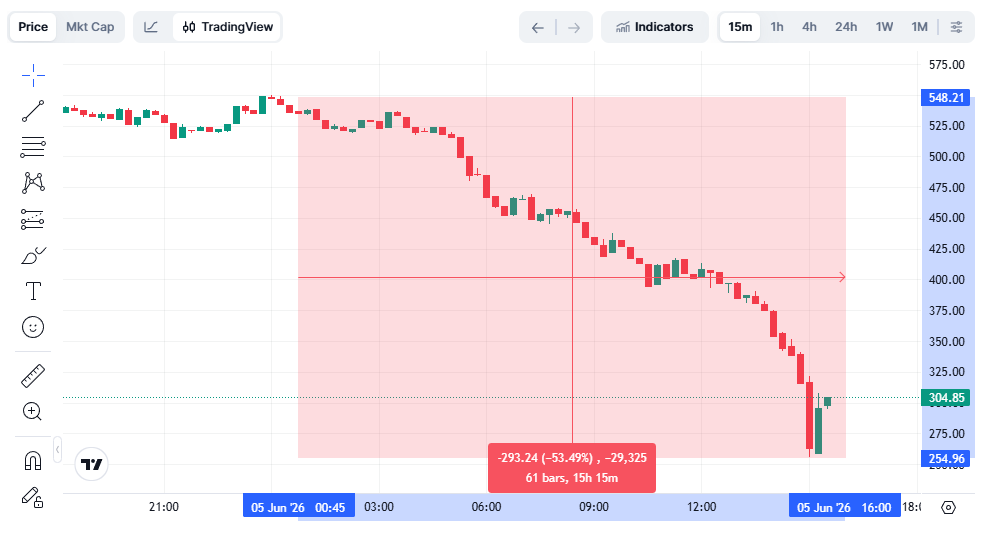
After the news broke, the Zcash token ZEC quickly nosedived, plummeting over 30% in a short time; by the afternoon, the sell-off didn't stop, panic continued to spread, and the price once fell to around $250, with the intraday loss widening to over 50%.
Security researcher Taylor Hornby discovered the issue on May 29th and has completed vulnerability verification in a local environment, generating test counterfeit ZEC, further validating that the vulnerability is an executable attack path. Currently, the two biggest controversies surrounding Zcash are: First, whether counterfeit ZEC has ever appeared in the privacy pool over the past four years; Second, how can officials prove that no counterfeit ZEC has flowed into the privacy pool, an extremely difficult task to disprove.

Where Did the "Unlimited Minting" ZEC Come From?

The security of Orchard (Zcash's privacy-protecting "shielded pool") relies on zero-knowledge proof circuits, with the core rule being asset conservation: the spend of each transaction must come from legitimate inputs, and ZEC cannot be created out of thin air. Users can hide balances and transaction amounts, but the system must verify the transaction's legitimacy.

Security researcher Taylor Hornby discovered that a constraint in the Orchard circuit was incomplete (under-constrained), allowing attackers to input data that should not have passed, yet verification could still return as successful. In other words, without needing administrator privileges or controlling nodes, and not being a backdoor, as long as the system mistakenly deems a transaction legitimate, originally non-existent ZEC could be recorded as legitimate assets within Orchard.

Shielded Labs called it "unlimited, undetectable counterfeit ZEC".

The Bug is Fixed, but Historical Issues Remain Unresolved

For ordinary security incidents, the biggest fear is large losses, but the most troublesome aspect of Zcash's current crisis is that the losses cannot be directly quantified.

If an attack occurred on the transparent chain, the market could at least see the attack address, fund flows, and affected assets. However, Orchard's transaction amounts, balances, and fund paths are inherently hidden. Once counterfeit ZEC might have appeared in the pool, it's difficult for outsiders to judge whether it's still lingering in Orchard or has gradually flowed out through normal transactions.

More critically, Orchard is not a completely isolated black box. Users can migrate assets between different fund pools, and both real ZEC and potential counterfeit ZEC could mix within the pool.

The Zcash ecosystem can emphasize that there is currently no evidence of the vulnerability being exploited and can explain that the probability of malicious exploitation is low. But for traders, "no anomalies have been found" and "it has been proven that nothing happened" are not the same thing.

This is the core reason for ZEC's expanding decline. Until the question of whether counterfeit ZEC ever appeared in Orchard is proven, ZEC's supply credibility will remain under a shadow.

Arthur Hayes Liquidates Position, Igniting Market Confidence Crisis

After the ZEC vulnerability was exposed, BitMEX co-founder Arthur Hayes's public liquidation further amplified market panic.

Arthur Hayes stated on platform X that he has sold his entire ZEC holdings. Hayes said he learned about the attack yesterday but did not realize its conflict with his narrative framework. ZEC's 30% drop prompted him to reconsider and decide to take full profits on that position. He added that while he believes the possibility of additional minting is extremely low, he cannot formally prove its impossibility at the cryptographic level; he will continuously reassess his judgment and, if his assumption is disproven, will repurchase, hoping to build a position at a lower price; privacy is priceless, and he wouldn't mind repurchasing at a higher price.

This was quite damaging for ZEC. Over the past period, Arthur Hayes has been one of the key narrative drivers for ZEC. His bullish view was based on the long-term logic of privacy assets regaining pricing power in the context of AI, government surveillance, and big tech expansion. Therefore, his liquidation wasn't just a major holder taking profits; it resembled a public downgrade of ZEC's current narrative.

When a top narrative supporter chooses to exit first, long positions originally supported by belief and expectations are more likely to turn into collective profit-taking and risk aversion.

Community Sentiment Spiral, ZEC Transforms from Price Correction to Trust Crisis

Perhaps influenced by Arthur Hayes's liquidation, community discussions about ZEC quickly shifted from "whether to buy the dip" to "whether it can still be trusted."

On one hand, the community repeatedly emphasized the severity of the vulnerability itself. Compared to short-term price drops, many users were more concerned that a vulnerability theoretically capable of creating unlimited counterfeit coins had lurked in Orchard for nearly four years. For them, the price drop was just the surface; what truly shook confidence was the question mark placed on Zcash's core security assumptions.

On the other hand, the process of AI-assisted vulnerability discovery further exacerbated distrust. Taylor Hornby, with the aid of AI tools, conducted a targeted review of the Orchard circuit, ultimately discovered the vulnerability, wrote an exploit program, and generated counterfeit ZEC in a local environment. Although AI did not perform the audit independently, what the community more easily remembered was the narrative that "a key vulnerability existing for years was assisted in being found by AI in a short time," which quickly gained traction.

This turned public criticism towards Zcash's development and audit systems. The community questioned why a vulnerability existing since 2022 could go undetected on the mainnet for years? If even the core privacy pool could have constraint omissions, how can users trust Zcash's promises on supply and privacy security again?

Therefore, this decline is no longer just profit-taking. Before Zcash provides more convincing proof, no one is really willing to hold ZEC long-term.

Trending Cryptos

Related Reads

Tidal Investment: We Remain Bullish on the AI Industry Chain, But for Different Reasons Now

Tidal Investments remains optimistic about the AI industry chain, but the rationale has shifted. The market is concerned about massive concurrent fundraising by tech giants like SpaceX, OpenAI, Alphabet, and Meta, fearing an AI peak. However, the authors argue this signals the next act of AI development, not its end. Capital expenditure (Capex) from major cloud providers (Alphabet, Amazon, Meta, Microsoft, Oracle) continues to surge aggressively into 2026. This investment cycle is more resilient than past hardware cycles due to its scale and complexity. Bottlenecks have shifted from chips to critical physical infrastructure like power grids, transformers, cooling, and data center construction—areas with long lead times and limited capacity for rapid expansion. Supply chain data (e.g., Eaton's orders) confirms substantial, tangible progress. Key market concerns are addressed: 1. **ROI vs. Capex Growth**: While Capex growth outpaces revenue, the authors note cloud giants have historically overcome similar phases through scale. The cycle will only be in danger if Capex guidance is cut, orders are canceled, or AI product demand falters—none of which are currently observed. 2. **Comparison to the 2000 Dot-com Bubble**: Unlike the telecom bubble, where cheap, oversupplied fiber crashed prices, AI infrastructure (especially power) is constrained, customized, and subject to lengthy approvals, making a similar supply glut and crash unlikely. In conclusion, the wave of fundraising reflects the immense, ongoing capital needs for AI's next phase, constrained by slow-moving physical bottlenecks. The AI cycle is not over; the script has simply changed.

链捕手9m ago

Tidal Investment: We Remain Bullish on the AI Industry Chain, But for Different Reasons Now

链捕手9m ago

Grayscale: These 15 Profitable Crypto Protocols Are Severely Undervalued

Grayscale Research identifies 15 top-revenue crypto protocols trading at significant valuation discounts, with many at single-digit or even 1x revenue multiples. Protocols like Pump.fun, PancakeSwap, and Meteora have market capitalizations roughly equal to their annual revenue. The report argues these financially-focused protocols (DEXs, lending, staking) are fundamentally undervalued and could benefit from the potential passage of the CLARITY Act, expected as soon as next month. This legislation aims to clarify digital asset regulation, potentially reducing institutional barriers and driving on-chain activity. The analysis breaks down the protocols into three groups: the "1x Club" (market cap ≈ revenue), mid-tier protocols with 3-9x multiples (e.g., Aave, Lido, Jupiter), and high-multiple protocols like Hyperliquid (15x) and Uniswap (37x), where valuation reflects future potential rather than current cash flows. Grayscale applies a traditional DCF model to Aave, suggesting a one-year price target of ~$175, representing ~130% upside from current levels. The report notes a risk-off macro environment since the Iran conflict has further compressed valuations, creating a potential entry window. The conclusion highlights that while the valuation data presents an intriguing opportunity, the investment thesis is contingent on the CLARITY Act's passage and subsequent institutional capital flows. Investors are cautioned to consider Grayscale's inherent conflict of interest as a crypto asset manager with products tied to these assets.

marsbit36m ago

Grayscale: These 15 Profitable Crypto Protocols Are Severely Undervalued

marsbit36m ago

Sam Altman's Personal Alchemy of Wealth: Investing in 400 Companies, Over 10 Deeply Tied to OpenAI

The article investigates Sam Altman's personal wealth strategy, centered around his investments in approximately 400 companies while serving as OpenAI's CEO. Despite not holding direct equity in OpenAI, Altman has built a vast portfolio, with at least 10 of his investments having commercial ties or ongoing negotiations with OpenAI. This creates a complex network of potential conflicts of interest, drawing scrutiny from U.S. congressional committees and state attorneys general. Key investments highlighted include the anti-aging startup Retro Biosciences (valued at $258 million for his stake as of late last year) and the chipmaker Cerebras, whose value soared following an OpenAI procurement deal. His most significant financial gain is linked to the nuclear fusion company Helion, where a recent funding round reportedly increased his stake's value to at least $4.1 billion. The article details a decade-long relationship between Altman, Helion, and OpenAI, including a controversial non-binding power purchase agreement and Altman's efforts to secure investments from OpenAI and its backer SoftBank for Helion. Other points include internal investigations at Tools for Humanity (developer of Worldcoin) and OpenAI's massive contracts with tech giants like Nvidia. According to Forbes, Altman's net worth is around $3.4 billion, ranking him 1251st globally—a rise of over 1400 places since 2024. OpenAI's board states that Altman's external dealings are transparent and potential conflicts are carefully managed.

Odaily星球日报57m ago

Sam Altman's Personal Alchemy of Wealth: Investing in 400 Companies, Over 10 Deeply Tied to OpenAI

Odaily星球日报57m ago

Former SpaceX Engineer Reconstructs Financial Execution System Using First Principles

Former SpaceX engineer Lex Li applies "First Principles Thinking" to financial infrastructure with Plan Execution Lab, recently raising angel funding at a $50M post-money valuation. The team argues that the core function of finance is capital allocation, and the critical gap is not in trading but in execution, which remains highly manual and fragmented. While assets, liquidity, and settlement have migrated on-chain, execution workflows (monitoring, risk management, liquidity coordination) are still human-native. In an era of accelerating AI agents, strategy decay is rapid, shifting the competitive edge from having the best strategy to having the most robust execution network. Plan Execution Lab introduces two core components: 1. **PlanX**: A Financial Execution Protocol designed as infrastructure for the migration from CEX to DEX, providing on-chain execution capabilities, liquidity access, risk management, and capital orchestration. 2. **Xgent**: An Autonomous Financial Runtime. Users define investment intents, risk preferences, and constraints; Xgent automatically constructs an execution graph, verifies it, and handles ongoing execution and optimization—streamlining the process from Intent to Autonomous Execution. The long-term vision is to create the "Bloomberg Terminal for Autonomous Finance"—a shared operating environment and execution network built collectively by participants like execution nodes, liquidity providers, and autonomous agents. The future of finance, they contend, belongs not to isolated algorithms but to open, collaborative execution networks.

marsbit1h ago

Former SpaceX Engineer Reconstructs Financial Execution System Using First Principles

marsbit1h ago

Trading

Spot
Futures

Hot Articles

How to Buy ZEC

Welcome to HTX.com! We've made purchasing Zcash (ZEC) simple and convenient. Follow our step-by-step guide to embark on your crypto journey.Step 1: Create Your HTX AccountUse your email or phone number to sign up for a free account on HTX. Experience a hassle-free registration journey and unlock all features.Get My AccountStep 2: Go to Buy Crypto and Choose Your Payment MethodCredit/Debit Card: Use your Visa or Mastercard to buy Zcash (ZEC) instantly.Balance: Use funds from your HTX account balance to trade seamlessly.Third Parties: We've added popular payment methods such as Google Pay and Apple Pay to enhance convenience.P2P: Trade directly with other users on HTX.Over-the-Counter (OTC): We offer tailor-made services and competitive exchange rates for traders.Step 3: Store Your Zcash (ZEC)After purchasing your Zcash (ZEC), store it in your HTX account. Alternatively, you can send it elsewhere via blockchain transfer or use it to trade other cryptocurrencies.Step 4: Trade Zcash (ZEC)Easily trade Zcash (ZEC) on HTX's spot market. Simply access your account, select your trading pair, execute your trades, and monitor in real-time. We offer a user-friendly experience for both beginners and seasoned traders.

3.5k Total ViewsPublished 2024.03.29Updated 2026.06.02

How to Buy ZEC

Discussions

Welcome to the HTX Community. Here, you can stay informed about the latest platform developments and gain access to professional market insights. Users' opinions on the price of ZEC (ZEC) are presented below.

活动图片